


Aaron Sorkin Hits Refresh on Facebook in 'The Social Reckoning'

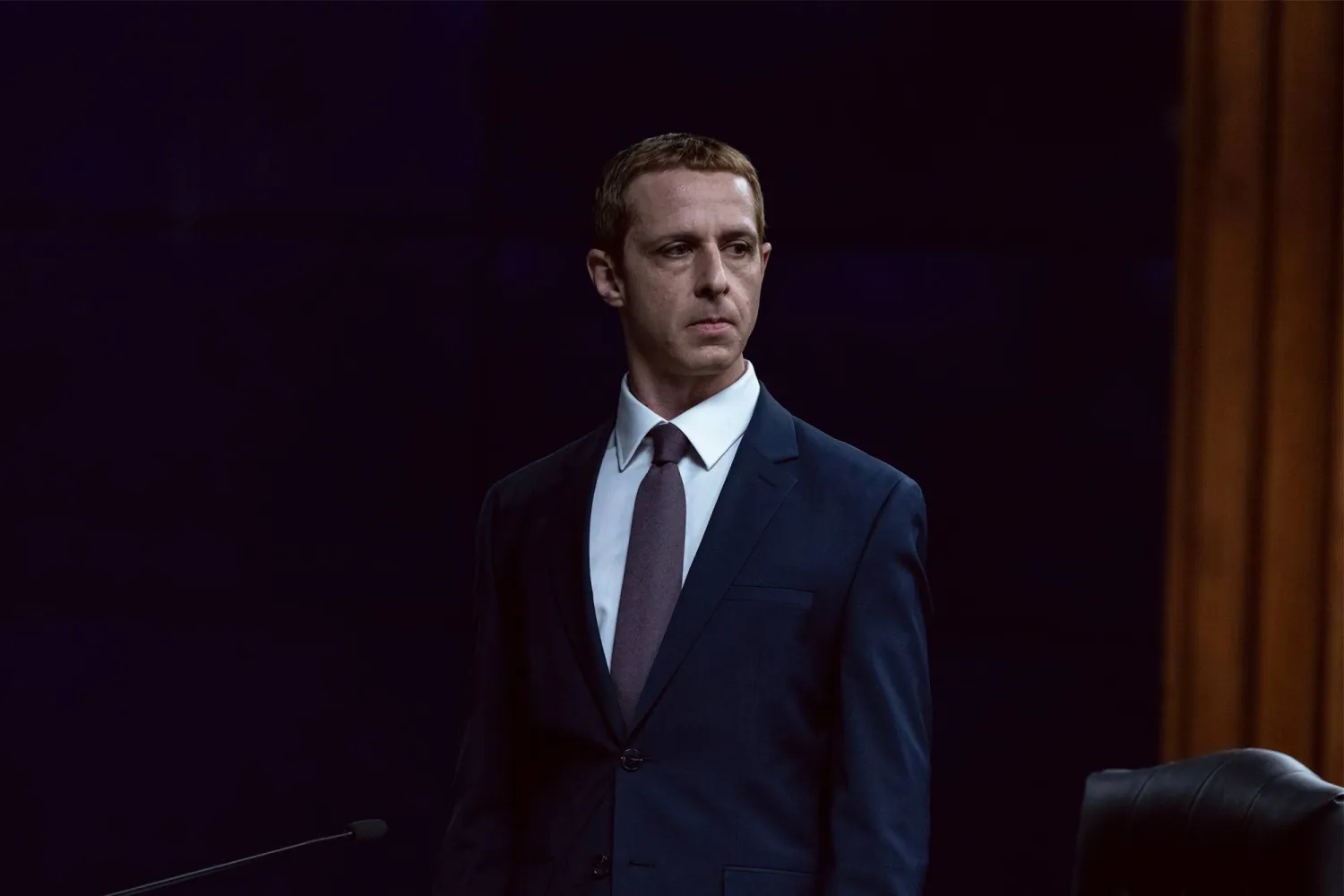
 This image released by Sony Pictures shows Jeremy Strong as Mark Zuckerberg, in a scene from “The Social Reckoning.” (Leah Gallo/Sony Pictures via AP)
This image released by Sony Pictures shows Jeremy Strong as Mark Zuckerberg, in a scene from “The Social Reckoning.” (Leah Gallo/Sony Pictures via AP)
TT

Aaron Sorkin Hits Refresh on Facebook in 'The Social Reckoning'

 This image released by Sony Pictures shows Jeremy Strong as Mark Zuckerberg, in a scene from “The Social Reckoning.” (Leah Gallo/Sony Pictures via AP)
This image released by Sony Pictures shows Jeremy Strong as Mark Zuckerberg, in a scene from “The Social Reckoning.” (Leah Gallo/Sony Pictures via AP)

When Aaron Sorkin made 2010’s “The Social Network,” he had heard of Facebook, he said at the time, “the way I’ve heard of a carburetor.” Sixteen years later, he has a much deeper idea of what Mark Zuckerberg’s social media empire has become.

“Back then, Facebook was a way to keep in touch with people you went to high school with. It’s something much different now,” Sorkin says. “‘The Social Network’ was about the invention of Facebook. ‘Social Reckoning’ is about what it’s become and, in particular, Facebook’s role in the rise of extremism and divisiveness.”

“The Social Reckoning,” which Sony Pictures will release Oct. 9, is one of the most timely movies arriving in theaters this fall. Last week, Sony debuted the film’s trailer the same day that Meta, Facebook’s parent company, agreed to pay up to $18 billion in penalties over claims its platform endangered children.

“The Social Reckoning” is poised to further scrutinize the social media behemoth at a time when Zuckerberg is under greater pressure than ever over the role Facebook plays in contemporary life and politics.

“When you see this movie, No. 1, I want you to be entertained,” Sorkin said in a recent exclusive interview with The Associated Press while doing the final mix on the film. “No. 2, you should be alarmed when you see the movie. I think people will be.”

Tech moguls are getting their close-up this fall

“The Social Reckoning” is one of several films this fall that will take aim at the tech moguls who have helped remake American life. Alex Gibney will unveil his four-hour documentary on Elon Musk, “Musk,” on Oct. 16. Luca Guadagnino’s “Artificial” dramatizes the saga of Sam Altman, the OpenAI chief executive.

But “The Social Reckoning,” which Sorkin wrote and directed, is sure to cause a stir given not just its subject but the legacy of “The Social Network.” Often cited as among the best American movies of the century, the film — directed by David Fincher and written by Sorkin — did much to examine and mythologize the origins of Facebook. It is, Sorkin acknowledges, a lot to live up to.

“To tell you the truth, I was hesitant,” Sorkin said. “I recognize the shadow that ‘The Social Network’ casts. But I think what’s going to happen is, 10 minutes into the movie, you’ll have forgotten about that and be invested in this.”

For the 65-year-old Sorkin, “The Social Reckoning” isn’t a sequel. It’s centered on the same figure, Zuckerberg, but captures him and his company at a dramatically different stage.

“It’s as if Henry Hill showed up in ‘Casino,’” says Sorkin, alluding to the “Goodfellas” protagonist.

Sorkin began contemplating “The Social Reckoning” around 2019, the same time he wrote an op-ed in The New York Times addressed to Zuckerberg. It alleged Facebook — which had just announced it was no longer going to fact-check political ads — was responsible for “crazy lies pumped into the water supply that corrupt the most important decisions we make together.” Zuckerberg responded by quoting Sorkin’s own dialogue from “The American President” about free speech.

“I read this, and I thought: it’s just impossible that Mark and the people around Mark don’t know the difference between an unpopular opinion and a lie,” Sorkin says. “And that kind of stayed with me.”

Sorkin has since said he blames Facebook for the Capitol riot on Jan. 6, 2021. Eventually, he was coaxed by Sony chief Tom Rothman and agent Ari Emanuel to wade back into one of his most beloved films.

“I said at the beginning I didn’t want to write ‘Jaws 2.’ I didn’t want to return and fail,” says Sorkin. “Then I met Frances Haugen and I met Jeff Horwitz and I started thinking more about it. I realized there was a terrific story and the only reason not to do it is being scared. And that’s just not a good enough reason.”

“The Social Reckoning” stars Mikey Madison as Haugen, a former data scientist at Facebook who became a whistleblower in 2021 and testified before Congress that Facebook was tuning its algorithm to put profit before public safety. Jeremy Allen White plays Wall Street Journal reporter Jeff Horwitz, a former Associated Press journalist. Jeremy Strong, not Jesse Eisenberg, plays Zuckerberg.

Zuckerberg and Meta have yet to say anything publicly about “The Social Reckoning.” The company declined to comment for this article.

In prepping “The Social Network,” Sorkin and producer Scott Rudin reached out to the company in an attempt to gain their cooperation. But after a lunch meeting, Facebook declined to participate — a blessing, Sorkin later realized. The script, Sorkin has said, “was vetted to within an inch of its life by a team of studio lawyers.” A similar process has followed on “The Social Reckoning.”

“I would have been happy to speak to him. I’ve never met Mark. I don’t know him at all,” Sorkin says. “And I don’t pretend to have any insight into how his mind works, only the results of how his mind works, and then I kind of reverse engineer it.”

Jeremy Strong takes over for Jesse Eisenberg

Sorkin initially reached out to Eisenberg about reprising the role of Zuckerberg. Before telling Eisenberg, or anyone else, of his plans, Sorkin spent two years researching and writing the screenplay.

“I didn’t know that Jesse simply did not want to play Mark Zuckerberg ever again,” Sorkin explains. “I talked to him a lot over a three-day weekend. He was clear that he loves ‘The Social Network,’ he loves how it launched his career, and he just doesn’t like being conflated with Mark Zuckerberg. I was just really lucky that Jeremy Strong had said, ‘Hey, listen, if for some reason Jesse doesn’t want to do it.’”

“It’s replacing Joe DiMaggio with Mickey Mantle,” he adds.

Strong’s performance, Sorkin says, “is a sight to see.” While the writer-director was happy to have no direct contact with Zuckerberg, Strong emailed the Facebook co-founder.

“Mark had no greater defender than Jeremy Strong, believe me,” Sorkin says. “Every night I’d get emails from him defending Mark. On the day we were shooting Jeremy’s last scene, as soon as we were done, he ran up to me and for the first time spoke in his own voice. He had only been using Mark’s voice. He came up to me and said, ‘If I had been playing Jeff, I’d have been defending Jeff.’ It was very important to him that I know that he didn’t mean any of that.”

When “The Social Network” came out, it included a postscript note that was meant to be a shock to audiences — that Facebook then had 500 million users. It now has some 3 billion. According to a study by Pew Research, 38% of Americans get their news from Facebook.

“I have a lot of empathy for wanting to build something, wanting to create something,” Sorkin says. “He has the kind of mind that can invent an entirely new social structure — one that he does feel comfortable in because he can sit at his keyboard. And it’s one that a lot of people feel a lot more comfortable in. There’s someone they can be at their keyboard that they can’t in not-digital life.”



Oasis Bring Swagger to Venice as Documentary Celebrates Reunion

 Noel Gallagher, left, and Liam Gallagher arrive at the 83rd edition of the Venice Film Festival in Venice, Italy, on Saturday, Sept. 5, 2026. (AP)
Noel Gallagher, left, and Liam Gallagher arrive at the 83rd edition of the Venice Film Festival in Venice, Italy, on Saturday, Sept. 5, 2026. (AP)
TT

Oasis Bring Swagger to Venice as Documentary Celebrates Reunion

 Noel Gallagher, left, and Liam Gallagher arrive at the 83rd edition of the Venice Film Festival in Venice, Italy, on Saturday, Sept. 5, 2026. (AP)
Noel Gallagher, left, and Liam Gallagher arrive at the 83rd edition of the Venice Film Festival in Venice, Italy, on Saturday, Sept. 5, 2026. (AP)

Liam Gallagher pumped his fist in the air and his brother Noel flashed a victory sign as the Oasis rock stars arrived by water taxi at the Venice Film Festival on Saturday ahead of a documentary chronicling their blockbuster reunion tour.

Asked by a Reuters reporter how it felt to be in Venice, Liam replied: "Biblical man, biblical." Noel opted for a more Italian response: "Bellissimo."

Later, Liam appeared less impressed by photographers yelling for attention. "Why all the shouting? Is this what you do at the Venice Film Festival? Scream at people?" he asked.

Oasis, the ‌Manchester band ‌whose anthems helped define the 1990s before feuding between the ‌two ⁠brothers tore it ⁠apart, reunited last year for a tour across Britain, Ireland, North and South America, Asia and Australia.

The documentary "Oasis: Don't Look Back in Anger" follows the gradual repair of one of music's most famous fractured relationships over weeks of rehearsal and months on the road.

"You sort of saw that reconciliation happen on stage in front of the world," said Dylan Southern, who directed the film alongside Will Lovelace.

The thaw takes time. ⁠When Liam arrives for his first rehearsal he doesn't acknowledge ‌anyone around him before leaving abruptly without saying ‌goodbye.

Underscoring their mutual animosity, Noel reveals that their respective children had never met before the ‌reunion tour but swiftly went on to become great friends. At the end ‌of the film, Noel describes Liam as "delightful" — something he admits he had never expected to hear himself say.

The filmmakers said they deliberately avoided interfering, keeping themselves largely invisible during the lengthy practice sessions and allowing events to unfold naturally.

As shooting moved into the concert stadiums, ‌Southern said the focus widened to include the fans whose affection became an integral part of the brothers' rapprochement.

Steven Knight, ⁠who wrote the ⁠script, said the filmmakers had no way of knowing whether the reunion would succeed, but always hoped the story would become one of forgiveness.

"From the beginning, we wanted to make this a film about reconciliation, redemption and forgiveness," he said, adding that neither Gallagher was likely to express emotion openly.

"They're British working-class men, so they're not going to high-five or hug or cry," he said.

Knight, who is writing the script for the next James Bond film, said the real-life story of the Oasis tour proved more compelling than anything he could have scripted.

"This is better than any fiction that you could write," he said. Southern chipped in: "And no one could play Liam Gallagher except Liam Gallagher."

The film is being shown out of competition at the Venice Film Festival, which runs until September 12.


Robert Pattinson and Oasis Bring Star Power to Venice Film Festival

 This image released by A24 shows Robert Pattinson, left, in a scene from the film "Primetime." (A24 via AP)
This image released by A24 shows Robert Pattinson, left, in a scene from the film "Primetime." (A24 via AP)
TT

Robert Pattinson and Oasis Bring Star Power to Venice Film Festival

 This image released by A24 shows Robert Pattinson, left, in a scene from the film "Primetime." (A24 via AP)
This image released by A24 shows Robert Pattinson, left, in a scene from the film "Primetime." (A24 via AP)

The worlds of rock and movie stardom are colliding at the Venice Film Festival, as both Robert Pattinson and Oasis frontmen Noel and Liam Gallagher arrive on the Lido for world premieres on Saturday.

Pattinson’s film, “Primetime,” is about the reality series “To Catch a Predator” and host Chris Hansen at the height of its success on Dateline NBC, while the Gallaghers are coming in support of a documentary about their 2025 reunion tour. Both films will be in US theaters in September.

With many movie star moments already in the rearview, from George Clooney’s lifetime achievement award to the emotional ovation for John Malkovich’s performance in “Wild Horse Nine,” the combination of Pattinson and Oasis on the same day could be a high-wattage pinnacle for this year’s festival.

Robert Pattinson plays Chris Hansen “Primetime,” which was written by Ajon Singh and directed by Lance Oppenheim, has already inspired discourse and headlines with just its trailer and subject matter. It’s based on journalist Luke Dittrich’s “Esquire” article “Tonight on Dateline This Man Will Die,” which explores a 2006 sting operation on Texas assistant district attorney Bill Conradt. He died by suicide as police officers descended on his home with the show’s television cameras outside.

Oppenheim, in his director’s statement, said that he “wanted to trace the disparate ambitions of people who existed inside this apparatus — a journalistic crusader, a mercenary TV producer and a wide-eyed Hollywood dreamer — converging into a moment of crisis.”

Hansen was not involved in the making of the movie and has made several public comments about it, including that he had always thought Denis Leary should have played him and questioning the motives of the filmmakers. He was invited to see the movie before the festival, but took issue with the NDA he was asked to sign beforehand.

Last year, the series was also the subject of an acclaimed documentary, “Predators,” from filmmaker David Osit. It's currently streaming on Paramount+.

For Pattinson, “Primetime,” in theaters Sept. 25, is one more buzzy performance in a banner year that’s already included memorable performances in hit films from “The Drama” to “The Odyssey” and with “Dune: Part Three” still to come.

The Oasis documentary, subtitled “Don’t Look Back in Anger,” is part concert film and part exploration of the contentious relationship between the Gallagher brothers, whose long-held feud led to Oasis disbanding in 2009. It includes never-before-seen rehearsals and what was then their first joint interview in 25 years.

“We set out to make a film about the reconciliation of two brothers, infamous for their volatile relationship, but we also wanted to make a film about the power of music and the way Oasis’ songs have continued to have a life of their own, as the band lay dormant for fifteen years,” co-directors Dylan Southern and Will Lovelace said in their directors' statement. “The documentary, like the reunion and the tour, took on a life of its own.”

It’ll be in theaters shortly after the festival. Disney is giving “Oasis: Don't Look Back in Anger” an IMAX release on Sept. 11, and it's expected to arrive on the Disney+ streaming service later this year.


Director Maggie Gyllenhaal Ditched AI for Marilyn Monroe Film

President of Venezia 83 Competition jury Maggie Gyllenhaal poses on the red carpet on the day of the opening ceremony of the 83rd Venice International Film Festival, in Venice, Italy, September 2, 2026. (Reuters)
TT

Director Maggie Gyllenhaal Ditched AI for Marilyn Monroe Film

President of Venezia 83 Competition jury Maggie Gyllenhaal poses on the red carpet on the day of the opening ceremony of the 83rd Venice International Film Festival, in Venice, Italy, September 2, 2026. (Reuters)

Actress-director Maggie Gyllenhaal said Friday she had abandoned using AI video-generation technology for her upcoming film about Marilyn Monroe because "it fundamentally did not work."

The American is head of the jury at this year's Venice Film Festival, but she is also premiering her new 17-minute film depicting 1950s screen icon Monroe.

The short movie imagines Monroe as a 100-year-old, with Dakota Johnson playing her before her death in 1962.

"The people who commissioned this project from me asked me to use AI," Gyllenhaal told a panel discussion about AI in Venice.

"They were using licensable AI, training it off of Marilyn Monroe films that we had licensed. And I went for it. I was like, 'All right, I'm curious. I don't know. Let's see'," Gyllenhaal told The Future of Creativity event.

"And it fundamentally did not work. We worked hard at it, and in the end, I threw it away because what was coming through Dakota playing Marilyn Monroe was so much more moving, human, alive."

Her statement underlines the current limitations of AI video technology, which has sparked fears about the impact on jobs throughout the film and TV industries.

The "Dark Knight" actress and director of "The Lost Daughter" also revealed how AI companies are seeking to license the images of actors in order to reproduce them through software.

"Someone who I respect a lot theoretically asked me to consider the idea of asking actors who trust me, because I have a lot of actors who trust me that I love, and they should trust me to give me their likeness and to make a film with them," she said.

"I thought it's completely and absolutely different paradigm than how I think, how I work," she added.