

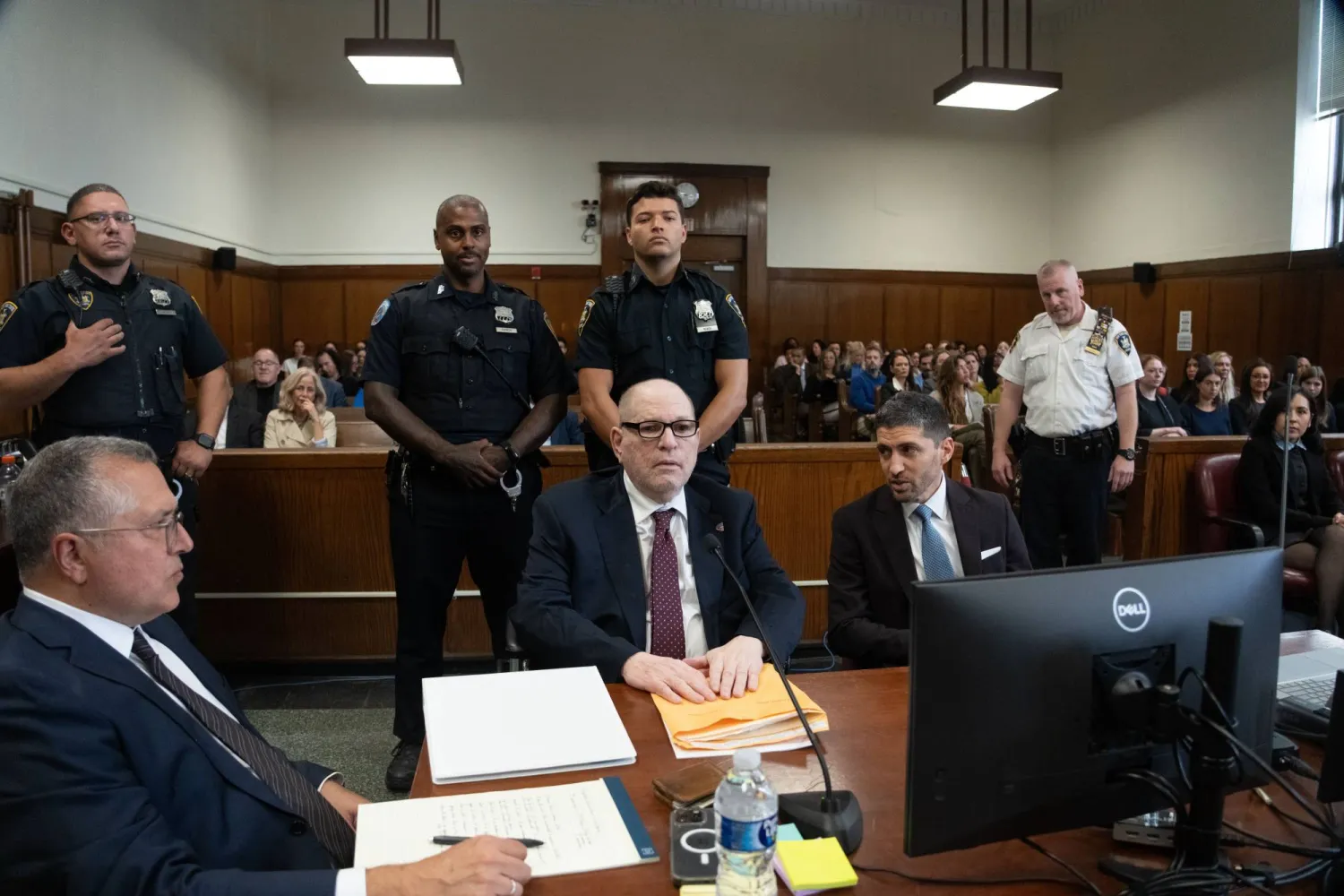

Harvey Weinstein Sentenced to 15 Years in Prison for 2006 Sexual Assault

 Harvey Weinstein appears in Manhattan Court for sentencing Wednesday, Sept. 23, 2026 in New York. (Steven Hirsch/New York Post via AP, Pool)
Harvey Weinstein appears in Manhattan Court for sentencing Wednesday, Sept. 23, 2026 in New York. (Steven Hirsch/New York Post via AP, Pool)
TT

Harvey Weinstein Sentenced to 15 Years in Prison for 2006 Sexual Assault

 Harvey Weinstein appears in Manhattan Court for sentencing Wednesday, Sept. 23, 2026 in New York. (Steven Hirsch/New York Post via AP, Pool)
Harvey Weinstein appears in Manhattan Court for sentencing Wednesday, Sept. 23, 2026 in New York. (Steven Hirsch/New York Post via AP, Pool)

Harvey Weinstein was sentenced Wednesday to 15 years in prison for sexually assaulting a TV production assistant in 2006, capping a yearslong legal odyssey that a judge said cemented the disgraced movie mogul’s reputation as “the literal face of the #MeToo movement.”

The landmark New York prosecution began nearly a decade ago with multiple accusers, but after retrials, mistrials, acquittals and appeals, it was whittled to a single victim: Miriam Haley, who said the Oscar-winning producer forcibly performed oral sex on her at his Manhattan apartment. She had worked briefly on the Weinstein-produced reality series “Project Runway.”

Weinstein, 74, pleaded for mercy, citing his age and health issues, including cancer and congestive heart failure. He apologized “to anyone I have affected with my actions” and said he felt remorse for Haley. However, he added, “I have to reiterate my innocence.” His lawyers said he will appeal.

Once a towering figure in Hollywood, with such hits as “Shakespeare in Love,” “Pulp Fiction” and “Chocolat,” Weinstein’s downfall came quickly after sexual assault allegations in 2017 set off the #MeToo movement. Several of his dozens of accusers were in court on Wednesday.

Judge Curtis Farber said Weinstein wielded his power as a Hollywood kingmaker to prey on women looking to break into the industry, treating them as “mere objects to be played with and discarded with impunity.”

Farber said Weinstein’s refusal to accept responsibility, portraying himself as a victim during jailhouse interviews, weighed heavily on his sentencing decision. Weinstein had faced up to 25 years in prison.

Some of Weinstein's accusers attended the sentencing

Haley credited the swell of other accusers, some of whom she hugged afterward, for giving her the courage to come forward.

For years, she said, “it was like a dark and painful secret that ate away at my spirit, my enthusiasm and sense of self-worth, that it took a long time to regain.”

Jailed since his original conviction, Weinstein has already served more than six years behind bars, leaving him with about nine years on his sentence. But a pending resentencing in Los Angeles, where he was originally ordered to serve 16 years in prison for a 2013 rape, could put him away for the rest of his life.

Farber said it'll be his counterpart in California who decides whether Weinstein can serve his sentences at the same time. If it were up to him, Farber said, he'd run them consecutively, stacking Weinstein’s New York punishment on top of his Los Angeles sentence.

Weinstein, seated in a wheelchair, was quickly moved out of the courtroom after the sentencing. In the gallery, Jessica Mann, a former aspiring actress whose rape allegations ended in an overturned conviction and two hung juries, wept profusely as prosecutors, Haley and other accusers consoled her.

Weinstein and Haley both spoke in court

Haley, 49, fought through tears herself as she spoke in court. After testifying at two of Weinstein’s trials — the original and last year's retrial — it was her second time confronting the ex-studio boss at a sentencing proceeding.

“Having been sexually assaulted by Harvey Weinstein has had a devastating effect on my life and sense of security that may never go away,” Haley said. “Making the decision to speak up will have me looking over my shoulder for years to come.”

Weinstein hired private investigators to keep tabs on her, she said, and his defense lawyers and supporters ridiculed her in the media.

“It’s a life sentence for me,” she said.

Minutes later, Weinstein apologized while underscoring his claims of innocence. He maintains that he never raped or sexually assaulted anyone.

It was also Weinstein’s second time speaking at his sentencing — the latest in a series of courtroom soliloquies filled with complaints about his lodging at New York City's notorious Rikers Island jail complex, boasts about his philanthropy and reminiscence about his moviemaking prowess.

“Reflecting on all that has happened since 2017 has helped me recognize how my past conduct has negatively affected others,” Weinstein said, some of his accusers shaking their heads as he spoke. “I live with many regrets and sincerely apologize to anyone I have affected with my actions.”

“I really do have remorse for Miriam Haley,” he added. “I am not a violent man. I ask for mercy. I promise I will pass it on.”

Haley says Weinstein 'still feels entitled'

Haley said afterward that she was happy with the sentence. But, she said, it's clear from Weinstein’s remarks that he does not acknowledge what he did.

“I think he still feels entitled, and that’s part of the problem,” said Haley, who has also gone by the name Mimi Haleyi.

Other accusers, including psychotherapist and former model Kaja Sokola, stood with her as she spoke outside the courthouse.

Haley’s lawyer, Gloria Allred, rejected any suggestion that Weinstein’s sentencing means the #MeToo era is over, telling reporters: “Women are empowered in a way they have never been before.”

“Today was about the survivors,” said Manhattan District Attorney Alvin Bragg, who sat in the courtroom alongside Weinstein’s accusers.

“I’m moved, as we should all be moved, by their courage and their steadfastness,” he added.

A retrial, a split verdict and another sentencing

Weinstein was originally sentenced in 2020 to 23 years in prison — 20 years for assaulting Haley and three years for raping Mann.

New York’s highest court erased those guilty verdicts in 2024, ruling that Weinstein was prejudiced by testimony from other women whose allegations weren’t part of the case.

Tried for a second time last year, Weinstein was again convicted of a first-degree criminal sex act for assaulting Haley. In a messy split verdict, the jury acquitted him of forcibly performing oral sex on Sokola and could not reach a verdict on a rape charge involving Mann.

After another retrial ended in a hung jury in May, Manhattan prosecutors dropped the rape charge rather than pursue a fourth trial after Mann said she could not bear to testify again.

The Associated Press does not typically identify people who say they are victims of sexual assault unless they grant permission, which Haley, Sokola and Mann have done.



Movie Review: In ‘Primetime,’ a Sinister Shift in Media, with a Dazzling Robert Pattinson

 This image released by A24 shows Tony Revolori, left, and Robert Pattinson in a scene from "Primetime." (A24 via AP)
This image released by A24 shows Tony Revolori, left, and Robert Pattinson in a scene from "Primetime." (A24 via AP)
TT

Movie Review: In ‘Primetime,’ a Sinister Shift in Media, with a Dazzling Robert Pattinson

 This image released by A24 shows Tony Revolori, left, and Robert Pattinson in a scene from "Primetime." (A24 via AP)
This image released by A24 shows Tony Revolori, left, and Robert Pattinson in a scene from "Primetime." (A24 via AP)

Buzzing with the sound of dial-up internet and the hum of grainy VHS tape, Lance Oppenheim’s “Primetime,” about Chris Hansen and his Dateline NBC series “To Catch a Predator,” identifies a seedy moment when media became the new arbiter of communal justice.

In “Primetime,” Hansen, as played with malicious precision by Robert Pattinson, is an ambitious TV journalist who scores big ratings by luring child predators out in front of his network TV cameras. But, more than that, he’s a new breed of media power — less a real person than a sleek assemblage of pixels who can, with a damning voiceover and a good close-up, seal a sad soul’s fate for videotape eternity.

In the opening scene of “Primetime,” Hansen has cornered a Long Beach, California, man who’s arrived to meet someone he thinks is a 13-year-old girl. Hansen strides into frame and asks the cowering man what his fate should be. “The electric chair?” he guiltily replies. No, Hansen says. “Dateline NBC.” A look of utter horror spreads across the man’s face.

That this minor character is played by Tony Revolori, the wonderful, kindly and too-little-seen star of “The Grand Budapest Hotel,” is more than a hint at Oppenheim’s sympathies. The British critic Charlie Brooker once wrote of “To Catch a Predator”: “When a TV show makes you feel sorry for potential child-rapists, you know it’s doing something wrong.” It's a good encapsulation of the moral dread that pulses through “Primetime.”

This is Oppenheim’s first feature film. The 30-year-old filmmaker has previously worked primarily in documentary, including the HBO series “Ren Faire” and the upcoming Elizabeth Holmes film “You Can See Everything,” co-directed with Nathan Fielder. And, perhaps because of that nonfiction sensibility, “Primetime” neither has a strong dramatic thrust nor offers especially deep portraits of its characters, including “Predator” producer Andie Bender (Merritt Wever), online vigilante Xavier Von Erck (Matthew Maher) and two of its actor “decoys”: Dan Plumb (Skyler Gisondo) and Del Harvey (Phoebe Bridgers). A more detailed history can be found in David Osit’s 2025 documentary, “Predators.”

Instead, “Primetime,” written by first-time screenwriter Ajon Singh, is predicated on a moment in time when something sinister was shifting in the media landscape. “TV is changing,” pronounces none other than Jeff Zucker, the former NBC Universal chief, playing himself. He frankly tells Hansen that he doesn’t like “To Catch a Predator,” but audiences do. He places the series in primetime, on Wednesday nights opposite ABC's “Lost,” ratcheting up the pressure for Hansen and company to deliver fresh blood. Viewers, no doubt, will be reminded, among other television news portraits, of Dan Gilroy’s “Nightcrawler,” the nocturnal neo-noir of “if it bleeds, it leads” local TV news.

A little glibly, “Primetime” revels in the dated ’00s aspirations of its characters: wannabe serious journalists chasing ratings and Hollywood hopefuls, like Dan, who are coaxed into performing as underaged children. The movie is always sitting in judgment of its characters — not an unfair perspective, by any means, but not one prone to three-dimensionality.

Then again, “Primetime” is most concerned with two-dimensional screens and their capacity to wreck lives, warranted or not. When a fan sitting next to Hansen on a plane asks him if he’s ever tempted to physically “bleed” the show’s targets, he smiles and replies, with a touch of pride: “I think what I do is maybe a little worse.”

Yet the cast elevates the film, especially Wever, whose producer is so casually good at the kind of manipulation her job requires. Bridgers is also an uncannily natural presence in her first major movie role.

But “Primetime” belongs to Pattinson. He’s always been best in more tightly outlined roles where his natural inclination to blur the edges can really go places. (This year has been especially good in this regard, with Pattinson playing the memorably unnerved fiancé of “The Drama” and the sleazy suitor Antinous of “The Odyssey.”) In “Primetime,” his Hansen is an anxious adjudicator whose zeal for a bigger target — a “whale” — comes as his hypocrisy grows more apparent. A National Enquirer reporter keeps calling with his own expose on Hansen.

From the film’s first moments, though, we know that what Hansen vilifies is within him, too. He sits quoting, maybe relishing, the lurid chat room exchanges of his subject. There aren’t many surprises in this vividly realized but predetermined drama. Yet it’s hard to argue with the case it presents. Says Hansen: “There used to be a pillory in every village. Now, there’s a television in every living room.”


Lionel Richie Takes a Break from Performing after Heart Procedure

Lionel Richie attends The King's Trust Global Gala at Casa Cipriani on Thursday, May 2, 2024, in New York. (Photo by Evan Agostini/Invision/AP)
TT

Lionel Richie Takes a Break from Performing after Heart Procedure

Lionel Richie attends The King's Trust Global Gala at Casa Cipriani on Thursday, May 2, 2024, in New York. (Photo by Evan Agostini/Invision/AP)

Lionel Richie is taking a break from touring as he recovers from a heart procedure, a representative for the singer confirmed in a statement to The Associated Press on Wednesday.

Richie underwent a common procedure for atrial fibrillation, or A-fib, and the “doctor said everything went perfectly,” it read. “Lionel is doing great but will take some time off and will be back on stage soon.”

A-fib is a quivering or irregular heartbeat that is a worrisome stage-setter for blood clots, stroke and heart failure. Some researchers believe more than 10 million Americans have it — most of them older.

The 77-year-old singer also postponed two concerts earlier this year, in June, after falling ill. And in August, reports of Richie checking himself into a hospital after a performance in St. Louis made the rounds online.

Richie was scheduled to perform with Earth, Wind & Fire Saturday in San Francisco, Sept. 30 in Chicago and Oct. 3 in Columbus, Ohio.

According to his website, he is currently scheduled to launch his “King of Hearts” residency shows at Las Vegas’ the Wynn in October and November.

The Oscar and four-time Grammy Award-winning Richie launched his career with The Commodores before becoming a successful solo artist. In addition to his well-known hits like “Hello,” Richie co-wrote the iconic charity single “We Are the World” with Michael Jackson and has sold over 100 million records.

He is also a judge on “American Idol.”


Paramount Wins Warner Bros Takeover After Settling States, Union Lawsuits

The Paramount logo is shown on one of the studio's structures at the Paramount studio lot in Hollywood, Los Angeles, California, US, February 26, 2026. (Reuters)
TT

Paramount Wins Warner Bros Takeover After Settling States, Union Lawsuits

The Paramount logo is shown on one of the studio's structures at the Paramount studio lot in Hollywood, Los Angeles, California, US, February 26, 2026. (Reuters)

Paramount Skydance emerged victorious on Monday from a legal battle over its $110 billion acquisition of Warner Bros Discovery after settling with a California-led group of US states and a Hollywood writers union, paving the way for one of the largest media mergers in history.

The settlement marks a major win for Paramount CEO David Ellison, who battled the states for months to finalize a deal that would dramatically concentrate power across Hollywood's film, TV, streaming and news businesses.

Paramount agreed to abide by temporary film quotas and a news oversight committee, avoiding a forced sale of cable assets such as CNN or any of its lucrative film franchises.

The settlement delighted Warner Bros shareholders, but drew criticism from opponents of the merger who say it will hurt Hollywood jobs. Shares ‌of Paramount pared ‌back earlier gains on Monday, while Warner Bros Discovery surged more than 10%.

The Writers ‌Guild ⁠of America settled ⁠its parallel case against Paramount, while saying it still believes the deal will damage the industry. The states' settlement forced the union to "contend with the reality of forging ahead alone, with no backing from government enforcers" in a complex case that would have cost millions of dollars.

California Attorney General Rob Bonta called the settlement "a strong antitrust outcome."

"More production, more choice, and guardrails that keep this industry competitive. I don't think these two companies should merge, but that's not something that we are focused on with our resolution here," he said at a press conference in Los Angeles.

Paramount ⁠promised in the state settlement to bring more film production to the US — ‌spending at least $300 million more each year in domestic production — and adhere ‌to US theatrical release quotas for five years.

The company will produce 30 movies in each of the first two years ‌of the deal, and 32 movies in each of the following three years, Bonta said. Each year, ‌at least four of those films must be independent films and at least 20% must be blockbusters. If it falls below that threshold, it will pay $30 million per film, most of it into funds to support workers.

Paramount also promised not to raise rates on theater operators for three years.

Under the settlement terms, Paramount will establish a news editorial independence board to ensure independence ‌at the CBS and CNN networks.

Reuters first reported on Friday that Paramount and the states could settle as soon as the weekend.

Ellison thanked the states and ⁠California Governor Gavin Newsom for ⁠his support throughout the process.

"Our goal has always been to build a stronger Hollywood — one with more stories told, greater choice for consumers and stronger competition," he said in a statement.

While Trump administration regulators cleared the deal, a coalition of 12 state attorneys general, led by California's Bonta, sued in July to block the merger, arguing it would reduce competition and create a media behemoth with the power to raise prices in movies and television.

The Writers Guild also sued to stop the deal, arguing it would decrease pay and worsen working conditions for film and TV writers.

The companies said earlier this year the merger will mean $6 billion in savings, through moves including cost cuts that would likely affect jobs across Hollywood as well as in the CNN and CBS newsrooms. The combined company is expected to hold $80 billion in debt.

The settlement helps Paramount avoid a $7 million-a-day "ticking fee" it would have owed Warner shareholders for each day the deal does not close past September 30.

Antitrust regulators in other jurisdictions globally, including the European Union and Britain, have already cleared the deal.