
Armani's Value Goes Beyond Style

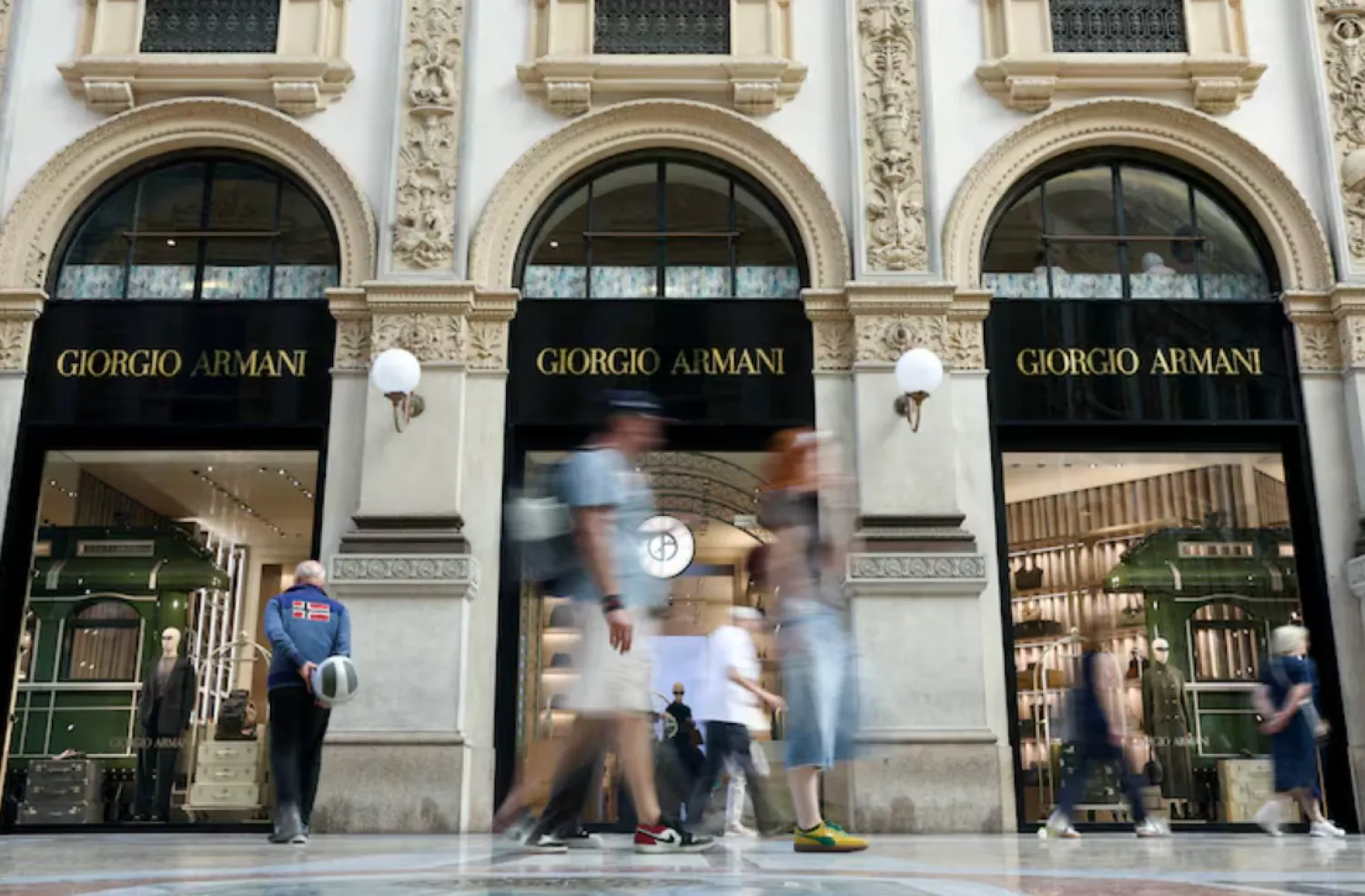
People walk past a Giorgio Armani store in Galleria Vittorio Emanuele II, following Giorgio Armani's death at the age of 91, in Milan, Italy, September 5, 2025. REUTERS/Gonzalo Fuentes/File Photo
TT

Armani's Value Goes Beyond Style

People walk past a Giorgio Armani store in Galleria Vittorio Emanuele II, following Giorgio Armani's death at the age of 91, in Milan, Italy, September 5, 2025. REUTERS/Gonzalo Fuentes/File Photo

Armani's economic value goes well beyond its stagnating fashion business and potential bidders are likely to take a close look at sales generated by fragrances and frames sold under the late designer's name, industry sources and analysts say.

The fashion house founded by Giorgio Armani 50 years ago reported revenue of 2.3 billion euros ($2.71 billion) last year, down 5% from a year earlier amid a global luxury slowdown and as a turn to casualwear reduces the appeal of its classic suits, Reuters reported.

But filings by the Italian company show that figure nearly doubles, to 4.25 billion euros, with the inclusion of sales from beauty and eyewear - made under licence since 1988 by L'Oreal and EssilorLuxottica respectively.

Giorgio Armani's will, published last week following his death on September 4, named those two companies alongside French luxury giant LVMH as potential buyers of the business.

Armani-branded perfumes and beauty products in L'Oreal's portfolio generate around 1.5 billion euros a year, industry sources and analysts estimate, while Armani eyewear contributes about 500 million euros for EssilorLuxottica.

Just over one-tenth of that goes to the Armani group as royalties, according to Reuters calculations based on filings.

Sales of licensed products could be fundamental to determining the price of Armani in a possible transaction, according to an industry source who has worked at a potential suitor.

While operating profit for Armani group, which depends largely on fashion, shrank to 3% of net revenue last year, the beauty and eyewear businesses are potentially more lucrative. L'Oreal reported an overall operating profit margin of 20% last year, while EssilorLuxottica's stood at nearly 17%.

The Armani brand is "great eyewear, great beauty, a great legacy, but the ready-to-wear brand today is not the hottest on the planet," HSBC analyst Erwan Rambourg told Reuters.

LICENCES CENTRAL TO POTENTIAL SALE

Armani's licence with EssilorLuxottica, in which the designer owned a 2% stake, was renewed in 2023 for 15 years. And the deal with L'Oreal runs until 2050.

Aware of the importance of these collaborations, Giorgio Armani's will states that priority for any sale should be given to groups with which his company "already has a partnership".

EssilorLuxottica and L'Oreal said last week they would assess a possible investment in Armani, which the will says should initially be a 15% stake. A second, larger stake should be transferred later to the same buyer or a listing sought, the will says.

LVMH, controlled by French billionaire Bernard Arnault, said it was honoured to be named as a potential partner.

Maintaining control of the sizeable Armani licence through a large stake purchase would be more significant for L'Oreal than for EssilorLuxottica.

A bid by L'Oreal for Armani may follow the precedent set by beauty group Estee Lauder, which purchased fashion label Tom Ford in 2022, keeping the fragrances but granting long-term licences to other players for apparel and eyewear.

Armani is "highly regarded" as a beauty brand, said Morningstar analyst Dan Su. It is also one of the best-known names in men's fragrances, a segment that is booming - L'Oreal CEO Nicolas Hieronimus told Reuters in July that its "Stronger with You" fragrance was a "phenomenon" among younger men.

Managing a fashion label in addition to beauty could add complexity for L'Oreal.

And despite their long collaboration, Armani would be a tough nut to crack for EssilorLuxottica, which dipped into fashion by acquiring streetwear brand Supreme in 2024, but has stressed its aim to become a med-tech group.

LVMH, with its depth and breadth of luxury expertise, would have the ability to manage a full acquisition that brings in-house the full suite of Armani's sprawling businesses, several industry experts said.

The French conglomerate could manage eyewear via its Thelios unit, while beauty is already a core business.

But LVMH may struggle to bring Armani beauty and eyewear in-house any time soon given the existing long-running licences.

Boss Arnault would also have to cohabit with a foundation set up by Armani that will hold de facto veto powers.

"LVMH and L'Oreal are like chalk and cheese," said Rambourg.


Fashion Commission, Saudi Retail Academy to Develop National Talent 

Fashion Commission, Saudi Retail Academy to Develop National Talent 
TT

Fashion Commission, Saudi Retail Academy to Develop National Talent 

Fashion Commission, Saudi Retail Academy to Develop National Talent 

The Saudi Fashion Commission signed a memorandum of understanding (MoU) with the Saudi Retail Academy to develop national capabilities and boosting specialized skills in the fashion and retail sectors, reported the Saudi Press Agency on Monday.

The MoU aims to support local talent and the creation of sustainable employment opportunities in this vital industry. It stems from the two sides’ keenness to cooperate in the fields of training and professional development.

The agreement was signed on the sidelines of the graduation ceremony of the academy’s first cohort.

The Fashion Commission focuses on developing local talent, transferring global expertise, and advancing the fashion sector in the Kingdom, while the Saudi Retail Academy is a non-profit institute and a specialized entity in training and development in the retail field and in building professional competencies and skills related to retail and sales.

The MoU aims to establish a framework for cooperation to design and implement specialized training programs that boost the readiness of national cadres and qualify them according to the highest professional standards, with a focus on developing skills in sales, customer experience, and store management to meet labor market requirement and the needs of the growing fashion sector.

Fashion Commission chief executive Burak Cakmak said that developing human capital is a fundamental pillar for the long-term growth of the Kingdom’s fashion sector.

The partnership reflects the commitment to strengthening the capabilities that form the foundation of a competitive and sustainable industry through investment in specialized skills within retail and customer experience, enabling brands to grow and supporting the sector’s confident evolution, he added.

Saudi Retail Academy chief executive Hend Al-Dhaban stressed that the partnership embodies a shared vision to empower national talent and elevate professionalism in the retail sector.

The agreement will help channel training expertise to meet the specialized needs of the fashion sector and equip young men and women with the practical skills required to succeed in the labor market, thereby boosting service quality and supporting localization targets and economic growth, she explained.

This cooperation is part of the Fashion Commission’s ongoing efforts to develop the fashion value chain through building strategic partnerships with specialized training and education entities, expanding professional opportunities for national talent, and linking education and training outputs with labor-market needs.

Through their partnership, the commission and the academy will help in building an integrated ecosystem that connects education, vocational qualification, and employment, bolstering the competitiveness of the fashion and retail sectors and supporting the objectives of Saudi Vision 2030 in empowering national cadres, localizing jobs, and improving quality of life.


Saudi 100 Brands Debuts Landmark Fashion Presentation at Saudi Cup 2026

The experience introduced global audiences to Saudi Arabia’s dynamic and growing fashion ecosystem - SPA
TT

Saudi 100 Brands Debuts Landmark Fashion Presentation at Saudi Cup 2026

The experience introduced global audiences to Saudi Arabia’s dynamic and growing fashion ecosystem - SPA

The Fashion Commission launched its Saudi 100 Brands showcase at the Saudi Cup 2026, marking a historic milestone for the world-renowned equestrian event at King Abdulaziz Racecourse in Riyadh.
The collections celebrate Saudi heritage by blending traditional and contemporary design. Jewelry and accessory brands also exhibited throughout, providing Saudi designers with a platform to reach a broader global audience. These showcases emphasize the fusion of heritage and modern design, offering a new perspective on the Kingdom's creative identity.
The Saudi 100 Brands program, a flagship initiative of the Fashion Commission, supports emerging designers by providing tools, expertise, and platforms to grow their global presence. This collaboration with the Saudi Cup underscores the importance of celebrating cultural heritage while advancing design innovation.

Each piece in the exhibition incorporates heritage motifs, textiles, and storytelling, reimagined through innovative design to appeal to modern and international audiences.

The exhibition aims to celebrate national identity, highlight local creative talent, and present the evolving direction of Saudi fashion, SPA reported.

Visitors explored the intersection of craftsmanship and cultural expression, discovering how designers honor tradition while advancing fashion design.

The experience also introduced global audiences to Saudi Arabia’s dynamic and growing fashion ecosystem.

This participation reflects the Fashion Commission’s vision to develop a thriving fashion sector rooted in cultural heritage and global ambition. By combining cultural narratives with innovative design, the commission enables Saudi fashion to contribute to global creative industries, nurture talent, and position Saudi brands for sustained success.


L’Oreal Shares Sink as Sales Miss Forecasts 

This photo taken on February 16, 2018 shows a board with the L'Oreal logo outside of the L'Oreal plant, in Lassigny. (AFP)
TT

L’Oreal Shares Sink as Sales Miss Forecasts 

This photo taken on February 16, 2018 shows a board with the L'Oreal logo outside of the L'Oreal plant, in Lassigny. (AFP)

L'Oreal shares fell heavily on the Paris stock market on Friday after the cosmetics giant posted sales that fell short of analyst expectations, stoking fears of weakness for its luxury brands and in the key Chinese market.

While revenues rose seven percent in the fourth quarter in Europe -- still the company's biggest market -- they edged up just 0.7 percent in North America and fell five percent in North Asia, which includes China.

Overall, sales were up 1.5 percent to 11.2 billion euros ($13.3 billion) in the final quarter of 2025 -- usually when the company benefits from strong holiday-fueled buying.

This was a marked slowdown from the 4.5-percent growth seen the previous year.

On a like-for-like comparison that excludes the impact of currency fluctuations, sales rose six percent, whereas the consensus forecast was around eight percent, analysts said.

The luxury division (Luxe) in particular, which includes high-end perfumes and make-up and is L'Oreal's biggest by revenue, saw a 0.5-percent sales slide in the fourth quarter, to 4.2 billion euros.

"We think the miss, led by North Asia and Luxe, will be a concern amid a vague outlook," said David Hayes, an analyst at investment bank Jefferies.

L'Oreal's stock was down 3.2 percent in morning trading, partly recovering from a drop of more than six percent at the open.

Net profit for the full year was down 4.4 percent to 6.1 billion euros.

Chief executive Nicolas Hieronimus said when he presented the results on Thursday that L'Oreal had achieved a "solid" performance "despite a context that was at the very least volatile and unfavorable".

For 2026, he said the company had to be "cautious and humble", although he expected "the beauty market to continue its acceleration" unless there was "a new surprise".

"We're going to have to intensify our efforts in terms of innovation to energize the market and win over customers," he added.