

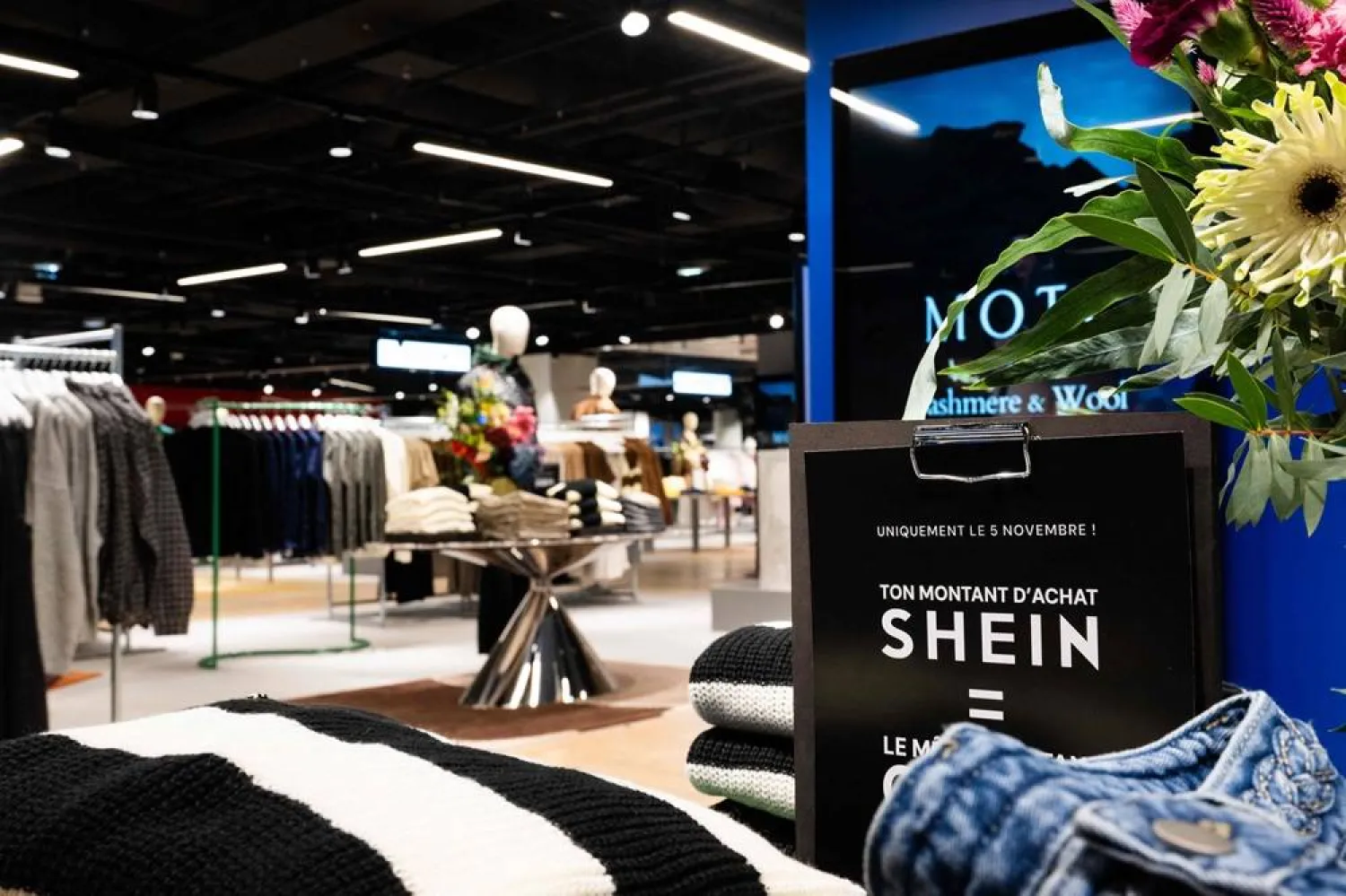

French Parliament Adopts Bill to Regulate Fast Fashion

This photograph shows the logo of Asian e-commerce giant Shein in its stall at the Bazar de l'Hotel de Ville (BHV) department store in Paris on November 4, 2025, on the eve of the opening of its first physical store at BHV in Paris. (AFP)
TT

French Parliament Adopts Bill to Regulate Fast Fashion

This photograph shows the logo of Asian e-commerce giant Shein in its stall at the Bazar de l'Hotel de Ville (BHV) department store in Paris on November 4, 2025, on the eve of the opening of its first physical store at BHV in Paris. (AFP)

The French parliament on Monday passed a bill aimed at curbing the rise of fast fashion, targeting major Asian e-commerce platforms, such as Shein and Temu.

The legislation, first tabled two-and-a-half years ago, seeks to regulate so-called "ultra-fast fashion" companies, known for selling large volumes of lower quality clothing at rock-bottom price.

Easy to order and replace, fast fashion items contribute to pollution from the textile industry, which accounts for nearly 10 percent of global greenhouse gas emissions.

The Senate passed the bill Monday after the lower house National Assembly did last week.

It imposes a per-item fee for producing textile en masse that will increase over time, and a ban on advertising for ultra-fast fashion brands, including by social media influencers.

Lawmakers hope to rein in Asian e-commerce companies that have exploded in popularity in France in recent years.

Trade Minister Serge Papin last week said the bill would target the main players, including three companies, which he said are driving the surge in ultra-fast fashion.

"Their names, which were still unknown three years ago... are now on everyone's lips in France: Temu, Shein and AliExpress," he said at the time.

But some have criticized the legislation for sparing European and French companies, such as Zara and Kiabi, with some leftist lawmakers in both chambers abstaining during the vote.

Green Party lawmaker Charles Fournier said last week the original bill had been "considerably scaled back", arguing that brands, such as Zara and H&M "have not become models of sustainable fashion".

Stop Fast Fashion, a coalition of organizations, also criticized what it called as a "greatly watered-down" version compared to the one originally put forward.

- Advertising ban doubts -

Anne-Cecile Violland, the center-right member of parliament who proposed the bill, said they needed legislation that could be passed "very quickly and be operational".

"We're coming down very hard on Shein, and that's the first step," she told AFP, adding she understood the disappointment.

The legislation targets ultra-fast fashion based on two criteria: the volume of clothing placed on the market and the cost of repairing garments relative to their purchase price.

The per-item fee will vary on a set scale according to how each brand scores on both these standards.

The levy could reach up to 20 euros ($23) per item by 2030, though the cap remains at 50 percent of the product's pre-tax price.

Part of these penalties will go towards collection and recycling infrastructure.

The legislation also requires ultra-fast fashion companies to display messages on their websites promoting more moderate consumption, including reusing and repairing clothing.

A ban on advertising, including by influencers, is a central plank of the bill, though questions remain over how it could be enforced.



Birkenstock Raises Annual Revenue Forecast on Strong Demand

Shares of the German sandal maker were up ‌7% in ‌premarket trading.  (Getty Images)
Shares of the German sandal maker were up ‌7% in ‌premarket trading. (Getty Images)
TT

Birkenstock Raises Annual Revenue Forecast on Strong Demand

Shares of the German sandal maker were up ‌7% in ‌premarket trading.  (Getty Images)
Shares of the German sandal maker were up ‌7% in ‌premarket trading. (Getty Images)

Birkenstock raised its full-year sales growth forecast on Wednesday, banking on resilient full-price demand for its premium sandals from affluent shoppers.

Shares of the German sandal maker were up ‌7% in ‌premarket trading.

A pullback in ‌US ⁠discretionary spending has ⁠weighed on much of the apparel and footwear sector, but brands such as Birkenstock catering to wealthier consumers have largely held up, benefiting from ⁠strong pricing power and ‌brand loyalty.

While ‌the Middle East conflict continues ‌to create uncertainty in the Gulf ‌region, the impact on the quarter was more contained than initially anticipated, the company said.

It now ‌expects fiscal year 2026 revenue growth of 15% ⁠on ⁠a constant currency basis, compared with its earlier forecast of a 13% to 15% rise.

The company posted third-quarter revenue of 719.5 million euros ($829.08 million), compared with analysts' estimate of 713.4 million euros, according to data compiled by LSEG.


Jeweller Pandora Raises 2026 Guidance as New Designs Draw in Shoppers

A view of the Pandora sign on one of the branches of the Danish jewellery maker Pandora in central Copenhagen, Denmark, August 13, 2025. (Reuters)
TT

Jeweller Pandora Raises 2026 Guidance as New Designs Draw in Shoppers

A view of the Pandora sign on one of the branches of the Danish jewellery maker Pandora in central Copenhagen, Denmark, August 13, 2025. (Reuters)

Jeweller Pandora raised its 2026 guidance for organic growth and profit margin on Wednesday, saying new designs and marketing were helping attract shoppers, and also reported second-quarter operating profit (EBIT) above analysts' expectations.

Pandora said EBIT for the April-June period came in at 1.46 billion Danish crowns ($225.35 million), against an average estimate of 1.10 billion expected by analysts in a company-compiled poll, reflecting partial refunds of previously paid ‌U.S. tariffs.

"We are ‌making progress in re-energizing Pandora's ‌growth engine," ⁠CEO Berta de ⁠Pablos-Barbier said in a statement.

"There is more work ahead, but we are moving in the right direction and raising our 2026 guidance for both growth and profitability," she added.

The company now expects organic growth at between 0% and 3% in ⁠2026, up from a previous range ‌of -1% to 2%, ‌and an operating profit margin between 22% and 23%, up ‌from 21% to 22%.

In the top job ‌since January, de Pablos-Barbier is leading a drive to release new designs, with its Pandora Wonders line - featuring pearl charms shaped like a frog, a pufferfish, or ‌a mushroom - launching in July in Paris during Haute Couture week.

Pandora's share price ⁠has ⁠been highly volatile over the past two years as the price of silver surged, prompting de Pablos-Barbier to announce in February a shift towards platinum-plated jewellery as a way of reducing its reliance on silver.

Pandora said on Wednesday it started pilot testing a limited range of platinum-plated jewellery in the Netherlands in July, and would do broader tests across markets in the fourth quarter, before scaling up the rollout next year.


Armani Stake Sale Could Be Delayed Beyond March 2027 Deadline

FILE PHOTO: People walk past a Giorgio Armani store in Galleria Vittorio Emanuele II, following Giorgio Armani's death at the age of 91, in Milan, Italy, September 5, 2025. REUTERS/Gonzalo Fuentes//File Photo
TT

Armani Stake Sale Could Be Delayed Beyond March 2027 Deadline

FILE PHOTO: People walk past a Giorgio Armani store in Galleria Vittorio Emanuele II, following Giorgio Armani's death at the age of 91, in Milan, Italy, September 5, 2025. REUTERS/Gonzalo Fuentes//File Photo

The planned sale of ‌a 15% stake in Italian fashion group Giorgio Armani may not be completed until after a March 2027 deadline set by the late designer's will, an Italian newspaper reported on Tuesday.

Citing company sources, the Corriere della Sera said market conditions for the luxury industry were still challenging and negotiating a deal could require time, said Reuters.

The indications on timing in the will are not binding, the sources said, adding the need to reach the best possible terms for a sale took precedence.

The company did not immediately ‌respond to ‌a request for comment.

Giorgio Armani, who died on ‌September ⁠4, 2025, instructed the ⁠eponymous foundation that controls the fashion house to sell an initial 15% stake within 18 months, giving priority to French luxury goods group LVMH, beauty giant L'Oreal and Franco-Italian eyewear maker EssilorLuxottica .

Corriere cited board documents from the Giorgio Armani Foundation as saying the process was still at an early stage and unlikely to ⁠be completed before 2027.

Evaluations over the stake ‌sale are under way but ‌remain preliminary because the transaction is complex, Rothschild & Co banker and foundation director ‌Irving Bellotti told an April board meeting, Corriere reported.

Bellotti said ‌that work on the deal would begin this year but was expected to be completed during 2027.

The group has also not ruled out a potential stock market listing, which would leave management in ‌the hands of the family and current executives under the foundation's strategic oversight, Corriere said, citing the ⁠sources.

Corriere also ⁠cited Chief Executive Giuseppe Marsocci as telling the foundation's board in April that net group sales in the first two months of 2026 fell 7.5% at current exchange rates and 3.9% at constant exchange rates from a year earlier.

The company adopted measures to cut operating costs by €25 million ($28.84 million), Marsocci added.

The drop, he explained, was driven by the wholesale channel where sales declined 10.7% year-on-year at constant exchange rates, while direct-to-consumer sales rose 3.5% net of currency effects, Corriere reported.

Giorgio Armani will approve first-half results on September 8, Corriere said, adding they should broadly confirm January-February trends.