


Fast-Fashion Giant Shein Plunges 10% on Hong Kong Debut

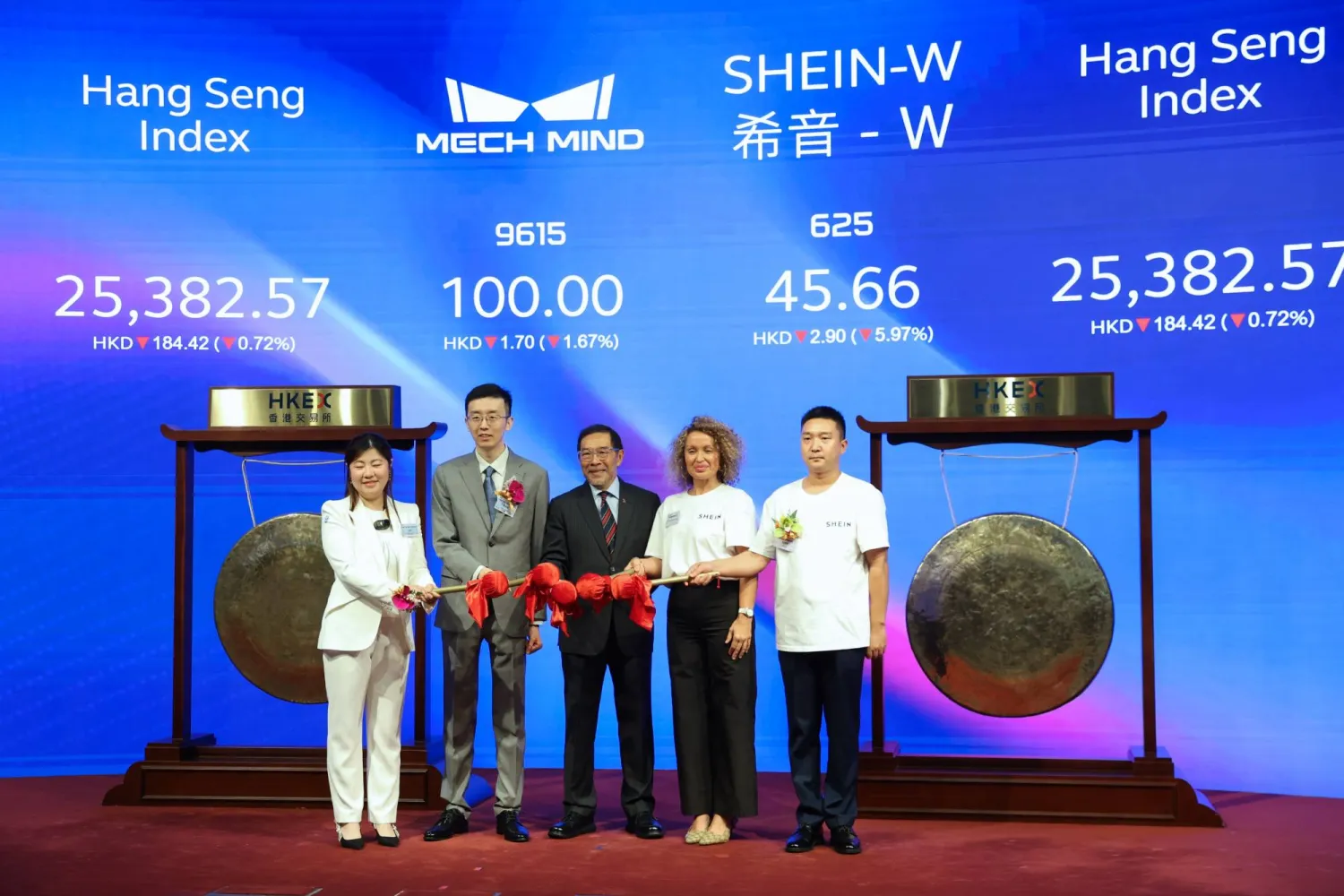
Carlson Tong (C), Chairman of Hong Kong Exchanges and Clearing Limited, attends SHEIN’s listing ceremony at the Hong Kong Exchanges and Clearing Limited (HKEX) in Hong Kong, China, 01 September 2026. (EPA)
TT

Fast-Fashion Giant Shein Plunges 10% on Hong Kong Debut

Carlson Tong (C), Chairman of Hong Kong Exchanges and Clearing Limited, attends SHEIN’s listing ceremony at the Hong Kong Exchanges and Clearing Limited (HKEX) in Hong Kong, China, 01 September 2026. (EPA)

Fast-fashion retailer Shein fell 10 percent on its long-awaited Hong Kong trading debut Tuesday, having raised US$1.7 billion in a high-profile initial public offering.

The flotation comes after the company's plans to list in New York and London were derailed by regulatory scrutiny, but it won approval from Chinese officials in July for the sale in the southern financial hub.

However, its shares fell to as low as HK$43.72 soon after the open, compared with its listing price of HK$48.56.

The IPO put the company's valuation at around US$26.3 billion -- well short of the nearly US$100 billion during private fundraising rounds in 2022.

Shein, known for its ultra-low prices and rapidly produced clothes, said proceeds from the sale would be used to finance its technological capabilities and boost its international presence.

The online retailer moved its headquarters to Singapore between 2021 and 2022, which analysts say was intended to avoid increasing global scrutiny of Chinese firms.

Its European customer base rose to 156 million average monthly users by the end of 2025, making it one of the continent's biggest e-commerce platforms alongside China's AliExpress and US titan Amazon, which have 193 million and around 180 million users respectively.

The company has faced scrutiny over its environmental footprint and allegations of human rights violations, and faces growing competition from low-cost e-commerce companies such as Temu and AliExpress.

Executive chairman Donald Tang told AFP last year that the company has "zero tolerance" for forced labor.

Morningstar analyst Lorraine Tan said in an August note that revenue growth "has converged to the pace seen by the fast fashion industry at below 10 percent in 2025".

She added the fall in valuation "does reflect that drop off in investor appetite for Shein's shares".

The company pioneered a formidable model that is hard to replicate, said Ken Pucker, a sustainable fashion expert at Tufts University.

- Chinese roots -

But its unprecedented growth also invited challenges of "newly imposed taxes and duties, compromised sustainability, privacy and copyright practices and competition", he added.

"Timing is not ideal given the company's slowing growth. That said, it has been trying to go public for around five years, and I am guessing that many of its investors were eager to get paid out."

In 2025, Shein reported a full-year net profit of US$2.06 billion but swung to a US$99 million loss in the first three months of this year after the United States scrapped an import duty exemption on small packages.

In a similar move, the European Union last month imposed a duty of three euros (US$3.50) per item for packages valued at less than 150 euros.

And France will impose a fee on ultra-fast fashion items from Tuesday that could eventually reach almost 20 euros per garment, as the government targets major Asian e-commerce platforms.

"Shein's near future is going to be marked by negative growth," e-commerce analyst Juozas Kaziukenas told AFP.

The retailer needs a "mid-air engine swap" to rebuild its supply chain on diversified inventory sources beyond shipping directly from China, he added.

Shein's CEO Sky Xu made a rare public appearance this year in the southern Chinese province of Guangdong, pledging to allocate greater resources in the country, which was seen by analysts as an attempt to realign the company with its roots.

The Hong Kong listing represents a "new Asian story for the company", as it redefines itself institutionally with "roots in China", said Lawrence Loh, a professor specializing in ESG markets at the National University of Singapore.

"The listing opens a new chapter for Shein to access new capital to resolve the sustainability issues, but this comes with a price of even higher levels of public scrutiny."

UK Retailer Debenhams Announces Return of McDonald as New Chair

FILE PHOTO: Debenhams logo is seen on smartphone in front of a displayed Boohoo logo in this illustration taken January 25, 2021. REUTERS/Dado Ruvic/Illustration/File Photo
TT

UK Retailer Debenhams Announces Return of McDonald as New Chair

FILE PHOTO: Debenhams logo is seen on smartphone in front of a displayed Boohoo logo in this illustration taken January 25, 2021. REUTERS/Dado Ruvic/Illustration/File Photo

British fashion retailer Debenhams said on Friday Iain McDonald has returned to its board as chair, replacing Tim Morris, as the company looks to focus on rebuilding its equity value after completing the initial stage of its turnaround.

Here are some details:

McDonald stepped down in February after Debenhams launched an equity raise, in which McDonald and his fund Belerion Capital invested about $5 million, making him ⁠the ninth largest ⁠investor in the group, per LSEG data.

McDonald, who had served as a non-executive director since June 2017, stepped down to facilitate his fund's participation in the funding earlier this year.

McDonald ⁠is currently chair and investor at London-listed cosmetics group Revolution Beauty, whose shares have soared over 60% so far this year.

Debenhams, formerly known as Boohoo, has seen its shares rise 8.6% so far this year.

Debenhams on Thursday reported a 13.9% rise in first-half adjusted core profit, driven by a return to growth at ⁠major brands ⁠including PrettyLittleThing, boohoo and Karen Millen.

Morris is stepping down with immediate effect after serving as chair for nearly two years and oversaw the group's new strategy, which was led by CEO Dan Finley.

As part of Friday's changes, Debenhams also appointed Michael Stewart and Stephen Rothwell as independent non-executive directors, bringing expertise in capital markets, investment management, technology and AI-enabled consumer platforms.


Next Nudges Up Profit Guidance but Sees UK Headwinds

Shoppers walk past a NEXT retail store in London, Britain, January 2, 2025. REUTERS/Hollie Adams/File Photo
TT

Next Nudges Up Profit Guidance but Sees UK Headwinds

Shoppers walk past a NEXT retail store in London, Britain, January 2, 2025. REUTERS/Hollie Adams/File Photo

British clothing retailer Next edged up its annual forecast on Thursday, as it reported a 10.5% profit rise for its first half, but expects sales growth to slow in its second half and warned of headwinds in its core UK market.

The group, which trades from more than 800 stores in the UK and Ireland, including Reiss, Joules and FatFace outlets, and has an online ⁠operation serving the ⁠UK and overseas markets, said full price sales were 7.7% higher in the six months to August 1, helped by a hot summer in Britain.

But it said full price sales growth would slow to 5.8% in its second half, and moderated its second half sales growth expectations for the UK to 2.0% from 2.8%, flagging concerns in its ⁠home market which accounts for about three quarters of sales.

"Our primary concerns are rising inflation, higher mortgage interest costs and a weak employment market. These worries will only be compounded if they are accompanied by tax increases," it said in reference to new finance minister John Healey's first budget on October 28.

"It seems likely that it (the government) will have to increase taxes in order to fund its expenditure,” Reuters quoted it as saying.

British households will see their energy bills rise in October, inflation ticked up on Wednesday, and, last week, Next rival John Lewis highlighted a tough UK ⁠trading environment, saying ⁠consumers were holding back on bigger ticket items.

Rival Primark said trading in continental Europe remained challenging, though Zara owner Inditex reported a strong start to autumn trading.

Next made a profit before tax of £569 million ($762 million) in its first half. It said its international business had made an encouraging start to the season, and raised its second half sales growth guidance to 20.5%.

The retailer, whose shares have increased by a quarter over the last year, raised its profit before tax guidance for its year to January 2027 by £12 million ($16 million) to £1.255 billion, reflecting the small upgrade in sales expectations and some additional cost savings, mainly in warehousing. It made £1.158 billion in 2025/26.


Ukrainian Fashion Designer Debuts Art between Air Raids

An empty street near the Ukrainian Foreign Ministry in Kyiv. (Asharq Al-Awsat)
TT

Ukrainian Fashion Designer Debuts Art between Air Raids

An empty street near the Ukrainian Foreign Ministry in Kyiv. (Asharq Al-Awsat)

In Kyiv's largest art museum, Arina Petrova and her father Serhii busily applied the final touches to their mannequins, anxious that a Russian drone attack could delay her long-awaited debut.

The fashion-designing duo from Ukraine's "Bob Basset" art house were about to present Petrova's first ever collection -- an array of punk leather animal costumes.

But with Russian jet-powered drones now crashing into Ukraine's capital on a daily basis, triggering air alerts that paralyze life in the city, the pair had more pressing concerns.

"If it's in the shelter, fine -- we'll do it in the shelter," Petrova told AFP, adding she was prepared to bring all the models and their cellist down to the basement to showcase their work.

Petrova and her 50-year-old father run their punk fashion studio out of Kharkiv, a heavily attacked city close to the Russian border.

Having arrived to the capital by minibus, their designs in hand, the pair wanted to show through their art that Kharkiv was still very much alive.

Petrova was concerned that a drone could cut things short.

"We want to have time to say what we want to say," the 28-year-old said with a sigh.

If halted, they would continue underground -- even if they had to use the flashlights on their cellphones to light up the show, she said.

As Petrova adjusted the lace on a corset, an alarm started blaring: Russian jet-powered drones were approaching the capital.

Security guards evacuated the audience.

Outside, a woman in a red dress posed for a photographer. There was a heavy explosion, she flinched, and without hesitation, resumed her pose with a smile.

In the distance, a plume of black smoke rose among the buildings.

- 'Become a little more ferocious' -

While other designs on display at Kyiv Fashion Week were full of color, Bob Basset's collection was monochrome.

In front of large black drapes, the designers adjusted a black leather breastplate adorned with a feather-like design, to be paired with a black horse mask.

For her first collection, entitled "Mutabor" ("I shall transform," in Latin), Petrova based her designs on creatures her father had imagined -- dark, feathered animals with claws.

"I feel like during war, everyone has to become a little more ferocious... grow fangs," the designer told AFP.

"You acquire something from the animal that makes you stronger."

Before Russia invaded in February 2022, Bob Basset had built a reputation designing leather masks, some of them worn by metal bands Korn and Slipknot.

But as Russian troops approached the outskirts of Kharkiv in 2022, the group closed their workshop and the family moved west.

Far from his hometown, Serhii sank into depression.

Leaving his wife and children safe in Europe, he returned to Kharkiv, under bombardment.

"I'm afraid," he said. "But I'm even more afraid of not being able to do anything tomorrow."

Their collection at Kyiv Fashion Week is their first in 11 years.

- Fashion amid the bombs -

Wearing a mask himself to hide a squint, Serhii has made face coverings the focus of his work -- a way to reinvent his identity.

He began creating masks for free for wounded soldiers who wanted to hide their scars.

His daughter joined him, and despite the sleepless nights, the workshop in Kharkiv came back to life.

"If I hadn't come back, this collection would never have existed," she said.

With just a few minutes to go before the show, Petrova appeared agitated.

In Kharkiv, anxiety kept her awake at night, as Russia bombed warehouses and logistics centers, complicating their work.

"If something hits the studio, everything we've worked on for a year will be gone," she said.

"Every day, there's this feeling that we have very little time. Something could happen, and you'll never be able to finish."

During a brief moment of respite from incoming strikes, a cellist played for a few moments.

Then, silently, the models made their way through the crowd, their faces masked, amid the flashes of cell phones.

The performance ended in a mix of applause and air raid sirens.

A woman approached Serhii to congratulate him, wearing a dress made from pieces of drones.

In the courtyard, Petrova smiled, despite the explosions from air defenses in the sky overhead.

She's used to it. In Kharkiv, "only those who are capable of creating under these conditions remain," she said.