


Naomi Osaka Exits US Open, but Not Before Displaying One More ‘Swaggy’ Fashion Ensemble

 Naomi Osaka, of Japan, arrives for a match against Elena Rybakina, of Kazakhstan, during the fourth round of the US Open tennis championships, Monday, Sept. 7, 2026, in New York. (AP)
Naomi Osaka, of Japan, arrives for a match against Elena Rybakina, of Kazakhstan, during the fourth round of the US Open tennis championships, Monday, Sept. 7, 2026, in New York. (AP)
TT

Naomi Osaka Exits US Open, but Not Before Displaying One More ‘Swaggy’ Fashion Ensemble

 Naomi Osaka, of Japan, arrives for a match against Elena Rybakina, of Kazakhstan, during the fourth round of the US Open tennis championships, Monday, Sept. 7, 2026, in New York. (AP)
Naomi Osaka, of Japan, arrives for a match against Elena Rybakina, of Kazakhstan, during the fourth round of the US Open tennis championships, Monday, Sept. 7, 2026, in New York. (AP)

Naomi Osaka may not have gone out of the US Open with much of a bang. But she surely went out with a burst — of color, and a bit of swag.

The two-time US Open champion lost a lopsided fourth-round match on Monday to Elena Rybakina. But she continued to make her mark as the undisputed fashion queen on tour.

Osaka, already known for her walk-on fashion reveals at tournaments, has been upping her game at the year's final major with a series of dramatic ensembles — all with a basketball theme, as her sponsor, Nike, honors the New York Knicks' championship win.

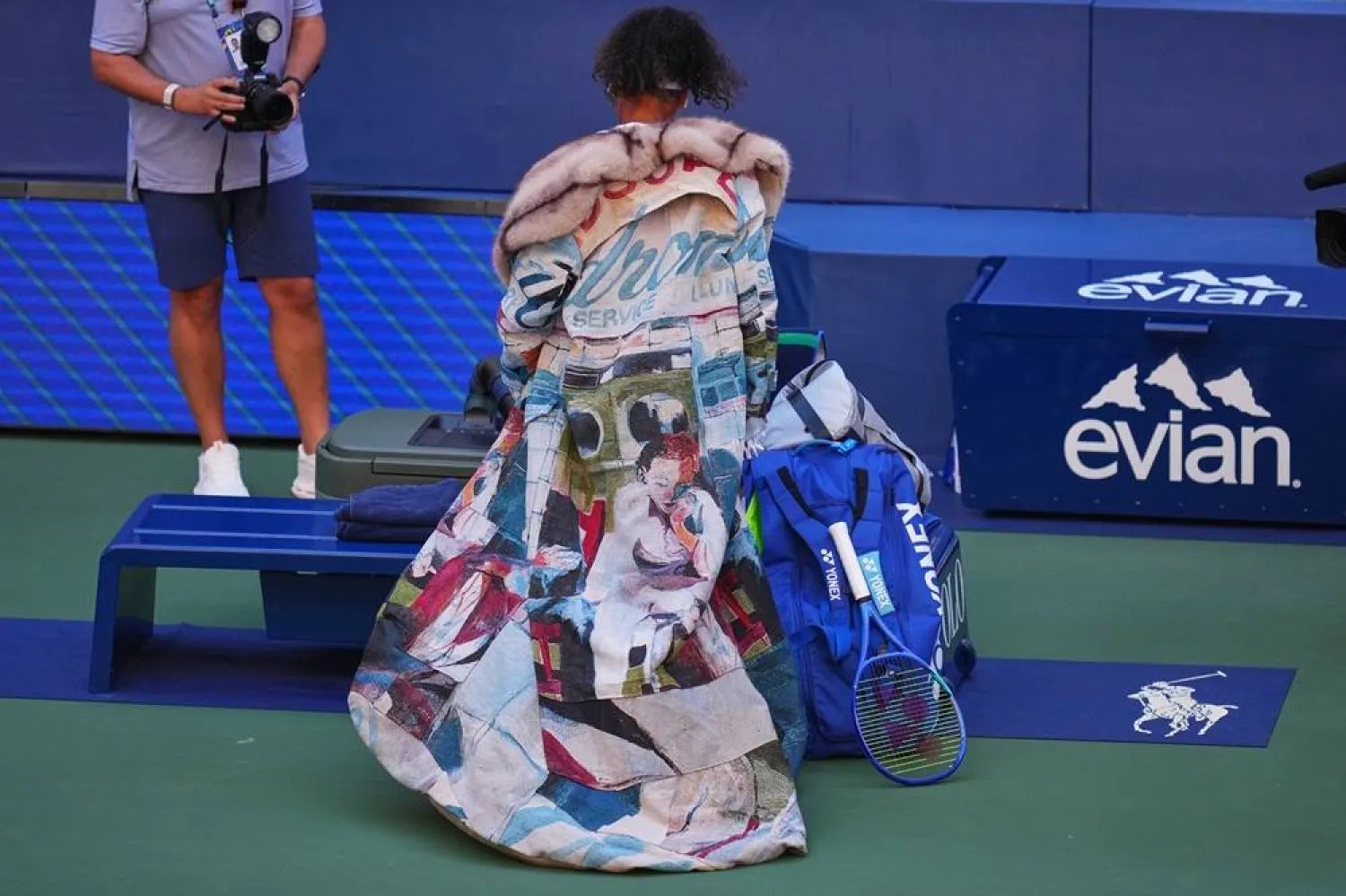
For her last look, she arrived on court Monday in a coat of many colors: a fur-trimmed cloak designed by Brooklyn-based label KidSuper.

“I felt really swaggy when I put it on," Osaka said after the match. “I feel like it embodied New York a lot."

For her increasingly dramatic looks the past week or so, Osaka has worked with celebrity stylist Law Roach — also known as Zendaya's stylist — displaying the work of multiple designers.

Monday's eclectic walk-on ensemble from KidSuper, the label of designer Colm Dillane, included not only the lavish coat, but a headband that echoed the blue, red and white NBA logo — only now, displaying a racket-wielding tennis player, not a basketball player.

For her first-round match a week ago, Osaka channeled NBA great Allen Iverson in a long, white tulle skirt and a dramatic gray, hooded robe. When she removed the hood, Osaka's hair was in cornrows under a headband, recalling Iverson's look when was the NBA MVP while playing for the Philadelphia 76ers. Her ensemble was designed by Who Decides War, the New York-based streetwear brand.

For round two, Osaka arrived on court in an ensemble by Thom Browne, with a flowing white jacket embroidered with crossed tennis rackets. Underneath, her tennis skirt's mesh fabric resembled a basketball net.

For the third round, Osaka, a four-time Grand Slam champion, wore the label Monse — an oversized hybrid of a gray suit jacket and hoodie sweatshirt over flowing gray fleece pants, an outfit meant to mesh business wear with sports wear.

After her loss Monday, Osaka was asked if she was disappointed that there may have been other fashion looks she'd been planning to display, had she remained longer.

“I mean, I think there’s always something, you know?” Osaka said. “I feel like that’s a way that I can have fun and sort of just excite myself, also.”

But the 28-year-old — who noted that she’d been hampered during Monday' match by pain in her leg — was philosophical about her loss.

“Maybe I’m just getting older, but I don’t feel sad,” Osaka said. “I think, also, if I reflect on my career and the things that I’ve been able to do, there’s nothing that I regret or there’s nothing that I’m sad about ... If I win another Grand Slam, it’s not going to change my life.”

Lululemon Forecast Cut Hits Shares, Underscores Challenge for Next CEO

FILE PHOTO: A logo is displayed inside a Lululemon outlet retail store at Bicester Village in Oxfordshire, Britain, August 21, 2024. REUTERS/Hollie Adams/File Photo
TT

Lululemon Forecast Cut Hits Shares, Underscores Challenge for Next CEO

FILE PHOTO: A logo is displayed inside a Lululemon outlet retail store at Bicester Village in Oxfordshire, Britain, August 21, 2024. REUTERS/Hollie Adams/File Photo

Shares of Lululemon Athletica fell about 18% in premarket trading on Friday after the sportswear maker cut its full-year forecast for a second time, underscoring the hurdles awaiting incoming CEO Heidi O'Neill.

Lululemon, known for its high-priced stretchy pants and athletic tops, has been grappling with declining sales for several quarters as it seeks to recover from merchandising missteps, an overreliance on promotions and intensifying competition, Reuters reported.

The firm's shares fell ⁠to $100.1 premarket, and ⁠if losses hold, it would wipe out more than $2.5 billion from Lululemon's market value and deepen the stock's year-to-date decline to about 41.5%.

O'Neill, a former Nike executive who takes the helm on September 8, will ⁠be tasked with reviving demand in North America, Lululemon's largest market, and restoring growth.

Revenue in the Americas, the company's largest market, fell 8% in the second quarter, compared with a 1% increase a year earlier, as the firm struggles to reignite demand amid inflationary pressure on consumer spending.

Morgan Stanley said that sales could deteriorate further in the second half, ⁠with ⁠limited visibility on when demand might recover, raising the risk of continued pressure on margins.

Following the results, at least 12 brokerages lowered their price targets on the shares, with Piper Sandler setting the Street-low target of $80, according to data compiled by LSEG.

The company trades at about 11.50 times forward earnings, compared with ​20.76 for Nike ​and 13.41 for Adidas, according to LSEG data.


One Year After Its Founder’s Death, Armani Faces Challenge of ‘Inevitable Evolution’

People walk past a Giorgio Armani store in Galleria Vittorio Emanuele II, in Milan, Italy, September 5, 2025. (Reuters)
TT

One Year After Its Founder’s Death, Armani Faces Challenge of ‘Inevitable Evolution’

People walk past a Giorgio Armani store in Galleria Vittorio Emanuele II, in Milan, Italy, September 5, 2025. (Reuters)

One year after the death of founder Giorgio Armani, the Italian fashion house is entering a pivotal period as the clock starts ticking on plans for an initial stake sale, after the group spent the last year focused on governance.

Armani, who died aged 91 on September 4, 2025, stipulated in his will that a first sale of around 15% of the company should take place between 12 and 18 months after his death, followed by the disposal of a larger stake or a bourse listing.

Industry executives and analysts warn, however, that one year on, the late designer's heirs and advisers must now focus on evolving, to keep the brand fresh and relevant.

"Continuity is the right choice to get through the first year. It becomes, or could become, a risk if it turns into inertia," said Francesco Fiorese, a partner at consultancy Simon Kucher.

The real test for the company, Fiorese ‌said, will be ‌to switch from "a succession model based on Giorgio Armani's legacy to a more autonomous system, capable of ‌making ⁠its own decisions while ⁠still preserving the brand's identity."

Armani group declined to comment.

NEW BUSINESS PLAN

Over the last year, Armani's sales declined 2.8% at constant currencies to €2.2 billion ($2.56 billion), and investors remain cautious about the luxury sector's health as the war with Iran drags on and Chinese consumer spending is faltering.

As he prepares a new business plan, CEO Giuseppe Marsocci, a group veteran now at the helm, told an event in July that Armani would not seek short-term fixes, while keeping faithful to the founder's long-term vision of an essential and elegant style with attention to detail and wearability.

He said Armani was still in a transition phase and looking for a new balance as the founding family worked closely with new board directors, ⁠including former Gucci CEO Marco Bizzarri.

Marsocci pointed to a joint venture to develop new Armani Hotels & ‌Resorts as an indication of future strategic moves.

"The great challenge will be maintaining ‌the balance between the identity that defines us and the inevitable evolution we will have to pursue," he said.

STAKE SALE

In his will, Armani listed ‌France's LVMH and licensees EssilorLuxottica and L'Oréal as potential buyers - or another luxury group of comparable standing.

The fashion house, which sources said is ‌working with Rothschild as financial adviser for the sale, had €500 million in net cash at the end of 2025.

Two people close to the matter said there was no pressure to clinch a sale and the deadlines set out in Armani's will are not strictly binding.

The process is expected to accelerate in the coming weeks, but a deal could be postponed if market conditions fail to support an adequate valuation, the sources said.

Bankers and advisers consulted ‌by Reuters put the group's valuation at around €5 billion to €7 billion.

LICENSING ACCORDS

For L'Oreal and EssilorLuxottica, a stake in Armani would help to protect licensing deals which last year netted almost €2 billion ⁠in revenue for the groups - and ⁠royalties for Armani.

"Licensing deals with L'Oreal and EssilorLuxottica have been profitable. With the market demanding more accessible entry points, like accessories and beauty, as consumer spending tightens, these areas show strong potential for continued growth," said Gonzalo Brujó, CEO of consultancy Interbrand Global.

EssilorLuxottica would be interested only in a small holding and could consider partnering with other bidders, two people close to the matter said.

L'Oréal has little interest in entering the fashion business but is keen to safeguard a beauty license that runs until 2050, according to another person close to the matter.

LVMH, large enough to incorporate fashion, eyewear and beauty, has closely studied the possibility of a stand-alone investment, according to a source with direct knowledge of the matter. But LVMH tends to control brands in its portfolio and an IPO could complicate its bid for Armani if the heirs decided to list the company, the source said.

EssilorLuxottica declined to comment, while LVMH was not immediately available for comment.

L'Oreal told Reuters in an emailed reply to queries that its position on a possible Armani stake had not changed and it was honored that Armani had mentioned the French cosmetic group. "L'Oréal will study this opportunity, which builds on our long-shared history, whenever the Armani S.p.A representatives choose to open the discussion," it added.


Fast-Fashion Giant Shein Plunges 10% on Hong Kong Debut

Carlson Tong (C), Chairman of Hong Kong Exchanges and Clearing Limited, attends SHEIN’s listing ceremony at the Hong Kong Exchanges and Clearing Limited (HKEX) in Hong Kong, China, 01 September 2026. (EPA)
TT

Fast-Fashion Giant Shein Plunges 10% on Hong Kong Debut

Carlson Tong (C), Chairman of Hong Kong Exchanges and Clearing Limited, attends SHEIN’s listing ceremony at the Hong Kong Exchanges and Clearing Limited (HKEX) in Hong Kong, China, 01 September 2026. (EPA)

Fast-fashion retailer Shein fell 10 percent on its long-awaited Hong Kong trading debut Tuesday, having raised US$1.7 billion in a high-profile initial public offering.

The flotation comes after the company's plans to list in New York and London were derailed by regulatory scrutiny, but it won approval from Chinese officials in July for the sale in the southern financial hub.

However, its shares fell to as low as HK$43.72 soon after the open, compared with its listing price of HK$48.56.

The IPO put the company's valuation at around US$26.3 billion -- well short of the nearly US$100 billion during private fundraising rounds in 2022.

Shein, known for its ultra-low prices and rapidly produced clothes, said proceeds from the sale would be used to finance its technological capabilities and boost its international presence.

The online retailer moved its headquarters to Singapore between 2021 and 2022, which analysts say was intended to avoid increasing global scrutiny of Chinese firms.

Its European customer base rose to 156 million average monthly users by the end of 2025, making it one of the continent's biggest e-commerce platforms alongside China's AliExpress and US titan Amazon, which have 193 million and around 180 million users respectively.

The company has faced scrutiny over its environmental footprint and allegations of human rights violations, and faces growing competition from low-cost e-commerce companies such as Temu and AliExpress.

Executive chairman Donald Tang told AFP last year that the company has "zero tolerance" for forced labor.

Morningstar analyst Lorraine Tan said in an August note that revenue growth "has converged to the pace seen by the fast fashion industry at below 10 percent in 2025".

She added the fall in valuation "does reflect that drop off in investor appetite for Shein's shares".

The company pioneered a formidable model that is hard to replicate, said Ken Pucker, a sustainable fashion expert at Tufts University.

- Chinese roots -

But its unprecedented growth also invited challenges of "newly imposed taxes and duties, compromised sustainability, privacy and copyright practices and competition", he added.

"Timing is not ideal given the company's slowing growth. That said, it has been trying to go public for around five years, and I am guessing that many of its investors were eager to get paid out."

In 2025, Shein reported a full-year net profit of US$2.06 billion but swung to a US$99 million loss in the first three months of this year after the United States scrapped an import duty exemption on small packages.

In a similar move, the European Union last month imposed a duty of three euros (US$3.50) per item for packages valued at less than 150 euros.

And France will impose a fee on ultra-fast fashion items from Tuesday that could eventually reach almost 20 euros per garment, as the government targets major Asian e-commerce platforms.

"Shein's near future is going to be marked by negative growth," e-commerce analyst Juozas Kaziukenas told AFP.

The retailer needs a "mid-air engine swap" to rebuild its supply chain on diversified inventory sources beyond shipping directly from China, he added.

Shein's CEO Sky Xu made a rare public appearance this year in the southern Chinese province of Guangdong, pledging to allocate greater resources in the country, which was seen by analysts as an attempt to realign the company with its roots.

The Hong Kong listing represents a "new Asian story for the company", as it redefines itself institutionally with "roots in China", said Lawrence Loh, a professor specializing in ESG markets at the National University of Singapore.

"The listing opens a new chapter for Shein to access new capital to resolve the sustainability issues, but this comes with a price of even higher levels of public scrutiny."