Gucci Owner Kering Drops 12% as Luxury Braces for Tough Winter

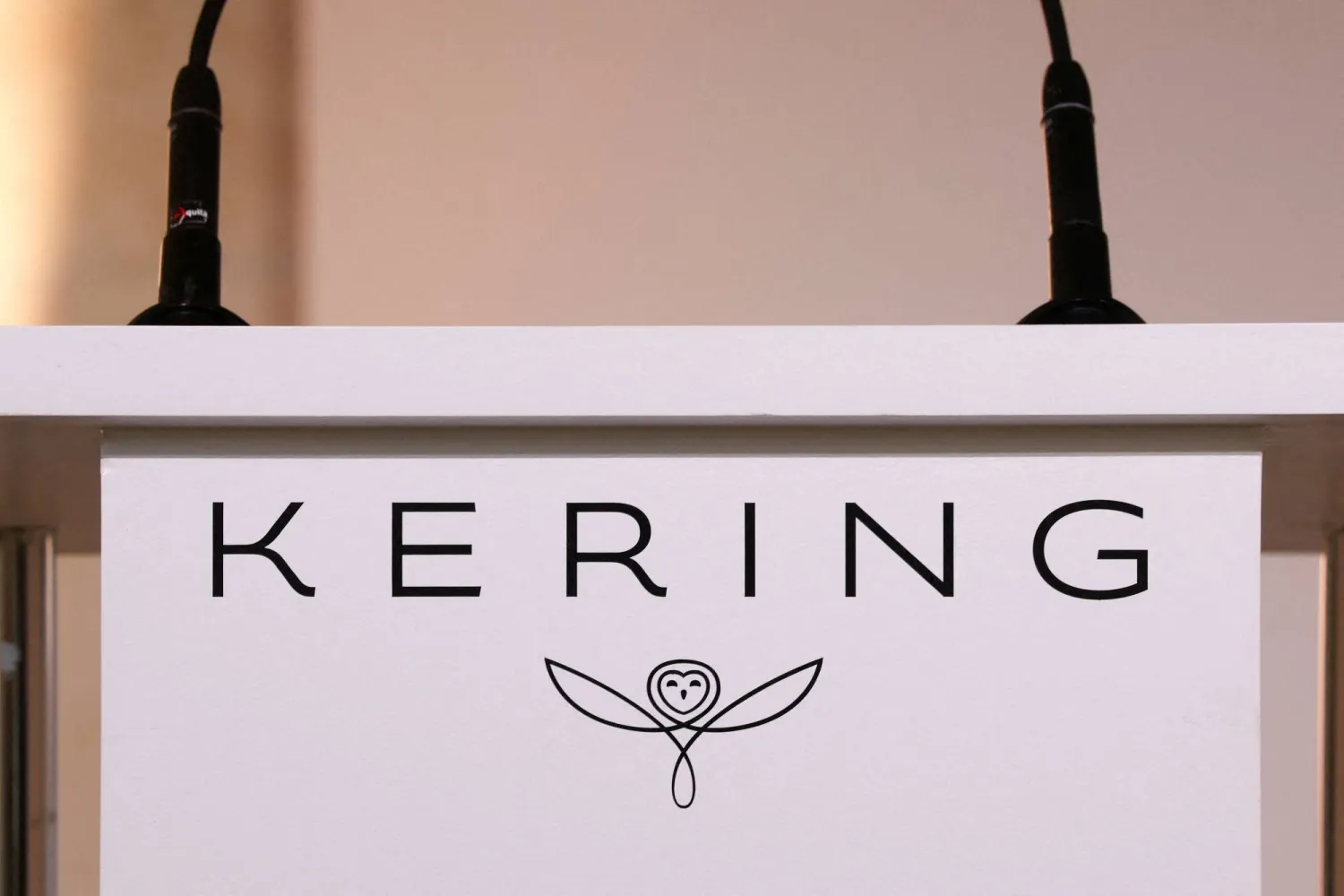
The logo of French luxury group Kering is pictured on the day of the Kering General Assembly meeting at the company's headquarters in Paris, France, May 28. (Reuters)
TT

Gucci Owner Kering Drops 12% as Luxury Braces for Tough Winter

The logo of French luxury group Kering is pictured on the day of the Kering General Assembly meeting at the company's headquarters in Paris, France, May 28. (Reuters)

Shares in Gucci owner Kering tumbled 12% on Friday after the group reported further sales declines, but said it would stick with CEO Luca de Meo's turnaround plan and accelerate store closures, aiming for 125 by year-end.

The recovery long promised by luxury brands seems nowhere in sight, as the expansion of war ‌in the Middle ‌East, along with China's tax crackdown on ‌the ⁠wealthy, piled further ⁠pressure on the world's biggest luxury conglomerates in the third quarter, and executives buckled in for a tough winter.

Riots in Paris, leaving Louis Vuitton shop windows smashed and electric-bike bonfires near luxury shopping hub Place Vendome, threw into sharp relief the political risk faced by luxury brands not just abroad but also ⁠at home.

Shares in LVMH and Hermes were ‌also down 1% to 1.5% on ‌Friday, as crude prices hit their highest level since early May, worsening ‌the squeeze on households that has curbed consumers' ability to ‌splurge on handbags and clothes.

Gucci's decline has continued despite de Meo's plan to make the brand's prices more enticing to middle-class consumers and creative director Demna's new collections hitting stores.

"The progress made on ‌improving brand desirability remains in its very early stages," JPMorgan analyst Chiara Battistini said in a ⁠note. Gucci ⁠sales improved in wholesale, but were down 6% overall as fewer shoppers visited its stores.

While Kering struggles to execute a turnaround against a weak economic backdrop, even high-end Hermes is showing signs of slowing, with its ready-to-wear division falling 2% in the third quarter due to weak Chinese demand. Overall, Hermes reported its weakest quarterly sales growth since 2020.

Across the sector, valuations have taken a beating as investors reassess future growth prospects. After a 40% slide in share price since January 1, Hermes' valuation is its lowest since 2014, while LVMH's is at a 10-year low.


AI Tools Help Brands Curb Black Friday Deals, from Clothes to Skincare

 Shoppers walk through the King of Prussia mall ahead of Black Friday sales outside Philadelphia, Pennsylvania, US, November 21, 2026. (Reuters)
Shoppers walk through the King of Prussia mall ahead of Black Friday sales outside Philadelphia, Pennsylvania, US, November 21, 2026. (Reuters)
TT

AI Tools Help Brands Curb Black Friday Deals, from Clothes to Skincare

 Shoppers walk through the King of Prussia mall ahead of Black Friday sales outside Philadelphia, Pennsylvania, US, November 21, 2026. (Reuters)
Shoppers walk through the King of Prussia mall ahead of Black Friday sales outside Philadelphia, Pennsylvania, US, November 21, 2026. (Reuters)

Consumer brands are increasingly turning to artificial intelligence to help set prices, hoping to reduce discounts to protect profit margins.

That could mean shallower bargains for inflation-weary US shoppers this holiday season, starting with Black Friday, an event synonymous with discounts, according to interviews with five firms that provide AI tools to brands and retailers.

It could also provide an additional headache for US consumers still grappling with inflation and tariff-fueled price hikes. Polls showed the rising cost of living under President Donald Trump was a top concern for voters in midterm elections that delivered the Democratic Party a sweeping majority in Congress.

Brands from Gap to Under Armour are using AI tools to manage inventory levels, recommend retail prices and figure out when and how steeply to discount products. Often, the tools conclude that companies can reduce discounts without dampening demand, the AI pricing firms told Reuters.

Software from retail decision-making company Impact Analytics, which counts Gap as a client, "generally shows you need fewer promos for less time on less products," CEO Prashant Agrawal said. A Gap spokesperson said ‌the brand uses Impact Analytics ‌to make "more informed markdown decisions based on demand and inventory signals."

Tools from AI pricing firm Kapnova advised ‌a ⁠billion-dollar beauty brand to ⁠reduce this year's Black Friday discount on a skincare product to 30% from an initially planned 40%, CEO James Sun said, declining to name the client due to confidentiality.

"As more companies understand their demand... and model it in a more rigorous way, the consumer will see less discounts on Black Friday," Sun said.

Holiday sales are set to rise 4.2% versus 2025 to just over $1 trillion, National Retail Federation estimates show, though the bump would be largely attributable to an inflation rate currently at 3.7%.

The AI pricing firms' algorithms use machine learning to synthesize sales data, inventory levels, competitors' prices, weather and economic conditions to predict shifting demand in real time.

The technology isn't completely new, but it has become more sophisticated over the past two years at predicting demand for products at specific prices, and ⁠adoption is ramping up, experts and industry executives say.

Tools from AI software company First Insight, whose customers include ‌Under Armour and value chain Family Dollar, recently suggested that one brand scale back a buy-one-get-one promotion ‌from 50% to 40% off, said founder Greg Petro, declining to name the client.

FROM VALUE CHAINS TO LUXURY

Companies across the consumer spectrum are dabbling in AI, but ‌few are openly discussing how they use it.

Under Armour and Family Dollar use First Insight to decide what to charge for a product ‌and to estimate how price changes will affect sales, the retail technology company said. AI-driven planning platform Anaplan said LVMH-owned Tiffany, Dolce & Gabbana, and Kering's Yves Saint Laurent use its software for pricing.

More than a dozen brands approached by Reuters, including Under Armour, Family Dollar, Tiffany, Dolce & Gabbana and Yves Saint Laurent, did not respond to multiple requests for comment.

While human managers may be tempted to slash prices to clear stale inventory or lure in new shoppers, AI software "has the confidence to hold its nerve" ‌when a lesser discount will do the trick, said Lindsay Fisher, co-founder of price optimization platform Sparkbox, which works with New Balance. New Balance did not respond to requests for comment.

The effects can be subtle, ⁠and "if done well... consumers won't realize it's ⁠happening," said Ryan Orabone, a consultant at Spaulding Ridge who has built an AI pricing tool.

PROBLEMATIC TOOLS?

AI-informed pricing risks backlash from cash-strapped shoppers.

"It is controversial," Sun, of Kapnova, conceded. "Consumers go, 'We want those discounts,' but retailers are getting smarter and smarter with AI."

The technology is still emerging, and the full scale of its price impact is unknown. But the limited available data and anecdotal evidence suggest discounts may be getting more targeted.

In sportswear, the share of products discounted over the past year increased, but the average discount came down, data compiled by Centric Market Intelligence show. The average on-sale sports bra, for example, was discounted by 32%, against 36% the year before.

Walmart has been using in-house machine-learning software to manage inventory since around 2019, while Dick's Sporting Goods and Ross Stores have used weather-forecasting AI tools to help plan inventory for at least two years.

AI-powered pricing tools are growing more common, said Martin Crepy, global head of consumer at consultancy Simon-Kucher. A 2025 survey by the firm showed that a third of companies now use AI pricing for demand forecasting, and 28% for real-time price optimization.

Predictive algorithms typically stop short of pricing items differently for individual customers — a controversial practice that retailers like Walmart and Target have said they don't engage in, and which several states have taken steps to curb.

But tools that allow retailers to quickly change prices, often called dynamic pricing, sit "one layer removed" from personalized pricing, according to former McKinsey consultant and e-commerce executive Sofia Serra.

"There's a legal and ethical question about it," said Serra. "Regulation is still evolving."


Paolo Bulgari, Italian Jeweler Who Turned a Family Business into Global Luxury Brand, Dies at 89

 Paolo Bulgari leaves his residence in Rome, April 14, 1975. (AP)
Paolo Bulgari leaves his residence in Rome, April 14, 1975. (AP)
TT

Paolo Bulgari, Italian Jeweler Who Turned a Family Business into Global Luxury Brand, Dies at 89

 Paolo Bulgari leaves his residence in Rome, April 14, 1975. (AP)
Paolo Bulgari leaves his residence in Rome, April 14, 1975. (AP)

Paolo Bulgari, the grandson of a Greek silversmith who helped transform the family jewelry business into a global luxury brand synonymous with Italian glamour and design, has died. He was 89.

His family announced his death Saturday, describing him as “the greatest jeweler of our time” and praising his humanity and entrepreneurial talent.

Bulgari presided for decades over a brand celebrated by supermodels, Hollywood stars and collectors for its bold designs and distinctive use of color.

Born in Rome in 1937, he was the grandson of Sotirios Voulgaris, who founded the jewelry business after leaving Greece. Originally from Paramythia, a mountain village in the Epirus region of northwestern Greece renowned for its silver jewelry, Voulgaris fled Ottoman rule and settled in Naples before opening a shop in Rome, adapting both his craft and his family name to his new home.

Paolo Bulgari joined the family business shortly after leaving school. Working alongside his father, Giorgio, he initially focused on precious stones, developing an expertise in gemstones that would inform his work as a designer and businessman throughout his career.

Turning away from the delicate aesthetic associated with Parisian jewelry houses, the Bulgari family embraced bold gemstones, rich yellow gold, generous proportions and unexpected combinations of color. Drawing inspiration from ancient Rome and Italy’s artistic heritage, the distinctive style helped set the brand apart internationally.

Alongside his brother Nicola and nephew Francesco Trapani, Bulgari led the company’s expansion into major luxury markets, opening stores in New York, Paris, Geneva and Monte Carlo. The business diversified beyond jewelry into watches, perfumes, leather goods and, eventually, hotels.

Heading the group since the mid-1980s, Bulgari guided the company through a period of significant international growth. Its jewelry was a fixture on celebrities spanning from Elizabeth Taylor to Zendaya. Tall and silver-haired, he occasionally appeared alongside the stars wearing his creations, maintaining a characteristically reserved presence.

In 2011, the family sold a controlling stake in the company to French luxury conglomerate LVMH in a deal valued at more than $5 billion, ending decades of direct family control.

Despite his association with the glamorous world of international luxury, Bulgari frequently referred to his family’s humble start. In 2019, he and his wife established the Paolo Bulgari Foundation to support young people through schooling and job training in disadvantaged neighborhoods on the outskirts of Rome.

“Many people don’t know it,” he wrote in the foundation’s introduction, “but at the origin of my surname there is a story of migration.”

His funeral will be held Monday at the Basilica of Santa Croce in Rome.


L'Oréal-led Group Reportedly Eyes Up to 15% Stake in Armani

A Giorgio Armani ad hangs behind broken glass during a demonstration organised by labor unions as part of nationwide protests called by the "Yellow Vests" movement joined by French high school and university students against the cost of living and rising fuel prices, in Paris, France, October 31, 2026. REUTERS/Pedro Nunes
TT

L'Oréal-led Group Reportedly Eyes Up to 15% Stake in Armani

A Giorgio Armani ad hangs behind broken glass during a demonstration organised by labor unions as part of nationwide protests called by the "Yellow Vests" movement joined by French high school and university students against the cost of living and rising fuel prices, in Paris, France, October 31, 2026. REUTERS/Pedro Nunes

French cosmetics group L'Oréal is set to lead a consortium of investors interested in buying a combined 15% in Italian fashion house Armani, with EssilorLuxottica set to join, the Corriere della Sera said on Thursday.

Citing sources, the Italian daily said L'Oréal aims to acquire around 10% of Armani, while EssilorLuxottica could take a stake of up to 5%.

According to Reuters, it added that luxury ⁠giant LVMH was ⁠no longer involved in the discussions.

Negotiations are well under way but no deal has been reached as discussions over valuation and other terms are continuing, the paper said.

Reuters reported this month ⁠that heirs of late designer Giorgio Armani, who now control the eponymous fashion empire, favor an eventual stock market listing over a sale to a large industry player, as they pursue an initial minority stake deal.

Armani, who died at 91 last year, said in his will his heirs should sell about 15% of ⁠the ⁠company between 12 and 18 months after his death, followed by the disposal of a further stake of 30% to 54.9% or a bourse listing.

In his will, he explicitly mentioned long-standing licensing partners L'Oréal, EssilorLuxottica and LVMH as preferred buyers, though without ruling out other industry players of "equal standing.”

Armani, L'Oreal, EssilorLuxottica and LVMH were not immediately available for comment.