A Year Ago, an Iranian Woman’s Death Sparked Hijab Protests. Now Businesses Are a New Battleground 

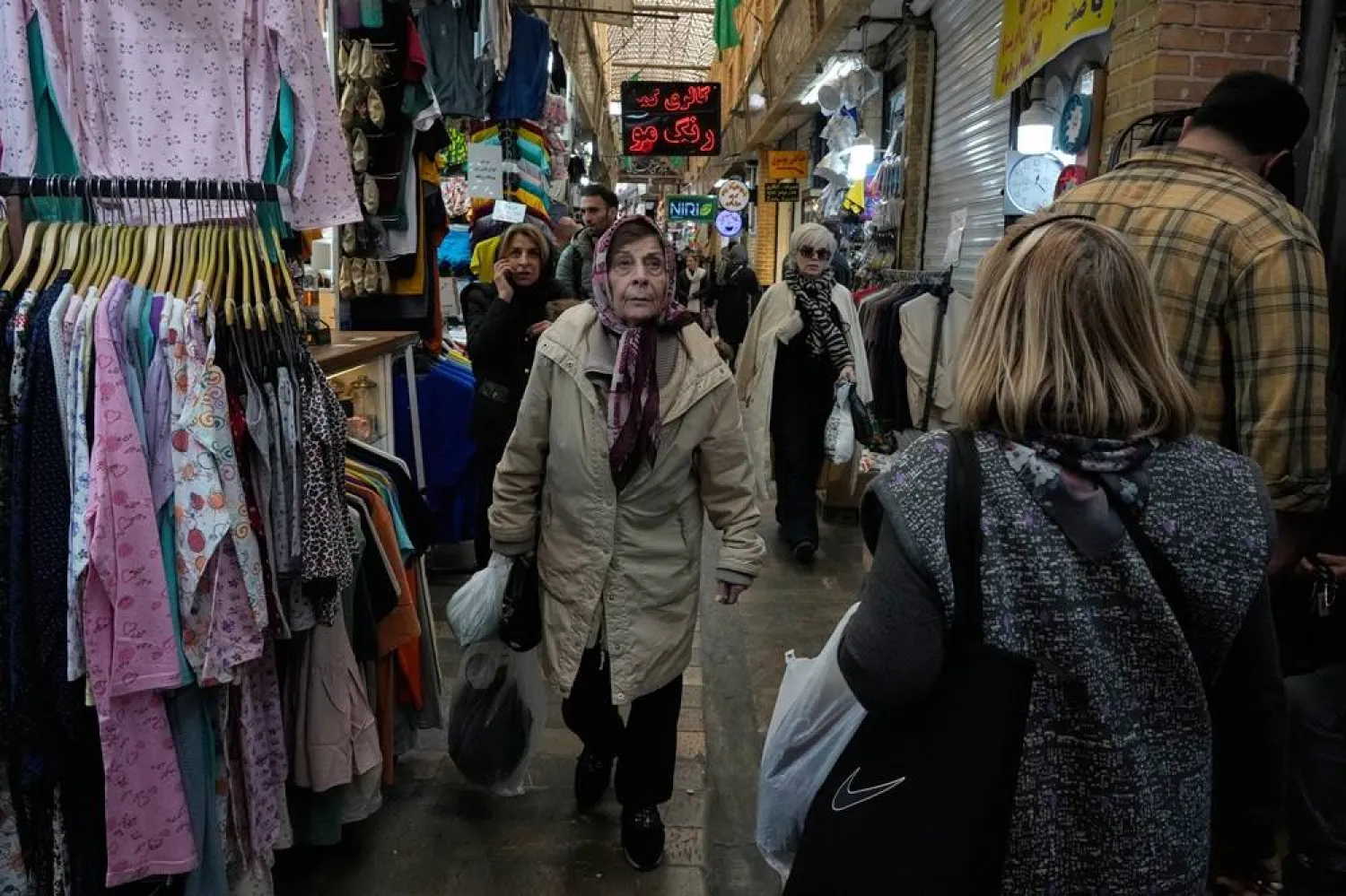
Iranian women walk in Tehran, Iran, Saturday, Aug. 5, 2023. (AP)
TT

A Year Ago, an Iranian Woman’s Death Sparked Hijab Protests. Now Businesses Are a New Battleground 

Iranian women walk in Tehran, Iran, Saturday, Aug. 5, 2023. (AP)

For months, Iranian authorities did little to enforce the law on women covering their hair but now the country’s theocracy is pushing to make businesses the new battleground over the mandatory headscarf.

The effort comes ahead of the first anniversary of nationwide protests that erupted after the Sept. 16 death of Mahsa Amini in the custody of the country's morality police. A crackdown by security forces that followed saw more than 530 people killed and over 22,000 arrested.

These days, with uncovered women a common sight on Tehran streets, authorities have begun raiding companies where women employees or customers have been seen without the headscarf, or hijab. Iran's parliament is discussing a law that would increase punishments on uncovered women and the businesses they frequent.

The developments could foment new unrest as parliamentary elections loom next year and the country's economy struggles under the weight of international sanctions imposed over Iran's nuclear program.

“If I face penalties and punishment, I will wear the headscarf since I am in a ... prominent position,” said Parvaneh, a doctor who treated protesters injured during demonstrations last year. Like several other women who spoke to The Associated Press, she asked that only her first name be used for fear of reprisals.

“But the young people I treated during the protests will not pull back,” she added.

For observant Muslim women, the head covering is a sign of piety before God and modesty in front of men outside their families. In Iran, the hijab — and the all-encompassing black chador worn by some — has long been a political symbol as well, particularly after becoming mandatory in the years following the 1979 revolution.

After the death of Amini, who was picked up for her allegedly loose headscarf, police were hesitant to strictly enforce the dress code — possibly to avoid even wider demonstrations and displays of defiance. But in recent weeks, the tone has changed.

“I’m telling you that this lack of hijab will be definitely put an end to,“ hard-line President Ebrahim Raisi said Wednesday.

Authorities have started sending warning text messages to women seen without the veil in cars: around 1 million messages were sent. In time, some 2,000 cars were confiscated and over 4,000 women referred to prosecutors.

Next, security forces scoured social media for companies with images of uncovered women in the workplace. One of the offices of Digikala, a hugely popular digital retail websites with more than 40 million active monthly users, was closed. Also briefly shut were the online bookstore Taghcheh and insurance marketplace Azki.

The crackdown extended beyond the capital of Tehran. In the northern city of Lahaijan, local health officials ordered hospitals and clinics to stop providing services to uncovered woman. In Damavand, a town some 60 kilometers (40 miles) east of Tehran, prosecutors ordered the arrest of a bank manager and a teller over serving a woman not wearing the hijab.

Outdoor café seating is now banned in the northeastern city of Mashhad and hard-liners in Isfahan want to ban the mixed working of men and women in shops.

The entertainment industry is also being watched. Police have threatened to shut down film productions that have women without headscarves working behind cameras.

Judges also have also sentenced female celebrities convicted of not wearing the veil to work in morgues as a public service, in lieu of prison time. They also have to obtain a mental health certificate from a psychologist before they can go back to their regular jobs.

“Instead of addressing people’s legitimate grievances, the regime continues to obsess over the hijab and act as if its very survival depends on whether women dress modestly,” said Haleh Esfandiari, a fellow at the Washington-based Wilson Center and an Iranian-American dual national who was held by Tehran in 2007.

A new bill before Iran's parliament could make penalties for women even more serious. It calls for fines of up to 360 million Iranian rials ($720) and prison sentences for women without the headscarf. The draft legislation also calls for more strictly segregating the sexes in schools, parks, hospitals and other locations.

It also envisages fines on businesses with female staff and customers who do not wear the hijab with up to three months of their income, while offending celebrities can be banned from leaving the country and performing.

The bill would also empower intelligence agencies and the Basij — the all-volunteer force of Iran's paramilitary Revolutionary Guard that has violently suppressed nationwide protests in the past — to confront women without hijabs.

Hard-liners have long demanded that the Basij enter the fight over the hijab, with some chanting at at Friday prayers in Tehran, “Guard, come to the street, put an end to hijab removal!”

But criticism of the proposed bill is already simmering.

Ezzeatollah Zarghami, a hard-line former Guard commander and the current minister for cultural heritage, warned that harsh sentences such as the mandatory morgue work “will cause more and significant problems instead of solving the hijab problem.”

Iran's Supreme Court overturned a court order impounding an uncovered woman's car for a year and revoking her license, setting a precedent.

Even if it passes, prominent lawyer Mahmoud Alizadeh Tabatabei described the draft law as meaningless since “the majority of women do not believe in it.”

“They will find out that the law is not enforceable,” Tabatabaei said.

Meanwhile, politicians known in Iran as reformists have seized on the hijab dispute as they seek to changes Iran's theocracy from within the system. Former President Mohammad Khatami, one of the country's most prominent reformists, has questioned whether enforcing the hijab was “wise and productive.”

With hard-liners dominating the parliament and elections coming up in March, the hijab could become a contested topic ahead of the polls.

But anti-hijab comments may not be enough as reformists have seen their popularity wane following the collapse of the 2015 nuclear deal under then-President Hassan Rouhani, also considered a moderate.

On the streets, many Iranian women and girls still forgo the headscarf despite possible consequences.

“After hearing about the bill I made my decision — I will go to my school with the full hijab but I encourage my students to remove it whenever it is possible,” said Mojgan, a 37-year-old secondary school teacher.

“My students are already ahead of me on that,” she added.


'Shivering from Cold and Fear': Winter Rains Batter Displaced Gazans

Displaced Palestinians walk past a large pool of standing water in Gaza City. Heavy winter rains have have made an already precarious life worse for displaced Gazans © Omar AL-QATTAA / AFP
TT

'Shivering from Cold and Fear': Winter Rains Batter Displaced Gazans

Displaced Palestinians walk past a large pool of standing water in Gaza City. Heavy winter rains have have made an already precarious life worse for displaced Gazans © Omar AL-QATTAA / AFP

It only took a matter of minutes after the heavy overnight rain first began to fall for Jamil al-Sharafi's tent in southern Gaza to flood, drenching his food and leaving his blankets sopping wet.

The winter rains have made an already precarious life worse for people like Sharafi, who is among the hundreds of thousands in the Palestinian territory displaced by the war, many of whom now survive on aid provided by humanitarian organizations, AFP reported.

"My children are shivering from cold and fear... The tent was completely flooded within minutes," Sharafi, 47, said on Sunday.

"We lost our blankets, and all the food is soaked," added the father of six, who lives in a makeshift shelter with his children in the coastal area of Al-Mawasi.

A fragile ceasefire between Israel and Hamas has been in place since October 10, following two years of devastating fighting.

But despite the truce, Gazans still face a severe humanitarian crisis, and most of those displaced by the war have been left with little or nothing.

Families are crowded into camps of tents hastily erected from tarpaulins, which are often surrounded by mud and standing water when it rains.

"As an elderly woman, I cannot live in tents. Living in tents means we die from the cold in the rain and from the heat in the summer," said Umm Rami Bulbul.

"We don't want reconstruction right now, just provide us and our children with mobile homes."

Nighttime temperatures in Gaza have ranged between eight and 12 degrees Celsius in recent days.

- Insufficient aid -

Nearly 80 percent of buildings in the Gaza Strip have been destroyed or damaged by the war, according to United Nations data.

And about 1.5 million of Gaza's 2.2 million residents have lost their homes, said Amjad Al-Shawa, director of the Palestinian NGO Network in Gaza.

Of more than 300,000 tents requested to shelter displaced people, "we have received only 60,000", Shawa told AFP, pointing to Israeli restrictions on the delivery of humanitarian aid into the territory.

The UN refugee agency for Palestinians, UNRWA, said the harsh weather had compounded the misery of Gazans.

"People in Gaza are surviving in flimsy, waterlogged tents & among ruins," UNRWA chief Philippe Lazzarini wrote on X.

"There is nothing inevitable about this. Aid supplies are not being allowed in at the scale required."

COGAT, the Israeli defense ministry body responsible for Palestinian civilian affairs, said in mid-December that "close to 310,000 tents and tarpaulins entered the Gaza Strip recently" as part of an increase in aid under the ceasefire.

Earlier this month, Gaza experienced a similar spell of heavy rain and cold.

The weather caused at least 18 deaths due to the collapse of war-damaged buildings or exposure to cold, according to Gaza's civil defense agency, which operates under Hamas authority.

On December 18, the UN's humanitarian office said that 17 buildings collapsed during the storm, while 42,000 tents and makeshift shelters were fully or partially damaged.

"Look at the state of my children and the tent," said Samia Abu Jabba.

"I sleep in the cold, and water floods us and my children's clothes. I have no clothes for them to wear. They are freezing," she said.

"What did the people of Gaza and their children do to deserve this?"


What Lies Ahead for Ukraine’s Contested Zaporizhzhia Nuclear Power Plant?

A Russian service member stands guard at a checkpoint near the Zaporizhzhia Nuclear Power Plant before the arrival of the International Atomic Energy Agency (IAEA) expert mission in the course of Russia-Ukraine conflict outside Enerhodar in the Zaporizhzhia region, Russian-controlled Ukraine, June 15, 2023. (Reuters)
TT

What Lies Ahead for Ukraine’s Contested Zaporizhzhia Nuclear Power Plant?

A Russian service member stands guard at a checkpoint near the Zaporizhzhia Nuclear Power Plant before the arrival of the International Atomic Energy Agency (IAEA) expert mission in the course of Russia-Ukraine conflict outside Enerhodar in the Zaporizhzhia region, Russian-controlled Ukraine, June 15, 2023. (Reuters)

The Zaporizhzhia nuclear power plant, Europe's largest, is one of the main sticking points in US President Donald Trump's peace plan to end the nearly four-year war between Russia and Ukraine. The issue is one of 20 points laid out by Ukrainian President Volodymyr Zelenskiy in a framework peace proposal.

Here are some of the issues regarding the facility:

WHAT ROLE MAY THE US PLAY?

Russia took control of the plant in March 2022 and announced plans to connect it to its power grid. Almost all countries consider that it belongs to Ukraine but Russia says it is owned by Russia and a unit of Russia's state-owned Rosatom nuclear corporation runs the plant.

Zelenskiy stated at the end of December that the US side had proposed joint trilateral operation of the nuclear power plant with an American chief manager.

Zelenskiy said the Ukrainian proposal envisages Ukrainian-American use of the plant, with the US itself determining how to use 50% of the energy produced.

Russia has considered joint Russian-US use of the plant, according to the Kommersant newspaper.

WHAT IS ITS CURRENT STATUS?

The plant is located in Enerhodar on the banks ‌of the Dnipro River and ‌the Kakhovka Reservoir, 550 km (342 miles) southeast of the capital Kyiv.

The Zaporizhzhia nuclear power plant has ‌six ⁠Soviet-designed reactors. They were ‌all built in the 1980s, although the sixth only came online in the mid-1990s after the collapse of the Soviet Union. It has a total capacity of 5.7 gigawatts, according to an International Atomic Energy Agency (IAEA) database.

Four of the six reactors no longer use Russian nuclear fuel, having switched to fuel produced by then-US nuclear equipment supplier Westinghouse.

After Russia took control of the station, it shut down five of its six reactors and the last reactor ceased to produce electricity in September 2022. Rosatom said in 2025 that it was ready to return the US fuel to the United States.

According to the Russian management of the plant, all six reactors are in "cold shutdown."

Both Russia and Ukraine have accused each other of striking the nuclear plant and of severing power lines to the plant.

The plant's equipment is powered by ⁠electricity supplied from Ukraine. Over the past four years these supplies have been interrupted at least eleven times due to breaks in power lines, forcing the plant to switch to emergency diesel generators.

Emergency generators ‌on site can supply electricity to keep the reactors cool if external power lines are cut.

IAEA ‍Director General Rafael Grossi says that fighting a war around a nuclear ‍plant has put nuclear safety and security in constant jeopardy.

WHY DOES RUSSIA WANT ZAPORIZHZHIA PLANT?

Russia has been preparing to restart the station but ‍says that doing so will depend on the situation in the area. Rosatom chief Alexei Likhachev has not ruled out the supply of electricity produced there to parts of Ukraine.

Oleksandr Kharchenko, director of the Energy Research Center in Kyiv, said Moscow intended to use the plant to cover a significant energy deficit in Russia's south.

"That's why they are fighting so hard for this station," he said.

In December 2025, Russia's Federal Service for Environmental, Technological and Nuclear Supervision issued a license for the operation of reactor No. 1, a key step towards restarting the reactor.

Ukraine's energy ministry called the move illegal and irresponsible, risking a nuclear accident.

WHY DOES UKRAINE NEED THE PLANT?

Russia has been pummeling Ukraine's energy infrastructure for months and some areas have had blackouts during winter.

In recent ⁠months, Russia has sharply increased both the scale and intensity of its attacks on Ukraine's energy sector, plunging entire regions into darkness.

Analysts say Ukraine's generation capacity deficit is about 4 gigawatts, or the equivalent of four Zaporizhzhia reactors.

Kharchenko says it would take Ukraine five to seven years to build the generating capacity to compensate for the loss of the Zaporizhzhia plant.

Kharchenko said that if Kyiv regained control of the plant, it would take at least two to three years to understand what condition it was in and another three years to restore the equipment and return it to full operations.

Both Ukrainian state nuclear operator Energoatom and Kharchenko said that Ukraine did not know the real condition of the nuclear power plant today.

WHAT ABOUT COOLING FUEL AT THE PLANT?

In the long term, there is the unresolved problem of the lack of water resources to cool the reactors after the vast Kakhovka hydro-electric dam was blown up in 2023, destroying the reservoir that supplied water to the plant.

Besides the reactors, there are also spent fuel pools at each reactor site used to cool down used nuclear fuel. Without water supply to the pools, the water evaporates and the temperatures increase, risking fire.

An emission of hydrogen from a spent fuel pool caused an explosion in Japan's Fukushima nuclear disaster in ‌2011.

Energoatom said the level of the Zaporizhzhia power plant cooling pond had dropped by more than 15%, or 3 meters, since the destruction of the dam, and continued to fall.

Ukrainian officials previously said the available water reserves may be sufficient to operate one or, at most, two nuclear reactors.


Egypt, Trump Reaffirm Strategic Alliance in 2025 amid Regional Turmoil

Egyptian President Abdel Fattah al-Sisi meets President Donald Trump ahead of a world leaders' summit on ending the Gaza war, in Sharm el-Sheikh, Egypt, October 13, 2025. (Reuters)
TT

Egypt, Trump Reaffirm Strategic Alliance in 2025 amid Regional Turmoil

Egyptian President Abdel Fattah al-Sisi meets President Donald Trump ahead of a world leaders' summit on ending the Gaza war, in Sharm el-Sheikh, Egypt, October 13, 2025. (Reuters)

After months of speculation over the trajectory of Egyptian-US relations, fueled by persistent talk of strain and an impending rift, a high-level meeting between President Donald Trump and President Abdel Fattah al-Sisi in Sharm el-Sheikh reaffirmed the resilience of the strategic alliance between Cairo and Washington, even as the region remains in turmoil.

The meeting followed a turbulent period marked by Trump’s adoption of a proposal to relocate Gaza’s population, an idea firmly rejected by Sisi and one that prompted warnings of a diplomatic crisis between the two longtime allies.

The subsequent signing of a Gaza peace agreement in Sharm el-Sheikh sent a clear signal that, despite sharp disagreements over policy, the foundations of the bilateral relationship remain intact.

Early in Trump’s second term, media reports said Sisi had scrapped plans to visit Washington. As the year draws to a close, speculation has said that the visit may happen. Trump has acknowledged Sisi as a friend and said he would be happy to meet him as well.

Trump’s election victory late last year raised Egyptian hopes of strengthening the strategic partnership. Sisi voiced that expectation in a congratulatory post on X, stating that he looked forward to working together with Trump to achieve peace, preserve regional peace and stability, and strengthen the strategic partnership.

Those hopes were tested when Trump floated a plan to “clean out Gaza” and relocate its residents to Egypt and Jordan. Cairo rejected the idea outright, mobilized international opposition, unveiled an alternative plan for Gaza’s reconstruction and hosted an emergency summit on the issue in March.

Limited public engagement

David Butter, a research fellow in the Middle East and North Africa program at Chatham House, noted that the striking feature of Egypt-US ties over the past year has been their low public profile.

Aside from Trump’s appearance in Sharm el-Sheikh, there was not much happening in the open, he told Asharq Al-Awsat.

Amr Hamzawy, an Egyptian political scientist and director of the Middle East program at the Carnegie Endowment for International Peace, described the first year of Trump’s second term as difficult for bilateral relations.

He said it began with talk of displacement and a “Middle East Riviera” in Gaza, but Egyptian diplomacy succeeded in shifting the trajectory.

Trump’s peace plan, he said, ultimately signaled rejection of displacement and spoke of security and political tracks for Gaza and a broader political process for the Palestinian issue, though details remain unclear.

Hamzawy added that the year opened from a tough starting point that followed what he called President Joe Biden’s hesitant stance on Gaza, when displacement was first discussed.

After nearly a year of Egyptian political and diplomatic effort, he said, displacement dropped from Washington’s agenda, even if it remains a risk that cannot be ignored.

Historically, Egypt has been a pivotal state for US national security, given its geography, demographic weight and diplomatic role, according to a recent report by the Congressional Research Service.

Gaza, the main test

The Gaza war shaped Egyptian-US relations during Trump’s first year back in office. Washington backed Egyptian-Qatari mediation to halt the war. US Secretary of State Marco Rubio thanked Cairo after a truce was reached between Israel and Hamas in January.

When hostilities resumed, however, Egypt faced complex diplomatic choices with both Washington and Israel. It rejected Trump’s call to resettle Gaza’s population, while its reconstruction plan failed to gain US or Israeli acceptance.

Cairo also drew criticism from Trump for declining to join US strikes against Yemen’s Houthis, the Congressional Research Service (CRS) revealed.

Butter noted that ties with the Trump administration were strained over Gaza after Sisi canceled a Washington visit early in the year, following Trump’s “Middle East Riviera” remarks, which left contacts at a minimum.

He said Trump’s Sharm el-Sheikh visit, the signing of the Gaza agreement and the celebration of his plan’s success offered a chance to reset relations. Egypt, he added, has become indispensable to Trump’s administration in Gaza.

Hamzawy said Gaza dominated the first year of Trump’s term, giving Egypt a chance to restore its standing with US and European decision-makers as a key mediator. Cairo put its vision on the table, he said, shifting US thinking toward parallel security and political tracks and from talk of disarmament to limiting weapons.

Throughout the year, Egypt publicly counted on Trump to end the Gaza war. In July, Sisi urged him in a televised address to press for a halt, saying Trump was capable of doing so.

Analysts Daniel Byman and Jon Alterman wrote in Foreign Policy that Egypt is indispensable to international responses to the Gaza war, even if it remains a difficult partner for Washington and Israel. The conflict, they said, restored diplomatic focus on Egypt and strengthened its leverage.

Sara Kira, director of the European North African Center for Research, said relations in Trump’s second term differ from his first. The earlier term saw broad alignment and personal warmth from Trump, particularly on counterterrorism, she said. The second term has been marked by divergence.

That surfaced in April when Trump called for free passage for US commercial and military vessels through the Suez Canal in exchange for US efforts to protect the waterway.

Positive signals despite differences

Despite disagreements over Gaza, there were positive signs elsewhere. Early in the year, the US State Department froze new funding for most aid programs worldwide, exempting humanitarian food programs and military aid to Israel and Egypt.

Washington did not include Egypt on a travel ban list issued in June. Trump said Egypt was a country with which the United States dealt closely and that things there were under control. Egypt was also spared higher US tariffs. Cairo has repeatedly stressed the depth and resilience of the strategic relationship.

Kira said Egypt exerted maximum pressure to achieve peace and stop the Gaza war, eventually convincing Washington of its approach and reaching a peace agreement in Sharm el-Sheikh. She said Egypt acted pragmatically and astutely, reading Trump’s personality and US interests.

As talks on the second phase of the Gaza agreement stall, Egypt continues to rely on the Trump administration to advance its plan. Cairo remains in contact with Washington and is working with it to prepare a donor conference for Gaza’s reconstruction, which has yet to receive sufficient momentum from the Trump administration.

The dialogue extends beyond Gaza to Libya, Sudan, Lebanon and Iran, as well as water security, led by Ethiopia’s Grand Ethiopian Renaissance Dam (GERD), which Egypt fears could affect its Nile water share.

GERD

In mid-June, Trump stirred controversy in Egypt when he wrote on Truth Social that the United States had “stupidly” funded the dam Ethiopia built on the Blue Nile, triggering a severe diplomatic crisis with Egypt.

In August, the White House released a list of Trump’s foreign policy achievements, which included a purported agreement between Egypt and Ethiopia over the dam.

Trump has repeatedly spoken of his administration’s efforts to resolve the dispute, but those claims have yet to translate into concrete action.

Hamzawy said there is an opportunity for Washington to mediate and revive an agreement reached near the end of Trump’s first term.

Charles Dunne of the Arab Center Washington DC wrote recently that Trump’s stance may please Cairo but could also produce adverse outcomes if Washington does not assume a mediation role.

The United States hosted talks with the World Bank in 2020 during Trump’s first term, but they failed after Ethiopia refused to sign the draft agreement.

Military ties endure

Military cooperation continued largely as usual. Since 1946, the United States has provided Egypt with about $90 billion in aid, with a sharp increase after 1979, which successive administrations have framed as an investment in regional stability, according to the CRS.

For more than a decade, Congress has imposed human rights conditions on part of Egypt’s aid.

Between fiscal years 2020 and 2023, the Biden administration and Congress withheld approximately $750 million in military funding. Trump’s technical annex to the proposed fiscal 2026 budget seeks $1.3 billion in military assistance for Egypt without conditions, the CRS said.

Hamzawy said the administration is far from imposing conditionality, noting that relations rest on mutual interests between a major power and a positively influential middle power.

Since the Gaza war, the Biden and Trump administrations have accelerated US arms sales to Egypt. The State Department notified Congress of military sales totaling $7.3 billion. In July, the Pentagon announced that the State Department had approved the sale of an advanced air defense missile system to Egypt, valued at approximately $4.67 billion. Egypt also hosted the Bright Star military exercises in September.

Kira said ties with Washington are driven by interests and that Cairo has positioned itself as a core regional player.

Hamzawy said Egypt occupies a central place in US Middle East thinking, as Washington needs a spectrum of allies, with Egypt at the heart of that network.