Schools Shut, Exams Cancelled: War Shatters Sudan’s Education Sector
Halime Adam Moussa, a Sudanese refugee who is seeking refuge in Chad for a second time, walks out of her shelter while children play, near the border between Sudan and Chad in Koufroun, Chad, May 10, 2023. (Reuters)
TT
TT
Schools Shut, Exams Cancelled: War Shatters Sudan’s Education Sector
Halime Adam Moussa, a Sudanese refugee who is seeking refuge in Chad for a second time, walks out of her shelter while children play, near the border between Sudan and Chad in Koufroun, Chad, May 10, 2023. (Reuters)
When war in Sudan's capital forced Sarah al-Sharif and her family to flee, the 19-year-old information technology student left her books and computer behind.
Now in Sennar, 30km (18 miles) southeast of Khartoum, she lacks a stable internet connection or passport to travel abroad and like many others sees no way of continuing her studies while fighting between rival military factions rages.
The conflict, which began in mid-April, has pushed Sudan's faltering education system into a state of collapse, with many schools shut down or repurposed to host displaced people, and most national end-of-year exams cancelled.
"This war has spelled the end of education in Sudan, and things have turned from bad to impossible," said Sharif.
The conflict has brought daily battles to the streets of Khartoum, a revival of ethnically-targeted attacks in Darfur, and the displacement of more than 4 million people within Sudan and across its borders.
According to Simone Vis of UNICEF in Sudan, there are "an alarming number of reports that both boys and girls are being recruited by armed groups".
At least 89 schools across seven states are being used as shelters for the displaced, according the United Nations, raising fears that many children will have no access to schools in the new academic year and could be exposed to child labor and abuse.
On Wednesday, the education minister cancelled most end of year school exams in war-affected areas.
"In the current circumstances, anyone would see that it is impossible to have a new academic year," said Sahar Abdullah, a displaced teacher from Khartoum also seeking refuge in Sennar.
Teachers strike
Even before the war between Sudan's army and the paramilitary Rapid Support Forces (RSF), Save The Children ranked Sudan as one of the top four countries globally where education was at extreme risk.
Now the number of children out of school has risen to 9 million from 6.9 million, more than one million school-aged children have been displaced and at least 10,400 schools have been closed since fighting started, according to the charity.
While Khartoum has a proud intellectual tradition, the schooling system had been run down by underinvestment, political interference and a grinding economic crisis. It was then disrupted by street protests before and after the 2019 ousting of former leader Omar al-Bashir, by unusually heavy floods in 2020 and by the coronavirus pandemic.
Due to overcrowded school classrooms, "some of the students would bring chairs with them to class. There weren't enough textbooks to help teachers do their job," said Abdullah, the displaced teacher.
State-employed teachers staged a three-month strike over pay and working conditions just before the war broke out. As many as 300,000 teachers have not been paid since March, a senior member of the Sudanese Teachers' Committee said.
"I haven't been paid a salary in four months, and I have no idea when I'll return to work," said Fatima Mohamed, a displaced teacher who fled Khartoum to Gedaraf state after her school was overtaken by the RSF.
'Wait and hope'
Despite the interruptions in recent years, Rabab Nasreldeen had managed to get to the third year of law studies at the University of Khartoum when the war broke out.
Then she too had to flee, abandoning educational certificates and papers that might allow her to continue studying elsewhere. "The only option we have is to wait and hope for the best," she said.
Aid workers are trying to help alleviate the crisis, setting up safe learning spaces and providing children with psychosocial support.
Education Cannot Wait, the UN global fund dedicated to education in emergencies, has raised $12.5 million and aims to provide educational services for 120,000 children in Sudan and neighboring countries.
During the COVID-19 pandemic, parents in wealthy countries "didn't want the children to wait a year or a month for their education," said Yasmine Sherif, the fund's executive director.
"So why should we expect them (in Sudan) to wait for education until the conflict is over?"
Some of those who have fled Sudan are seeking entry to schools and universities outside its borders, including in Egypt. But in Chad, where more than 377,000 refugees have arrived, there are no such options.
"I cannot go back to continue my education and I lost contact with my family," Khalifa Adam, a displaced student who escaped to Adre, Chad from Darfur, told Reuters. "I was told I can continue studying online but the internet connection here in Adre is very bad."
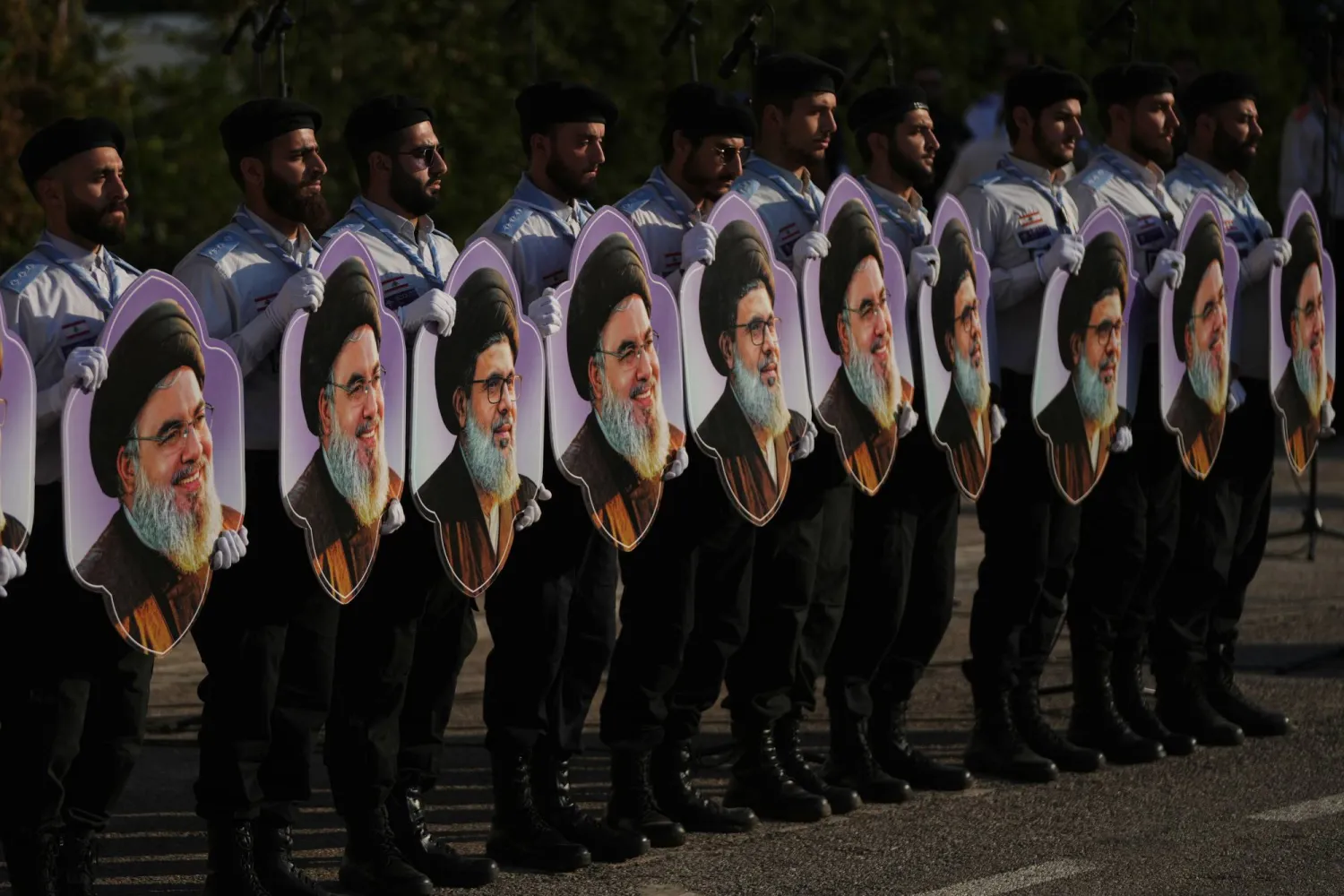
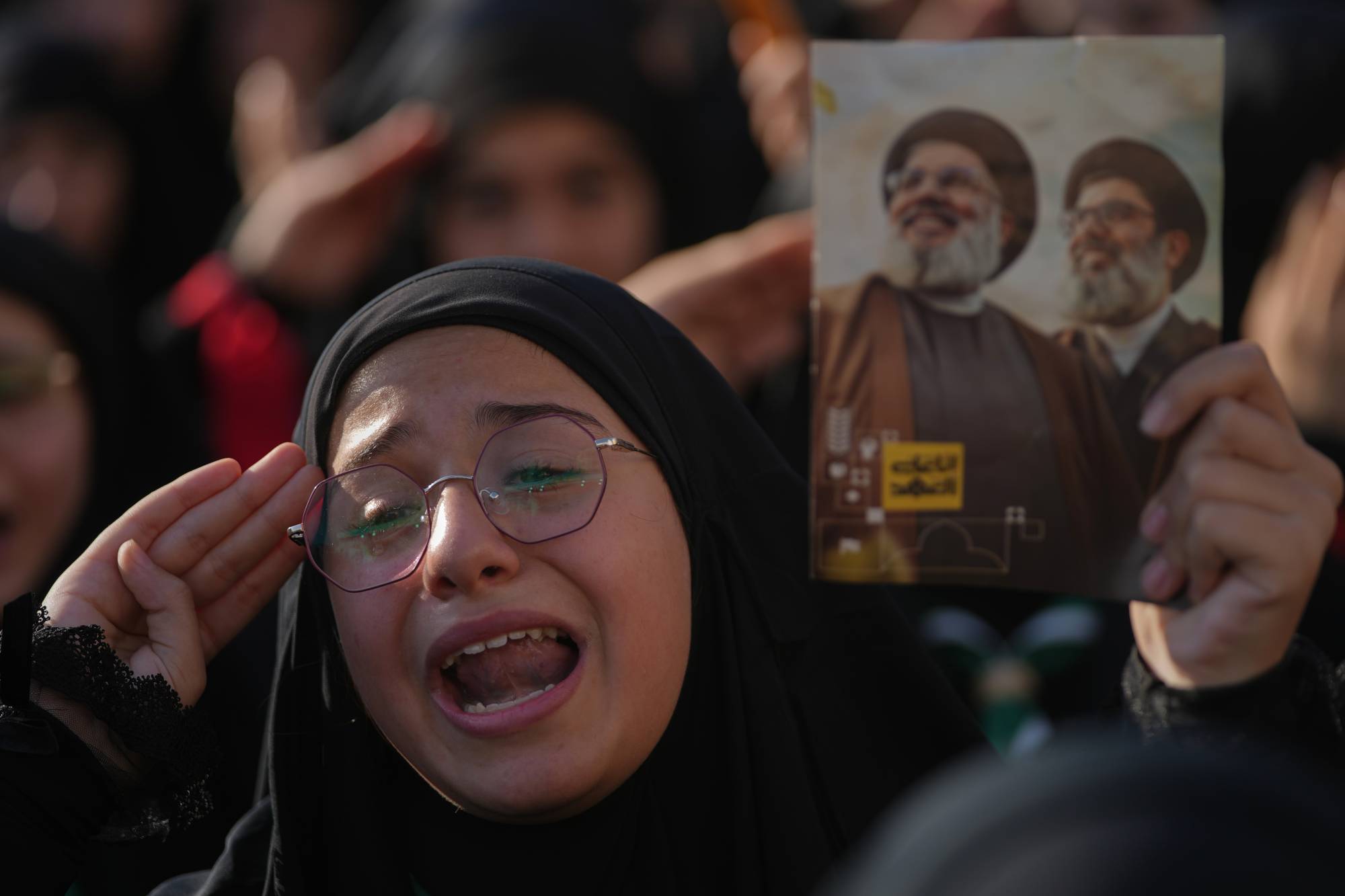
Members of Hezbollah's al-Mahdi Scouts hold portraits of Hezbollah leaders Hassan Nasrallah and his cousin and successor, Hashem Safieddine, during a gathering marking the second anniversary of their assassinations in Israeli airstrikes, in Dahiyeh, a southern suburb of Beirut, Lebanon, Sunday, Oct. 4, 2026. (AP Photo/Hassan Ammar)
Members of Hezbollah's al-Mahdi Scouts hold portraits of Hezbollah leaders Hassan Nasrallah and his cousin and successor, Hashem Safieddine, during a gathering marking the second anniversary of their assassinations in Israeli airstrikes, in Dahiyeh, a southern suburb of Beirut, Lebanon, Sunday, Oct. 4, 2026. (AP Photo/Hassan Ammar)
“Imagine if he had not died,” my interlocutor says over the phone from Beirut. He has close knowledge of Hezbollah and is in daily contact with its broader social environment.
He poses a hypothetical question: What if Hassan Nasrallah had survived and had been the one required to lead the confrontation?
He does not mean a military confrontation with Israel. “That is what the party is doing, and that is its playing field,” but rather “a confrontation with himself, his supporters and his community over this catastrophe he brought upon them.”
Would he have signed a ceasefire agreement? Would he have agreed to negotiations or opposed them as his successor does today? Would he have been able to return to the “If I had known” line he used after the 2006 July War?
A torrent of questions that will never find answers, and “an enormous void the size of the hole that swallowed him and his comrades in the southern suburbs,” says another source from southern Lebanon who witnessed all the Israeli wars on Lebanon, lost family members, friends and homes, and stands on the opposite political side from Hezbollah.
He continues: “Two years have passed, and the community and its surroundings are still in a state of shock and complete denial... a state of collective delirium. It is as if people did not lose a military commander or a religious leader, but rather the person who gave them a narrative about their circumstances.”
There is broad agreement over Nasrallah’s ability to “theatricalize” the war and its losses, transforming the costs borne by the afflicted, the grieving and the bereaved into an epic moment of euphoria and victory. That, it seems, is what his supporters and followers miss most today. It is as though their involvement in the war of support and the price they paid for it remains a detail compared with the absence of the person who could dictate its favorable narrative.
That rhetorical void is not due only to the fact that Hezbollah Secretary-General Naim Qassem lacks his predecessor’s ability, but also because Nasrallah himself had begun losing his public space, image and public presence well before his assassination. In this sense, “the moment of his assassination came as a rescue from many losses and enormous obligations.”
The source says: “Nasrallah actually died before the moment of his assassination... He died with the pager operation and the series of assassinations that followed. He died when he lost his ability to mobilize and justify, when he was no longer able to offer people a narrative, and when no one cared about his speeches or waited for them as they once did.”
Here, the source points to a role he considers more important than the organizational position Nasrallah held within the party. He “was neither a military tactician nor a religious man in the conventional sense, so much as a ‘man of mobilization’ who gave the party a power normally enjoyed by states, not parties or armed organizations.”
Such an overwhelming presence, of course, does not emerge overnight.
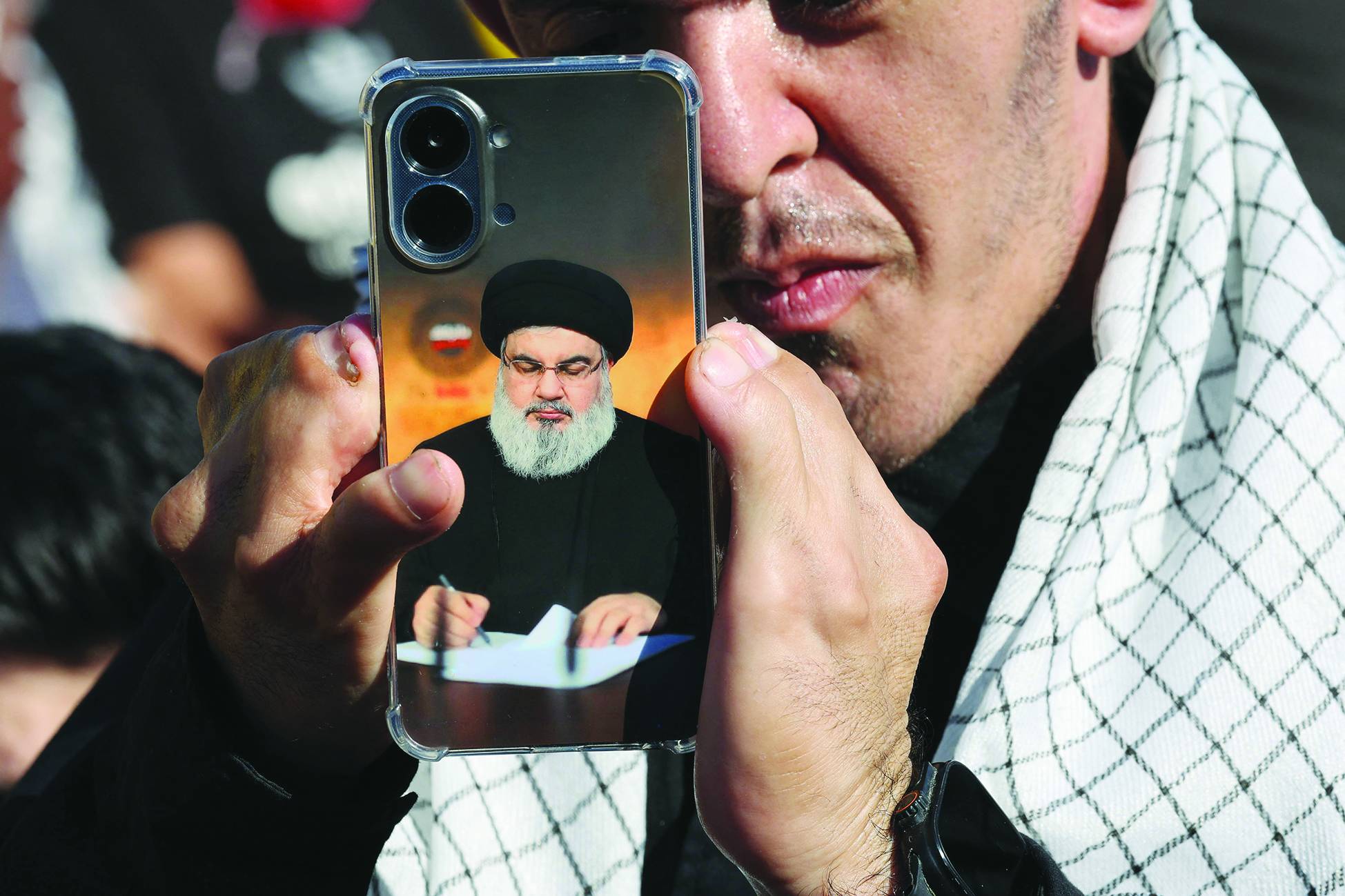
A supporter of Hezbollah, who was injured in the Israeli pager operation against the group, uses his phone whose back cover bears the image of slain leader Hassan Nasrallah during a ceremony held to mark the second anniversary of Nasrallah's killing in a strike by Israel, in Beirut's southern suburbs on September 27, 2026. (Photo by Anwar AMRO / AFP)
“As Though He Never Existed”
A sociologist and writer who follows transformations within Hezbollah and its social environment recalls Nasrallah between 2000 and 2006 and describes him as closer to a “party activist” before he gradually built a presence that, in his view, was consolidated with the assassination of Rafik Hariri, when his words acquired regional weight.
Since the 2000 liberation, Nasrallah had cultivated this aura and “worked tirelessly on it,” relying on the party’s full media apparatus to establish an image “closer to a legend and demigods,” thereby justifying the continuation of carrying arms.
Until quite recently, his television appearances were like “Umm Kulthum evenings. The streets would empty, people would sit transfixed in front of their screens, and they would be enthralled by what they heard.”
Paradoxically, those listening were not Hezbollah members, nor were they all part of its immediate social environment. At different stages, Nasrallah had become a public event: “His supporters listened to him, his opponents listened to him, neighboring countries listened to him, and everyone waiting to know what would happen the next day listened to him.”
Today, two years later, “it is as though he never existed.”
A woman from southern Lebanon belonging to a family with considerable social and religious standing traveled to Tyre and Nabatieh one day before the second anniversary commemorating the assassinations. She says: “I did not see his pictures on the streets or buildings as was customary. Had I not caught sight of a small picture of him, tucked away to the side in a small shop, I would not have noticed his complete absence from the public scene at all.”
She adds: “Even in private gatherings, no one talks about him anymore. What seemed even stranger to me was that this coincided with the anniversary... It may seem at first that there is indifference toward him, but I believe he has become that absent figure who is ‘not spoken of.’ He is now the quintessential Shiite ‘taboo.’”
According to the woman, who is close to the party’s social environment and trusted within its small community without being part of it, it seems that “there are no longer many who love the ‘Sayyed’ outside the hard core of party supporters and those on the party payroll.”
Even his former broad base of supporters did not go to the condolence gatherings, which are “a central ritual for Shiites.”
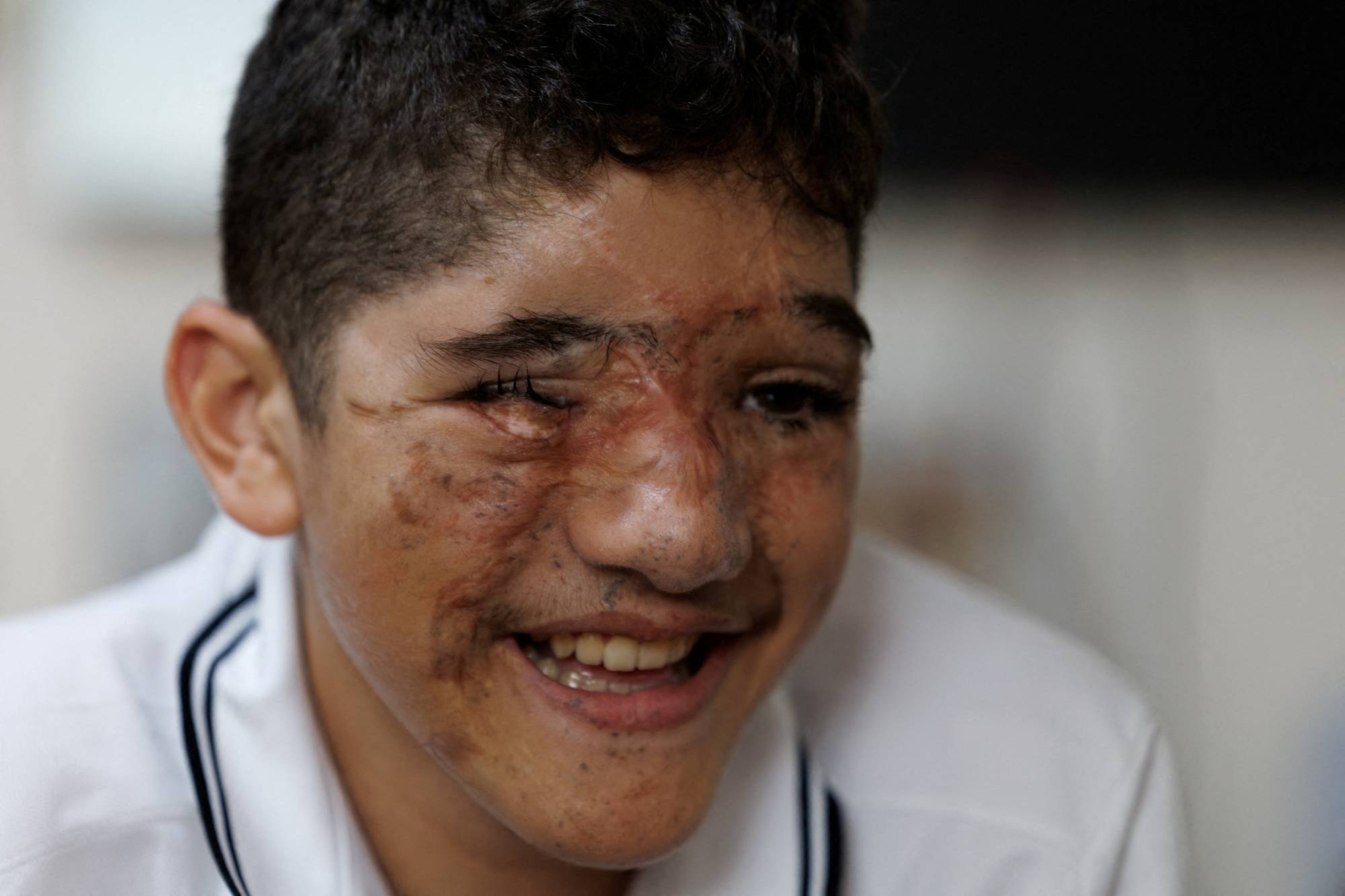
Ali Abbas, 14, who lost his right eye with severe damage to his right lower eyelid and lost some fingers in pager attacks across Lebanon on September 17, 2024, recovering at his home, in Barish, in the Tyre district, southern Lebanon, September 1, 2026. REUTERS/Zohra Bensemra
“Only the Guard Remains”
My interlocutor from the south brings me back to Nasrallah’s legacy, saying that “there is no one left to inherit him... even Hezbollah as we knew it died with him.”
To explain this view, he elaborates: “In politics, Nasrallah caused unprecedented political embarrassment for his closest allies by declaring the war of support after personally assuring Parliament Speaker Nabih Berri that he would do the opposite. Then, after the six rockets were launched, Berri made calls and tried to persuade the party not to issue a statement claiming responsibility for the rockets. He obtained another explicit commitment, which did not survive even a few hours before it too was broken.”
Until October 7, 2023, Nasrallah played a regional role with a relatively comfortable margin for maneuver. He was “the trusted intermediary between Iran and Lebanon, government, sects, people and institutions. He played roles in relations with the surrounding region and the outside world, sparing Tehran many direct confrontations with neighboring countries. He would pass on decisions and absorb the shocks in its place.”
But that, the source says, gradually began to change after October 7, and then fundamentally after Nasrallah was killed, to the point that “today, only the Revolutionary Guard remains. Nothing else. The Guard directly controls every part of the party, its leadership, fighters and strategy. Naim Qassem is unable to play the role of intermediary or messenger.”
As for the party’s structure, the source continues: “Hassan Nasrallah is the last black-turbaned figure in the secretary-general’s office. Naim Qassem wears a white turban, and that reflects a different religious hierarchy. His [reported] deputy is Mohammed Raad, a member of Parliament and not even a religious cleric.”
If we exclude the person who had been a candidate for the secretary-generalship before Qassem but was excluded, or removed himself, as some say, Ibrahim Al-Sayyed Amin, who was the closest to the position after Hashem Safieddine, one might turn to Nasrallah’s son, Mohammed Mahdi. He is a young cleric with a turban and an active party cadre.
“But he has not been prepared for that role and has not yet matured,” according to several sources who agree on the point.
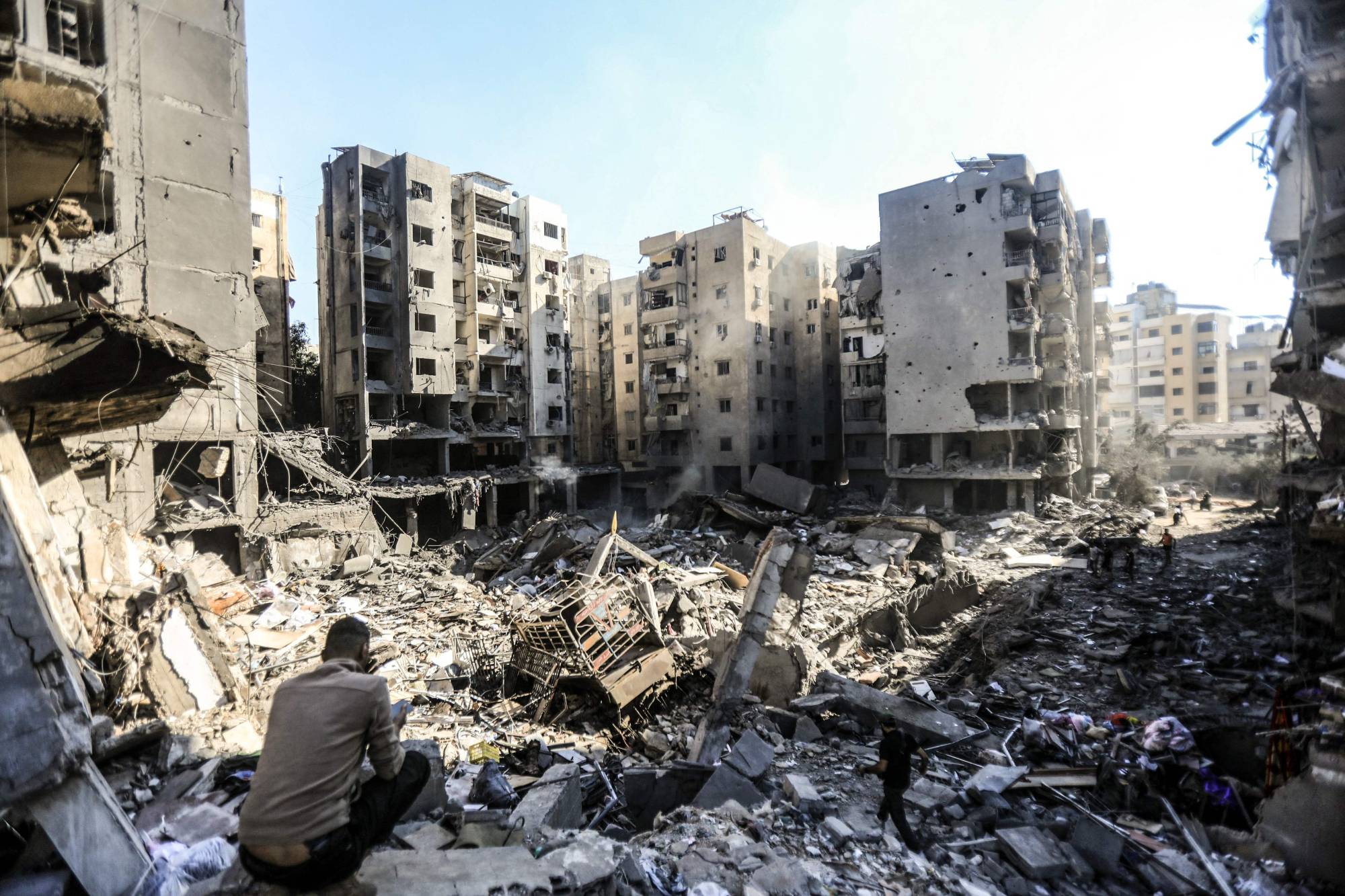
People check the rubble of buildings which were levelled on September 27 by Israeli strikes that targeted and killed Hezbollah leader Hassan Nasrallah in the Haret Hreik neighbourhood of Beirut's southern suburbs, on September 29, 2024. (Photo by AFP)
Nasrallah’s Sons... The Burden of the Legacy
One source explains: “After his death and the deaths of those around him, we can see the importance of family ties within the circle of trust that surrounded him, and which turned out to underpin the party’s leadership.” According to the source, “what Nasrallah destroyed by choosing to remain in his position surrounded by these close leaders, and by waiting for the death that was inevitably approaching him, was the fabric of family, clan and party together. It is difficult, if not impossible, to repair.”
What is striking is that throughout all this, he did not include his sons or work to prepare any of them to succeed him.
According to the sociologist and writer, “historical leaders of this magnitude do not think about succession, perhaps because of some form of narcissism in them, leaving their children struggling with their identities and with managing the weight of the legacy on their shoulders.”
The sons, specifically Jawad and Mohammed Mahdi, who have increased their public presence recently, are “a phenomenon worth pausing over, particularly as each tries to humanize the father and imitate his image... but in reality, with little success.”
A close examination of the social media accounts the two young men have recently turned to shows a determined effort to borrow from their father’s behavior, from imitating the movement of his hand and his manner of speaking to something resembling a division of roles. One, for example, appears to emulate a religious authority in his turban, while the other invokes Guevara and the liberation of peoples at times, then the martyrs and the righteous, along with his certainty that his father will return with them, at others.
“The Spell of the Eyes”... Just a Bubble
Today, instead of building on that “legend,” “Nasrallah’s narrative has become a farce... and is now at the mercy of the wind,” one source says. He continues: “Two years after his death, all we have to do is look at the ease with which his immediate circle is handling his legacy to realize that there is no custodian of this legacy... All those narratives about his leadership charisma, his commanding presence and the spell of his eyes, the common comparison used to describe Nasrallah, drawn from descriptions of Gamal Abdel Nasser, have suddenly vanished. As if they were merely a bubble.”
“All it takes is for a marginal politician to claim on television that he used to sit with him for around seven hours. What kind of exaggeration is that? Or, for example, his son Mahdi talking about how he would prepare breakfast for him, or the video showing him driving around in a car in the southern suburbs, for which we do not know the context, date or source. Was it the party media? Al-Manar TV? Who decided that these stories should be made public today?”
The Loss of Voice and Image
More questions all point to the same issue: the opening up of the narrative that Nasrallah had monopolized. His narrative about himself and his party, whose rhythm he controlled through a committed media machine that did not depart from what he dictated.
Was that why the slogan of the anniversary was “We Remain Committed to the Pledge”? And was that why Qassem launched an institution to preserve and publish Nasrallah’s legacy?
Perhaps the aim was to “humanize” the man and make him an accessible figure, conveying a message to the grieving popular base that he was like them and among them despite his absence.
But in practice, the result was exactly the opposite.
The “void the size of the hole” and the leadership crisis are viewed by the sociologist through the lens of the mass of people that was once strongly present and has become “more obscure and closed than ever,” and “completely unknown to anyone outside its close members.”
He says: “It is as though the Shiites as a whole have withdrawn, leaving a void in the mechanisms of daily life, in their relationship with other parties, other sects and the broader Lebanese sphere.” Apart from the small number who appear on social media and fiercely defend the war of support, the social mass that Nasrallah once represented appears, in his view, less visible and less present.
He says: “It is as though, with the loss of Nasrallah, they lost the voice and the image.”
But what appears from the outside to be a decline reveals, within the narrow circles of trust, another ordeal.
A girl, a member of Hezbollah's al-Mahdi Scouts cries as she holds up a poster during a gathering marking the second anniversary of the assassinations of Hezbollah leaders Hassan Nasrallah and his cousin and successor, Hashem Safieddine, who were killed in Israeli airstrikes, in Dahiyeh, a southern suburb of Beirut, Lebanon, Sunday, Oct. 4, 2026. (AP Photo/Hassan Ammar)
Is “Shelter” Inevitably Coming?
The woman from southern Lebanon says that “the void in the party’s leadership today seems like a luxury compared with the void in the forces that drive daily life for southerners.” She continues: “It is as though Amal has inherited the streets and the scene in Tyre in particular instead of the party. What the party members once represented as a deterrent to the activists is no longer there today, so these people have become a de facto authority controlling everything... and there is much bitterness in that.”
Today, many people in southern Lebanon want to believe their new secretary-general’s statement that “shelter” is inevitably coming, and that Iran will not abandon them or stop supporting them with money, weapons and influence. But they remain silent about the fact that the money will not come, and that the mere use of the word “shelter” instead of the “decent housing and decent furnishings” Nasrallah promised them after the 2006 July War says a great deal about their circumstances.
Between denial and the deep mourning suffered by the party’s community, the greatest shock remains “the loss of the power and the ‘surplus of power’ they enjoyed for more than two decades and wielded as a daily weapon against the rest of the Lebanese... Therefore, their social contract today appears to be based on treating that narcissistic wound by directing all their anger at the agents.”
It is as though the excessive talk of traitors and agents compensates them for the deafening silence about everything else. In their view, these are the Lebanese, all Lebanese outside their own community, and everyone who did not support them in their support effort. So they erupt in anger whenever they are mentioned, seeking relief from their misery through more insults and threats.
Scars from Oct. 7 Fuel Deep Divisions Over Netanyahu Ahead of Israeli Electionhttps://english.aawsat.com/features/5327173-scars-oct-7-fuel-deep-divisions-over-netanyahu-ahead-israeli-election
People walk past an election billboard showing Israeli Prime Minister Benjamin Netanyahu with the Hebrew phrase "We will not surrender" in Tel Aviv, Israel, 06 October 2026. (EPA)
TT
TT
Scars from Oct. 7 Fuel Deep Divisions Over Netanyahu Ahead of Israeli Election
People walk past an election billboard showing Israeli Prime Minister Benjamin Netanyahu with the Hebrew phrase "We will not surrender" in Tel Aviv, Israel, 06 October 2026. (EPA)
As Israel gears up for its first elections since the Hamas-led Oct. 7, 2023 attack, Prime Minister Benjamin Netanyahu and his opponents are putting it at the heart of their campaigns.
Nearly every poster, stump speech or televised debate seems to reference the attack, which has scarred the country and remains fresh in the minds of voters. Three years on, the worst security failure in Israel’s history now threatens to end the career of its longest-serving prime minister.
“October 7 is kind of a framework for the entire political discussion that is going on,” said Tamar Hermann, an expert on Israeli public opinion at the Israel Democracy Institute, a Jerusalem think tank. “All of us are post-traumatic in a way.”
Netanyahu’s opponents want him to pay for the failures that led to the deadliest day in Israel’s 78-year history and plunged the country into a series of inconclusive wars. His defenders say Netanyahu was betrayed by the military establishment and that he has led Israel through a dramatic rebound from its darkest hour.
A loss in the Oct. 27 election would likely end the career of the soon-to-be 77-year-old Netanyahu. A victory would mark the greatest turnaround yet for a man who has defied naysayers for three decades.
A deadly day that has shaken an entire region
On the morning of Oct. 7, Hamas militants fired several thousand rockets into Israel and thousands of fighters attacked through holes blown in the border fence or with boats or motorized paragliders. Some 1,200 people were killed and 251 others taken hostage.
Israel responded with a military offensive that has killed over 74,000 Palestinians in the Gaza Strip, according to local health authorities, left the territory in ruins and sparked an ongoing humanitarian catastrophe. Israel later went to war against Hezbollah in Lebanon, seized a chunk of Syria, attacked targets in Yemen and joined the US in two wars against Iran.
Hundreds of Israelis, mostly young soldiers, have died, and nearly every household has been touched by the violence. Netanyahu promised “total victory,” but Hamas, Hezbollah and Iran’s theocratic government all remain intact.
Israel’s international standing has plummeted, a number of foreign governments have accused it of genocide — a charge it vehemently rejects — and Netanyahu is now wanted by the International Criminal Court.
After a string of resignations by top security officials, Netanyahu is the only senior figure from Oct. 7 still in office, making this month’s election in many ways a referendum on his leadership.
It's the focus of the campaign for both sides Netanyahu and his opponents have put Oct. 7 at the forefront of their campaigns — for different reasons.
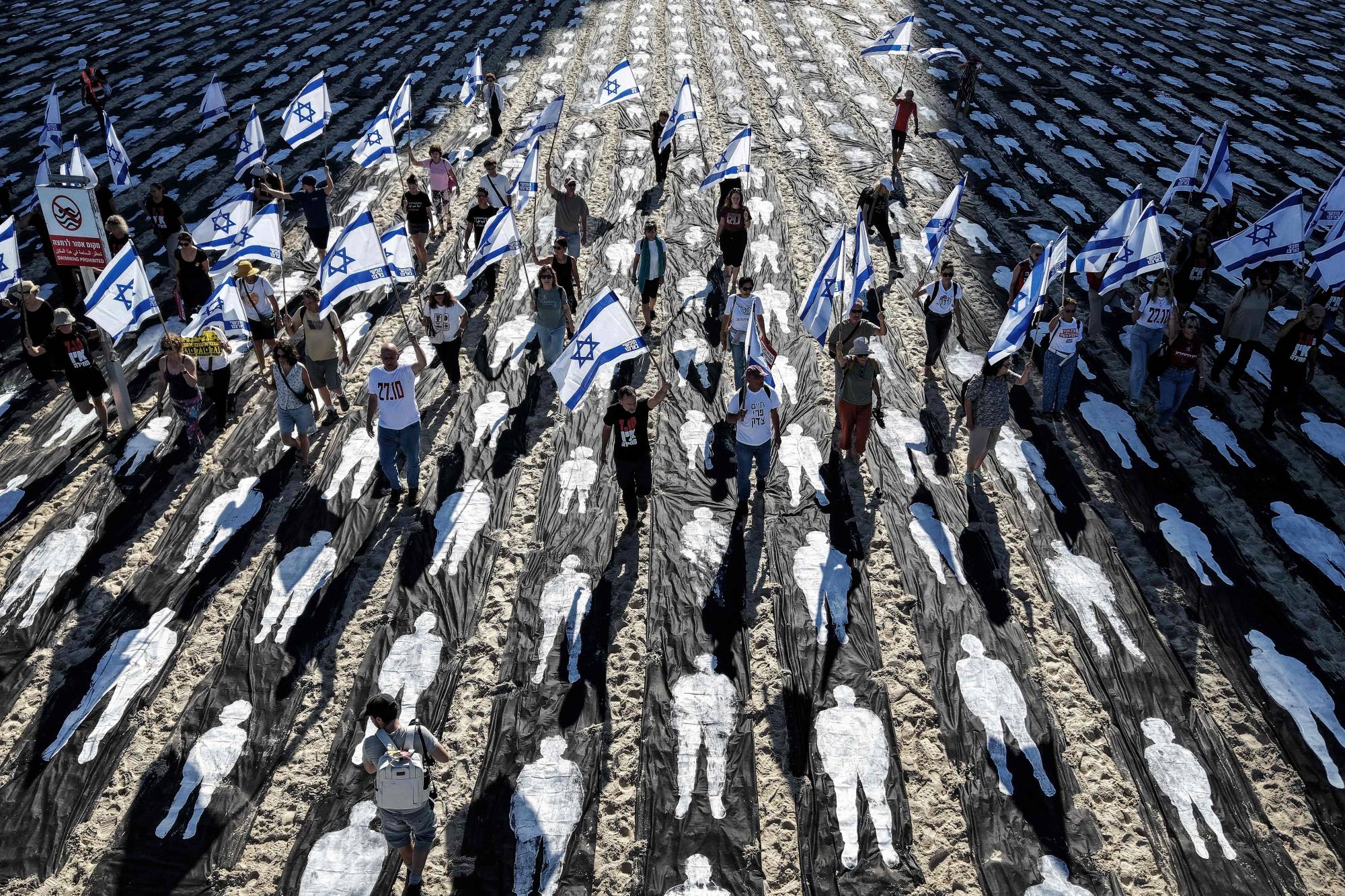
An aerial view shows people waving Israeli flags as they stand on a commemorative installation set up on the beach to mark the third anniversary of Hamas's October 7 attack on Israel, in Tel Aviv on October 7, 2026. (AFP)
His opponents — from across the political spectrum — call his outgoing coalition “the massacre government,” a reference to the Oct. 7 attack occurring on their watch. Netanyahu says he has led a “war of redemption.”
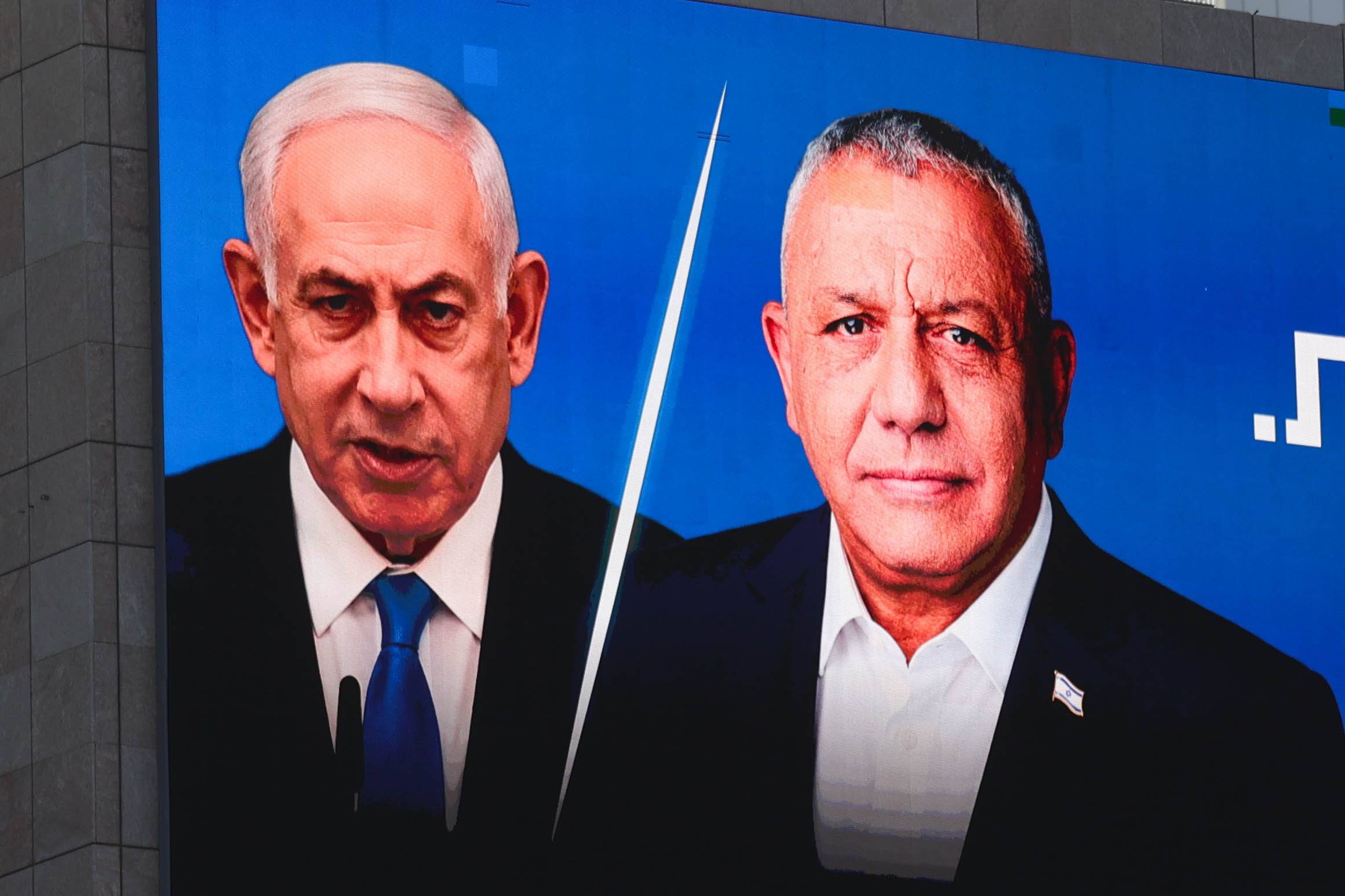
His chief rival is Gadi Eisenkot, a former military chief whose son and nephew were killed in battle in Gaza. The opponents have pledged to form a government of “repair and reconstruction” — beginning with the formation of an official commission of inquiry into Oct. 7.
They also have vowed to end draft exemptions for ultra-Orthodox religious men, a long-standing policy that has outraged the secular majority at a time of war, and accuse Netanyahu of threatening Israel's democratic institutions.
“The most fateful elections in the history of the State of Israel are between evasion and enlistment,” Eisenkot wrote on X. “Between taking responsibility and fleeing from responsibility.”
Netanyahu has repeatedly rejected calls for a commission of inquiry while trying to shift the blame to security officials. He recently accused the then-head of the Shin Bet security service, Ronen Bar, of withholding information ahead of the attack. Bar has vowed to file a defamation lawsuit.
Netanyahu insists the country is stronger than ever.
“Our enemies expected us to collapse,” he said in a recent address to the United Nations. “Well, we didn’t collapse. Instead, we rose and fought like lions.”
Oct. 7 victims are seeking seats in parliament
Eisenkot’s new Yashar party list includes two parents who lost children on Oct. 7. Netanyahu’s Likud party also includes two grieving parents, among them the mother of a policeman killed in battle on Oct. 7 whose remains were the last to be returned to Israel as part of a ceasefire. Another Likud candidate lost both legs while serving in Gaza.
The leader of the dovish Democrats party, Yair Golan, is a retired general who put on his uniform and rushed to the southern border to fight on Oct. 7. The centrist Together party’s list has another former general, Noam Tibon, who also battled militants as he rescued his son’s family, and the mother of a soldier killed that day.
Other parties have also added people directly impacted by the attack.
Organizers, including victims' relatives, say they are keeping politics out of a mass memorial service in Tel Aviv on Wednesday. But they have hardly concealed their anger at the country’s leadership.
“We will not let anyone evade responsibility,” Yonatan Shamriz, whose brother was taken hostage and mistakenly killed by Israeli soldiers after escaping captivity, said in a radio interview.
A large election billboard shows Israeli Prime Minister Benjamin Netanyahu (C-L) and leader of the Yashar party, Gadi Eisenkot (C-R), in Tel Aviv, Israel, 06 October 2026. (EPA)
There is little discussion of the Palestinians
Largely missing from the Israeli public discourse is any discussion of the dire situation in Gaza or the fate of the Palestinians.
Israeli leaders have said little about the unprecedented death toll in Gaza, the humanitarian catastrophe and the lack of reconstruction. Instead, they have focused largely on the country’s pain over Oct. 7.
There is almost no mention of peace talks, and even Netanyahu’s challengers largely oppose the establishment of a Palestinian state alongside Israel, the international community's preferred solution for the decades-old conflict.
When a pair of Israeli filmmakers released a documentary last month about civilian deaths in Gaza, party leaders across the spectrum, including Eisenkot, accused them of treason.
Oct. 7 has hardened the bitter split over Netanyahu
Polling suggests a close race between Netanyahu and his chief rival, Eisenkot, with an uncertain outcome.
According to the Israel Democracy Institute, over 60% of Israelis say their attitudes toward Oct. 7 are a central factor in whom to vote for. That number jumps to 68% among the Jewish majority; Arab voters are most concerned with a crime wave in their communities.
But Hermann, the IDI polling expert, said this doesn’t necessarily mean bad news for Netanyahu. She says the past three years have hardened attitudes on both sides.
Just because everyone says Oct. 7 is important, she said, “doesn’t mean that they will come out with the same conclusion.”
Satellite Photos Show How Israeli Forces Have Erased Gaza Townshttps://english.aawsat.com/features/5327169-satellite-photos-show-how-israeli-forces-have-erased-gaza-towns
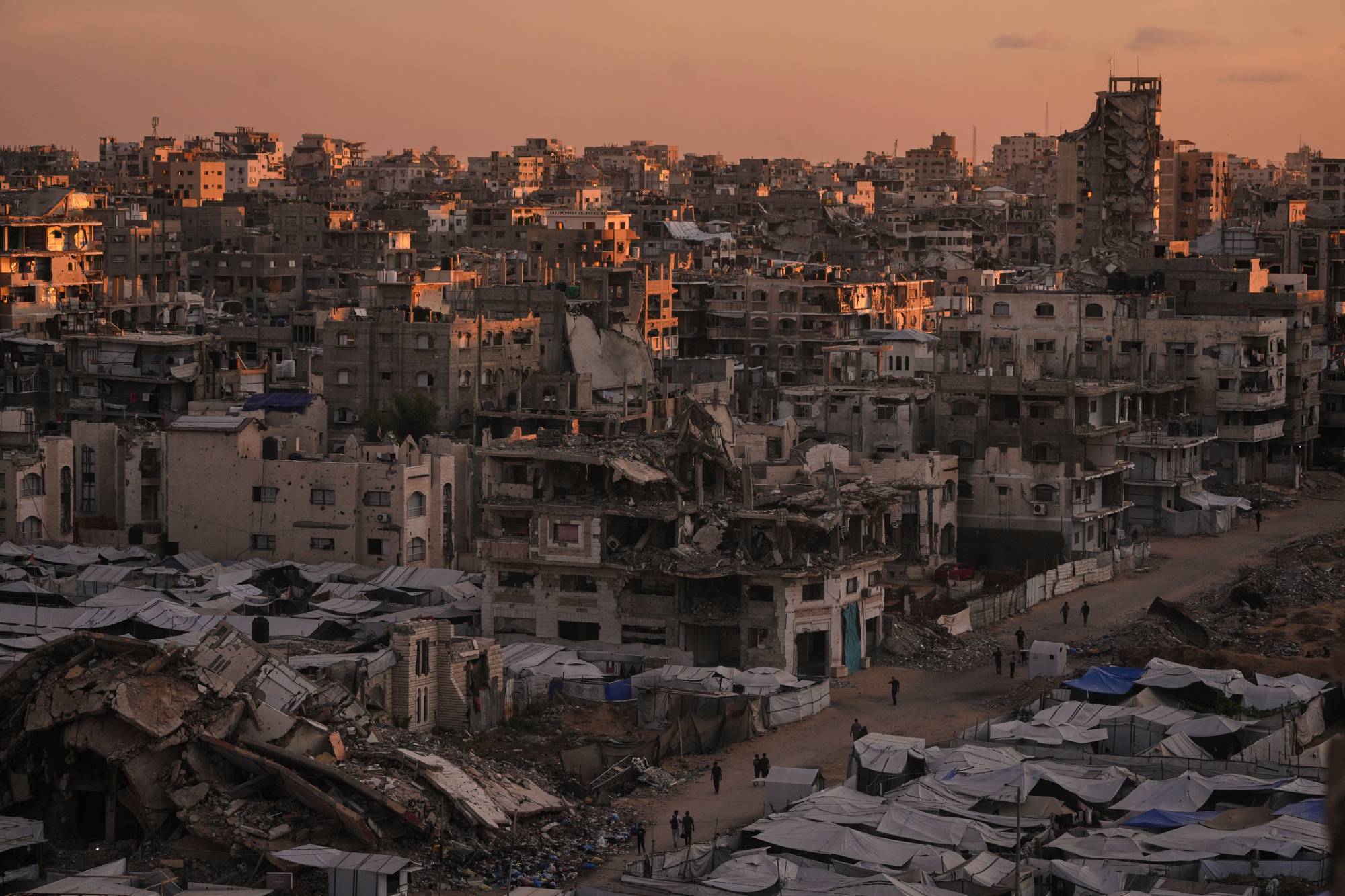
A Palestinian walks amid the rubble of buildings destroyed during the war in Gaza City, October 7, 2026. (Reuters)
TT
TT
Satellite Photos Show How Israeli Forces Have Erased Gaza Towns
A Palestinian walks amid the rubble of buildings destroyed during the war in Gaza City, October 7, 2026. (Reuters)
It’s perhaps the most dramatic wound inflicted on the Gaza Strip by Israel’s military campaign over the past three years: The city of Rafah, once home to a quarter million people, has been erased.
Satellite imagery shows the Israeli military has systematically razed the southern city and other towns and districts to the ground and in some places plowed away the rubble. Demolition, using bulldozers and explosives, has continued unabated since the Israel-Hamas ceasefire deal reached a year ago, as the military solidifies its hold on just over 60% of the territory that it still controls.
Gaza’s mangled landscape is just one of the wounds on top of wounds that the enclave's 2 million Palestinians have endured since Israel launched its campaign to destroy Hamas after the fighters’ Oct. 7, 2023, attack on southern Israel.
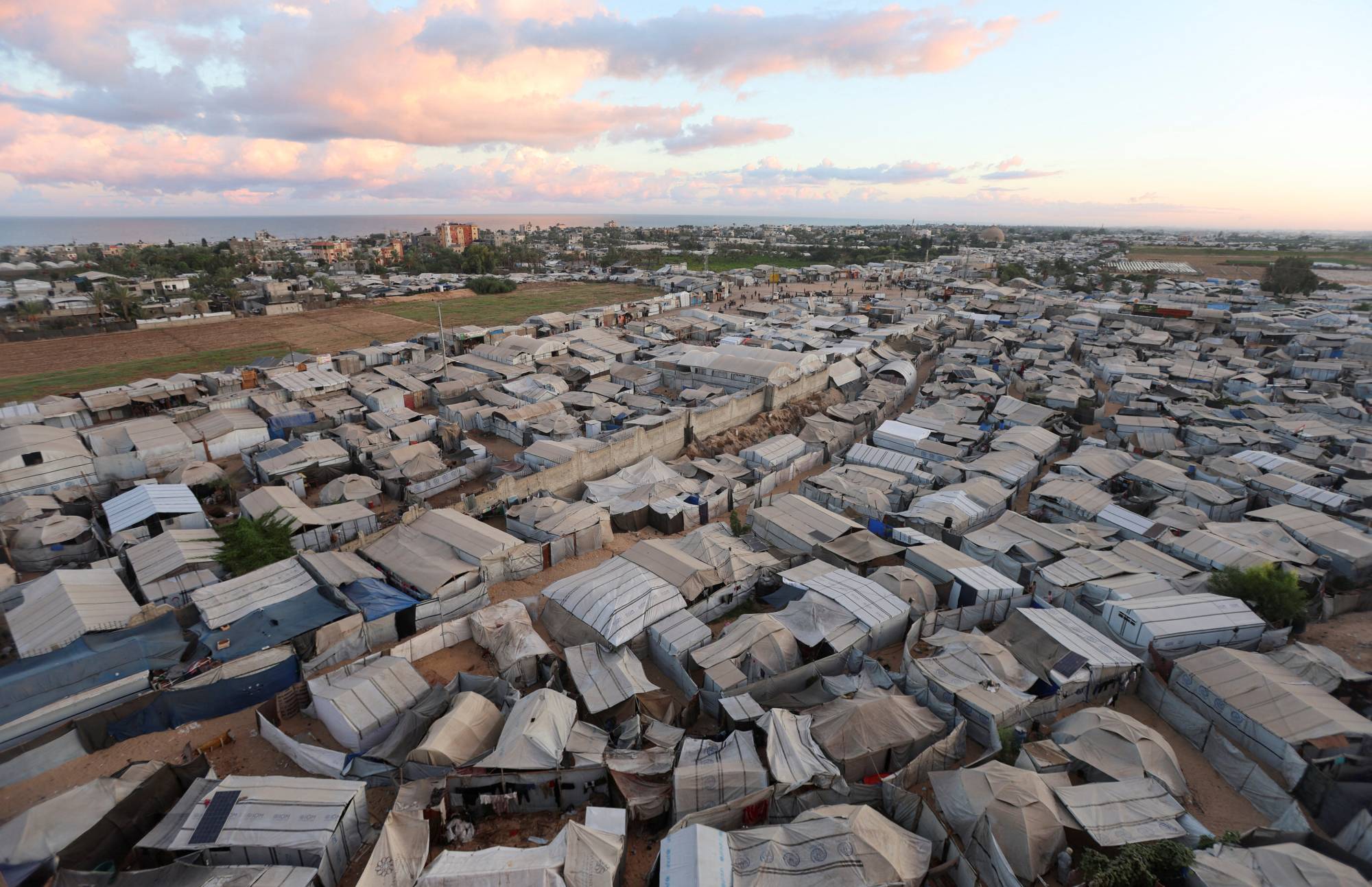
More than one out of every 10 people from Gaza’s prewar population has been killed or wounded by Israeli fire. While nearly every family mourns dead or cares for wounded, most also had to move multiple times to escape fighting and Israeli evacuation orders. With almost the entire population homeless, the coastal territory is now effectively one of the world's most populated tent cities. Ramshackle canvas and nylon shelters blanket beaches and former agricultural lands and fill empty lots.
Little is likely to change for the foreseeable future. While the ceasefire deal stopped the offensives and heaviest bombardment, Israel hits tents, cars and buildings almost daily in strikes that it says target Hamas members — but that regularly kill women, children and other family members.
People no longer have to flee from place to place, but few can rebuild homes because Israel bars most construction material from entering Gaza. The ceasefire agreement’s plan for the large-scale reconstruction of Gaza has never gotten off the ground because Israel and Hamas have failed to reach a deal on disarming the group.
Palestinians walk along a street surrounded by buildings destroyed in Israeli military strikes during the Israel-Hamas war in Gaza City, Tuesday, Oct. 6, 2026. (AP)
In the meantime, Palestinians wrestle with tragedy
Najwa Abu Eita lost her 7-year-old daughter when Israeli forces struck her home in the central refugee camp of Nuseirat in September 2024, and her three other children were injured in the attack. Abu Eita lost an eye, her face remains heavily damaged and scarred, and she has trouble breathing.
A hairdresser before the war, she now has no work, living in a tent by the ruins of her home. Worst of all, she says, her children are frightened by her face and avoid looking at her.
“My 4-year-old son tells me, ‘Momma, I’ll give you one of my eyes.’ And inside, I’m weeping,” she said.
On the Israeli-held side, destruction continues Gaza’s population is squeezed into about 40% of the tiny territory, and Israel’s military controls the rest. Satellite imagery by Planet Labs PBC shows that the vast majority of buildings in the Israel-held part have been bulldozed or exploded down to piles of rubble, much of it after major fighting ended a year ago.
The Israeli military says it demolishes buildings to prevent their use by Hamas or to destroy the group’s tunnel networks.
But a UN-appointed expert said in a February report that the scale of destruction of civilian housing and infrastructure in Gaza “is unprecedented even by the terrible standards of modern warfare since the 20th century.”
The report warned that it could constitute a crime against humanity or reach the level of genocide, which under international law includes “deliberately inflicting conditions of life calculated to bring about physical destruction.”
Israel rejects accusations of genocide, saying it targets Hamas fighters and their infrastructure that are interwoven with civilian areas.
The Planet Labs imagery shows at least 50 Israeli military outposts built throughout the Israeli-held part of Gaza, at least 18 of them constructed since the ceasefire began. Many have been put on top of former neighborhoods where the rubble of demolished buildings nearby has been cleared away.
Most of Rafah was razed before the ceasefire, but images show that troops continue to demolish the few remaining buildings. Several abandoned UN buildings have been spared, as well as a municipal sports field that now appears to contain a military base.
A new base also stands on what was once the main intersection of the southern town of Bani Suheila. Leveled over the past year, the town is now a wasteland intersected by a spiderweb of dirt paths that were once streets.
In Jabaliya in the north, most of the al-Awda Hospital Complex was reduced to rubble in recent months, as were a number of UN-run school buildings, satellite images show. Jabaliya was once home to the Gaza Strip’s biggest refugee camp, home to some 120,000 refugees and tens of thousands of other residents in a densely built urban district.
Now one of the few buildings still standing is the octagonal-shaped Indonesian Hospital, empty since troops shut it down in June 2025. The Israeli military built a new base nearby.
Similarly, most of Beit Hanoun, once a town of some 70,000 people in Gaza's far northeast corner, and Shijaiya, a Gaza City neighborhood founded 800 years ago, are now block after block of leveled houses and apartment towers.
A tent camp sheltering displaced Palestinians in Al-Mawasi, Khan Younis in the southern Gaza Strip, October 7, 2026. (Reuters)
Gaza’s economy has been wrecked
An increased flow of aid and commercial products brought Gaza back from famine that arose in some areas last year under a monthslong Israeli ban on food and other goods. But most of the population remains dependent on international relief. Jobs are few, mostly connected to selling in the market.
Shadi Barawi lost his father early in the war. Soon after that, Barawi was hit by shrapnel from a strike near his home in Gaza City, and his leg was amputated — one of some 6,000 amputees left by the war.
After losing his leg, “I lost all hope in life,” the 35-year-old said. But he was the sole support, he said, for his own family of six and his five sisters.
A barber before the war, he returned to giving haircuts to earn some money. With no prosthetic limb, he balances on his crutches as he works in the same tent where he lives.
“I’m working in tough circumstances,” he said. “I’m on one leg. I might do cuts for three customers, then I get tired and stop and rest, but then I keep going,” he said.
Others still search for their dead
Thousands of bodies remain buried under buildings smashed by Israeli strikes. Since the ceasefire, Gaza authorities have slowly been going from site to site to try to find them.
Last week, a search team finally came to the Gaza City home of Haneen al-Khodari. When her building was hit in December 2023, al-Khodari was thrown into a nearby tree, and after weeks in the hospital, she was told her parents, siblings and many of her cousins were killed, she said. The bodies of 17 of them remained trapped under wreckage ever since.
But after eight hours digging through the ruins, the team only recovered the remains of a small child and two bones. The search for the rest was called off.
Al-Khodari sat on the pavement, her hopes dashed. “We had been waiting for this moment for three years,” she said.
A plastic sheet on the ground in front of her contained what they’d found, labeled with the words, “Mixed bones.”
لم تشترك بعد
انشئ حساباً خاصاً بك لتحصل على أخبار مخصصة لك ولتتمتع بخاصية حفظ المقالات وتتلقى نشراتنا البريدية المتنوعة