Jamal Mustafa to Asharq Al-Awsat: I Couldn’t Provide Bribe Demanded by Judge, So I Was Jailed for Another 10 Years

Saddam Hussein and Jamal Mustafa Sultan.
TT

Jamal Mustafa to Asharq Al-Awsat: I Couldn’t Provide Bribe Demanded by Judge, So I Was Jailed for Another 10 Years

Saddam Hussein and Jamal Mustafa Sultan.

In the final installment of his interview with Asharq Al-Awsat, Jamal Mustafa Sultan, a former Iraqi official and Saddam Hussein’s son-in-law, delves into his arrest, the collapse of hopes for resistance against US forces, and the turmoil that followed the American invasion of Iraq in 2003.

Mustafa faced a harsh journey during the 2003 US invasion of Iraq. He traveled to rally tribal leaders to defend Baghdad, only to return and find the city occupied. Declared a fugitive, his face appeared on the US “most-wanted” playing cards.

Mustafa fled to Syria but was denied asylum and sent back to Iraq, where he was arrested. Accused of leading resistance and car bombings, the court found no evidence to convict him.

In 2011, a judge offered him release in exchange for a bribe, which Mustafa could not afford. His proposal to sell family land to pay was rejected, leaving him imprisoned for another decade. He was eventually freed over lack of evidence.

A US soldier watches the toppling of Saddam Hussein’s statue in Baghdad on April 7, 2003. (Reuters)

After his release, Mustafa went to Erbil, where Kurdish leader Masoud Barzani invited him for a meeting. Barzani welcomed him warmly and asked how he could help. Mustafa requested assistance in obtaining a passport, praising Barzani’s generosity.

Mustafa shared that Saddam respected Barzani, once calling him a “tough but honorable opponent.” He also revealed that, before the 2003 US invasion of Iraq, Barzani had assured Saddam that Kurdish forces would not fight the Iraqi army.

Recalling the lead-up to the war, Mustafa said Saddam tasked him with reconnecting with tribal leaders to encourage them to resist the invasion.

He delivered personal messages from Saddam, along with financial support, to help tribes host Iraqi soldiers stationed nearby. Mustafa later traveled to the Anbar province to rally tribes and bring them to defend Baghdad.

This account offers a rare glimpse into the behind-the-scenes efforts to resist the US invasion and the complex relationships that shaped Iraq’s history.

As the US invasion loomed, Mustafa met with thousands of tribal leaders to rally support for Baghdad’s defense.

“During the war, I met with over 4,500 tribal sheikhs from across Iraq,” he said. But when he returned to Baghdad after a trip to Anbar, everything had changed. “The city had fallen, and everything was in chaos.”

Mustafa tried to locate his associates but found no one. On April 11, 2003, he sent his driver to search for allies.

By chance, his brother, Lt. Gen. Kamal Mustafa, located him. “He told me we needed to leave Baghdad. I hadn’t planned to leave, but he convinced me it was the logical choice—we had no weapons, no men, and no resources. Staying would only mean capture.”

The brothers fled to Ramadi, where tribal leaders offered them refuge, and from there, they attempted to seek asylum in Syria. After just two days, Syrian authorities sent them back to Iraq.

Back in Baghdad, Mustafa and Khalid Najm, Iraq’s last intelligence chief, stayed with a university friend, Dr. Hafidh Al-Dulaimi. While there, Al-Dulaimi’s nephew suggested surrendering to Ahmed Chalabi’s forces, but Mustafa refused.

Saddam Hussein meets with top members of his regime. (Getty Images)

Shortly after, armed men stormed the house. “They came with tanks and masks,” Mustafa recalled. He and Najm were arrested on April 21, 2003—a day he will never forget.

Mustafa shared his experiences in US detention after his capture. “The interrogations were relentless, often involving psychological and physical pressure,” he added.

“They focused on weapons of mass destruction—’did Iraq have them, and where were they?’ Everyone faced the same questions. They also asked about US pilot Michael Scott Speicher, whose plane was shot down during the Gulf War. Though his remains were later found, the Americans kept questioning us, believing more was being hidden.”

Life in the detention center was highly controlled. Detainees were grouped in blocks of seven and given 30 minutes of outdoor time. Sultan recalled a chilling moment when Ahmed Hussein, Saddam’s office chief, told him during exercise: “The president has been captured.”

“We had clung to hope that Saddam’s freedom could lead to Iraq’s liberation,” Mustafa said. “His arrest shattered that hope and signaled the occupation’s permanence.”

He also described mysterious construction in the prison. “We saw carpenters working constantly. Eventually, they built a wooden barrier, blocking the corridor from view. We could only guess what it was for.”

When asked if Saddam had led the resistance before his capture, Mustafa confirmed: “Yes, the resistance began after the war. It wasn’t planned in advance because, at that time, the focus was purely military—army against army.”

“After the occupation, a new phase started. Battles unfolded in stages, and Saddam was leading the resistance during this one. He was the hope of the resistance, of the Iraqi people, and of Arabs and Muslims,” Mustafa revealed.

His remarks offer a glimpse into the post-invasion dynamics and the symbolic role Saddam played during Iraq’s turbulent transition.

Mustafa also recounted the difficulty of reaching his family after his arrest.

“After my capture, I lost all contact with my family. I didn’t have any phone numbers for my brothers, friends, or colleagues. Even if I had, phone lines had been disrupted—many exchanges had been bombed, and communication in Iraq was severely impacted,” he told Asharq Al-Awsat.

Mustafa recalled an encounter with the International Red Cross during his detention.

Saddam Hussein and his daughter Hala. (Courtesy of the family)

“The Red Cross offered me the chance to write a message to my family, as is their usual practice. But I was at a loss—who could I write to? I had no idea where my brothers or family were. I didn’t know anything about their whereabouts.”

Then, Mustafa had an idea. “I thought of Ammo Baba, a well-known football coach in Iraq. I didn’t know his address, but I remembered the address of the Police Club, where I had been president. I decided to write the letter there, addressed to Ammo Baba, asking him to pass it on to my family.”

Mustafa’s story highlights the communication challenges and isolation faced by detainees during the Iraq War.

He then described the prolonged separation from his family following his arrest. “I had no hopes of hearing from my family when I sent my letter through Ammo Baba,” Mustafa said.

“The situation was too difficult. After two and a half to three months, I received a response from Ammo Baba. He sent his regards, inquired about my health, and included a message from Yassin, a coach who worked with me. Along with the letter, they sent me sportswear—a shirt and shorts.”

Mustafa’s communication with his family may have been limited, but the letter served as a lifeline.

“A couple of years later, I received the first message from my wife, Hala, after two years in detention.”

Jamal Mustafa Sultan with his children.

When asked if he had been separated from his family for 18 years, Mustafa confirmed: “Yes, I hadn’t seen them or my children for 18 and a half years.”

“There were no visits or conversations, except for a brief period when we were held by the Americans. During that time, they allowed us five minutes a week to speak with our families. I would split the time—two and a half minutes with my mother and siblings, and the rest with my wife and daughters,” he said.

However, he revealed that after 2010, communication was cut off entirely.

“When we were transferred to Iraqi custody, they stopped allowing any contact. I was careful not to make calls with the Iraqis, as I feared enemies or foreign agents could record them,” explained Mustafa.

Mustafa’s story underscores the isolation he endured and the limited means of contact with his loved ones during years of detention.

Rebuilding the Army: One of the Syrian Govt’s Greatest Challenges

Soldiers and police officers from the former Syrian regime handing in weapons last year to new security forces in Latakia, Syria. (Ivor Prickett for The New York Times)
TT

Rebuilding the Army: One of the Syrian Govt’s Greatest Challenges

Soldiers and police officers from the former Syrian regime handing in weapons last year to new security forces in Latakia, Syria. (Ivor Prickett for The New York Times)

When opposition factions in Syria came to power a year ago, one of their first acts was to dismiss all of the country’s military forces, which had been used as tools of repression and brutality for five decades under the rule of Bashar al-Assad and his family.

Now, one of the biggest challenges facing the nascent government is rebuilding those forces, an effort that will be critical in uniting this still-fractured country.

But to do so, Syria’s new leaders are following a playbook that is similar to the one they used to set up their government, in which President Ahmed al-Sharaa has relied on a tightknit circle of loyalists.

The military’s new command structure favors former fighters from Sharaa’s former Hayat Tahrir al-Sham group.

The Syrian Defense Ministry is instituting some of the same training methods, including religious instruction, that Sharaa’s former opposition group used to become the most powerful of all the factions that fought the Assad regime during Syria’s civil war.

The New York Times interviewed nearly two dozen soldiers, commanders and new recruits in Syria who discussed the military training and shared their concerns. Nearly all spoke on the condition of anonymity because the Defense Ministry bars soldiers from speaking to the media.

Several soldiers and commanders, as well as analysts, said that some of the government’s rules had nothing to do with military preparedness.

The new leadership was fastidious about certain points, like banning smoking for on-duty soldiers. But on other aspects, soldiers said, the training felt disconnected from the needs of a modern military force.

Last spring, when a 30-year-old former opposition fighter arrived for military training in Syria’s northern province of Aleppo, instructors informed roughly 1,400 new recruits that smoking was not permitted. The former fighter said one of the instructors searched him and confiscated several cigarette packs hidden in his jacket.

The ban pushed dozens of recruits to quit immediately, and many more were kicked out for ignoring it, according to the former fighter, a slender man who chain-smoked as he spoke in Marea, a town in Aleppo Province. After three weeks, only 600 recruits had made it through the training, he said.

He stuck with it.

He said he was taken aback by other aspects of the training. The first week was devoted entirely to Islamic instruction, he said.

Soldiers and commanders said the religious training reflected the ideology that the HTS espoused when it was in power in Idlib, a province in northwestern Syria.

A Syrian defense official, who spoke on the condition of anonymity because he was not authorized to speak publicly, said the government had not decided whether minorities would be allowed to enlist.

Syria’s leaders are relying on a small circle of trusted comrades from HTS to lead and shape the new military, several soldiers, commanders and recruits said.

The Syrian Defense Ministry did not respond to a detailed list of questions or repeated requests for comment.

After abolishing conscription, much hated under the Assad regime, the new military recruited volunteers and set qualifications like a ninth-grade education, physical fitness and the ability to read.

But soldiers who had fought with the opposition in the civil war were grandfathered into the ranks, even if they did not fulfill all the criteria, according to several soldiers and commanders.

“They are bringing in a commander of HTS who doesn’t even have a ninth-grade education and are putting him in charge of a battalion,” said Issam al-Reis, a senior military adviser with Etana, a Syrian research group, who has spoken to many former opposition fighters currently serving in the military. “And his only qualification is that he was loyal to Ahmed al-Sharaa.”

Former HTS fighters, like fighters from many other factions, have years of guerrilla-fighting experience from the war to oust the Assad dictatorship. But most have not served as officers in a formal military with different branches such as the navy, air force and infantry and with rigid command structures, knowledge that is considered beneficial when rebuilding an army.

“The strength of an army is in its discipline,” Reis added.

Most soldiers and commanders now start with three weeks of basic training — except those who previously fought alongside Sharaa’s group.

The government has signed an initial agreement with Türkiye to train and develop the military, said Qutaiba Idlbi, director of American affairs at the Syrian Foreign Ministry. But the agreement does not include deliveries of weapons or military equipment, he said, because of American sanctions remaining on Syria.

Col. Ali Abdul Baqi, staff commander of the 70th Battalion in Damascus, is among the few high-level commanders who was not a member of the HTS. Speaking from his office in Damascus, Abdul Baqi said that had he been in Sharaa’s place, he would have built the new military in the same way.

“They aren’t going to take a risk on people they don’t know,” said the colonel, who commanded another opposition group during the civil war.

Some senior commanders said the religious instruction was an attempt to build cohesion through shared faith, not a way of forcing a specific ideology on new recruits.

“In our army, there should be a division focused on political awareness and preventing crimes against humanity and war crimes,” said Omar al-Khateeb, a law graduate, former opposition fighter and current military commander in Aleppo province. “This is more important than training us in religious doctrine we already know.”

*Raja Abdulrahim for The New York Times


Winter Storm Rips through Gaza, Exposing Failure to Deliver Enough Aid to Territory

Palestinians cross a flooded street following heavy rain in Khan Younis, southern Gaza Strip, Thursday, Dec. 11, 2025. (AP Photo/Abdel Kareem Hana)
TT

Winter Storm Rips through Gaza, Exposing Failure to Deliver Enough Aid to Territory

Palestinians cross a flooded street following heavy rain in Khan Younis, southern Gaza Strip, Thursday, Dec. 11, 2025. (AP Photo/Abdel Kareem Hana)

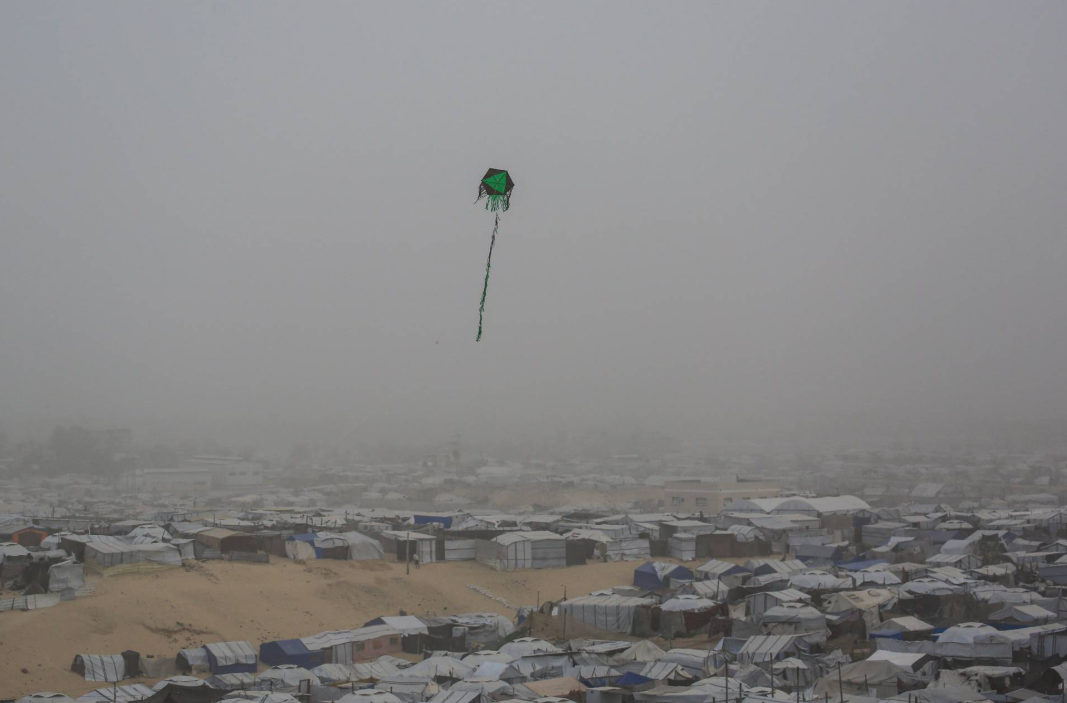
Rains drenched Gaza’s tent camps and dropping temperatures chilled Palestinians huddling inside them Thursday as storm Byron descended on the war-battered territory, showing how two months of a ceasefire have failed to sufficiently address the spiraling humanitarian crisis there.

Children’s sandaled feet disappeared under opaque brown water that flooded the camps. Trucks moved slowly to avoid sending waves of mud toward the tents. Piles of garbage and sewage turned to waterfalls.

“We have been drowned. I don’t have clothes to wear and we have no mattresses left,” said Um Salman Abu Qenas, a mother displaced from east of Khan Younis to a tent camp in Deir al-Balah. She said her family could not sleep the night before because of the water in the tent, The AP news reported.

Aid groups say not enough shelter aid is getting into Gaza during the truce. Figures recently released by Israel's military suggest it has not met the ceasefire stipulation of allowing 600 trucks of aid into Gaza a day, though Israel disputes that finding.

“Cold, overcrowded, and unsanitary environments heighten the risk of illness and infection,” said the UN agency for Palestinian refugees, UNRWA, in a terse statement posted on X. “This suffering could be prevented by unhindered humanitarian aid, including medical support and proper shelter."

Rains falling across the region wreak havoc in Gaza Sabreen Qudeeh, also in the Deir al-Balah camp, said her family woke up to rain leaking from their tent's ceiling and water from the street soaking their mattresses. “My little daughters were screaming and got shocked when they saw water on the floor,” she said.

Ahmad Abu Taha, a Palestinian man in the camp, said there was not a tent that escaped the flooding. “Conditions are very bad, we have old people, displaced, and sick people inside this camp,” he said.

In Israel, heavy rains fell and flood warnings were in effect in several parts of the country — but no major weather-related emergencies were reported as of midday.

The contrasting scenes with Gaza made clear how profoundly the Israel-Hamas war had damaged the territory, destroying the majority of homes. Gaza’s population of around 2 million is almost entirely displaced and most people live in vast tent camps stretching for miles along the beach, exposed to the elements, without adequate flooding infrastructure and with cesspits dug near tents as toilets.

The Palestinian Civil Defense, part of the Hamas-run government, said that since the storm began they have received more than 2,500 distress calls from citizens whose tents and shelters were damaged in all parts of the Gaza Strip.

Not enough aid getting in Aid groups say that Israel is not allowing enough aid into Gaza to begin rebuilding the territory after years of war.

Under the agreement, Israel agreed to comply with aid stipulations from an earlier January 2025 truce, which specified that it allow 600 trucks of aid each day into Gaza and an agreed-upon number of temporary homes and tents. It maintains it is doing so, though AP has found that some of its own figures call that into question.

COGAT said Dec. 9, without providing evidence, that it had “lately" let 260,000 tents and tarpaulins into Gaza and over 1,500 trucks of blankets and warm clothing. The Shelter Cluster, an international coalition of aid providers led by the Norwegian Refugee Council, sets the number lower.

It says UN and international NGOs have gotten 15,590 tents into Gaza since the truce began, and other countries have sent about 48,000. Many of the tents are not properly insulated, the Cluster says.

Amjad al-Shawa, Gaza chief of the Palestinian NGO Network, told Al Jazeera Thursday that only a fraction of the 300,000 tents needed had entered Gaza. He said that Palestinians were in dire need of warmer winter clothes and accused Israel of blocking the entry of water pumps helpful to clear flooded shelters.

"All international sides should take the responsibility regarding conditions in Gaza,” he said. “There is real danger for people in Gaza at all levels.”

Senior Hamas official Khaled Mashaal said that many people’s tents have become worn out after the two-year war, and people cannot find new places to shelter. He said Gaza also needs the rehabilitation of hospitals, the entry of heavy machinery to remove rubble, and the opening of the Rafah crossing — which remains closed after Israel said last week it would open in a few days.

COGAT did not immediately respond to a request for comment on the claims that Israel was not allowing water pumps or heavy machinery into Gaza.

Ceasefire at a critical point Mashaal, the Hamas official, called for moving to the second, more complicated phase of the US-brokered ceasefire.

“The reconstruction should start in the second phase as today there is suffering in terms of shelter and stability,” Mashaal said in comments released by Hamas on social media.

Regional leaders have said time is critical for the ceasefire agreement as mediators seek to move to phase 2. But obstacles to moving forward remain.

Prime Minister Benjamin Netanyahu’s office said Wednesday that the militants needed to return the body of a final hostage first.

Hamas has said Israel must open key border crossings and cease deadly strikes on the territory.


Ukraine Hasn’t Held Elections since Russia’s Full-scale Invasion. Here’s Why

President of Ukraine Volodymyr Zelensky speaks to press before his meeting with President of Cyprus in Kyiv on December 4, 2025, amid the Russian invasion of Ukraine. (Photo by Genya SAVILOV / AFP)
TT

Ukraine Hasn’t Held Elections since Russia’s Full-scale Invasion. Here’s Why

President of Ukraine Volodymyr Zelensky speaks to press before his meeting with President of Cyprus in Kyiv on December 4, 2025, amid the Russian invasion of Ukraine. (Photo by Genya SAVILOV / AFP)

Ukrainian President Volodymyr Zelenskyy has rejected suggestions that he is using the war as an excuse to cling to power, saying he is ready to hold elections if the US and other allies will help ensure the security of the poll and if the country's electoral law can be altered.

Zelenskyy’s five-year term was scheduled to end in May 2024, but elections were legally put off due to Russia’s full-scale invasion. That has become a source of tension with US President Donald Trump, who has criticized the delay as he pushes Zelenskyy to accept his proposals for ending the war.

Zelenskyy responded to that criticism on Tuesday, saying he was ready for elections.

“Moreover, I am now asking — and I am stating this openly — for the United States, possibly together with our European colleagues, to help me ensure security for holding elections,” he told reporters on WhatsApp. “And then, within the next 60–90 days, Ukraine will be ready to hold them.”

Until now, Zelenskyy has declined to hold an election until a ceasefire is declared, in line with Ukrainian law that prevents a poll from being held when martial law is in effect. Ukrainians largely support that decision.

Here is a look at why Ukraine has not been able to hold elections so far:

A wartime election would be illegal

Ukraine has been under martial law since February 2022, when Russia launched its full-scale invasion. The country’s constitution provides for martial law in wartime, and a separate law bars the holding of elections while it remains in force.

Beyond being illegal, any nationwide vote would pose serious security risks as Russia bombs Ukrainian cities with missiles and drones. With roughly one-fifth of the country under Russian occupation and millions of Ukrainians displaced abroad, organizing a nationwide ballot is also widely seen as logistically impossible.

It would also be difficult to find a way for Ukrainian soldiers on the front line to cast their votes, The Associated Press said.

Although Zelenskyy’s term formally expired in May 2024, Ukraine's constitution allows him to legitimately remain in office until a newly elected president is sworn in.

What Trump said

In an interview with Politico published on Tuesday, Trump said it was time for Ukraine to hold elections.

“They’re using war not to hold an election, but, uh, I would think the Ukrainian people ... should have that choice. And maybe Zelenskyy would win. I don’t know who would win.

“But they haven’t had an election in a long time. You know, they talk about a democracy, but it gets to a point where it’s not a democracy anymore.”

Trump's comments on elections echo Moscow's stance. The Kremlin has used Zelenskyy’s remaining in power after his expired term as a tool to cast him as an illegitimate leader.

What Zelenskyy said Zelenskyy reiterated previous statements that the decision about when to hold elections was one for the Ukrainian people, not its international allies.

The first question, he said, is whether an election could be held securely while Ukraine is under attack from Russia. But in the event that the US and other allies can guarantee the security of the poll, Zelenskyy said he is asking lawmakers to propose legal changes that would allow elections to be held under martial law.

“I’ve heard it suggested that we’re clinging to power, or that I’m personally holding on to the president’s seat, that I’m clinging to it, and that this is supposedly why the war is not ending. This, frankly, is a completely absurd story.”

Zelenskyy has few political rivals

Holding elections in the middle of a war would also sow division in Ukrainian society at a time when the country should be united against Russia, Zelenskyy has said.

One potential candidate who could challenge Zelenskyy in an election is former army chief Valerii Zaluzhnyi, the current Ukrainian ambassador to Britain. Zaluzhnyi has denied plans to enter politics, though public opinion surveys show him as a potential Zelenskyy rival.

Petro Poroshenko also is a key political rival of Zelenskyy’s and the leader of the largest opposition party. He is unlikely to run again, analysts said, but his backing of a particular candidate would be consequential.