A Look at the World Leaders Joining China's Military Parade in a Show of Solidarity with Beijinghttps://english.aawsat.com/features/5182137-look-world-leaders-joining-chinas-military-parade-show-solidarity-beijing
A Look at the World Leaders Joining China's Military Parade in a Show of Solidarity with Beijing
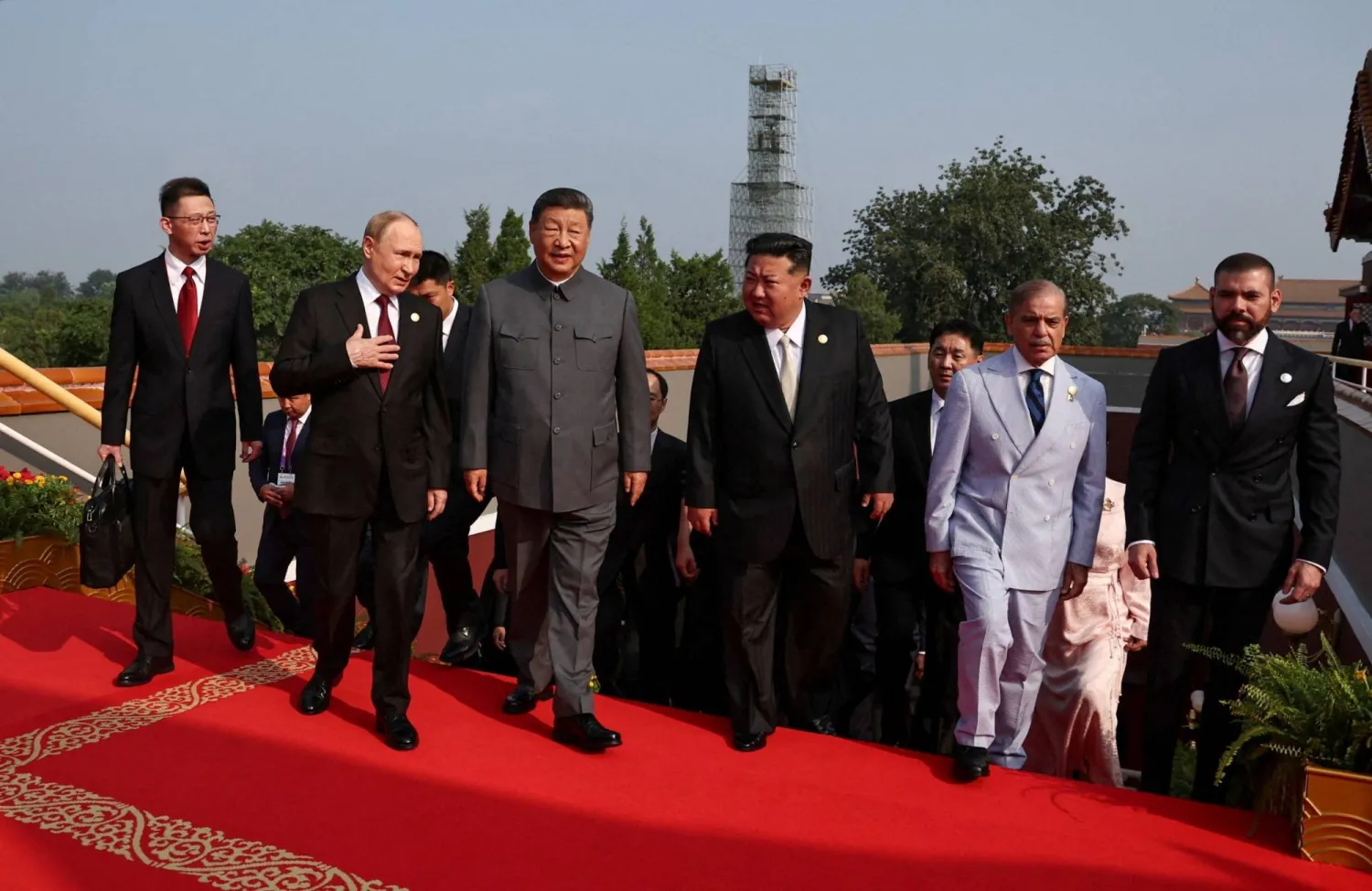
Russian President Vladimir Putin, Chinese President Xi Jinping, North Korean leader Kim Jong Un, Pakistan's Prime Minister Shehbaz Sharif and heads of foreign delegations arrive for a military parade marking the 80th anniversary of the end of World War Two, in Beijing, China September 3, 2025. Sputnik/Alexander Kazakov/Pool via REUTERS
A Look at the World Leaders Joining China's Military Parade in a Show of Solidarity with Beijing
Russian President Vladimir Putin, Chinese President Xi Jinping, North Korean leader Kim Jong Un, Pakistan's Prime Minister Shehbaz Sharif and heads of foreign delegations arrive for a military parade marking the 80th anniversary of the end of World War Two, in Beijing, China September 3, 2025. Sputnik/Alexander Kazakov/Pool via REUTERS
Leaders from about two dozen countries joined Chinese President Xi Jinping to mark the 80th anniversary of the end of World War II with a military parade in the Chinese capital on Wednesday, in a show of solidarity among nations friendly to Beijing.
Russian President Vladimir Putin and North Korean leader Kim Jong Un, who made a rare foreign trip to attend, flanked Xi as they ascended to the viewing platform overlooking Tiananmen Square and watched the display of military hardware and marching troops. Observers say the joint appearance was a show of unity against the United States.
While leaders from the US, Western Europe, Japan, South Korea and India skipped the event, Xi showed Beijing's growing influence in the Global South and other emerging economies with his guest list.
Here's a glance at Xi's guests:
US adversaries
Joining Putin and Kim included Iranian President Masoud Pezeshkian, all considered US adversaries. Russia's close ally Belarusian President Alexander Lukashenko walked next to Kim after taking group pictures with other leaders.
Putin and Kim chatted animatedly with Xi as they climbed up the stairs to the viewing platform.
The sight of these leaders, with Xi, appeared to observers as a challenge to a US-led international order.
Leaders from Asia and Africa
Indonesian President Prabowo Subianto, who initially canceled his trip to China due to protests at home, made it to Beijing and took part in the event with his counterparts in Southeast Asia, such as Cambodia's King Norodom Sihamoni, Vietnamese President Luong Cuong and Malaysian Prime Minister Anwar Ibrahim. Myanmar’s military leader, Senior Gen. Min Aung Hlaing was there too.
Other leaders from South and Central Asia also attended, including Pakistan's Prime Minister Shehbaz Sharif and Kazakhstan president Kassym-Jomart Tokayev.
Zimbabwe's President Emmerson Mnangagwa was also on the guest list.
Most European leaders stayed away
The only European leaders attending the parade were Serbia's Russia-friendly President Aleksandar Vucic and Slovakian Prime Minister Robert Fico.
But former Romanian prime ministers Adrian Năstase and Viorica Dăncilă took the group picture with current leaders.
Victory and Defeat Scenarios for Iran’s Proxies in Lebanon and Iraqhttps://english.aawsat.com/features/5256453-victory-and-defeat-scenarios-iran%E2%80%99s-proxies-lebanon-and-iraq
An Israeli artillery unit fires towards Lebanon, amid escalating hostilities between Israel and Hezbollah, as the US-Israeli conflict with Iran continues, in northern Israel, March 28, 2026. (Reuters)
Victory and Defeat Scenarios for Iran’s Proxies in Lebanon and Iraq
An Israeli artillery unit fires towards Lebanon, amid escalating hostilities between Israel and Hezbollah, as the US-Israeli conflict with Iran continues, in northern Israel, March 28, 2026. (Reuters)
The future of Iran’s regional allies, particularly Hezbollah in Lebanon and armed factions in Iraq, is increasingly uncertain as a widening conflict reshapes the Middle East and tests the limits of Tehran’s long-standing proxy strategy.
Lebanese politician Michel Chiha once outlined a vision of Lebanon as a country open to the world through its coastline, protected internally by its mountainous terrain. He advocated a liberal, service-based economy rather than heavy industry, while emphasizing that Israel represented the primary external threat.
His assessment was largely accurate, but incomplete. Chiha did not fully account for the broader geopolitical system that governs Lebanon, one influenced by global and regional powers.
Lebanon has historically been vulnerable to shifts between these two levels. When global and regional dynamics align, the country experiences relative stability. When they clash, Lebanon often pays a heavy price, including political paralysis, internal unrest, and even civil war. If such conflicts persist without resolution, international powers tend to intervene, often delegating regional actors to impose a settlement.
This pattern has repeated itself at key moments in Lebanon’s modern history: the 1958 crisis at the end of President Camille Chamoun’s term; the outbreak of civil war in 1975; Syria’s 1990 intervention that ended General Michel Aoun’s military government; the 2008 Doha Agreement following Hezbollah’s takeover of Beirut; and more recently, political shifts culminating in the election of President Joseph Aoun after the failure of Hezbollah’s “support war” to meaningfully assist Gaza.
Iran in the region
Iran’s confrontation with the US-led global order dates back to the 1979 revolution. However, the strategic environment changed dramatically after the September 11, 2001, attacks and the subsequent US invasion of Iraq in 2003.
The collapse of Saddam Hussein’s regime reshaped the regional balance of power. For the first time, US forces were positioned directly on Iran’s borders, in both Iraq and Afghanistan. Tehran responded by expanding its influence through a network of allied groups across the region.
This strategy centered on the development of proxies, linked geographically through what became known as the “Axis of Resistance” and the concept of “unity of arenas.” These networks extended across Iraq, Syria, Lebanon and Yemen, allowing Iran to project influence across land, sea and air.
The so-called “Arab Spring” represented both an opportunity and a setback for Iran. On one hand, it enabled Tehran to expand its presence by filling political and security vacuums. On the other, it exposed its intentions, particularly as it mobilized allied groups to support friendly regimes.
Hezbollah’s intervention in Syria marked a turning point. The group became deeply involved in a prolonged and complex conflict, exposing vulnerabilities at multiple levels — security, military and ideological. These weaknesses became evident during subsequent confrontations with Israel, particularly during the Gaza war, when Israel penetrated Hezbollah’s structure and targeted senior leaders.
An Israeli Air Force F-16 fighter aircraft flies over Marjeyoun in southern Lebanon on March 28, 2026. (AFP)
Iraq enters the picture
Iraq occupies a central place in Iran’s geopolitical thinking. Historically, it has been viewed as a major source of threat to Iranian national security, from ancient times through to the modern era under Saddam Hussein during the Iran-Iraq War.
After 2001, Iran found itself effectively encircled by US forces. The emergence of the ISIS group in 2014, which seized large areas of Iraqi territory, further underscored Iraq’s strategic importance. For Tehran, maintaining influence in Iraq is essential to ensuring internal stability and national security. Control or strong influence over Iraq provides strategic depth and helps prevent potential threats from emerging on its western border.
Following the 2003 invasion, Iran’s regional strategy became more clearly defined: Iraq as the base, Syria as the corridor, and Lebanon — through Hezbollah — as the strategic endpoint or “crown jewel.”
October 7
The October 7, 2023 attack by Hamas on Israel is widely viewed as a “black swan” event, one that disrupts the foundations of the existing order without immediately creating a new equilibrium.
The attack triggered a chain reaction across the region. It exposed the limitations of Iran’s proxy-based strategy and highlighted what is known in political theory as the “principal-agent problem.” In this dynamic, the patron state - Iran - pursues broader strategic goals, while proxies focus on local or ideological objectives.
This misalignment creates inherent risks. When proxies succeed, both sides benefit. When they fail, the proxies bear the immediate consequences.
In the case of October 7, Iran was drawn into a conflict it neither fully anticipated nor sought to escalate. It encouraged Hezbollah to intervene under the banner of a “support war” for Gaza. The result was a cascading deterioration, with both Hamas and Hezbollah suffering significant losses.
The concept of “unity of arenas” began to unravel as the conflict expanded. By 2025, the situation escalated further when Israel and the United States launched a coordinated military campaign against Iran in June, lasting 12 days.
The campaign included strikes on Iranian nuclear facilities using advanced bunker-busting munitions carried by US B-2 bombers. It also reflected an unprecedented level of coordination between Washington and Tel Aviv, not only in execution but also in planning and target allocation.
Another defining feature of the conflict has been its reliance on remote warfare. Iran has used missiles and drones to strike Israel and regional targets, while Israel, backed by US capabilities, has relied on air power and technological superiority, including the use of artificial intelligence in target selection and strike coordination.
Lebanon and Iraq in the crossfire
The regional conflict has drawn in multiple actors, though with varying levels of involvement. Yemen’s Houthi militants have played a more limited and delayed role, likely reflecting logistical constraints and strategic calculations.
In contrast, Hezbollah in Lebanon and Iran-aligned factions within Iraq’s Popular Mobilization Forces have been more actively engaged.
In Lebanon, Iran has sought to rebuild Hezbollah following its setbacks in 2024. Reports suggest the group has been retrained in a decentralized form of warfare known as “mosaic warfare,” which emphasizes dispersion, flexibility and the avoidance of large-scale confrontations. This approach relies on a combination of rockets, anti-tank weapons and drones, effectively returning Hezbollah to tactics used prior to Israel’s withdrawal from southern Lebanon in 2000.
In Iraq, the situation differs. Armed factions have conducted attacks against US interests but have also targeted Iraqi state institutions, including intelligence facilities and radar systems. This dual targeting reflects internal divisions and raises concerns about the erosion of state authority.
A woman sits in a cemetery before the funeral of Lebanese journalists, Al Manar reporter Ali Shaib, Al Mayadeen reporter Fatima Ftouni and cameraman Mohammed Ftouni, who were killed by a targeted Israeli strike, amid escalating hostilities between Israel and Hezbollah, as the US-Israeli conflict with Iran continues, in Choueifat, Lebanon, March 29, 2026. (Reuters)
Lebanon and Iraq’s challenges
Lebanon and Iraq share similarities as internationally recognized sovereign states, yet both face significant challenges in exercising full control over their territories.
In Iraq, militias within the PMF are formally integrated into the state’s security structure. However, some operate according to independent agendas that do not always align with national interests.
In Lebanon, Hezbollah operates as both a military force confronting Israel and a powerful domestic actor. It has often challenged state authority and pursued policies that diverge from official government positions.
The impact of the conflict has been more severe in Lebanon. The country has experienced displacement, particularly in the south and in parts of Beirut, as well as widespread destruction in Hezbollah strongholds. Israeli forces have also established a presence in southern territories they had not previously occupied.
In contrast, Iraq has not faced large-scale displacement or foreign occupation during this phase of the conflict. However, internal instability remains a concern, particularly as tensions between different political and ethnic groups persist.
Strategically, Iraq continues to serve as a cornerstone of Iran’s regional system. Lebanon, by contrast, has become more isolated, especially following the disruption of supply routes to Hezbollah through Syria.
War outcome
Several scenarios could shape the outcome of the conflict, each with significant implications for Iran’s proxies in Lebanon and Iraq.
Diplomatic solution:
At present, this scenario appears unlikely. The United States is demanding concessions that Iran had previously rejected, while Tehran is putting forward conditions that are seen as difficult to meet. Among these are demands related to control over key maritime routes and broader regional security arrangements.
Iran has also linked any potential ceasefire to developments on the Lebanese front, suggesting an effort to maintain influence there. A diplomatic resolution would raise critical questions about Hezbollah’s future, including the status of its weapons, its fighters and its role within Lebanon’s political system.
Current situation persists:
A prolonged war of attrition is seen as a scenario that could work in Iran’s favor. Time and economic resources, particularly oil revenues, could allow Tehran to sustain the conflict while gradually wearing down its adversaries.
However, this scenario carries significant risks. It could lead to deeper instability across the region, particularly in Gulf states, while exacerbating internal tensions in Iraq. In Lebanon, continued conflict could further weaken state institutions and increase the risk of internal unrest.
War scenario:
A broader military escalation remains a possibility. Reports indicate that the United States has considered expanded operations involving ground, naval and air forces.
Potential targets could include Iran’s strategic oil export facilities, such as Kharg Island, as well as key islands controlling access to the Strait of Hormuz. More complex operations, such as seizing enriched uranium, are considered less likely due to the challenges involved.
For Washington, any such operation would need to achieve a clear outcome. Failure could have significant consequences for the United States and its allies.
If a military campaign were to succeed, Lebanon would face major challenges, including addressing Hezbollah’s future and managing relations with Israel. Iraq, on the other hand, could see an opportunity to strengthen state authority and consolidate internal stability.
If it were to fail, the broader regional situation would likely remain unstable, with limited immediate impact on Iraq but continued uncertainty for Lebanon.
Questions Over Israel’s Interceptor Stockpiles as Middle East War Drags onhttps://english.aawsat.com/features/5256395-questions-over-israel%E2%80%99s-interceptor-stockpiles-middle-east-war-drags
Streaks of light illuminate the sky during an interception attempt, amid the US-Israeli conflict with Iran, as seen from Ashkelon, Israel, March 28, 2026. (Reuters)
TT
TT
Questions Over Israel’s Interceptor Stockpiles as Middle East War Drags on
Streaks of light illuminate the sky during an interception attempt, amid the US-Israeli conflict with Iran, as seen from Ashkelon, Israel, March 28, 2026. (Reuters)
The ability of Israel's highly sophisticated air defenses to keep intercepting Iranian attacks is coming under scrutiny as the Middle East war drags on into a second month.
The military has dismissed reports that it is running low on the interceptors used to shoot down the steady stream of Iranian missiles and Hezbollah rockets fired at Israel.
However, some analysts suggest that the war against Iran has significantly drained allied resources, with long-range interceptors among the most severely depleted, reported AFP.
Israel has a multi-layered air defense array, with a variety of systems intercepting threats at different altitudes.
The top tier consists of the anti-ballistic missile Arrow systems, with Arrow 2 operating both within the Earth's atmosphere and in space and Arrow 3 intercepting above the Earth's atmosphere.
Below that sits David's Sling, which was created to target medium-range threats including drones, shorter-range ballistic missiles and cruise missiles.
Israel's famed Iron Dome system is the third tier and was originally designed to intercept short-range rockets and artillery shells.
US systems also complement Israel's air defenses with some THAAD anti-missile batteries reportedly in Israel.
"There is no area in Israel that is not under multi-layer defense," said reservist Brigadier General Pini Yungman, who played a key role in developing the country's air defenses and is now president of defense company TSG.
But "there is no 100 percent in defense," he told AFP.
"To get the 92 percent that we are getting all together with all the systems, it's outstanding".
The Israeli military, which reveals few details about its air defenses, says Iran has launched more than 400 ballistic missiles since the start of the war on February 28 -- sparked by US and Israeli strikes on Iran.
Spokesman Lieutenant Colonel Nadav Shoshani recently lauded the interception rate as "exceeding expectations".
Most damage in Israel has been caused by falling debris, but among the 19 civilians killed in the country since the start of the war, more than half died when Iranian missiles broke through.
- 'Nearing exhaustion' -
Around two weeks after the war began, news outlet Semafor first reported that Israel was "running critically low on ballistic missile interceptors", citing unnamed US officials.
An Israeli military source at the time denied the reports, saying there was no shortage "as of now" and that the military was "prepared for prolonged combat".
But analysis published by the London-based RUSI defense think tank on Tuesday indicates that the US, Israel and regional allies have burned through vast quantities of missiles and interceptors since the end of February.
Researchers estimated that in the first 16 days of conflict, allied forces expended 11,294 munitions costing roughly $26 billion.
Stockpiles of long-range interceptors and precision munition in particular, it said, were "nearing exhaustion".
"This basically means that if the war continues, coalition aircraft have to fly deeper into Iranian airspace -- and on the defensive side it means absorbing more Iranian missiles and drones," one of the co-authors, US Air Force Lieutenant Colonel Jahara Matisek, told AFP.
Long and costly production timelines make the depletion of high-end interceptors, like Israel's Arrows, particularly critical.
Each Arrow 2 interceptor costs an estimated $1.5 million, with Arrow 3s around $2 million.
"The bottleneck isn't just money. It's industrial physics," Matisek said, pointing to issues including capacity constraints at the supplier level.
These are "production lines that don't scale like an iPhone factory," he said.
These are munitions "you save for the worst threats" he said, and the supply "is never going to be huge".
The RUSI analysis estimated that 81.33 percent of Israel's pre-war Arrow interceptor stocks had already been depleted, and that they would likely "be completely expended by the end of March".
- Accelerated production -
Yungman insisted that, taking into account all its air defense systems, Israel could produce interceptors faster than Iran could produce ballistic missiles.
He added that Israel accelerated its interceptor production after Hamas's October 7, 2023, attack and upgraded its systems to deal with ballistic missiles.
The military confirmed on Monday that it was a malfunction in David's Sling that had allowed Iranian ballistic missiles to strike the southern towns of Dimona and Arad last week.
Dimona is widely believed to hold Israel's undeclared nuclear arsenal.
Israeli financial newspaper Calcalist reported that the military had chosen to use David's Sling in a bid to preserve Arrow interceptor stocks.
Faced with the challenges posed by Iranian missiles, Israel has three options to conserve interceptor stocks, Jean-Loup Samaan, a senior researcher at the Middle East Institute of the National University of Singapore, told AFP.
"Mixing the different missile systems in order to avoid massive shortages; not intercepting missiles or drones if they land in unpopulated areas; and increasing the pressure on the offensive campaign, hoping that they are able to degrade Iran's capabilities before the Israeli amilitary’s air defense resources run out".
Middle East Power Struggle Faces Defining Momenthttps://english.aawsat.com/features/5256047-middle-east-power-struggle-faces-defining-moment
Map showing the Strait of Hormuz, alongside a 3D-printed model of US President Donald Trump (Reuters)
Perhaps the worst-case scenario long feared in decision-making circles has come true. With the assassination of Supreme Leader Ali Khamenei, Washington and Tel Aviv used the same “shock and awe” approach Israel has relied on in recent years, one that delivers rapid gains before losing momentum by the end of a campaign.
This time, however, US President Donald Trump broke a taboo and opened a Pandora’s box, pushing the region into war on shaky grounds and with no clear end. He forced a confrontation of mutual deterrence with an Iranian system that has lost its regional deterrent image.
The expansion of these rival projects in the Middle East, shifting between confrontation and coexistence, has reached a breaking point.
The Khamenei project, which dominated four Arab capitals for decades, has suffered repeated setbacks over the past ten years after peaking in the wake of the Arab Spring. It drained its limited resources and drew the attention of Washington, and Israel’s determination to confront it.
The failure of coexistence made a clash inevitable, one the current US administration has not handled with the patience of a major power.
In the first US military intervention of its kind since 2003, Trump’s war on Iran has lacked a clear endgame. His rhetoric mixed shifting goals with flexible timelines to pressure Tehran. Over time, his administration lost control of the war’s narrative and psychological edge, while hesitating to escalate militarily. The failure to quickly weaken Iran led Washington to conclude that following Israel’s pace would deepen US involvement.
Who decides in Tehran?
Uncertainty also surrounds decision-making in Tehran. The system appears to be paying the price of successive assassinations, from Qassem Soleimani to Ismail Haniyeh and Hassan Nasrallah.
Now it faces a new deterrence phase after Khamenei’s killing, a leader who balanced conservatives and reformists, and the Revolutionary Guard with negotiators.
The new Supreme Leader, Mojtaba Khamenei, deepens concerns over hereditary rule and strengthens the security establishment over the religious one. The transition remains unclear, including loyalties and decision-making centers.
Will power be collective and contested, or will Mojtaba consolidate control, if he is not targeted? His legitimacy depends on the continuation of the war in the near term. Ending it would raise questions about his authority and force decisions on dealing with Washington, including easing the air blockade and rebuilding after war and sanctions.
A fragile deterrence balance
Washington believed the cost of confronting Iran was low, concluding with Israel that military action offered better results than diplomacy. That calculation proved wrong.
The United States destroyed much of Iran’s conventional capabilities but has not stopped its ballistic missile launches or its ability to disrupt shipping in the Strait of Hormuz. Tehran has used the strait as economic leverage, linking pressure on the regime to damage to the global economy.
The result has been the biggest supply disruption since the 1970s energy crisis, forcing the Trump administration to temporarily ease sanctions on Iranian oil.
Iran’s strategy unfolded in three phases. First, survival, preventing collapse and internal unrest. In a leadership vacuum, Tehran’s security system escalated deterrence sharply. As US rhetoric hinted at regime change, Iran treated the war as existential, despite knowing it could not win a conventional fight.
Second, raising the cost of war for Washington and the global economy. Credibility of deterrence became central. Without a response to a strike as major as Khamenei’s assassination, Iran risks appearing defeated, weakening its regional deterrence and internal stability.
Both sides turned to what Thomas Schelling called the “diplomacy of violence,” using constant military threats as pressure.
Another goal for Tehran has been internal cohesion, using external war to limit divisions and strengthen hardliners.
The past week marked a peak in tensions over Hormuz and energy infrastructure. Both sides stepped back from full escalation after recognizing the cost of retaliation would be too high. Signals of restraint emerged, along with a need for communication and clear red lines.
Trump moved first by announcing negotiations, surprising both Iran and Israel. The fight shifted from the battlefield to diplomacy, where the side that moves first shapes the outcome.
Mediation on three tracks
Arab diplomatic sources told Asharq Al-Awsat that mediation is underway, led by Pakistan, Egypt and Türkiye through three channels in Iran: the Revolutionary Guard, the foreign ministry and parliament speaker Mohammad Qalibaf.
Each country is using its own channels. No other states are currently positioned to mediate, especially as these three have not been targeted by Iranian missiles. The sources also point to advanced US proposals seeking a middle ground.
The challenge is timing. Washington wants a quick deal, while Tehran says time is tight, especially with communication risks under Israeli surveillance.
Iran’s proxies under strain
Iran’s regional proxies form the second pillar of deterrence. The idea of unified, simultaneous fronts proved largely unrealistic. It materialized only once after the 2023 “Al-Aqsa Flood” operation before the axis suffered repeated blows.
In the 2025 Iran-Israel war, these groups stayed neutral. Now, after Khamenei’s assassination, they have entered the conflict.
Assassinations by Israel and the United States weakened the network, while sanctions since 2019 cut resources. Supply routes through Iraq and Syria have also been strained.
Iran now leads from the front as its proxy network narrows. Its strategy focuses on expanding battlefields, not unifying them, with centralized control in Tehran. The Revolutionary Guard is now coordinating directly with Hezbollah and Iraq’s Popular Mobilization Forces.
Hezbollah is fighting with depleted resources and a strained base. The Popular Mobilization Forces, long avoiding direct confrontation with US troops, have now targeted American forces and interests in Iraq and beyond, potentially reshaping deterrence and boosting Iran’s influence.
But the group is divided. Some factions continue attacks, others prioritize political interests. The result is fragmented deterrence and weaker credibility.
What comes next?
The key question is whether Tehran will insist on including Hezbollah in any deal, or whether Israel will impose a new reality south of the Litani River.
Even if Washington ends the war, Israel may keep pressure on Iran. Tehran’s proxies remain under pressure but not defeated. This ambiguity may weaken them over time without leading to full settlements.
Neither war nor truce will resolve local crises across these arenas.
As Carl von Clausewitz said, war continues politics by other means. Tehran is now shifting from deterrence to negotiation as part of its survival strategy. Signals point to pragmatic figures within hardline structures who can engage across factions.
Washington is trying to reach them, while Israel has targeted some, including Ali Larijani.
The key shift is now between Washington and Israel. Trump surprised Israel by considering de-escalation and sending Vice President JD Vance to deliver that message to Benjamin Netanyahu.
Both sides have moved to negotiating under fire, raising stakes while testing intentions. Washington favors Qalibaf, Tehran prefers Vance.
Gains and losses
Victory is relative. For Iran, staying at the table is a win despite heavy losses. Early talk of regime change has faded, even in Israel, under US pressure.
The narrative has shifted from regime change to control of Hormuz. Trump negotiates through pressure, Iran deters through endurance. Nuclear deadlock is now mirrored on the battlefield.
Both sides want to end the war, but on terms they can sell at home.
Russia and China prefer that Trump does not dominate global energy routes. Iran is part of a wider struggle over influence. If Trump falls short, Washington risks its image as a guarantor of global navigation.
Trump has hinted at joint management of Hormuz with Iran’s new leader, echoing US-China competition in the South China Sea.
A limited US intervention, combined with hesitation and economic risks, may give Iran an edge in the near term, strengthening its internal control, though long-term recovery depends on a clear deal with the West.
لم تشترك بعد
انشئ حساباً خاصاً بك لتحصل على أخبار مخصصة لك ولتتمتع بخاصية حفظ المقالات وتتلقى نشراتنا البريدية المتنوعة