


Many Unresolved Questions Remain as a Ceasefire Begins in Gaza

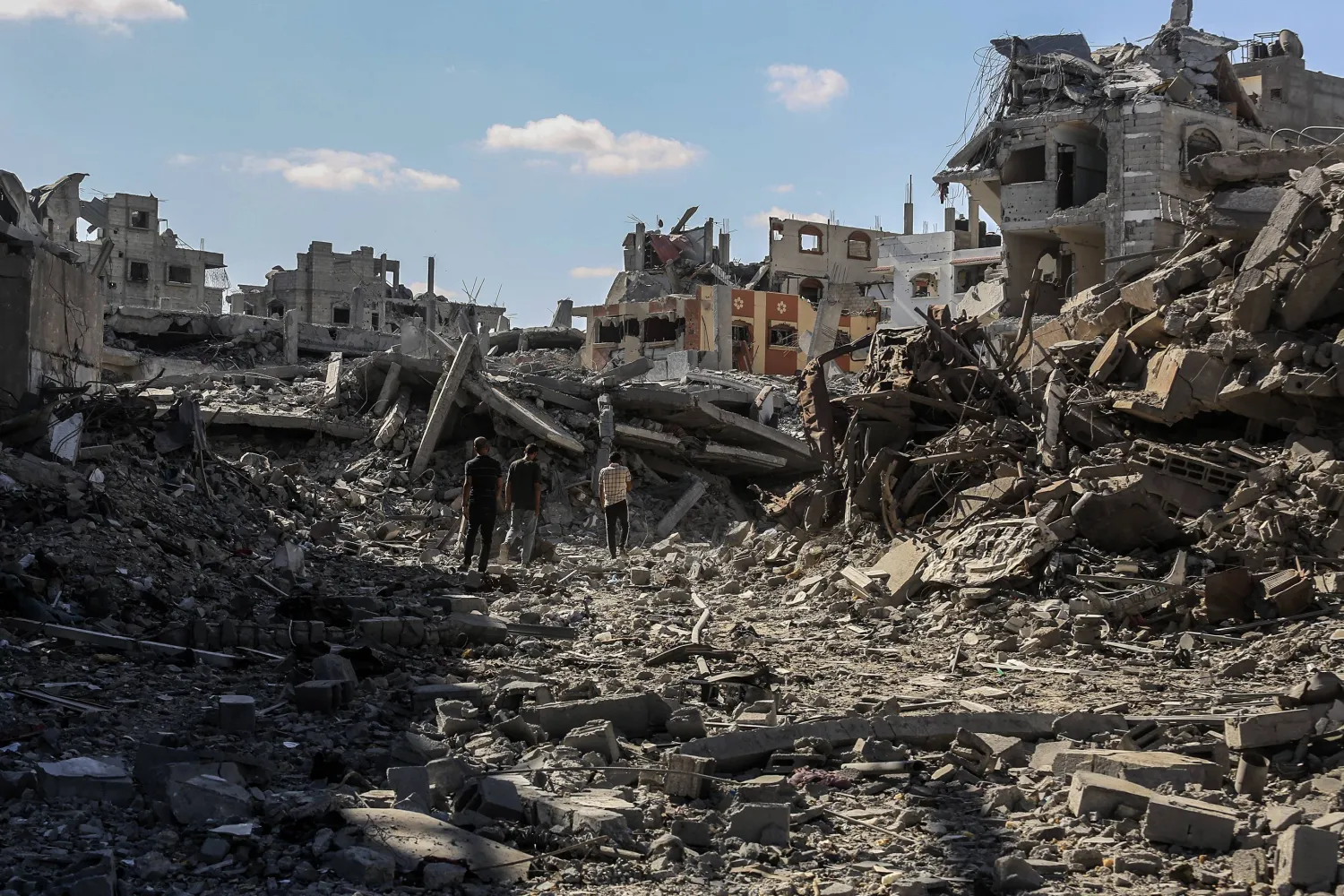
10 October 2025, Palestinian Territories, Khan Yunis: People inspect a destroyed building as displaced Palestinians return to their homes after the Israeli army withdrew from some areas east of Khan Younis in the southern Gaza Strip, following the announcement of an agreement between Israel and the Palestinian Hamas on the implementation of the first phase of the US peace plan for the Gaza Strip.(dpa)
TT

Many Unresolved Questions Remain as a Ceasefire Begins in Gaza

10 October 2025, Palestinian Territories, Khan Yunis: People inspect a destroyed building as displaced Palestinians return to their homes after the Israeli army withdrew from some areas east of Khan Younis in the southern Gaza Strip, following the announcement of an agreement between Israel and the Palestinian Hamas on the implementation of the first phase of the US peace plan for the Gaza Strip.(dpa)

Bombardment stopped and Israeli troops pulled back in Gaza on Friday under a ceasefire between Israel and Hamas. But will the agreement lead, as US President Donald Trump proclaimed, to “a Strong, Durable, and Everlasting Peace”?

It took pressure on Israel and Hamas from the United States, Arab countries and Türkiye, each saying it was time to end a two-year war that has devastated the Gaza Strip, killed tens of thousands of Palestinians, sparked other conflicts around the region and increasingly isolated Israel.

That push sealed an agreement on a first phase that is to free the remaining living Israeli hostages within days in exchange for the release of hundreds of Palestinians imprisoned by Israel.

But it left unanswered a long list of questions over what happens next.

The war began when Hamas-led fighters stormed into Israel on Oct. 7, 2023, killing some 1,200 people and taking 251 hostage.

Israel wants to ensure that Hamas disarms. Hamas wants to ensure Israel pulls its troops completely out of Gaza and is not allowed to restart the war. At the same time, a postwar government for Gaza must be worked out to replace Hamas’ rule. Without that, reconstruction is unlikely, leaving Gaza’s more than 2 million people in continued misery.

With no trust between the sides, much relies on continued pressure from the US, Egypt, Qatar and Türkiye. Any hitch in working out those intertwined issues could unravel everything and potentially lead to Israel resuming its campaign to destroy Hamas.

Here is what we know about the deal.

The first steps begin

The ceasefire came into effect at noon Friday. The Israeli military said it had pulled back its troops to lines inside Gaza agreed on for the first day, withdrawing from much of Gaza City, the southern city of Khan Younis and other areas. Troops remain in most of the southern city of Rafah, towns of Gaza's far north and the wide strip along Gaza's border with Israel.

The military said Palestinians displaced to the south would be able to move back to their homes in the north. Thousands were already filling roads heading north.

By Monday, Hamas is to release the remaining 48 hostages, around 20 of them believed to be alive. Israel will release around 2,000 Palestinians, including several hundred serving prison sentences and others seized from Gaza during the war. Hamas also will hand over the remains of around 28 hostages believed to have died, though for logistical reasons that may take longer.

At the same time, hundreds of aid trucks will start moving into Gaza.

Negotiations for the next phases would then begin.

Troop withdrawal

Hamas had long insisted it would not release its last hostages unless Israeli troops leave Gaza completely. After agreeing to free them first, Hamas says it is relying on guarantees from Trump that the full withdrawal will happen.

How long it will take — weeks, months, years — is unknown.

An initial 20-point plan issued by Trump last week called for Israel to maintain a narrow buffer zone within Gaza along their shared border, and Israel has also spoken of keeping hold of the Philadelphi corridor, a strip of land on Gaza’s border with Egypt.

Israel is unlikely to relinquish those areas unless Hamas disarms and the void left in running Gaza is filled by a body that Israel deems palatable.

Trump's plan also called for an Arab-led international security force to move into Gaza, along with Palestinian police trained by Egypt and Jordan. It said Israeli forces would leave areas as those forces deploy.

It is not known whether that system will be followed or an alternative will be negotiated.

Disarmament

Hamas long refused to give up its weapons, saying it had a right to armed resistance until Israel’s occupation of Palestinian territories ends.

For Israel, disarmament is a key demand. Prime Minister Benjamin Netanyahu has repeatedly said its campaign will not end until Hamas’ military capabilities are dismantled, including the network of tunnels built around the territory.

There are signs, however, that Hamas could agree to a “decommissioning” of its offensive weapons, handing them over to a joint Palestinian-Egyptian committee, according to the Arab officials with direct knowledge of the negotiations who spoke on condition of anonymity.

Future government

Israel has said it wants Gaza purged of Hamas influence. But it has also rejected giving any role to the West Bank-based Palestinian Authority or any arrangement that could lead to the creation of a Palestinian state.

Hamas, which has ruled Gaza since 2007, has agreed to step down from governing the territory and hand over governance to a body of Palestinian technocrats.

What takes its place is uncertain.

Under Trump's plan, an international body will govern. The Council of Peace and Board of Peace have both been floated as names for the body.

It would hold most power while overseeing the administration of Palestinian technocrats running day-to-day affairs. It would also hold the commanding role of directing reconstruction in Gaza. Trump’s initial 20-point plan called for former British Prime Minister Tony Blair to lead the body.

Hamas has so far not agreed, saying Gaza’s government should be worked out among Palestinians.

The stakes

Israelis celebrated the agreement announced overnight after three days of talks in the Egyptian resort city of Sharm el-Sheikh. For much of the Israeli public, freeing the last of the hostages held for two years has been their top priority.

But Palestinians in Gaza were more uncertain. There was relief that the relentless bombardment and ground offensives may stop for a time and aid may flow in. But there was also skepticism and worry over how long any pause in fighting would last, whether hundreds of thousands will be able to return to their homes, and whether Gaza — its cities largely in ruins — will ever be rebuilt.

Many Palestinians fear Israel will take any breakdown in the talks as a chance to resume its assault. For months, Netanyahu and his hard-line allies have insisted they will keep long-term direct security control over Gaza and have spoken of pushing out its Palestinian population, ostensibly on a “voluntary” basis. In Gaza, many believe that remains Israel’s objective.

Pressure from the US and its allies — if it continues after hostages are out — could prevent Israel from relaunching a full-fledged war.

But there is another, murkier scenario.

If Hamas and Israel cannot reach a final deal or negotiations drag on inconclusively, Gaza could slide into an unstable limbo, with Israeli troops still holding parts of it and Hamas still active. In that case, Israel would be unlikely to allow significant reconstruction, leaving Gaza’s population languishing in tent camps or shelters.



‘Our Land, Our Sky:’ West Bank Palestinians Fly Kites in Defiance of Israeli Settlers

 A youth releases a kite in the colors of the Palestinian flag as he takes part in a kite festival under the theme "The Land Is Our Land and the Sky Is Our Sky," in the village of Burin near the West Bank city of Nablus, Friday, July 10, 2026. (AP)
A youth releases a kite in the colors of the Palestinian flag as he takes part in a kite festival under the theme "The Land Is Our Land and the Sky Is Our Sky," in the village of Burin near the West Bank city of Nablus, Friday, July 10, 2026. (AP)
TT

‘Our Land, Our Sky:’ West Bank Palestinians Fly Kites in Defiance of Israeli Settlers

 A youth releases a kite in the colors of the Palestinian flag as he takes part in a kite festival under the theme "The Land Is Our Land and the Sky Is Our Sky," in the village of Burin near the West Bank city of Nablus, Friday, July 10, 2026. (AP)
A youth releases a kite in the colors of the Palestinian flag as he takes part in a kite festival under the theme "The Land Is Our Land and the Sky Is Our Sky," in the village of Burin near the West Bank city of Nablus, Friday, July 10, 2026. (AP)

As brightly colored kites climb above Burin, a Palestinian village in the Israeli-occupied West Bank, children race across a sun-baked hillside, watching their creations soar into the sky.

Behind them, the red-roofed houses of Har Bracha, an Israeli settlement, overlook the village below.

Established in 1983, the settlement, illegal under international law, is one of several that encircle Burin, a village of a few thousand people.

Every summer since 2009, residents have gathered on this hill for a kite festival, held on land they say has been partly lost after being confiscated by settlers.

"We want to tell the settlers that this is our land, this is our sky. If we can't reach those lands anymore, our kites can," Ghassan Najjar, one of the festival's organizers, told AFP.

While the festival is primarily for children, it also carries a "political message," he says.

In Burin, conversations rarely drift far from settler attacks or the steady spread of Israeli settlements across the Palestinian territory.

As early as 2008, the United Nations Office for the Coordination of Humanitarian Affairs (OCHA) had warned of settler attacks in the area, citing shootings targeting Burin residents and the uprooting of their olive trees.

Since the start of the war in Gaza in October 2023, the United Nations has reported a sharp increase in violence attributed to Israeli settlers in the West Bank, while several Israeli ministers have continued to call for the annexation of all or part of the territory.

Palestinians and solidarity activists fly kites towards the Israeli settlement of Har Bracha from the village of Burin, south of Nablus in the occupied West Bank on July 10, 2026. (AFP)

- 'Our roots' -

For a few hours, however, the hillside takes on the air of a village fair.

A clown paints children's faces, music fills the air, as families spread picnic carpets across the grass.

Kites in the black, white, green and red of the Palestinian flag soar overhead, joined by another in the colors of Egypt, flown in tribute to the Egyptian national football team.

"Our children have the right to play and to have a real and good life," says Najjar.

Yet even this celebration unfolds under the shadow of the conflict.

Before gathering, residents say they first checked that no groups of Israeli settlers were nearby.

"Sometimes we are scared... Last year we didn't come because settlers had attacked the village," says 15-year-old Sanaa Bashar Najjar.

"We stay only half an hour or an hour, just to get a bit of fresh air. With the war and the economic hardship, we're simply trying to breathe."

Another resident, Dalia Zaban, says her parents' home was attacked, its windows smashed and cars vandalized.

"Today, we just hope they don't come down here," she said.

As the afternoon wears on, the wind begins to fade and the kites slowly drift back to earth.

The villagers, however, say they will return next summer, determined to reclaim at least a patch of sky.

Wearing sunglasses and dressed with care, Burin resident Qusai Walid Eid summarizes the feeling, saying he attends the festival every year to strengthen "our roots in this land".


What Does Removing Syria from the US List of State Sponsors of Terrorism Mean for Its Economy?

US President Donald Trump holds a bilateral meeting with Syrian President Ahmed al-Sharaa alongside the NATO leaders summit at the Bestepe Presidential Compound in Ankara, Türkiye, July 8, 2026. REUTERS/Jonathan Ernst
TT

What Does Removing Syria from the US List of State Sponsors of Terrorism Mean for Its Economy?

US President Donald Trump holds a bilateral meeting with Syrian President Ahmed al-Sharaa alongside the NATO leaders summit at the Bestepe Presidential Compound in Ankara, Türkiye, July 8, 2026. REUTERS/Jonathan Ernst

The US administration’s decision to begin the process of removing Syria from its list of State Sponsors of Terrorism (SST) - where it has remained since 1979 - marks the country’s most significant political and economic shift in decades.

The designation was more than a political label; it served as the legal cornerstone of the extensive US sanctions architecture imposed on Syria. Its removal could reopen the door to trade, investment, and large-scale reconstruction.

The announcement followed what Washington described as “positive changes” by the Syrian government and formal assurances from Syrian President Ahmed al-Sharaa that Syria would not support acts of international terrorism in the future.

Secretary of State Marco Rubio subsequently notified Congress of President Donald Trump’s intention to rescind the designation after the required 45-day congressional notification period, describing the move as “historic” and saying it offers Syria a genuine opportunity to rebuild and open a new chapter for its people.

Syrian officials welcomed the decision. Finance Minister Mohammad Yosr Barnieh called it “a historic moment” heralding a new era of prosperity, investment, and economic recovery. He said the move would open a new chapter for the Syrian economy, accelerate recovery, encourage investment, and facilitate Syria’s reintegration into the global economy.

Central Bank Governor Safwat Raslan likewise described the decision as “a positive turning point” that would strengthen confidence, attract investment, and help reintegrate Syria into the global financial system. He reaffirmed the central bank’s commitment to reforms, monetary stability, and long-term economic recovery.

Reconnecting to the Global Financial System

In practical terms, the decision paves the way for Syrian banks to gradually reconnect with the global financial system, correspondent banking networks, and the SWIFT international payments system. The terrorism designation had effectively prevented foreign correspondent banks from dealing with Syrian financial institutions for fear of US legal penalties.

Reintegration could improve access to trade finance and sharply reduce the cost of remittances from Syrians abroad. For years, expatriates have relied on costly informal channels to circumvent sanctions. Easier remittance flows would provide a direct boost to household incomes and financial stability.

Removing Barriers to Investment

For years, US secondary sanctions linked to the terrorism designation discouraged foreign companies from participating in reconstruction projects, fearing hefty fines or exclusion from the US market.

Highlighting the policy shift, the US administration quoted Trump as telling Al-Sharaa: “I promised to remove all the barriers preventing you from rebuilding your country, and very soon you will finally be able to do so.” Trump also said US companies are already interested in investing in Syria.

Removing the designation significantly reduces reputational risk and gives multinational companies greater legal and procedural certainty to invest in infrastructure, real estate, telecommunications, and other sectors.

Reviving Trade and the Energy Sector

Foreign trade is also expected to benefit. Previous restrictions limited imports of advanced industrial equipment and technology classified as “dual-use” goods with potential civilian and military applications. Easing those restrictions would allow Syrian manufacturers to import production lines, agricultural equipment, and medical supplies with far fewer regulatory hurdles.

The energy sector, which has suffered years of severe deterioration, could also benefit. International companies would be able to provide spare parts, technical expertise, and technology needed to rehabilitate damaged oil and gas fields and repair aging power plants, helping ease chronic electricity shortages and support industrial production.

Restoring Access to International Financing

Syria’s designation as a State Sponsor of Terrorism also triggered an effective US veto on loans, grants, technical assistance, and other support from international financial institutions, particularly the World Bank and the International Monetary Fund.

With the designation removed, Damascus could theoretically begin negotiations with these institutions to secure development financing, support economic restructuring, and implement monetary and fiscal reforms.

From Blanket Prohibition to Risk-Based Assessment

Legal experts say the decision fundamentally changes how international companies and financial institutions assess Syria.

Previously, US law effectively imposed a blanket prohibition on doing business with Syria, leaving banks and corporations with virtually no room for discretion. Now, the automatic legal barrier is removed. Banks and companies can independently assess the remaining legal and commercial risks and proceed with transactions that comply with other applicable sanctions. This represents a fundamental shift, giving investors and financial institutions flexibility that has not existed since Syria was added to the terrorism list in 1979.

Why the Economic Crisis Will Not End Overnight

Despite the significance of Rubio’s announcement and the June 30, 2025 executive order easing certain restrictions, the economic impact is unlikely to be immediate.

The biggest constraint is that removing Syria from the terrorism list does not dismantle the broader sanctions regime. Numerous US laws and executive orders targeting key economic sectors, entities, and individuals remain in force.

In addition, Syria is likely to face prolonged caution from international banks — a phenomenon known as “over-compliance.” Many financial institutions are expected to spend months, if not years, conducting extensive legal reviews before reopening accounts or facilitating trade with Syria, seeking to avoid penalties under the sanctions that remain in place.

Ultimately, Syria’s economic recovery will depend not only on the easing of US restrictions but also on its ability to implement deep structural and institutional reforms, improve the business environment, and maintain monetary stability.

Removing Syria from the State Sponsors of Terrorism list is a major step toward reducing reputational risk and reopening international markets. But a full recovery remains a long-term process that will require the gradual dismantling of the remaining sanctions, which continue to pose the greatest obstacle to Syria’s reintegration into the global economy.


Who Benefits from the Damascus Bombings at Such a Sensitive Time?

Syrian security personnel inspect a burned vehicle near the Four Seasons Hotel after two explosions rocked the area earlier while Syrian President Ahmed al-Sharaa was meeting French President Emmanuel Macron at the presidential palace, in Damascus, Syria, Tuesday, July 7, 2026. (AP)
TT

Who Benefits from the Damascus Bombings at Such a Sensitive Time?

Syrian security personnel inspect a burned vehicle near the Four Seasons Hotel after two explosions rocked the area earlier while Syrian President Ahmed al-Sharaa was meeting French President Emmanuel Macron at the presidential palace, in Damascus, Syria, Tuesday, July 7, 2026. (AP)

Two successive explosions struck one of Syria’s most sensitive locations at a particularly delicate moment for the country’s authorities, occurring about 10 kilometers (6 miles) from where French President Emmanuel Macron was staying during his visit to Damascus.

Sources close to the Syrian government told Asharq Al-Awsat that several parties could stand to benefit from the attack, foremost among them remnants of the former regime and those opposed to the growing French-Syrian rapprochement.

Other sources monitoring the security situation, however, said initial indications point more toward ISIS, which remains Syria’s foremost security challenge.

At least 18 people were injured, including the assistant tourism minister and four police officers, in twin explosions near the Ministry of Tourism, close to the Four Seasons Hotel Damascus, where Macron was staying.

The attack came less than a week after a bombing at a lawyers’ cafe near the Palace of Justice that killed 10 civilians and wounded about 20 others.

Security expert Abdullah Al-Najjar told Asharq Al-Awsat that the bombings bore the hallmarks of remnants of the former regime seeking to derail the transitional justice process, “which will certainly reach them.”

The attack also aims to portray Syria as unsafe. He said the improvised explosive devices were crude and indiscriminate, targeting civilians and security personnel alike. Their purpose was to create the impression of weak security control rather than expose a genuine collapse in security.

Syria's Interior Minister Anas Khattab (C) inspects an area near the Four Seasons Hotel following two blasts in Damascus on July 7, 2026. (AFP)

He noted that any criminal could plant a crude explosive device in a trash container and another in a parked vehicle, like what happened in Tuesday’s attack.

Former diplomat and political analyst Bassam Barabandi told Asharq Al-Awsat that whenever Syria shows “serious signs” of recovery, forces threatened by the country’s improving fortunes respond.

In his view, the interests of remnants of the former regime converge with those of ISIS, Hezbollah, Iran, and Israel.

Barabandi noted that many individuals who served under the former regime remain embedded throughout Syrian society, while state institutions are still being rebuilt and newly recruited security personnel have yet to acquire the experience needed to fully maintain security.

The scale of the bombings suggests either individuals or small groups seeking revenge, or an organization capable of mounting larger operations whose objective is not widespread destruction in a country already devastated by war, but rather to spread instability across Syria, he remarked.

Barabandi also stressed that international support for stabilizing Syria remains strong and is likely to translate into greater assistance for rebuilding the country’s security institutions.

Major investments are unlikely to be affected because they are driven largely by political considerations, although local economies and small businesses are expected to bear the brunt of the impact, he added.

Syrian President Ahmed al-Sharaa, left, and French President Emmanuel Macron arrive for an agreement signing ceremony in Damascus, Syria, Tuesday, July 7, 2026. (AP)

Sources close to the government told Asharq Al-Awsat that crude explosive devices of this kind often evade explosives detection and are intended more for political messaging than military effect.

They added that preliminary assessments point more toward remnants of the former regime than ISIS, whose attacks typically target security personnel, soldiers, and those it considers apostates. ISIS operations also tend to inflict far greater casualties, unless the group has radically changed its tactics.

Security expert Diaa Qaddour described such assessments as speculative because so many parties could benefit from bombings at such a sensitive moment for Syria.

Nevertheless, he said it was impossible to ignore that ISIS remains “the largest and most prominent security challenge in Syria.”

Qaddour told Asharq Al-Awsat that Tuesday’s coordinated bombing resembled an attack in Damascus’ Bab Sharqi district in May near a Defense Ministry building that killed a soldier and wounded several civilians. ISIS claimed responsibility for that attack.

He stressed that the greater danger lies not only in the existence of an experienced ISIS cell operating in the heart of the capital and one of its most sensitive districts, but also in its ability to strike whenever it chooses despite extensive counterterrorism efforts by the Interior Ministry.

The recent rise in attacks has tarnished the image of the relative stability Syria had enjoyed in recent months, precisely the outcome sought by those behind the bombings, Qaddour said.

He urged the Interior Ministry and intelligence services to undertake a thorough review of their approach to security threats and develop a comprehensive strategy to eliminate or at least contain them.