
What Syria’s Military Map Looks Like One Year After Assad Ouster

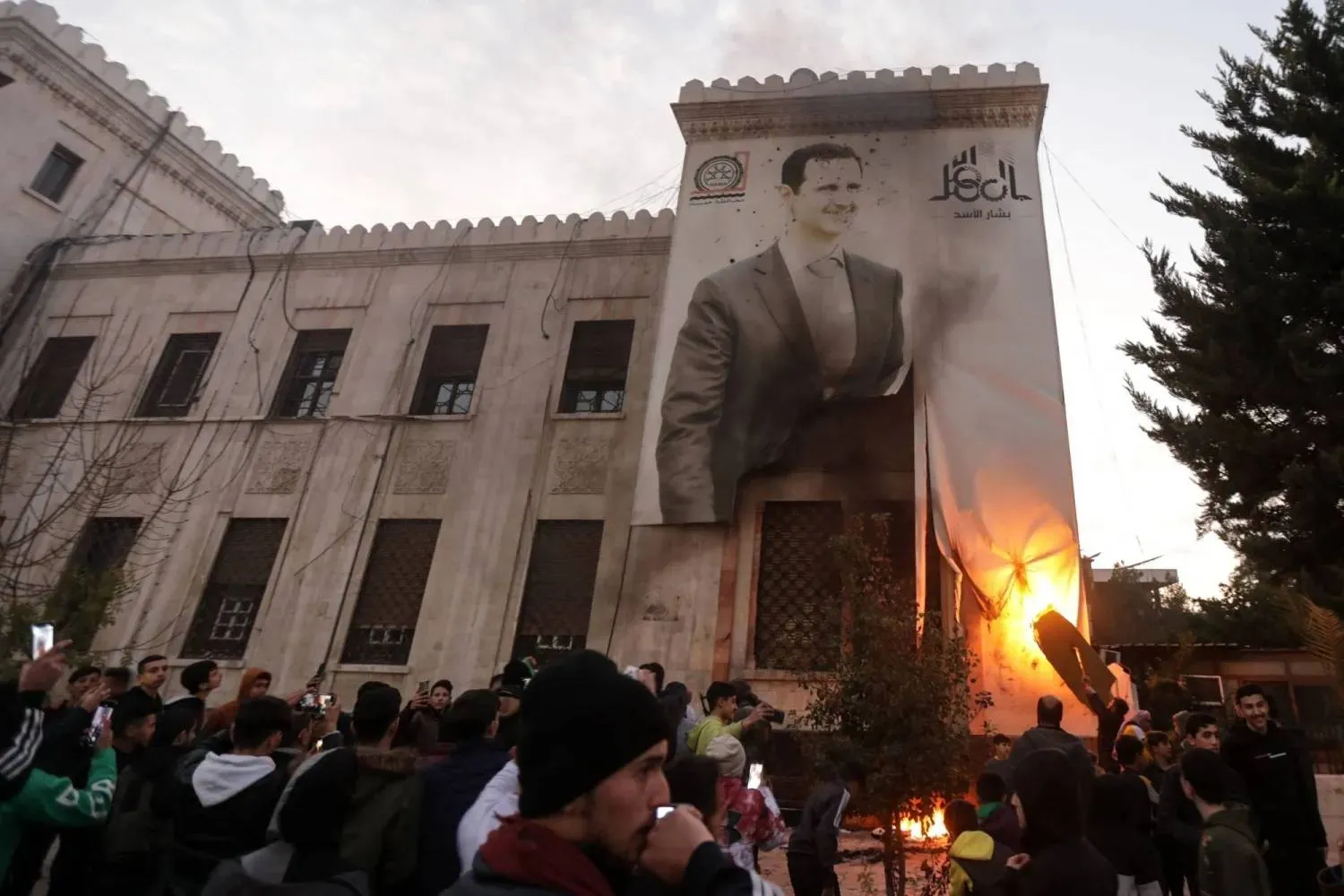
Hama residents set fire to a large banner of Bashar al Assad after armed factions seized the city last December (AFP)
TT

What Syria’s Military Map Looks Like One Year After Assad Ouster

Hama residents set fire to a large banner of Bashar al Assad after armed factions seized the city last December (AFP)

Syria’s map of control has been shaken to its core since late 2024, when the Deterrence of Aggression offensive erupted and the Assad government fell, unleashing a series of security and military shifts that continued to redraw the country’s landscape through 2025.

But this fluid map is unlikely to hold, according to a study by the Syrian research group Jusoor Center for Studies. With regional and international actors working to head off the chaos and potential partition that threaten wider stability, any near term changes in who controls what are expected to come through political and security pressure rather than a return to large scale battles.

Mahmoud Eibo, one of three researchers who worked on a report on territorial influence in Syria in 2025, told Asharq Al-Awsat that the balance of control shifted sharply after the launch of the Deterrence of Aggression battles on November 27, 2024.

In less than two weeks, the Assad government lost the areas it had held since 2020, which covered more than half of the country.

Iranian withdrawal from Syrian territory

With the government’s fall, Iran’s presence also unraveled after more than a decade of entrenchment. Iran backed militias withdrew from rural Damascus, Homs, Aleppo, the southern provinces and from Al-Bukamal and Al-Mayadin.

Eibo said the militias “withdrew completely” after supply lines linking them to Lebanon and Iraq were severed, which effectively ended Iran’s influence and that of its militias across Syria.

The military role of Hezbollah also came to an end. The group had been one of Tehran’s key proxies in Syria since 2013, when its intervention began with the capture of Al-Qusayr.

But the turning point ended in the same town, after factions in the Deterrence of Aggression campaign seized Al-Qusayr in late 2024 and Hezbollah forces pulled out entirely.

The moment marked a definitive end to Hezbollah’s long military presence in Syria, after the group lost one of its most critical geographic links to Iran through Syrian territory.

Many areas that had been under the indirect influence of Hezbollah and Iran backed factions also slipped out of their orbit and reverted to the authority of the new Syrian state and its security and military institutions in the north.

The largest shift in influence last year came at the expense of the Syrian Democratic Forces, known as the SDF, Eibo said. The Dawn of Freedom operation ended the group’s presence in strategically important areas west of the Euphrates, beginning with the fall of Tel Rifaat and surrounding villages and extending toward Manbij, which cost the SDF one of its key cities in the region.

As a result, the SDF’s influence contracted in northern and eastern Aleppo countryside and the group withdrew eastward toward Raqqa, Hasakeh and parts of Deir Ezzor.

Sweida and the south

In the south, a limited but consequential development emerged in Sweida province. Local groups linked to Sheikh Hikmat Al-Hajri seized parts of the province after government forces withdrew, taking advantage of the security vacuum.

Although the area under their control is geographically small, it created a pocket of influence outside the new government’s authority and added another layer of instability to the southern provinces.

In parallel, Israel capitalized on the collapse of the southern front. It pushed beyond the buffer zone and established a presence in select points and strategic hilltops near the disengagement line.

Although the area is small, the symbolic and intelligence value of the chosen positions gives Israel leverage through monitoring and pressure, keeping the south open to volatility.

What the new map shows

Syria’s territorial map at the end of 2025 reflects a new political landscape dominated by four actors: the Syrian government, the SDF, the National Guard forces in Sweida and Israel, each wielding varying degrees of influence.

The Syrian government remains the primary authority. Beyond its broad political and social control, it holds 69.3% of the country’s territory, covering major cities, most administrative structures and key transport routes. It does not, however, control four provincial capitals: Quneitra, Sweida, Hasakeh and Raqqa.

The SDF controls 27.8% of Syria’s territory, concentrated in the north and east. The expanse is significant but uneven in terms of internal stability. The group faces serious political pressure tied to the implementation of the March 10, 2025 agreement, which is expected to reshape its relationship with the Syrian government.

The National Guard forces in Sweida, loyal to Sheikh Hikmat Al-Hajri, control 2.8% of the country. Their influence is small in size but distinct in nature. The significance lies in their location and in the direct support they receive from Israel, which positions them within a broader framework aimed at prolonging instability in the south.

Their presence overlaps with Israel’s incursion into Syrian territory, which covers 0.1% of the country. Despite the small footprint, the choice of elevated positions and small villages with high surveillance value reflects strategic intent.

Israel is not seeking territorial control, but rather an early warning line and a tighter grip over the border zone, while supporting an environment that prevents full stability in the south. This aligns with its indirect role in reinforcing the position of the Sweida National Guard forces.

Change driven by political pressure

According to Eibo, Syria’s map of control has undergone a fundamental rupture since late 2024, ending a geopolitical phase that had been largely settled since 2020.

The country has entered a more fluid and complex period marked by the retreat of traditional actors and the emergence of new, still unsettled zones of influence.

Although limited security and military shifts continued through 2025, it is unlikely that the current map will hold. Regional and international efforts are focused on avoiding chaos and partition.

Any upcoming change in territorial control will most likely be driven by political and security pressure and by reengineering spheres of influence rather than a return to large scale military confrontations.
How Iranians Are Communicating Through Internet Blackout

 People walk past closed shops at the almost empty traditional main bazaar, in Tehran, Iran, Tuesday, March 10, 2026. (AP)
People walk past closed shops at the almost empty traditional main bazaar, in Tehran, Iran, Tuesday, March 10, 2026. (AP)
TT

How Iranians Are Communicating Through Internet Blackout

 People walk past closed shops at the almost empty traditional main bazaar, in Tehran, Iran, Tuesday, March 10, 2026. (AP)
People walk past closed shops at the almost empty traditional main bazaar, in Tehran, Iran, Tuesday, March 10, 2026. (AP)

Iran's latest internet blackout has lasted more than 14 days, connectivity monitor Netblocks said Friday.

The nature of the limits on internet activity shows "this is a government-imposed measure" and not the result of damage from US and Israeli airstrikes, Netblocks research chief Isik Mater told AFP.

"It is a deliberate shutdown imposed by the authorities to suppress the flow of information and prevent further dissent," said Raha Bahreini, Iran researcher at Amnesty International.

Here are some of the ways information is still flowing in and out of Iran.

- Shortwave radio -

Amsterdam-based nonprofit Radio Zamaneh began shortwave broadcasts during the January protests, sending a nightly Farsi news program from 11:00 pm Tehran time.

"It's really difficult for the regime to jam shortwave because it's a long-distance broadcast," executive director Rieneke van Santen told AFP.

"People can just listen on a super cheap, small, simple radio... It's one of those typical emergency fall-back solutions."

Declining to specify where the transmitter is located, she said it is "closer to the Netherlands than to Iran" -- although Tehran "can figure it out" if they choose.

- Phone calls -

Many with ties to Iran are still receiving landline phone calls from inside -- "quite surprising" given the internet blackout, said Mahsa Alimardani of global rights organization Witness.

Fearing the authorities listening in, people often avoid speaking directly about political topics, such as the killing of Ali Khamenei, she added.

"It's not possible to communicate about sensitive issues through these brief phone calls," Amnesty's Bahreini said.

The required prepaid international calling cards are expensive and often fail to provide their face value in minutes.

"You buy a phone card for 60 minutes, but in eight minutes, it's out," van Santen said.

"It's really just phone calls from family members saying, after the bombing, we're still alive."

- VPN or other internet services -

Virtual private networks (VPNs) -- widely-used services that encrypt internet traffic -- can't create an internet connection where none is available.

But even at around one percent of typical levels, Iran's connectivity is "still a large figure in absolute terms", Netblocks' Mater said.

Iranians suspected of using VPNs since the war began have received warning text messages claiming to be from the authorities.

Before the war, millions turned to Toronto-based company Psiphon, which creates specialist tools more capable than typical "off-the-shelf" VPNs.

Offering techniques including disguising users' data as different types of internet traffic, Psiphon "is able to evade detection more successfully", data and insights director Keith McManamen told AFP.

With up to six million unique daily users in Iran before the latest internet shutdown, connections have now tumbled to fewer than 100,000.

Few but the most tech-savvy users can reach Psiphon's network for now.

Nevertheless, "the situation is extremely dynamic. We're seeing changes not just day to day, but hour by hour," McManamen said.

A similar service, US-based Lantern, is also widely used in Iran.

- Satellite broadcasts -

Created by US-based nonprofit NetFreedom Pioneers, Toosheh is a "filecasting" technology using home satellite TV equipment to broadcast encrypted data to people in Iran.

Users record from the Toosheh satellite TV channel onto a USB stick plugged into their set-top box, which they can then decrypt using a special app installed on their phone or computer.

From that initial download, the data can be copied and shared across multiple households.

The group estimated around three million active users in Iran across 2025, with "thousands to hundreds of thousands... since the (internet) shutdown in January," the group's director of projects Emilia James told AFP.

From its usual educational repertoire ranging from English lessons to news, content these days includes more on "personal safety and digital security... helping people to stay safe," she added.

Since people are tuning in to a broadcast signal, there is no way for the government to track them, she added.

- Starlink -

Elon Musk-owned satellite internet service Starlink was used during this year's protests to get information out, while the government attempted to jam its signals.

At around $2,000 on Iran's black market, the terminals are expensive and very rare in poorer regions like Balochistan or Kurdistan that have suffered the most government repression, Alimardani said.

Meanwhile, Amnesty has received reports of "raids on houses... arrests of people who had Starlink devices," Bahreini said.

Charges for those caught communicating with the outside world range from prison sentences to the death penalty, she added.

Starlink did not respond to AFP's request for comment on usage in Iran.


Will Ahmadinejad Return to the Political Scene in Iran?

Iranian former President Mahmoud Ahmadinejad. (AFP)
TT

Will Ahmadinejad Return to the Political Scene in Iran?

Iranian former President Mahmoud Ahmadinejad. (AFP)

A report by The Atlantic said the strike that hit a region close to Iranian former President Mahmoud Ahmadinejad’s residence in the first days of the war on Iran has returned to the spotlight a still controversial political figure even though he left office for over a decade ago.

On the first day of the Iran war, the assassination of Supreme Leader Ali Khamenei overshadowed news of a strike near Ahmadinejad’s home, said the report.

“Many who remembered his term in office - marked by Holocaust denial, atom-bomb fetishism, and shoving revolutionary ideology down the throats of a country already weary of it - celebrated his reported assassination,” it added. He was president from 2005 to 2013.

“Among those who have followed Ahmadinejad’s post-presidential career, however, his targeting was more of an enigma. Since leaving office, Ahmadinejad has harshly criticized the Iranian government, and as a result, Iran’s Guardian Council has formally excluded him from running for president,” said the report.

For more than a decade, he has been known more as a regime opponent than as a supporter. “I don’t understand why Israel would want to kill him in the first place,” Meir Javedanfar, who co-wrote a biography of Ahmadinejad, told The Atlantic. “Perhaps to settle scores? It makes no sense.”

Contrary to early reports, Ahmadinejad is alive, his associates revealed, requesting anonymity. “The circumstances of his survival may prove significant as the war drags on. Whatever the intent, Ahmadinejad’s associates say the strike was in effect a jailbreak operation that freed the former president from regime control.”

“Long before the war, the government had posted a small number of bodyguards near Ahmadinejad, nominally to protect a prominent citizen but also to keep tabs on him. The regime has never been sure what to do with him,” said the report.

About a month ago, after the January protests, his freedom of movement was further reduced, his phones confiscated, and the contingent of bodyguards increased from single digits to about 50. The bodyguards were based a few hundred meters from Ahmadinejad’s residence itself, at the entrance to a cul-de-sac in Narmak, in northeast Tehran. They established a checkpoint to monitor the houses and high school on that street.

“A February 28 strike hit not the residence, but the security forces nearby. In the ensuing mayhem, Ahmadinejad and his family evidently escaped their home and went underground. The government believed he had died, and his death was announced by official channels, as well as the reformist daily Sharq.”

“When rumors arose that Ahmadinejad had escaped, regime elements immediately suspected that he had been spirited away to take part in a coup,” said The Atlantic. “Ahmadinejad’s only public statement since the attack has been a brief eulogy for the supreme leader, calculated to show that Ahmadinejad was alive and to dispel speculation that he had declared himself an enemy of the state. His location is unknown to the government.”

In 2018, former Defense Minister Hussein Dehghan likened Ahmadinejad to “the door of the mosque, which can’t be burned or thrown away” without torching the mosque itself.

“Arresting Ahmadinejad could unsettle the regime,” Javedanfar said. “He knows a hell of a lot about it.”

“Ahmadinejad’s fans say that he has popular support, and that any postwar government will want him around to lend that support. If the current regime survives, it will need all the legitimacy it can get. If it does not, the United States might need someone with intimate - if outdated - knowledge of the Iranian state to be involved with what comes next. Ahmadinejad could still be useful,” the report said.


How Have US Presidents Tapped Strategic Petroleum Reserves During War?

GILLETT, TEXAS - MARCH 11: Pump jacks operate in a field on March 11, 2026 in Gillett, Texas. Brandon Bell/Getty Images/AFP
TT

How Have US Presidents Tapped Strategic Petroleum Reserves During War?

GILLETT, TEXAS - MARCH 11: Pump jacks operate in a field on March 11, 2026 in Gillett, Texas. Brandon Bell/Getty Images/AFP

The US plans to release 172 million barrels of oil from its Strategic Petroleum Reserve, more than 40% of a wider release coordinated with allies, to help dampen prices spiked by supply disruptions from the US-Israeli war on Iran.

The US sale, announced late on Wednesday, is part of a 400-million-barrel release by members of the International Energy Agency. The US Department of Energy said the US drawdown would begin next week and take about four months.

The SPR currently holds about 415 million barrels, most of which is high sulfur, or sour ‌crude, that US ‌refineries are geared to process. The crude is ‌held ⁠underground in hollowed-out salt ⁠caverns on the coasts of Texas and Louisiana that can store 714 million barrels.

Here is how US presidents have tapped the SPR in times of war:

RUSSIA INVADES UKRAINE

In March 2022, the month after Russia invaded Ukraine, former President Joe Biden ordered the release of 180 million barrels over six months - the largest sale ever from the emergency stash. Biden, ⁠and later President Donald Trump, slowly bought some oil ‌to replenish the reserves, but little ‌has been added back as Congress needs to provide more money to ‌do so.

LIBYA CIVIL WAR

In ⁠June 2011, former ⁠President Barack Obama ordered the release of 30 million barrels of oil from the reserve to offset disruptions to global markets from civil war in oil producer Libya. That sale was coordinated with the Paris-based IEA, resulting in an additional 30-million-barrel release from other member countries.

OPERATION DESERT STORM

In 1990-1991, after the Iraqi invasion of Kuwait, former President George H. W. Bush sold about 21 million barrels in two phases. In October 1990, the US ordered a 3.9-million-barrel test sale. In January 1991, after US and allied warplanes began attacks against Baghdad and other military targets in OPEC-member Iraq as part of Operation Desert Storm, Bush ordered the sale of 34 million barrels, of which half was sold.