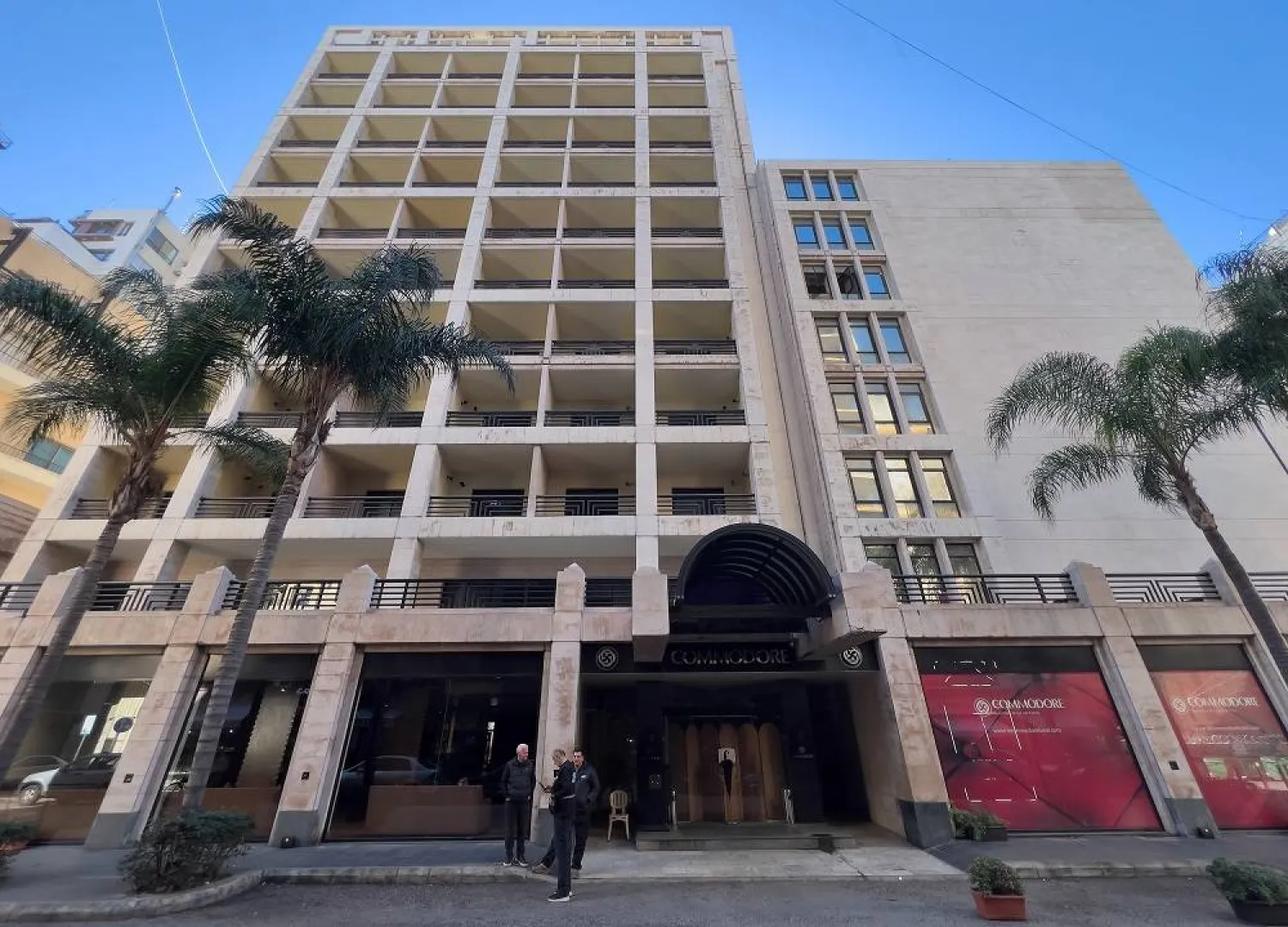

Beirut’s Commodore Hotel, a Haven for Journalists During Lebanon’s Civil War, Shuts Down

People stand outside the closed Commodore hotel, in Beirut, Lebanon, Sunday, Jan. 11, 2026. (AP)
TT

Beirut’s Commodore Hotel, a Haven for Journalists During Lebanon’s Civil War, Shuts Down

People stand outside the closed Commodore hotel, in Beirut, Lebanon, Sunday, Jan. 11, 2026. (AP)

During Lebanon’s civil war, the Commodore Hotel in western Beirut's Hamra district became iconic among the foreign press corps.

For many, it served as an unofficial newsroom where they could file dispatches even when communications systems were down elsewhere. Armed guards at the door provided some sense of protection as sniper fights and shelling were turning the cosmopolitan city to rubble.

The hotel even had its own much-loved mascot: a cheeky parrot.

The Commodore endured for decades after the 15-year civil war ended in 1990 — until this week, when it closed for good.

The main gate of the nine-story hotel with more than 200 rooms was shuttered Monday. Officials at the Commodore refused to speak to the media about the decision to close.

Although the country’s economy is beginning to recover from a protracted financial crisis that began in 2019, tensions in the region and the aftermath of the Israel-Hezbollah war that was halted by a tenuous ceasefire in November 2024 are keeping many tourists away. Lengthy daily electricity cuts force businesses to rely on expensive private generators.

The Commodore is not the first of the crisis-battered country’s once-bustling hotels to shut down in recent years.

But for journalists who lived, worked and filed their dispatches there, its demise hits particularly hard.

“The Commodore was a hub of information — various guerrilla leaders, diplomats, spies and of course scores of journalists circled the cafes and lounges,” said Tim Llewellyn, a former BBC Middle East correspondent who covered the civil war. “On one occasion (late Palestinian leader) Yasser Arafat himself dropped in to sip coffee with” with the hotel manager's father, he recalled.

A line to the outside world

At the height of the civil war, when telecommunications were dysfunctional and much of Beirut was cut off from the outside world, it was at the Commodore where journalists found land lines and Telex machines that always worked to send reports to their media organizations around the globe.

Across the front office desk in the wide lobby of the Commodore, there were two teleprinters that carried reports of The Associated Press and Reuters news agencies.

“The Commodore had a certain seedy charm. The rooms were basic, the mattresses lumpy and the meal fare wasn’t spectacular,” said Robert H. Reid, the AP’s former Middle East regional editor, who was among the AP journalists who covered the war. The hotel was across the street from the international agency’s Middle East head office at the time.

“The friendly staff and the camaraderie among the journalist-guests made the Commodore seem more like a social club where you could unwind after a day in one of the world’s most dangerous cities,” Reid said.

Llewellyn remembers that the hotel manager at the time, Yusuf Nazzal, told him in the late 1970s “that it was I who had given him the idea” to open such a hotel in a war zone.

Llewellyn said that during a long chat with Nazzal on a near-empty Middle East Airlines Jumbo flight from London to Beirut in the fall of 1975, he told him that there should be a hotel that would make sure journalists had good communications, “a street-wise and well-connected staff running the desks, the phones, the teletypes.”

During Israel's 1982 invasion of Lebanon and a nearly three-month siege of West Beirut by Israeli troops, journalists used the roof of the hotel to film fighter jets striking the city.

The parrot

One of the best-known characters at the Commodore was Coco the parrot, who was always in a cage near the bar. Patrons were often startled by what they thought was the whiz of an incoming shell, only to discover that it was Coco who made the sound.

AP’s chief Middle East correspondent Terry Anderson was a regular at the hotel before he was kidnapped in Beirut in 1985 and held for seven years, becoming one of the longest-held American hostages in history.

Videos of Anderson released by his kidnappers later showed him wearing a white T-shirt with the words “Hotel Commodore Lebanon.”

With the kidnapping of Anderson and other Western journalists, many foreign media workers left the predominantly-Muslim western part of Beirut, and after that the hotel lost its status as a safe haven for foreign journalists.

Ahmad Shbaro, who worked at different departments of the hotel until 1988, said the main reason behind the Commodore’s success was the presence of armed guards that made journalists feel secure in the middle of Beirut’s chaos as well as functioning telecommunications.

He added that the hotel also offered financial facilities for journalists who ran out of money. They would borrow money from Nazzal and their companies could pay him back by depositing money in his bank account in London.

Shbaro remembers a terrifying day in the late 1970s when the area of the hotel was heavily shelled and two rooms at the Commodore were hit.

“The hotel was full and all of us, staffers and journalists, spent the night at Le Casbah,” a famous nightclub in the basement of the building, he said.

In quieter times, journalists used to spend the night partying by the pool.

“It was a lifeline for the international media in West Beirut, where journalists filed, ate, slept, and hid from air raids, shelling, and other violence,” said former AP correspondent Scheherezade Faramarzi.

“It gained both fame and notoriety,” she said, speaking from the Mediterranean island of Cyprus.

The hotel was built in 1943 and kept functioning until 1987 when it was heavily damaged in fighting between Shiite and Druze militiamen at the time. The old Commodore building was later demolished and a new structure was build with an annex and officially opened again for the public in 1996.

But Coco the parrot was no longer at the bar. The bird went missing during the 1987 fighting. Shbaro said it is believed he was taken by one of the gunmen who stormed the hotel.


Kharg Island: Iran’s Vital Oil Hub in the Crosshairs?

This handout image taken by the European Space Agency (ESA) captured by the Copernicus Sentinel-2 satellite shows a view of Iran's Kharg Island, which hosts the country's main crude export terminal and is responsible for the overwhelming majority of its oil shipments to the world, about 25 kilometers south of the mainland in the north of the Gulf, on March 2, 2026. (AFP / ESA)
TT

Kharg Island: Iran’s Vital Oil Hub in the Crosshairs?

This handout image taken by the European Space Agency (ESA) captured by the Copernicus Sentinel-2 satellite shows a view of Iran's Kharg Island, which hosts the country's main crude export terminal and is responsible for the overwhelming majority of its oil shipments to the world, about 25 kilometers south of the mainland in the north of the Gulf, on March 2, 2026. (AFP / ESA)

Kharg Island, a scrubby stretch of land in the northern Gulf, handles almost all of Iran's crude exports and any attempt to seize it would mark a major escalation in the conflict, analysts say.

The US and Israel have so far treaded carefully around the island, but an Axios report over the weekend cited Trump administration officials saying capturing Kharg was on the table as the war in the Middle East persists.

The island, located around 30 kilometers (19 miles) off the Iranian mainland, handles roughly 90 percent of Iran's crude exports, according to a JP Morgan note released Sunday.

Any move on the territory, which is about one-third the size of Manhattan, would have swift repercussions, experts say.

"A direct strike would immediately halt the bulk of Iran's crude exports, likely triggering severe retaliation in the Strait of Hormuz or against regional energy infrastructure," JP Morgan said.

Iranian strikes have all but halted maritime traffic in the Strait of Hormuz -- through which a fifth of global crude oil and liquefied natural gas normally pass -- and have also impacted oil infrastructure in other Gulf states.

But Iranian energy assets have not been degraded so far and targeting the island would be "a very risky move", Farzin Nadimi, senior fellow at the Washington Institute for Near East Policy, told AFP.

Iran is not only "experienced in using alternatives" in wartime, it could "cause a lot more damage on the Gulf oil and gas installations if they want to and they can do a lot more very quickly, and everybody knows that".

"I don't think that seizing the island will go any further than US Congressional debates," he added -- the prospect having been discussed in Washington since the hostage crisis that started in 1979 during the foundation of the Islamic republic.

Kharg underwent key developments during Iran's oil expansion in the 1960s and 1970s, with much of the country's coast too shallow for supertankers.

Iran has looked to diversify its export capabilities by opening the Jask terminal outside the Strait of Hormuz chokepoint in the Gulf of Oman in 2021, but Kharg remains "a critical vulnerability" for Iran, JP Morgan said.

"It is a cornerstone of Iran's economy and a major source of revenue for the Iranian Revolutionary Guard," JP Morgan added, referring to the well-resourced ideological branch of Iran's army.

- 'Very difficult' -

The war has sent oil prices soaring, although US President Donald Trump's suggestion on Monday that the conflict could end soon has calmed the market.

Over the weekend, the director of the White House National Energy Dominance Council Jarrod Agen told Fox News that "what we want to do is get such massive oil reserves in Iran out of the hands of terrorists".

Also in recent days, the Washington Post reported heightened speculation that US ground forces could be being prepared to deploy, citing analysts saying Kharg Island would be an early target.

Nadimi said Washington could move to seize the island when hostilities end, but that it was "not a wise move" during combat when Kharg is "almost an entire island of oil facilities and pipelines and tank farms".

"It is very difficult to wage a military operation on that particular island," he said.

But other oil infrastructure could be in the crosshairs, with Trump repeatedly referencing his operation to topple Venezuelan president Nicolas Maduro and gain access to the country's oil reserves in January as a blueprint.

Iran -- the fourth-biggest crude producer within the Organization of the Petroleum Exporting Countries (OPEC) -- vowed not one liter of oil would be exported from the Gulf while the war continues.

Any attack on its infrastructure would get an "eye for an eye" response, it said.

On Saturday, Israel launched its first attack of the war on oil facilities in Iran, but it said they were used "to operate military infrastructure".

The same day, Israeli opposition leader Yair Lapid argued for stronger steps, saying in an X post: "Israel needs to destroy all of Iran's oil fields and energy industry on Kharg Island; that's what will crush Iran's economy and bring down the regime."


Lebanon’s Latest Conflict Brings Rare Public Backlash Against Hezbollah as War Flares Again

Two women look at the sea as boxes of food prepared for Iftar during Ramadan lie on a bench along the Corniche, following an escalation between Hezbollah and Israel amid the US-Israeli conflict with Iran, in Beirut, Lebanon, March 10, 2026. (Reuters)
TT

Lebanon’s Latest Conflict Brings Rare Public Backlash Against Hezbollah as War Flares Again

Two women look at the sea as boxes of food prepared for Iftar during Ramadan lie on a bench along the Corniche, following an escalation between Hezbollah and Israel amid the US-Israeli conflict with Iran, in Beirut, Lebanon, March 10, 2026. (Reuters)

The Lebanese mother of two had just awakened to prepare the pre-dawn meal before another day of fasting during the holy month of Ramadan when Israeli warplanes began attacking southern Lebanon in retaliation for rockets and drones launched by Hezbollah.

The family quickly packed up and headed toward Beirut, seeking safety from another deadly war between Israel and Hezbollah. With tens of thousands of others fleeing on that March 2 day, the usually one-hour trip from the southern city of Nabatiyeh took 15 hours.

“I am against giving pretexts to Israel,” said the 45-year-old woman, who spoke on condition of anonymity for fear of reprisals from the Hezbollah supporters she lives among.

“I am totally against Hezbollah’s decision to start with the first strike,” said the woman, who is now living with her husband, their 17- and 12-year-old children, and her mother-in-law inside a school turned into a shelter in the Lebanese capital.

As Hezbollah enters a new round of fighting with Israel just 15 months after the last Israel-Hezbollah war ended with a November 2024 US-brokered ceasefire, the Iran-backed group and political party is facing increasing grassroots discontent within its base and problems with the Lebanese authorities.

Population still reeling from the previous war

On March 2, two days after Israel and the US launched attacks on Iran, igniting a war in the Middle East, Hezbollah fired missiles and drones into Israel for the first time in more than a year.

Hundreds of thousands of residents of southern Lebanon, the eastern Bekaa valley and Beirut’s southern suburbs have fled their homes after Israeli warnings that their neighborhoods, towns and villages would be targeted.

The new round of fighting comes as Shiite communities that suffered the brunt of the last conflict are still reeling from it. The last Israel-Hezbollah war killed more than 4,000 people in Lebanon and caused $11 billion in damage, according to the World Bank.

Unlike in the past, when many people were afraid to publicly criticize Hezbollah, some Lebanese Shiites are openly blaming the group for their current misery as they find themselves living in the street, on public squares, or with relatives or friends amid cold weather and fasting during Ramadan.

For Hussein Ali, it was the second time in less than two years that he was forced to leave his house in Beirut’s southern suburb of Haret Hreik. During the last Israel-Hezbollah war, the apartment where he lived was destroyed and now the vegetable vendor is worried the same thing will happen again.

“No one wanted this war,” said the man, who is also staying in the school and relying on aid to survive. “People haven’t recovered from the previous war."

Government takes a harsher stance

After the end of Lebanon's civil war in 1990, militias were required to disarm, but Hezbollah was exempted because it was fighting Israel's occupation of southern Lebanon at the time.

Now the Lebanese government has sought to crack down on the group’s armed wing and end its status as a parallel armed force outside of state control.

The shift was clear when, on March 2, the Lebanese government moved to declare Hezbollah’s military activities illegal, with all but two of the 24 Cabinet ministers voting in favor; only the two Hezbollah ministers voted no. Even ministers from Hezbollah’s strongest ally, the Amal group of Parliament Speaker Nabih Berri, voted to approve the measure.

“The government confirms that the decision of war and peace is only in the hand of the state,” Prime Minister Nawaf Salam said, adding that the government “orders the immediate ban on all of Hezbollah’s military activities as they are illegal and it should be forced to hand over its weapons to the Lebanese state.”

The Lebanese army has since begun to crack down and last week arrested three Hezbollah members who were found transporting weapons at a checkpoint. But the men were released on bail Monday.

Government officials have accused Hezbollah of repeatedly taking unilateral military actions that should be under state authority. On Oct. 8, 2023, the group began attacking Israel a day after the assault led by the Iranian-backed Hamas on southern Israel triggered the war in Gaza.

Now, the group has entered the fray on behalf of Iran to avenge the killing of its supreme leader, Ali Khamenei, as well as in retaliation, it says, for Israeli violations of the November 2024 ceasefire.

Some Hezbollah supporters see the war as justified

Ali al-Amin, a Lebanese journalist who is a harsh critic of Hezbollah, said that while some people are now criticizing the armed group more than in the past, many still remain quiet out of fear for their safety.

“Criticism could have a high cost and not all people express their opinions,” said al-Amin, a Shiite from south Lebanon, who added that many poor Shiites rely on assistance that could be cut off anytime by Hezbollah or the allied Amal movement.

In the past, people who criticized Hezbollah on social media were sometimes roughed up by its supporters and forced to make new videos saying they were wrong.

But the group still has many supporters. They say that Hezbollah's decision to strike was justified because Israel had not abided by the November 2024 ceasefire.

Since the ceasefire, Israel has continued to carry out almost daily airstrikes against Hezbollah, which have killed about 400 people, including dozens of civilians, and that have also prevented the reconstruction of destroyed areas.

“We cannot tolerate that anymore,” said Ali Saleh who was displaced from a southern village near Nabatiyeh. “I pray for God to protect our young men and make them victorious against Israel."

Even the Shiite woman who criticized Hezbollah's move to strike first said that if the party hadn't, the result might have been the same.

“If we attack they will attack us and if we don’t attack they would have attacked us,” she said.

Sadek Nabulsi, a political science professor at the Lebanese University whose thinking aligns with Hezbollah, said the latest complaints are nothing new and don’t represent a fissure in grassroots support for the Iranian-allied groups. There was a similar outcry during the 14-month Israel-Hezbollah war that ended in 2024 and the monthlong war in 2006, he said.

“Hezbollah’s base of support is known for ... tolerating pain,” Nabulsi said. “If you look at this base of support, despite all the harsh conditions, it is still coherent, patient and waiting for salvation.”


Gaza Patients Face Death Again as Rafah Crossing Stays Closed

Palestinian patients sit in wheelchairs in the courtyard of the Red Crescent Hospital in Khan Younis while waiting to leave for treatment (AFP)
TT

Gaza Patients Face Death Again as Rafah Crossing Stays Closed

Palestinian patients sit in wheelchairs in the courtyard of the Red Crescent Hospital in Khan Younis while waiting to leave for treatment (AFP)

Patients and wounded in Gaza are facing increasingly harsh conditions after Israeli authorities again closed the Rafah land crossing, which had been partially reopened for a short period under a ceasefire agreement following a prolonged shutdown that prevented tens of thousands from leaving for medical treatment.

The crossing’s reopening at the beginning of February had raised hopes among patients and the wounded that they would be able to travel abroad for treatment. However, Israeli restrictions on the number of people permitted to leave further complicated the situation.

Those hopes faded when the crossing was closed again following the start of the war with Iran on the 28th of last month.

Twelve-year-old Asmaa al-Shawish, who suffers from a rare disease known as Sanfilippo syndrome, has for years faced the threat of death as her health has recently deteriorated sharply, her mother told Asharq Al-Awsat.

Her mother said the girl had obtained a medical referral to receive treatment abroad in 2023, shortly before the war began, but did not manage to travel in time. She remained inside Gaza, and her condition has continued to worsen day by day.

She said her daughter is losing the ability to drink water and suffers from brain atrophy as well as enlargement of the liver and spleen. The child also experiences constant seizures and requires daily treatment in hospitals in an effort to keep her alive as long as possible. Her condition, she added, is deteriorating rapidly.

“When the Rafah crossing opened, we felt a little hope that we might be able to travel again,” she said. “But the large number of patients and wounded waiting like us delayed our departure until the occupation closed it again, leaving us to face our fate on our own.”

“Every time I see my daughter in this condition, I grieve over her harsh circumstances,” she added. “I see her taking her last breaths, and she could die at any moment.”

20,000 Patients

According to the Gaza Health Ministry, more than 20,000 patients and wounded people urgently need treatment abroad. Deaths are already being recorded among those waiting for the crossing to reopen regularly, as it operated before the war, so they can travel and save their lives.

The ministry said hospitals in the enclave lack the medical capabilities needed to save these patients amid the difficult conditions imposed by the Israeli blockade. It added that some medicines have completely run out, while others are close to being depleted.

According to the government media office, the total number of travelers and returnees during the period when the Rafah land crossing was partially open reached 1,148 out of the 3,400 expected to travel in both directions. This represents about 33% compliance with the agreement that was supposed to be implemented after the ceasefire.

Government sources from Hamas told Asharq Al-Awsat that there are “no promises to reopen the Rafah land crossing, even partially.”

Hazem Qassem, a spokesman for Hamas, said the continued closure of the Rafah crossing “under flimsy security pretexts and false claims” represents a “blatant and dangerous violation” of the ceasefire agreement and a retreat from commitments made to mediators, particularly Egypt.

He said the move is part of efforts to “tighten the blockade” imposed on the enclave, preventing tens of thousands of wounded people from traveling to receive what he described as their natural right to medical treatment.

Continued Killings

On the ground, Israel has continued its escalation, killing more Palestinians and striking multiple targets across the enclave.

The Israeli military said on Tuesday it had killed six Palestinians, three of whom it said had crossed the “yellow line” north of the enclave, and three armed Hamas members in tunnels in Rafah.

The number of Palestinian deaths since the ceasefire has risen to more than 656, including at least 20 killed since the start of the war with Iran. The cumulative toll since Oct. 7, 2023, has reached 72,134 deaths.

This coincided with Israeli airstrikes, artillery shelling and gunfire in several areas on both sides of the yellow line in the enclave. For the second consecutive day, bulldozers were seen demolishing what remained of homes east of Khan Younis, about 20 meters from Salah al-Din Road.

A warplane also struck a house whose residents had evacuated following an Israeli order in northern Khan Younis. Another strike hit a mobile phone charging point and an internet service station in an empty area next to tents housing displaced people southwest of Gaza City.