


As US and Iran Talk Truce, Israel Digs in for a 'Forever War'

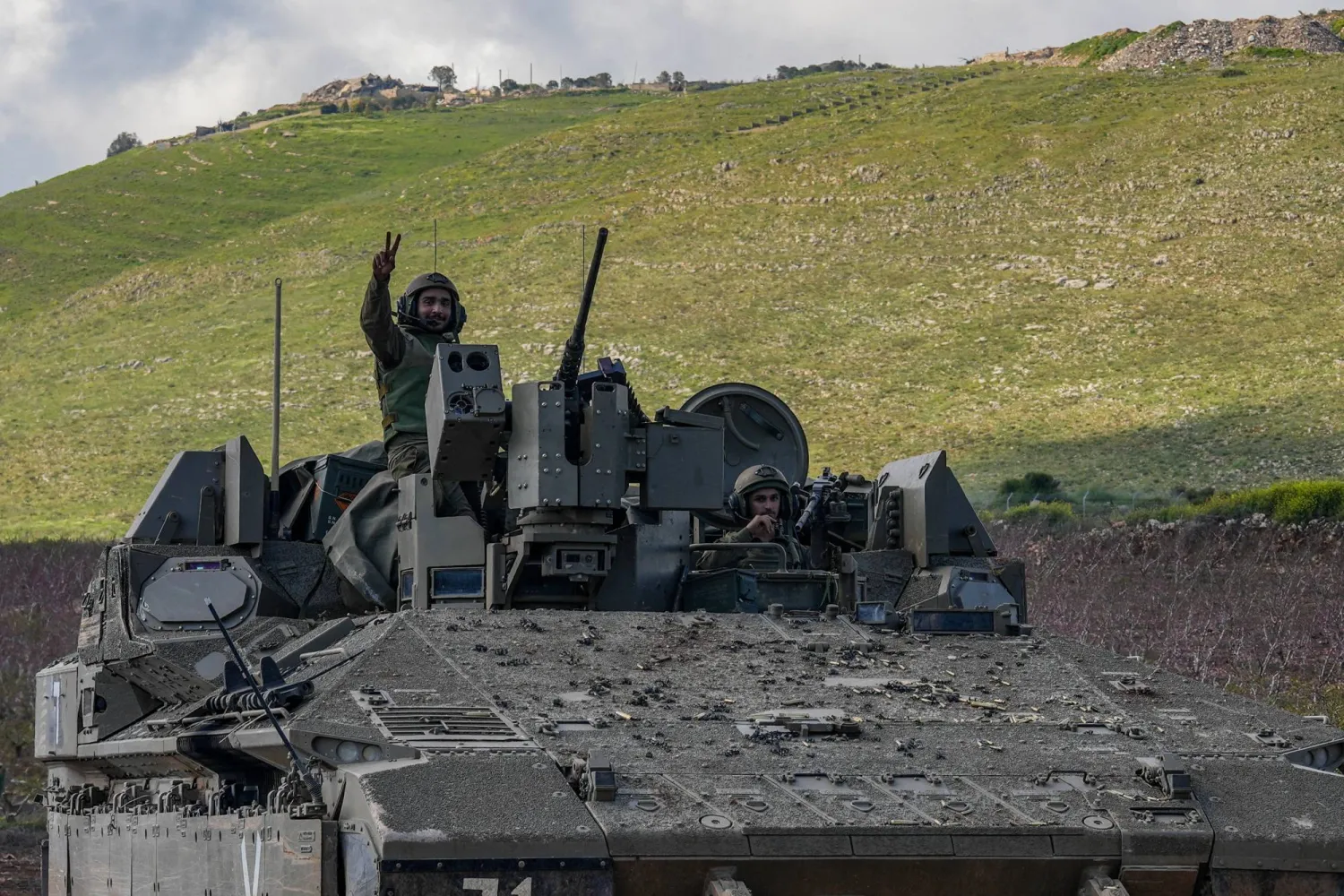
An Israeli soldier gestures from an Israeli armored personnel carrier (APC), as they leave southern Lebanon and enter Israel, as seen from the Israeli side of the border, April 8, 2026. REUTERS/Ayal Margolin
TT

As US and Iran Talk Truce, Israel Digs in for a 'Forever War'

An Israeli soldier gestures from an Israeli armored personnel carrier (APC), as they leave southern Lebanon and enter Israel, as seen from the Israeli side of the border, April 8, 2026. REUTERS/Ayal Margolin

Even as the US and Iran seek to cement a ceasefire, Israel is seizing more territory from its neighbors in preparation for a long, drawn-out conflict across the Middle East.

Israel's creation of "buffer zones" in Gaza, Syria and now Lebanon reflects a strategic shift after the attacks of October 7, 2023, one that puts the country in a semi-permanent state of war, six Israeli military and defense officials told Reuters.

The approach also acknowledges a reality the officials said had become increasingly clear after two-and-a-half years of conflict: Iran's clerical leadership, Hezbollah in Lebanon, Hamas in Gaza and militias across the region cannot be eliminated outright.

"Israel's leaders have concluded that they are in a forever war against adversaries who have to be intimidated and even dispersed," said Nathan Brown, of the Carnegie Endowment for International Peace.

The US and Iran agreed on Wednesday to a pause in fighting while they negotiate a broader end to the war, which erupted on February 28. Israel agreed to halt its attacks on Iran but says it will not stop its campaign against Iranian-backed Hezbollah.

Hezbollah joined the war on March 2 by firing rockets at Israel, which then launched a ground invasion of southern Lebanon to clear a buffer zone up to the Litani River - a broad swathe of land that makes up about 8% of Lebanese territory.

Israel has ordered the area's hundreds of thousands of residents to flee and is in the early stages of destroying homes in Shi'ite Muslim villages that it believes have been used by Hezbollah to store weapons or stage attacks.

A senior ‌military official, who requested ‌anonymity to discuss security matters, said the aim was to "clear" an area stretching 5-10 km beyond the border, putting Israeli border towns out ‌of range ⁠of Hezbollah rocket-propelled ⁠grenade fire.

In some Lebanese villages close to the border, Israeli troops found evidence that nearly 90% of homes contain weapons or equipment linking them to Hezbollah, the official said.

That means the homes are viewed as enemy military positions that must be destroyed, according to the official who said that many southern Lebanese villages sat on hilltops, giving them a direct line of sight into Israeli towns or army positions.

The use of buffer zones represents a new security doctrine that "border communities cannot be protected from the border", according to Assaf Orion, a retired Israeli brigadier general and former head of military strategy.

"Israel no longer waits for the attack to come," he added. "It sees an emerging threat and it attacks it preemptively."

Once the buffer against Hezbollah is secured, Israel will have seized or occupied territory in Lebanon, Syria, the West Bank and the Gaza Strip, where it remains in control of over half the territory after an October ceasefire with Hamas.

Under the ceasefire, Israel is meant to withdraw from all of Gaza as Hamas disarms, though ⁠the chances of that happening in the near future appear slim.

"We have established security belts deep beyond our borders," Israeli Prime Minister Benjamin ‌Netanyahu said in a video message released by his office on March 31.

"In Gaza - more than half of the Strip's ‌territory. In Syria, from the Mount Hermon summit until the Yarmuch River. In Lebanon - a vast buffer zone that thwarts the threat of invasion and keeps anti-tank fire a distance away from our communities."

The Lebanese buffer ‌zone plan has yet to be presented to Netanyahu's cabinet, according to a member of the cabinet and two of the officials.

The Israeli military referred queries about the buffer zones to ‌Netanyahu's office, which didn't immediately respond to a request for comment.

DEFENCE MINISTER VOWS TO RAZE VILLAGES

Israel has long held territory beyond its borders, including the occupied West Bank and Gaza, as well as the Golan Heights in southern Syria, territories captured in a 1967 regional war. Israel subsequently annexed the Golan Heights in 1981.

Hundreds of thousands of Israeli settlers now live in the West Bank among about 3 million Palestinians, who seek the territory as the heartland of a future state.

To many displaced Lebanese and Palestinian people, Israel's seizure of their land and destruction of their villages signals further territorial expansion, an interpretation reinforced by rhetoric from some far-right members ‌of Netanyahu's cabinet.

Bezalel Smotrich, Netanyahu's finance minister, said in March that Israel should extend its border up to the Litani River. He has made similar comments about Gaza, saying the territory should be annexed and settled by Israelis.

However, another Israeli military official, who also ⁠spoke on the condition of anonymity to discuss operational ⁠planning, said the Litani would not mark a new border. Rather, the buffer zone would be monitored with ground troops carrying out raids as needed, without necessarily holding positions along the river.

Israeli Defense Minister Israel Katz likened the devastation exacted on southern Lebanon to the scorched-earth policy used against Hamas in Gaza that saw entire cities depopulated.

"The village homes adjacent to the border, which serve as Hezbollah outposts for all intents and purposes, will be destroyed according to the Rafah and Khan Younis model in Gaza, to remove the treat from Israeli towns," he said on March 31.

Eran Shamir-Borer, an international law expert at the Israel Democracy Institute, said the destruction of civilian property was largely unlawful, with exceptions that include the property being used for a military purpose.

"Sweeping destruction of houses in southern Lebanon that is not based on individual analysis would be unlawful," he added.

ISRAELIS SCEPTICAL OF LONG-TERM PEACE DEALS

Israeli leaders' preference for a strategy led by the use of buffer zones follows decades of failed attempts to secure long-term peace agreements with the Palestinians, Lebanon and Syria.

The Israeli public is deeply skeptical of negotiated peace agreements with the Palestinians. A 2025 poll from the Pew Research Center found that just 21% of Israelis believe Israel and a potential future Palestinian state could coexist peacefully.

A poll from the Tel Aviv-based Institute for National Security Studies found that just 26% of Israelis believed the October ceasefire in Gaza would lead to many years of calm. Most expected a swift resumption of fighting, the poll showed.

Ofer Shelah, a research program director at the institute, said that in the absence of a negotiated peace settlement with Lebanon, having a buffer zone in the north would prevent the threat of attacks or a ground incursion by Hezbollah forces.

But he said the increased personnel needed to patrol fronts across Lebanon, Gaza, Syria and the occupied West Bank would eventually put major strain on the military's forces.

"We would be better off eventually going back to the international border and maintaining a mobile active defenses beyond the border, without having outposts there," Shelah added.
Iraq Fish Die-off Leaves Farmers Mourning Lost Livelihoods

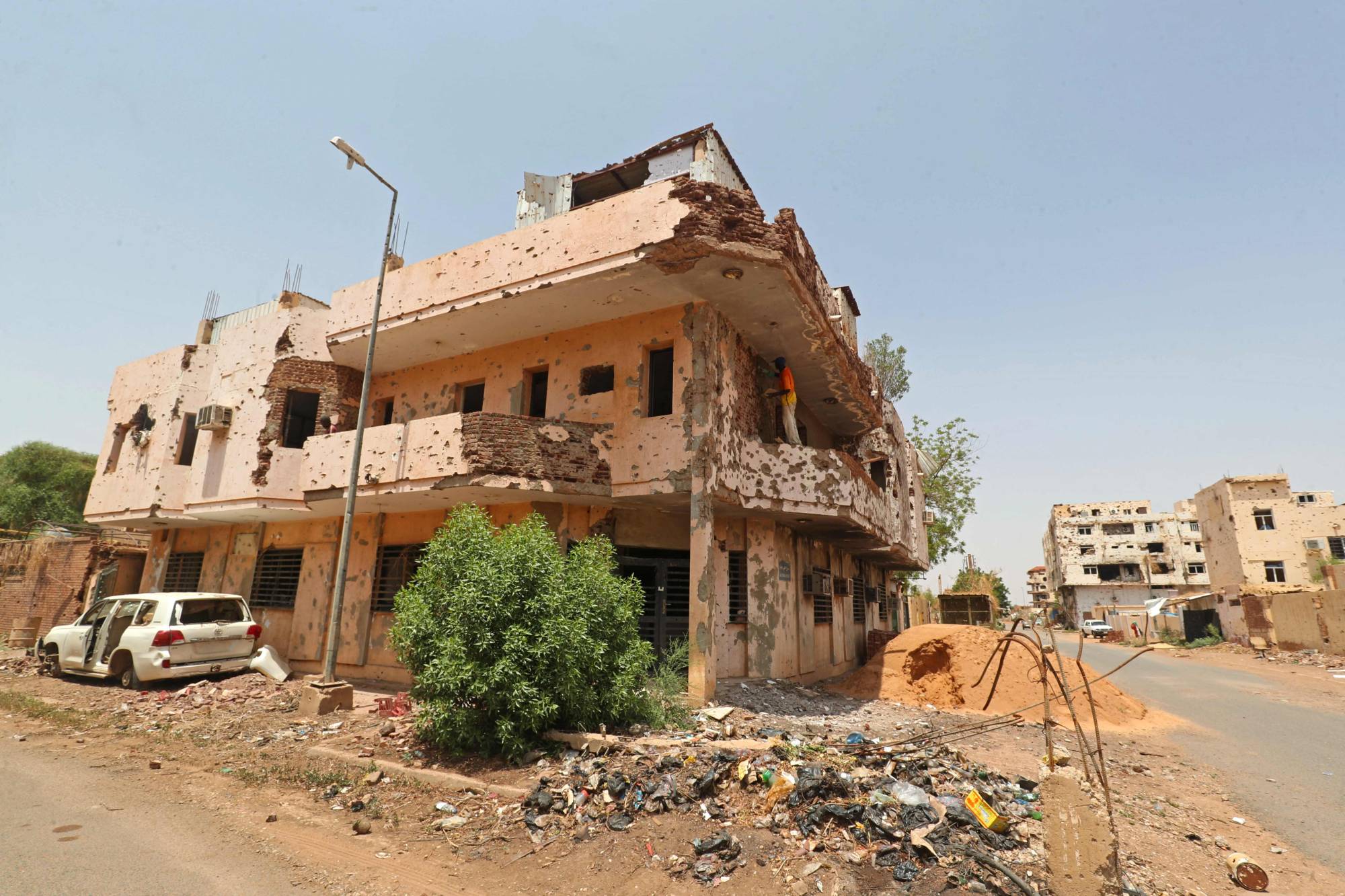
An Iraqi fish farmer stands over dead fish floating in a tank at his farm in the town of Zubaydiya, near the city of Kut in southern Iraq on April 14, 2026. (AFP)
TT

Iraq Fish Die-off Leaves Farmers Mourning Lost Livelihoods

An Iraqi fish farmer stands over dead fish floating in a tank at his farm in the town of Zubaydiya, near the city of Kut in southern Iraq on April 14, 2026. (AFP)

On the banks of Iraq's Tigris River, Haidar Kazem mourned 300 tons of the fish he had carefully raised in ponds wiped out by a flood of polluted water.

Water supplies in Iraq, the eastern half of what is known as the region's fertile crescent and which the United Nations ranks among the countries most affected by climate change, are in a dire state.

"In just two hours, my entire project was gone -- fish I had spent a year-and-a-half raising. I am back to zero," the 43-year-old fish farmer told AFP.

Earlier this month, after yet another very dry season, a brief spate of rain led authorities to open the gates of the Hamrin Dam, sending water into the Diyala, a tributary that is choked with untreated sewage.

The flood then swept the contaminated water into the larger Tigris, and the pollution was so severe that it was visible in satellite images.

Images from Copernicus Sentinel analyzed by AFP show that, following the late-March rainfall, a noticeably dark stream flows from Diyala to the Tigris throughout the period from March 28 to April 12.

"No one told us that polluted water was headed our way," Kazem said, adding that the contaminated stream reached his ponds on April 5, killed all his fish and caused losses exceeding a million dollars.

Kazem buried his stock -- carp for Iraq's beloved grilled dish masguf -- and now spends his days cleaning their floating cages on the banks of the Tigris, haunted by the question: how will he save his livelihood?

"I don't know any other trade, and I don't have the money to restart," he said.

- 1,000 tons -

Arkan al-Shimari, the head of the agriculture department in Kazem's province Wasit, said that the sewage stream has killed more than 1,000 tons of fish.

According to authorities, several water treatment plants discharge untreated sewage into the Diyala River, which years of drought in Iraq have left low and notorious for its foul odor.

Environmental open-source investigator Wim Zwijnenburg said that the Diyala consistently appears darker than the Tigris due to wastewater discharge, its low depth and weaker currents.

Normally, it would gradually mix into the Tigris, but this time heavy rain created a stronger current in Diyala, sending less-diluted polluted water into the Tigris, and "thus affecting downstream fisheries and potentially also water treatment plants".

As the situation worsened, authorities restricted water supply -- normally treated water from the Tigris -- in several areas of Wasit, reporting 20 documented cases of poisoning and rash.

Declining rain over recent years, coupled with rising temperatures, has brought water levels in the Tigris and Euphrates rivers to staggering lows, for which Baghdad also accuses upstream dams built by neighboring Türkiye and Iran.

- Black water -

Following the recent fish die-off, authorities vowed they would take the necessary measures to treat wastewater before discharge.

But decades of conflicts have left the country's infrastructure in a pitiful state and its water management systems in disrepair.

Iraq's new agency INA quoted a Baghdad official as saying that authorities will soon open seven more water treatment plants in the city.

In the town of al-Numaniyah, fish farmer Mazen Mansour, 51, gazed over the still water in his empty floating cages, which until recently held 38,000 fish he had been counting on selling next month.

Mansour said he did not realise polluted water had flooded the area until he saw his fish dying in the evening. He tried to save them by pumping air into his basins to provide oxygen, but it was too late.

"The water was black and filled with sewage," he said.

"All our work was gone in one night," added the father of four.

Now, he said, there is nothing he can do but wait and hope for compensation from the government.

"We urge the state to compensate us and hold those responsible accountable."


Why Iran’s ‘Mosquito Fleet’ Remains a Potent Threat in the Strait of Hormuz

Revolutionary Guard speedboats are seen during maneuvers in the Strait of Hormuz. (Tasnim)
TT

Why Iran’s ‘Mosquito Fleet’ Remains a Potent Threat in the Strait of Hormuz

Revolutionary Guard speedboats are seen during maneuvers in the Strait of Hormuz. (Tasnim)

Iranian warships sunk by US and Israeli attacks litter naval harbors along the Gulf coast, but what is sometimes called a “mosquito fleet” lurks in the shadows.

It is a flotilla of small, fast, agile boats designed to harass shipping, and it forms the heart of the naval forces deployed by the Iranian Revolutionary Guards Corps, a force separate from Iran’s regular navy, reported the New York Times.

These boats, and especially the missiles and drones that the Guards navy can launch from them, or from camouflaged sites onshore, have been the main threat stymying shipping through the Strait of Hormuz.

Iran had vowed to keep the strait closed until there was a ceasefire in Lebanon. The ceasefire there took effect on Thursday. On Friday, senior Iranian officials made conflicting statements about whether that truce had prompted Iran to open the strait.

On Saturday, Iran’s military said the waterway had “returned to its previous state” and was “under strict management and control of the armed forces.”

Welcoming the initial Iranian announcement of the opening, US President Donald Trump pronounced the Hormuz situation “over,” while stressing on social media that the US blockade of Iranian ports would remain in place until a peace deal was reached.

The task of keeping the strait closed would fall to the Guards navy.

“The IRGC navy works more like a guerrilla force at sea,” said Saeid Golkar, an expert on the Guards and a political science professor at the University of Tennessee at Chattanooga.

“It is focused on asymmetrical warfare, especially in the Persian Gulf and the Strait of Hormuz,” he added. “So instead of relying on big warships and classic naval battles, it depends on hit-and-run attacks.”

During the war, at least 20 vessels were attacked, according to the International Maritime Agency, a United Nations agency.

The Guards navy rarely claimed the attacks, which analysts said were most likely carried out by drones fired from mobile launchers on land, which generate a faint footprint, difficult to trace.

On April 8, after a two-week ceasefire in the war was announced, General Dan Caine, the chairman of the Joint Chiefs of Staff, said more than 90% of the regular navy’s fleet, including its main warships, sat at the bottom of the ocean.

An estimated half of the Guards navy’s fast attack boats were also sunk, Caine said, but did not specify how many. Estimates of the overall number range from hundreds to thousands — it is difficult to count them.

The boats are often too small to appear on satellite images, and they are moored along piers within deep caves excavated along the rocky coastline, ready to be deployed in minutes, analysts said. Their arsenal poses a major threat to commercial ships in the gulf and the strait.

“It remains a disruptive force,” said Admiral Gary Roughead, a retired chief of US Naval Operations. “You never quite knew what they were up to and what their intentions were.”

Stepping in where the regular navy couldn’t

The Guards land forces were formed soon after the 1979 revolution because its leader, Khomeini, did not trust the regular army to protect the new government.

The Guards navy was added around 1986. The regular navy had proved reluctant during the Iran-Iraq war to attack oil tankers from Iraq’s financial backers, said Farzin Nadimi, a specialist on the Guards navy at the Washington Institute, a policy think tank in the US capital.

Eventually those attacks ratcheted up, and the United States then deployed warships to escort tankers. One of them, the USS Samuel B Roberts, almost sank after hitting an Iranian mine. In a subsequent battle, the US Navy scuppered two Iranian frigates and a number of other naval vessels.

Three years later, the Iranians watched as the United States laid waste to the Iraqi military during the first Gulf war.

That combination of events convinced Iran that it could never prevail in a direct confrontation with the US military, so it developed a stealth force to harass ships in the gulf, Nadimi said.

The Guards navy has an estimated 50,000 men, he said, and divides its forces into five sectors along the Gulf, including some presence on many of the 38 Gulf islands that Iran controls.

Overall, it has constructed at least 10 well-hidden, fortified bases for attack boats. One, Farur, is the center of operations for the naval special forces, whose equipment, even their sunglasses, are modeled on their US counterparts.

“The IRGC navy has always believed that it is at the forefront of the confrontation with the ‘Great Satan’, and has been in constant friction with the Americans in the Gulf,” Nadimi said.

An arsenal of small, nimble boats

Iran started by using recreational boats mounted with rocket-propelled grenades or machine guns, naval analysts said.

Over the years, it built a range of specially designed small boats, as well as miniature submarines and marine drones. Iran claims that some of those boats can reach speeds of more than 100 knots, or 115 miles per hour, experts said.

The Guards navy also recently developed larger, more sophisticated warships, many of which were targeted in the war, said Alex Pape, the chief maritime expert at Janes, a defense analysis firm.

Those damaged included its largest drone carrier, the Shahid Bagheri, a converted container ship that could also launch anti-ship missiles.

To counter a potential swarm of smaller boats, US warships have high-caliber cannons and other weaponry, experts said. Commercial vessels, though, have no way to fend off such attacks.

But the Iranians have never tested swarm attacks of small boats in combat, said Nicholas Carl, an Iran expert at the American Enterprise Institute, a think tank in Washington.

Since Trump on Monday imposed a naval blockade on ships traveling from Iranian ports, even the most powerful US warships are avoiding spending any time patrolling in the vicinity of the narrow Strait of Hormuz. There is little room to maneuver and almost no warning time to ward off a drone or a missile fired from nearby, experts said.

The US warships enforcing the blockade are likely to remain outside the strait, in the Gulf of Oman or even farther, in the Arabian Sea, where they can monitor shipping traffic but are far more difficult for the Guards to attack, experts said.

On Wednesday, Iran warned that it could expand operations into the Red Sea, another key shipping route in the region, through its proxy force in Yemen.

*Neil MacFarquhar for the New York Times


When Does Peace Become the Rule Rather than the Exception?

The United Nations needs structural reform (Photo by Reuters)
TT

When Does Peace Become the Rule Rather than the Exception?

The United Nations needs structural reform (Photo by Reuters)

It has become common among analysts to say that the world has entered a new global order, where the logic of “might makes right” has replaced the “power of right,” and the old rules-based international system has faded. International relations are increasingly managed through power and influence rather than consensus and multilateralism. This emerging order is shaped by empires of varying scale seeking to expand spheres of influence and sources of wealth through force, rather than relying on international agreements that place large and small states on equal footing.


It is widely understood that the primary goal of any cooperative global order is the pursuit of sustainable peace. In that regard, the Dutch philosopher of Portuguese origin Baruch Spinoza (1632–1677) described peace as “not merely the absence of war but a virtue, a state of mind, a disposition for benevolence, confidence, justice.” Albert Einstein (1879–1955) stressed that “peace cannot be kept by force; it can only be achieved by understanding.” Since antiquity, Plato viewed the establishment of peace and friendship as the highest duty of both citizen and lawgiver, while Aristotle held that victory in war is not enough, and that the real objective is to secure peace. Mahatma Gandhi (1869–1948) asserted that peace does not arise from armed conflict, but from justice upheld even in the face of challenges.


Peace as the exception


Against these perspectives, historical experience shows that peace has been the exception rather than the rule. Over roughly 3,500 to 5,000 years of recorded human history, the world has seen only about 230 to 268 years entirely free of major wars, less than 10 percent of its history. This indicates that conflict has been the dominant feature of human relations, both at the individual and collective levels.


A distinction must be made between the “international system” and the “global order.” The international system describes how the world functions in terms of actors, power, motives, and constraints. The global order, by contrast, is a political, institutional, and cultural structure formed through negotiation, cooperation, or even coercion, as occurred after the First and Second World Wars, each of which ended with victors and defeated parties. The global order is not fixed; it is the result of deliberate choices by active powers to organize and manage the world.


It is fair to say that the global order that emerged after the Second World War achieved notable successes. The likelihood of large-scale global wars declined, traditional empires with vast geographic reach came to an end, and levels of welfare and prosperity rose to unprecedented levels. The foundations of national sovereignty were also reinforced for many states, based on the principles associated with the Peace of Westphalia. However, this order no longer meets the demands of the profound transformations underway today. This helps explain the growing sense of crisis, the widespread global unease, and serious concern about the outbreak of a third world war carrying the risks of nuclear catastrophe.


Shifts and alternative models


In recent decades, influence across the globe has been redistributed, with the rise of new powers challenging Western dominance built on material wealth and scientific and technological advancement. Countries within the BRICS group, for example, are playing an increasingly influential economic and political role. This shift goes beyond the transfer of power; it also involves deep intellectual and cultural changes, as non-Western states seek to assert their identities and present alternative models of governance and development.


This phase, sometimes described as “post-Western,” presents major existential challenges for both the West and its competitors. It requires broader international cooperation, especially in addressing cross-border issues such as climate change, cybersecurity, migration, organized crime, and terrorism. Yet these shifts are not without tension. Rising powers are seeking to advance their interests, leading to friction with established powers, particularly in trade relations and sometimes in direct confrontations, complicating efforts to build a stable global balance.


The rise of nationalist and populist trends adds another layer of instability. These movements, by their nature, tend to question and undermine international cooperation while prioritizing narrow interests, weakening international institutions and threatening global stability. Regional conflicts and great-power competition, such as tensions between the United States and China, further intensify this fragmentation.


Another major challenge lies in balancing universal values with national particularities. International standards cannot be imposed unilaterally without regard for cultural and political diversity. As a result, constructive dialogue and flexible, network-based diplomacy, rather than rigid hierarchical structures, become essential to establishing common ground for building peace.


Strait of Hormuz is a theater for major conflict (Photo by Reuters)


A test of adaptation and cooperation


In sum, the current international system is undergoing a profound transformation shaped by the rise of new powers, the relative decline of Western influence, escalating conflicts, mounting global challenges, and intense competition for economic gains that strengthen position and safeguard sovereignty. The future of this system depends on the ability of international actors to adapt, cooperate, build new partnerships, and embrace multiple perspectives to understand the world’s complexity.


In this context, the emergence of alternative narratives should not be viewed as a threat but as an opportunity for a deeper understanding of a multipolar world. The international system now taking shape reflects a significant historical shift in which the West is no longer the sole center of power, but one among several.


The path toward a more complex and interconnected global order, where different models of governance coexist, is already taking form. Navigating this new reality requires innovative thinking and openness to change, while preserving the structures and institutions that have proven their value, foremost among them the United Nations, which requires structural reform to prevent decline. Ultimately, building a more just, peaceful, and sustainable world depends on a collective will capable of reconciling difference with cooperation.
