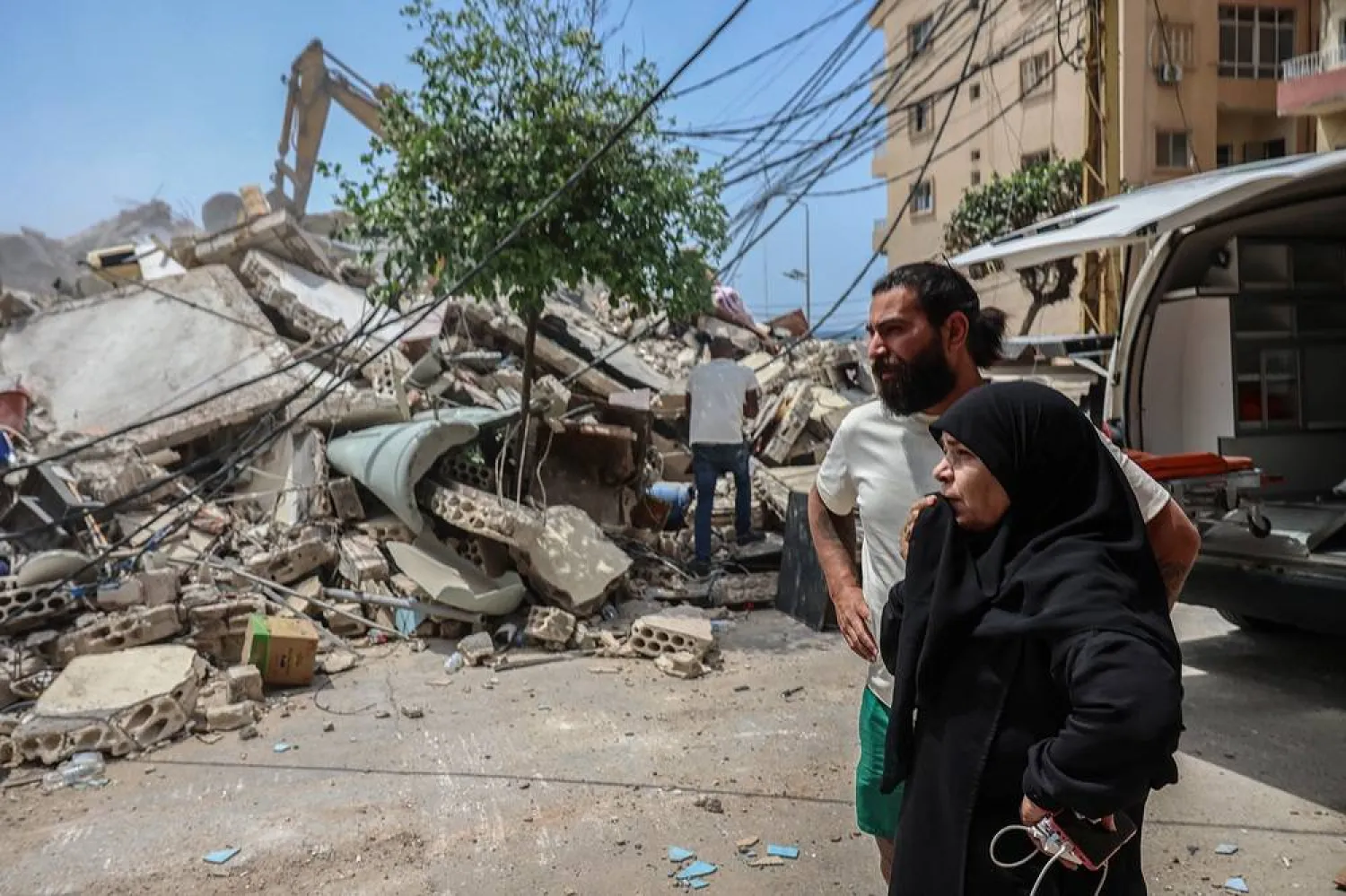
In Final Moments Before Truce, Israeli Strike Kills Lebanese Man’s Family

 A woman reacts as emergency personnel search for survivors at the site of an Israeli strike carried out just before a 10-day ceasefire between Lebanon and Israel, in Tyre, Lebanon, April 17, 2026. (Reuters)
A woman reacts as emergency personnel search for survivors at the site of an Israeli strike carried out just before a 10-day ceasefire between Lebanon and Israel, in Tyre, Lebanon, April 17, 2026. (Reuters)
TT

In Final Moments Before Truce, Israeli Strike Kills Lebanese Man’s Family

 A woman reacts as emergency personnel search for survivors at the site of an Israeli strike carried out just before a 10-day ceasefire between Lebanon and Israel, in Tyre, Lebanon, April 17, 2026. (Reuters)
A woman reacts as emergency personnel search for survivors at the site of an Israeli strike carried out just before a 10-day ceasefire between Lebanon and Israel, in Tyre, Lebanon, April 17, 2026. (Reuters)

Hassan Abu Khalil's family miraculously survived six weeks of war in southern Lebanon, but tragedy struck in the final minutes before a ceasefire came into force. An Israeli strike late on Thursday killed 13 of his relatives, leaving him the sole survivor.

Abu Khalil, 36, stepped out to see friends just before midnight, when a US-brokered truce between Lebanon and Israel was meant to halt fighting that had raged since March 2 between Israel and armed group Hezbollah.

“I heard a very powerful strike, and when I came ‌back to the neighborhood, ‌I found this had happened," Abu Khalil told Reuters on ‌Friday ⁠as he watched ⁠a bulldozer dig through the mountains of pulverized concrete that was once his home in the southern Lebanese port city of Tyre.

"In this building, more than 13 members of my family are missing under the rubble. What then, Israel? Just before the ceasefire, it was one massacre after another against us," he said.

Later on Friday, Lebanon's state news agency said rescue teams had recovered 13 bodies and pulled 35 wounded survivors from the ruins ⁠of the building that was hit the previous evening. It ‌reported that 15 other people were unaccounted for.

The ‌Israeli military did not immediately respond to a request for comment on the strike.

Lebanon's health ministry ‌says 2,294 people have been killed between March 2 and Thursday, when the ‌ceasefire came into force. The toll includes 177 children and 274 women.

'MY FUTURE IS GONE'

On Friday, thousands of Lebanese streamed through Tyre on the way to their southern villages. They crossed over a dirt berm that Lebanese soldiers had erected over the ruins of a main bridge ‌destroyed by Israel earlier on Thursday. Many were relieved to return to their southern villages, even if they were destroyed.

But ⁠Abu Khalil spent ⁠the first day of the ceasefire in a haze of despair, unable to eat or sleep.

He stood wringing his hands next to a bulldozer working through the ruins, his eyes locked on the gaping hole that rescuers were searching.

"Since the strike, I've been here and haven't gone anywhere. Every time they pull someone out, we run over to see what happened, who it is - my friend I grew up with, my friend's mother, my friend's father," Abu Khalil said.

He said he had been living in the United Kingdom but returned to Lebanon to be with his extended family.

"Who is left? No one is left. I wish I had never gone out for that coffee and had stayed with them," he said.

“My future is gone here. This was my life, this was my family - what now? What more is there after this?"


After Six Months of Iran War, US Goals Have Shifted. The Strait of Hormuz is Now a Top Concern

Vessels are seen in the Strait of Hormuz, off the port city of Bandar Abbas in southern Iran on August 10, 2026. (Photo by Atta KENARE / AFP) /
TT

After Six Months of Iran War, US Goals Have Shifted. The Strait of Hormuz is Now a Top Concern

Vessels are seen in the Strait of Hormuz, off the port city of Bandar Abbas in southern Iran on August 10, 2026. (Photo by Atta KENARE / AFP) /

When President Donald Trump launched the war with Iran in late February, he initially forecast it would last four to five weeks. Six months later, there's still no off-ramp in sight despite Trump's repeated assertions that the war has been won or a deal to resolve it was nearly complete.

A June memorandum of understanding designed to pave the way to end the war has fallen by the wayside. US stockpiles of key weapons have diminished, and the Trump administration has pivoted to pressuring Iran economically rather than launching more strikes, The Associated Press said.

As the shape of the war has morphed over the last half year, so have the goals for the conflict.

One of the prime goals now — reopening the Strait of Hormuz — was not one of Trump's original objectives. The waterway had been a vital shipping lane through which about 20% of the world's oil passed.

But Iran seized on it as a chokepoint for the global economy and it has been largely closed since the war started, driving up prices for fuel and fertilizer needed for farms and creating economic and political pressure in the US.

The US has had tactical success on its goals to degrade Iran's military capabilities. But some of the other key objectives Trump laid out at the start of the conflict remain unfulfilled — and others have shifted.

Here’s a look at the objectives and what we know about where they stand:

Stop Iran from having a nuclear weapon

Last June, Trump declared that the US had “obliterated” Iran’s nuclear program. But when the war started, his aides justified the strikes by warning that Iran had been just weeks away from developing a bomb.

One of the most pressing questions has been what will be done with a stockpile of about 970 pounds (440 kilograms) of enriched uranium that Tehran could potentially use for a weapon. The material is believed to be buried under three sites bombed by the US and Israel last year. Trump said in a May 29 social media post that it would be retrieved by the US “in close coordination and conjunction with Iran, plus the International Atomic Energy Agency, and DESTROYED.”

Iran has not said whether it would consent. Without permission from Iran, experts have said seizing it would be a dangerous mission requiring a sizable deployment of US troops into the country.

Officials said that Tehran reaffirmed in the June memorandum of understanding that it would not procure or develop nuclear weapons. The deal called for Iran to dilute its stockpile of highly enriched uranium. But many other details about Iran's program were left for future negotiations, and it's unclear how much progress, if any, was made before talks quickly fell off.

Reopen the Strait of Hormuz

Trump has said that a proposed deal with Iran would include the reopening of the strait and the US ending its blockade of Tehran’s ports, but at other times he has suggested the international waterway would somehow become American territory and indicated the US could impose a toll on passing ships.

Trump also has repeatedly said that the strait is open, including during an interview on Wednesday on conservative commentator Glenn Beck’s radio show.

“It’s a functioning strait. Yes, every once in a while, there’ll be a drone or a rocket or something shot, but it is a very functioning strait,” Trump said.

Destroy Iran's ability to fire missiles

One of the prime objectives laid out by the administration was to “destroy their missiles and raze their missile industry to the ground."

Trump said in late March that Iran's missiles “are mostly decimated" and that 90% of their missiles and launchers were knocked out.

By mid-May, that shifted to a more conservative estimate, with the president saying that 82% of Iran's missiles were gone.

Iran has shown its ability to still launch attacks in the region, including drone strikes on ships sailing through the strait.

As recently as July, the US military still had Iranian military targets to strike, with its Central Command announcing it was striking “Iranian military command centers, air defense and coastal surveillance sites, maritime capabilities, missile and drone launch sites and communications networks.”

Destroy Iran's defense industrial base

Early in the war, the president and his administration sometimes listed this as a standalone objective. Other times, it has fallen off their list.

US Central Command has said its targets for strikes in Iran have included weapons production and missile and drone manufacturing facilities.

Secretary of State Marco Rubio told lawmakers in early June that Iran has had “massive destruction” of its defense industrial base and “80 to 90% of attrition. It will take years for them to rebuild it.”

Eliminate Iran's navy and air force

The US and Israel quickly established air superiority in the skies above Iran, where they flew largely unchallenged.

Rubio told lawmakers that Iran still has drone capabilities, but it lacks the ability to use swarms of drones to attack targets, as it did at the start of the war. He also said Iran does not have a navy anymore, and relies on small craft outfitted with machine guns that harass ships and sometimes drop mines in the water.

Trump on Wednesday said that Iran's navy and air force are “totally gone."

Protect America's Middle Eastern allies

Trump, in a March social media post, added another objective for the US: “Protecting, at the highest level, our Middle Eastern Allies ...".

The US maintains thousands of troops on bases and other installations in the region, but Trump has been unclear on how far he'd be willing to go to protect Middle East allies from threats in the long term. In June, when the US said Iran fired missiles at Kuwait and Bahrain, the US launched strikes on Iran in response.

In mid-August, Trump threatened in an interview that the US would bomb Oman if it “gets in the way," using an expletive for emphasis.

Cut off support for Iranian proxy groups

In March, Trump and his administration repeatedly said degrading Iran's proxy terror networks was a key goal.

As time has gone on, administration officials have offered fewer updates about this objective, which the president described as ensuring that “the region’s terrorist proxies can no longer destabilize the region or the world and attack our forces” and “ensuring that the Iranian regime cannot continue to arm, fund, and direct terrorist armies outside of their borders.”

Early on, the US struck Iranian-aligned militia groups in Iraq. But the biggest focus has been Israel's war in Lebanon against Hezbollah, which Iran backs. Iran has insisted that the fighting in Lebanon must be stopped as part of any deal with the US, Israel and the Lebanese government announced a deal, which was mediated by the US, for Israeli forces to leave southern Lebanon in exchange for Hezbollah's disarmament — something an administration official described as a “huge step,” speaking on condition of anonymity because they were not authorized to address the issue on the record. But the militant group has refused direct talks and its leader has said it will not disarm.



Death of Al-Amin Khalifa Fhimah: The Libyan Who Escaped the Noose of the Lockerbie Case

A photo shows late Libyan President Muammar Gaddafi with Al-Amin Khalifa Fhimah (second from left) upon the latter's arrival in the capital Tripoli, a day after his definitive acquittal in the plane bombing case (Tripoli, February 1, 2001) (Getty Images)
TT

Death of Al-Amin Khalifa Fhimah: The Libyan Who Escaped the Noose of the Lockerbie Case

A photo shows late Libyan President Muammar Gaddafi with Al-Amin Khalifa Fhimah (second from left) upon the latter's arrival in the capital Tripoli, a day after his definitive acquittal in the plane bombing case (Tripoli, February 1, 2001) (Getty Images)

On August 25, 2026, in a quiet corner of the Libyan capital Tripoli, the life of Libyan citizen Al-Amin Khalifa Fhimah came quietly to an end at the age of nearly 70.

His death officially closes one of the most mysterious and compelling chapters in the history of the diplomatic and intelligence conflict between East and West. It also closes a living chapter in the case of the bombing of Pan Am Flight 103, which was traveling from Frankfurt to New York via London when it exploded over the Scottish town of Lockerbie in 1988, an incident that reshaped international politics for decades.

For an entire decade, the name of this man, who began his career as a low-ranking airline employee, echoed through the corridors of the United Nations Security Council. His photograph appeared on television screens around the world and in newspapers for years as the "second suspect" in the most horrific act of aerial terrorism of the 20th century.

Fhimah was an unwilling participant in a unique legal and political saga in which the details of his everyday life on the island of Malta became the basis of an international case that nearly brought an entire country to the brink. He later stood behind the glass of the historic Camp Zeist courtroom in the Netherlands and heard the word "acquitted" pronounced by Scottish justice at the dawn of the new millennium. He returned home carrying an acquittal that politics had been unable to grant him for years.

His death has reopened the memories of the era of crippling sanctions and international isolation, reminding the world of the story of a man who lived at the heart of the storm and died in complete seclusion, far from the political turmoil that had nearly consumed him.

Forgotten Beginnings: From Tripoli to Luqa Airport

Al-Amin Khalifa Fhimah was born in 1956 in the Souq al-Jumaa area on the outskirts of the Libyan capital, Tripoli. He progressed through his career until he joined Libyan Arab Airlines. In the mid-1980s, he was sent to work as an airline official, dispatcher, and station manager for the company at Luqa Airport in Malta.

The position appeared routine for the young employee, had it not intersected with the intense intelligence conflict unfolding across the Mediterranean between the former Libyan regime and the United States and its Western allies.

At the time, Fhimah did not know that his signature on cargo documents and the timing of his shifts at the Mediterranean airport would later become key evidence cited in the international indictment prepared by senior investigators in Washington and London.

The Night the Plane Fell and the International Storm Began

On December 21, 1988, the sky over the Scottish town of Lockerbie was torn apart when a Boeing 747 operated by Pan Am, Flight 103, exploded while traveling from Frankfurt to New York, killing 270 people.

After three years of complex joint investigations by the US Federal Bureau of Investigation (FBI) and Scottish police, two Libyan nationals were formally accused in November 1991: Abdelbaset al-Megrahi and Al-Amin Khalifa Fhimah.

At the time, Western investigators alleged that Fhimah had used his position and contacts at Malta's airport to facilitate the passage of a bomb-laden brown Samsonite suitcase. The suitcase contained a timed bomb concealed inside a cassette recorder and was allegedly placed aboard a Libyan Airlines flight bound for Frankfurt, from where it was transferred to the doomed Pan Am flight.

Historic Handover and Trial on Neutral Ground

Tripoli initially refused to hand over its citizens, placing Libya under severe international sanctions and an air and economic blockade imposed by the UN Security Council in 1992.

Libya endured a decade of deep isolation and economic paralysis until difficult diplomatic efforts led by Arab and African parties produced a unique legal and historic settlement.

Under the settlement, Libya agreed in 1999 to hand over the two suspects for trial before a special Scottish court, but on neutral ground at Camp Zeist, a former US military base near Utrecht in the Netherlands, under Scottish criminal law.

Camp Zeist Shock: Historic Acquittal and Return

On January 31, 2001, the world held its breath as Scottish judges delivered the verdict millions had been awaiting. While his associate Abdelbaset al-Megrahi was convicted and sentenced to life imprisonment, the court definitively acquitted Al-Amin Khalifa Fhimah of all charges and ordered his immediate release from behind the bulletproof glass enclosure.

The judges based his acquittal on insufficient evidence and major gaps in the witnesses' account, particularly that of Maltese clothing merchant Tony Gauci. The defense also conclusively established that Fhimah was not in Malta but was in Sweden on a business trip when the bomb-laden suitcase was checked in.

Voluntary Seclusion Until His Final Days

Following his acquittal, Fhimah returned immediately to Libya, where he received a hero's welcome in Tripoli from both officials and the public. He was portrayed as living proof that Western justice itself had established the innocence of the Libyan state from the full American account of events.

Yet the man, exhausted by years of fear, uncertainty, and detention, made a firm decision to stay completely out of the spotlight and politics. He lived the rest of his life as an ordinary citizen among his family in Tripoli, refusing to give press interviews that might reveal the secrets of that era.

The announcement of his death and the official mourning that followed brought a complete chapter of the bitter Libyan-Western conflict to a close.


Gaza’s Children Lose Simple Joy as Israel Warns Against Kite-Flying

Boys fly a kite against the backdrop of smoke rising from the Gath shelter, that houses displaced Palestinians, after an Israeli air strike in the west of Khan Younis, southern Gaza Strip on January 31, 2026. (AFP)
TT

Gaza’s Children Lose Simple Joy as Israel Warns Against Kite-Flying

Boys fly a kite against the backdrop of smoke rising from the Gath shelter, that houses displaced Palestinians, after an Israeli air strike in the west of Khan Younis, southern Gaza Strip on January 31, 2026. (AFP)

There are few joys left for 10-year-old Ahmed Hamdouna, whose childhood has already been scarred by years of war and displacement in Gaza.

Now, what little reprieve he found playing with scraps of plastic and sticks has also been torn away, as Israel warns it will step up military operations in the territory if kites continue to land on the Israeli side of the border.

"My father stopped me from flying my kites because of the occupation's threats," said Ahmed, who has been displaced to Deir el-Balah in the central Gaza Strip.

"I felt heartbroken after spending so much time collecting sticks and nylon, only for the occupation to prevent us from playing with them," he told AFP.

"We are just young children. They destroyed our home and our whole neighborhood -- what more do they want?"

Israel accuses Hamas of cynically using children and says the kites could pose a threat, years after a wave of incendiary kites and balloons sparked fires in Israeli farmland.

A series of kites have flown in recent days across the border into southern Israel, communities shaken by the Hamas-led attacks of October 7, 2023.

Hamas has denied responsibility. No explosives were detected, but at least one kite had a political message on it.

On Wednesday, an official of the US-led Board of Peace supervising the ceasefire plan in the territory said: "All militant activity in Gaza must stop, including the flying of kites."

"Israel, too, must comply with the ceasefire," a board official said.

Hamas spokesman Hazem Qassem said the popular committees in Gaza's displacement camps were trying to prevent children from flying kites, over fears they could be targeted by the Israeli military.

Ahmed said he was now scared of playing, but couldn't understand why the Israeli military was "afraid of kites when they are just paper and string".

"I don't want to hurt anyone. I just want to play like children everywhere else," he said.

- 'Sense of freedom' -

For Gaza's children, building kites was a simple way to find joy among the ruins of war.

"There are no toys here, no amusement parks, not even a football to play with. The kite is the only thing we can make with our own hands that makes us happy when we fly it in the sky," said 11-year-old Yamen al-Mubayyed, who has also been displaced to Deir el-Balah.

"My friends and I get together and make them using pieces of wood we collect from destroyed houses, along with paper and string. We glue them together using flour and water, then go to the sea to fly them," he told AFP.

Yamen said even the buzz of Israeli surveillance drones didn't put him off flying his kites.

"It is the only thing that makes us feel that we children are alive and gives us a sense of freedom," he said.

Israel has kept up attacks in Gaza, saying it is targeting gunmen, despite a US-backed ceasefire which came into effect in October.

Israeli army chief Lieutenant General Eyal Zamir on Tuesday vowed to push on with demilitarizing Gaza "using all necessary means".

- 'Kill the joy in their hearts' -

For parents in Gaza, the once-harmless activity now carries immense worries.

Akram Abu Shurkh, 30, said he had forbidden his children from making kites but felt he had "killed the joy in their eyes" in doing so.

"These are children who do not understand military calculations. They only see it as a game and a way to release their energy," he told AFP.

"But I see death in the touch of the string and the flying of the kite."

In southern Gaza, 34-year-old Umm Moaz Huwayla said her heart raced from worry every time her children went outside with their kites, but felt she couldn't stop them from playing.

"The occupation wants to kill the joy in their hearts," she told AFP.

"They are not asking for much, only to live their childhood, even with a piece of string and a sheet of paper."