


Strait of Hormuz Blockade Step by Step: What Do We Know?

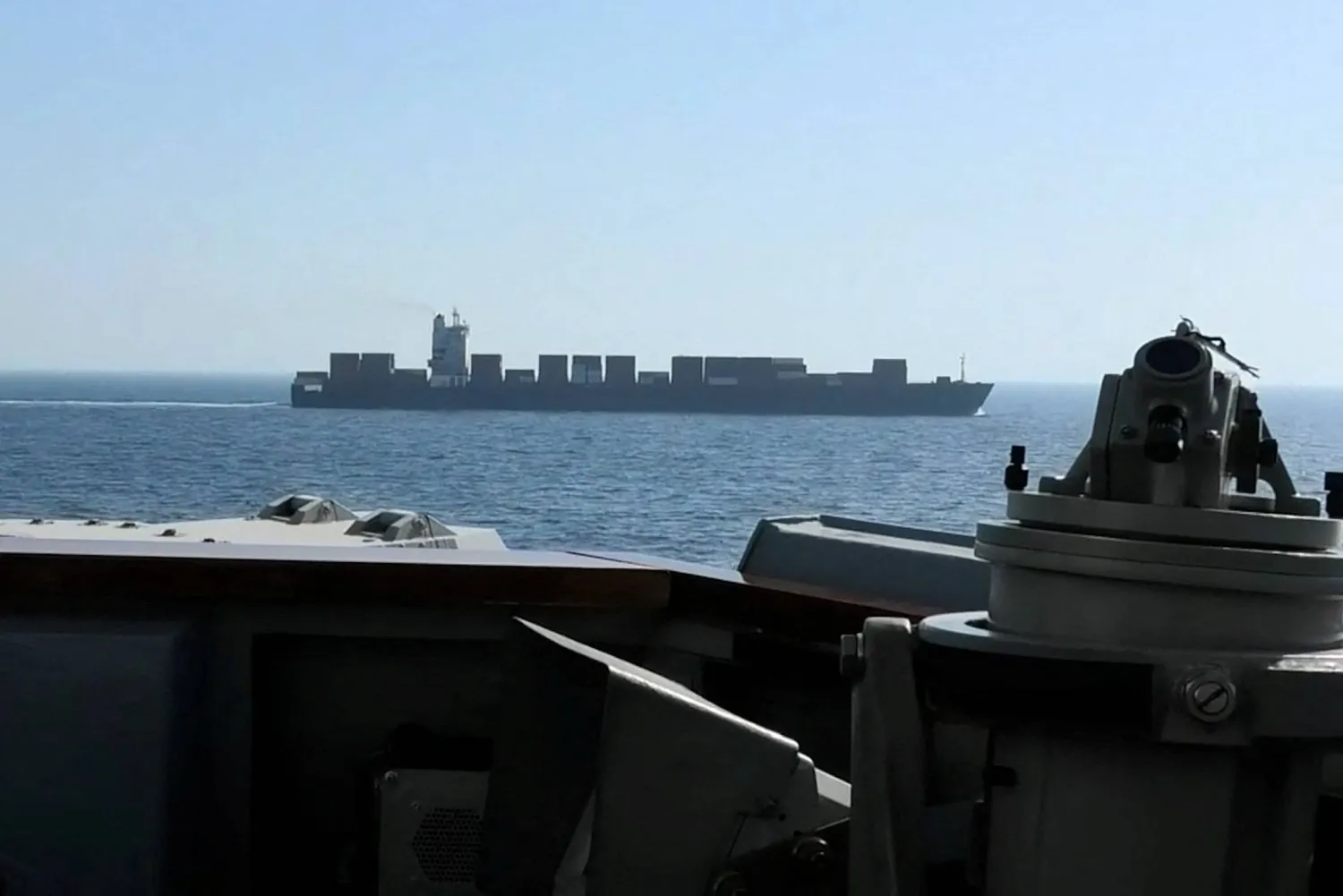
A view of Iranian-flagged cargo ship M/V Touska as the US Navy Arleigh Burke-class Aegis guided missile destroyer USS Spruance conducts its interception in a location given as the north Arabian Sea, in this screen capture from a video released April 19, 2026. (CENTCOM/Handout via Reuters)
TT

Strait of Hormuz Blockade Step by Step: What Do We Know?

A view of Iranian-flagged cargo ship M/V Touska as the US Navy Arleigh Burke-class Aegis guided missile destroyer USS Spruance conducts its interception in a location given as the north Arabian Sea, in this screen capture from a video released April 19, 2026. (CENTCOM/Handout via Reuters)

Shipping traffic through the Strait of Hormuz remained mostly at a standstill on Monday, with just three vessels crossing the vital waterway, according to Kpler, a maritime data firm.

On Sunday, a US Navy destroyer attacked and seized an Iranian-flagged cargo ship that US President Donald Trump said had tried to evade the US blockade on ships traveling to and from Iranian ports.

In a separate incident, the United Kingdom Maritime Trade Operations center, which is administered by Britain’s Royal Navy, said that two vessels had been hit while trying to cross the Strait of Hormuz, according to a notice published on Saturday.

In one instance, gun ships operated by Iran’s Revolutionary Guards Corps fired at a tanker without radio warning, the British organization said. In the second incident, a container ship was hit by “an unknown projectile” that damaged some of the containers.

On Tuesday, the US military said it had seized an Iran-linked tanker in international waters, in what appears to be the latest move to enforce a blockade as the ceasefire deadline looms.

The US military said it had boarded the tanker Tifani “without incident.”

The ship, capable of carrying 2 million barrels of crude, last reported its position on Tuesday morning near Sri Lanka in the Indian Ocean, according to MarineTraffic tracking data. It was close to fully loaded and had signaled Singapore as its destination.

A two-week ceasefire between the US and Iran is set to expire early Wednesday.

Latest developments

The US Navy has turned back 27 ships trying to enter or exit Iranian ports since an American blockade outside the contested Strait of Hormuz began about a week ago, the military’s Central Command said on Monday.

On Sunday, a Navy destroyer disabled and seized the Touska, an Iranian cargo ship, in the Gulf of Oman after it tried to evade the blockade. It was the first time a vessel was reported to have tried to evade the US-imposed blockade on any ship entering or exiting Iranian ports since it took effect last week.

The guided-missile destroyer Spruance, one of more than a dozen Navy warships enforcing the US blockade, ordered the vessel’s crew to evacuate its engine room.

The Spruance then fired several rounds from its Mk-45 gun into the ship’s propulsion system as it steamed toward the port of Bandar Abbas in Iran, Central Command said in a statement that included a video of the firing.

American officials will determine what to do with the disabled vessel once the search is completed, a US military official said on Monday, speaking on the condition of anonymity to discuss operational matters, according to the New York Times. One option would be to tow the stricken ship to Oman, independent specialists said. An alternative would be to let the Touska steam to an Iranian port, if it can.

A spokesman for Iran’s military reiterated a threat on Monday to “take the necessary action against the US military” in response to the ship’s seizure, Iran’s state broadcaster reported.

How is the US imposing the blockade?

According to CENTCOM, more than 10,000 US personnel, including sailors, marines, and airmen, are participating in the operation, supported by over a dozen warships and dozens of aircraft. The effort spans key waterways surrounding Iran, including the Arabian Gulf and the Gulf of Oman.

The US blockade on Iranian ports does not have a defined geographic boundary, and the United States can interdict vessels almost anywhere in international waters until they arrive at their final port.

Analysts say modern technology allows blockade enforcement at great distances.

Can ships evade the blockade?

Maritime intelligence experts say that more ships in and around the Strait of Hormuz seem to be adopting “spoofing” tactics to avoid detection.

Under international maritime law, most large commercial vessels travel with a transponder that automatically transmits the ship’s name, location, route and other identifying information. That includes a nine-digit number with a country code, which serves as a digital fingerprint for a ship.

The tactics were used by Russian “shadow fleet” vessels evading sanctions related to the invasion of Ukraine in 2022.

When a ship is engaged in spoofing, its captain can type in a false origin or destination or can pretend to be piloting another ship altogether. Vessels can also temporarily turn off their transponders, seeming to disappear in one place and reappear in another.

The strait is “a contested information environment,” said Erik Bethel, a partner at Mare Liberum, a maritime technology venture capital fund.

Still, whatever ruses they employ, vessels going to and from Iran may get only so far. It is difficult to pass between the open ocean and a waterway as narrow as the Strait of Hormuz without being detected.

“My expectation is that the US Navy can sit out in the Gulf of Oman,” said Ami Daniel, the chief executive of Windward, a maritime intelligence data provider. “I don’t think there’s a way to breach the blockade.”

What are the US and Iranian strategies?

The US blockade sets up a significant test in the Iran war: Which side can endure more economic pain?

Instead of directing missiles and bombs, Trump is trying to choke off Iran’s oil exports, which make up just about all of the government’s revenue.

Some experts questioned whether the US blockade would work.

“Iran is already hurting, and they have shown that they are willing to take more than a couple of hits,” said Ahmet Kasim Han, a professor of international relations at TED University in Ankara, Türkiye.

Iran’s strategy appears to be using its leverage over global energy markets, where Tehran has discovered new powers that can cause pain in the US economy through spikes in the price of gasoline and other staples.

Why is the strait so important?

The Strait of Hormuz is a strategic waterway connecting the Gulf to the Gulf of Oman and the Indian Ocean. It is the only sea route for moving oil, natural gas and other cargo out of the Gulf. Iran’s coastline runs along the entire route.

At the strait’s narrowest and most vulnerable point — between Iran to the north and the Musandam Peninsula of Oman to the south — the navigable channel is about two miles wide each for inbound and outbound traffic, according to the International Energy Agency.

The legal status of the strait is complex. It lies within the territorial waters of Iran and Oman, but under international law it is treated as an international waterway where ships are generally guaranteed passage.

Iran has signed but not ratified that framework and has disputed the extent of those rights.

Before the war, about 20% of global oil and liquid natural gas passed through the strait. Most of the fossil fuels are bound for Asia, especially China, India, Japan and South Korea.

Other large vessels also use the strait, including car carriers and container ships.

Crucial industrial goods traveling through Hormuz include helium from Qatar, fertilizer from Oman and Saudi Arabia, and plastic feedstocks from Saudi Arabia and Emirati petrochemical plants.

How does Iran control the strait?

Iran’s military can threaten shipping traffic throughout the Strait of Hormuz, even though much of its navy has been destroyed by US and Israeli strikes.

The United States and Israel launched their war against Iran on the argument that if Iran one day got a nuclear weapon, it would have the ultimate deterrent against future attacks.

It turns out that Iran already has a deterrent: geography.

“The Iranians have thought a lot about how to utilize the geography to their benefit,” said Caitlin Talmadge, a professor at the Massachusetts Institute of Technology who studies Gulf security.

*The New York Times


‘If Ebola Comes, We’ll Be Wiped Out’: Fear Grips Camps in DR Congo

A staff member hangs up protective equipment to dry after washing them at the Ebola Treatment Center (ETC) in Munigi on June 2, 2026. (AFP)
TT

‘If Ebola Comes, We’ll Be Wiped Out’: Fear Grips Camps in DR Congo

A staff member hangs up protective equipment to dry after washing them at the Ebola Treatment Center (ETC) in Munigi on June 2, 2026. (AFP)

Dorcas Mapenzi fears the worst if Ebola comes to the Kingonze camp, where she lives alongside more than 25,000 other displaced people in the conflict-hit eastern Democratic Republic of Congo.

"If Ebola comes, we'll be wiped out as we're packed like sardines," the displaced woman told AFP at the sprawl of tarpaulin and tents on the outskirts of Bunia, the capital of the northeastern Ituri province, the epicenter of the latest outbreak.

Spread by close contact, the deadly viral disease has spread like wildfire in the vast central African country's east, where decades of armed conflicts have forced millions of people from their homes and into camps where they live cheek-by-jowl.

Nearly a million of those displaced are in Ituri -- among the provinces of the desperately impoverished DRC most prey to the east's litany of armed groups -- where the prospect of the epidemic spreading throughout the refugee camps has sparked alarm.

The World Health Organization's director general, Tedros Adhanom Ghebreyesus has warned that the eastern DRC "faces a catastrophic collision of disease and conflict", with the fighting hampering efforts to tackle the epidemic.

Visiting Bunia on Saturday, Tedros called for more international help and financial aid to combat the spread of Ebola.

He also said it was essential to assuage fears among affected communities who are deeply distrustful of authorities and halt the spread of false information about the virus.

The current outbreak was officially declared in the DRC and neighboring Uganda on May 15.

As of May 31, the WHO said 321 cases had been confirmed in the DR Congo, including 48 deaths. Thjere are nine confirmed cases in Uganda, including one fatality.

- 'Everyone will die' -

No infection has yet been recorded at the Kingonze displaced persons' camp, where Mapenzi now lives.

But conditions in the camp are ripe for a disease passed on through close physical contact and bodily fluids.

"I've already heard of Ebola and it's a disease that scares me a lot," Mapenzi said as she washed her laundry in a basin on the ground.

"We displaced people here have no hygiene.

"Our children play next to filthy toilets and even relieve themselves on the ground, in the middle of the tarpaulins that serve as our homes," the young woman said.

Deborah Nzale, a widow and head of her family, lives with nine people in a small tarpaulin shelter of barely three square meters (32 square feet).

"Given these conditions, how are we going to protect ourselves against this disease, when everyone tells us we need to distance ourselves to fight Ebola?" she asked.

No vaccine or treatment exists for the Bundibugyo strain of Ebola responsible for the latest outbreak.

So attempts to contain the virus's spread have had to rely mainly on protective measures and rapid contact tracing.

"We sleep piled on top of each other, with everyone's sweat," Nzale said.

"If a single person gets infected here in this camp, everyone will die."

- 'Ebola really kills' -

So far, Kingonze's displaced residents have not received any protective gear.

"Ebola really kills," a poster at the entrance warns.

"People looking to raise awareness come through here with messages but, surprisingly, we don't have the kit we need to protect ourselves," Budjo Amos complained.

"I don't even have soap to wash my hands," said Amos, who fled the province's common communal violence.

"The most urgent thing is to give us clean water," he insisted.

There is just a single borehole in Kigonze. Empty jerrycans pile up in front. Water flows from the tap for just a few hours a day.

"The state has to intervene urgently," Amos pleaded.

Already long absent from swathes of Ituri, the Congolese state has been criticized for its delayed response to the outbreak, which was declared several weeks after the first cases emerged.

Many hospitals in the region still lack essential equipment, especially isolation tents for patients.

According to Ituri's military governor, the province counts around 61 displaced persons camps housing nearly 970,000 people.

"We need to deploy equipment and qualified, specialist medical staff as quickly as possible," Lieutenant General Johnny Luboya Nkashama told AFP on Friday, "to spare this province from disaster".


Beirut Southern Suburbs Residents Live Between Displacement, Return

Vehicles drive on the highway as people leave Beirut's southern suburbs after Israel ordered strikes on Dahiyeh, in Beirut, Lebanon, 01 June 2026. EPA/WAEL HAMZEH
TT

Beirut Southern Suburbs Residents Live Between Displacement, Return

Vehicles drive on the highway as people leave Beirut's southern suburbs after Israel ordered strikes on Dahiyeh, in Beirut, Lebanon, 01 June 2026. EPA/WAEL HAMZEH

The latest Israeli threat threw Beirut’s southern suburbs into turmoil within hours. Schools were evacuated, parents rushed to pull their children out of classrooms, and many residents fled their homes in haste. Roads filled with a new wave of displacement, reviving scenes the Lebanese have endured repeatedly in recent months.

But the threat did not end when the warning did. The alert was lifted, but the anxiety stayed. Some people returned to work, but not to a sense of safety. For many, the question is no longer when the strike will come, but how to live under the constant expectation of the next warning.

The home that is no longer safe

Layla Hassan told Asharq Al-Awsat that the latest threat to the southern suburbs did not end for her when the warning expired. The feeling it left behind still follows her. The problem, as she sees it, is no longer tied to a single security incident, but to a permanent state of uncertainty.

She said the natural bond between people and their homes has changed radically. “The home, which once represented the safe space people turned to in fear or danger, has now become one of the sources of anxiety.”

The warning, she said, made returning more complicated than leaving, especially for those responsible for children or other family members.

Life in displacement, despite its hardship and lack of services, can sometimes feel less cruel than the anxiety of returning, she said. Electricity, water, cramped spaces and the strain of daily life become secondary details beside one overriding concern, keeping the family safe.

She added that repeated displacement gradually pushes people to adapt to abnormal conditions, until the mere feeling of safety becomes a goal in itself, even at the cost of the life they once knew.

People leave Beirut's southern suburbs after Israel ordered strikes on Dahiyeh, in Beirut, Lebanon, 01 June 2026. EPA/WAEL HAMZEH

Every day begins with fear

Fatima Shams has not returned to the southern suburbs since Monday’s threat. She told Asharq Al-Awsat that “the Lebanese are living today in a state of constant anticipation that has made fear part of the daily routine. Every morning begins with a different question, but the meaning is the same, will this day pass safely?”

She described how the latest threat disrupted the daily lives of families. Her sister was at school when exams were halted and students were urgently evacuated. Within minutes, parents had to leave work and head to schools, caught between traffic-clogged roads and fear of a sudden security development.

“The hardest thing people are living through is not only the fear of strikes, but the constant feeling of instability,” she said. “Families are no longer able to plan their day or their week, because any new warning can overturn everything.”

She said the danger no longer feels confined to one area after warnings and tensions spread to different parts of Lebanon, making insecurity more widespread than ever.

Anticipation is wearing people down

Ali Noureddine, from the southern town of Toul and a resident of Beirut’s southern suburbs, described life for residents as “deadly anticipation.”

He told Asharq Al-Awsat that “the crisis is no longer linked to the warning itself, but to the psychological state that follows it. After every threat, people remain trapped between the possibility of returning to normal life and the possibility of a new escalation.”

He said this constant anxiety drains residents more than direct security incidents, because it turns life into an open-ended wait that no one knows when it will end.

The anxiety, he added, is not limited to the southern suburbs. It reaches the south as well, where families follow news of their towns, homes and areas with no clarity over what comes next.

People leave Beirut's southern suburbs after Israel ordered strikes on Dahiyeh, in Beirut, Lebanon, 01 June 2026. EPA/WAEL HAMZEH

We carry our memories in a bag

Layan Abdullah has not returned to the southern suburbs since the latest threat. For the university student, campus life is no longer about lectures, exams and ambitions. It is about displacement and the search for safety.

She told Asharq Al-Awsat that “her life has become a matter of packing belongings into a bag, moving to a new place, then preparing for the possibility of doing it again.”

Her generation, she said, can no longer think about future projects or career plans. The priority has narrowed to getting through the day safely.

She spoke of the harsh feeling that accompanies each displacement, reducing an entire life to a single bag. “A person does not leave behind only walls and furniture, but memories, details and relationships tied to a place.”

She also pointed to the added suffering of families with patients who need continuous medical care. Every move brings new questions about safe roads, access to hospitals and securing treatment, adding another layer of pressure to the psychological burden everyone is carrying.

Displacement from the southern suburbs and fear of losing Bint Jbeil forever

Hassan Bazzi does not describe the latest threat to Beirut’s southern suburbs as a passing security incident. For him, it was a moment that revived deeper fears about his future and the future of his hometown, Bint Jbeil.

He told Asharq Al-Awsat that “he found himself, like thousands of others, facing the prospect of another displacement from the southern suburbs, while carrying the feeling that the distance between him and his southern town, where he had spent years planning to return and settle, is growing day by day.”

“After the latest threat to the southern suburbs, the same feeling returned, that our entire lives have become suspended,” he said. “It is no longer only about where we live today or tomorrow, but about an entire future that we do not know whether we will be able to reclaim.”

He said he owns land and property in Bint Jbeil that he had seen as his life project and source of stability after more than three decades of work. But with the war continuing and the political and military scene growing more complicated, he now feels those plans slipping farther away.

“I imagined I would return to live on my land and take care of what I had built over the years. I thought the hardship of 30 years would give me a chance to rest and settle down. Today, I feel all of that has been postponed indefinitely,” he said.

He said repeated threats and continued displacement from the southern suburbs and the south have left people in a state of accumulated psychological exhaustion, making it hard to think about the future or make any long-term plans.

“I fear our children will grow up not knowing these villages as we knew them, and I fear that waiting to return will become a permanent state,” he said. “That is why displacement from the southern suburbs alone is not what worries me. What worries me more is that a day may come when I feel Bint Jbeil has become just a memory.”


‘Life and Hope’: Lebanon Hospital Resilient After Israeli Attack

02 June 2026, Lebanon, Tyre: Debris and extensive damage are pictured inside the Jabal Amel Hospital in Tyre after Monday's Israeli strike. (dpa)
TT

‘Life and Hope’: Lebanon Hospital Resilient After Israeli Attack

02 June 2026, Lebanon, Tyre: Debris and extensive damage are pictured inside the Jabal Amel Hospital in Tyre after Monday's Israeli strike. (dpa)

In a south Lebanon hospital heavily damaged by deadly Israeli strikes nearby, Dr. Nasser al-Masri held a new-born baby, calling him "a message of life and hope" despite the war.

Israeli strikes near the Jabal Amel hospital in Tyre on Monday killed four people and wounded 127, including four doctors, 27 nurses, and eight administrative employees, Lebanon's health ministry said.

They also caused "severe and extensive damage" to the facility, it added.

"Despite everything that happened yesterday, there was a scheduled delivery today... (and) the mother insisted on delivering at the hospital," Masri said.

"This baby was born today, he's just a few minutes old... He brought us a message of life and a message of hope for the future."

Glass was scattered across some hospital rooms on Tuesday, while dust and debris covered beds and tables.

Medication was strewn on corridor floors, and staff tried to work as others cleaned up around them.

"We're taking in any patient that comes to us," Masri said, adding that "even two hours after the raids, we were able to work normally, and the administration is determined to stay and work".

Around the hospital, the devastation was stark: a nearby building had been levelled, others were severely damaged and debris was scattered round near parked ambulances.

The roof of the hospital's parking collapsed, crushing several vehicles. Bulldozers worked to clear away the rubble.

- 'Steadfast' -

Inspecting the damage, Mohammad Derbaj, head of the hospital's maintenance department, said that "the civilian buildings were not the intended target, but rather Jabal Amel was targeted in order to put it out of service, but we are steadfast".

"What happened has increased our determination and strength," he added, as the hospital administration "made a decision yesterday that the hospital will return... We will work day and night to restore the hospital to what it was".

Israeli strikes have not spared Lebanese hospitals since the start of the latest Israel-Hezbollah war on March 2.

The health ministry says 17 hospitals have been damaged, with three forced to close, and 128 rescuers and medical personnel have been killed.

The Lebanese Italian hospital in Tyre was also damaged by an Israeli attack in April.

A strike last month near the city's Hiram hospital wounded 13 staff and damaged it, according to the ministry.

At Jabal Amel hospital on Tuesday, Hussein Qassir, head of the intensive care unit, told AFP they transferred patients from one ICU ward after it sustained significant damage in the airstrikes.

"We were expecting a strike near or adjacent to the hospital... but I didn't expect that the intensive care unit would be this damaged (but) the situation could have been so much worse.

"Despite this, we continue... it is our duty."

- 'Criminality' -

Abdinasir Abubakar, World Health Organization Representative to Lebanon, said on Tuesday that "two out of three hospitals" in the Tyre district, Jabal Amel and Hiram, "are damaged although continuing to function, and the third hospital is overwhelmed as it deals with an influx of injured patients".

The historic city in southern Lebanon, which still hosts thousands of displaced people from nearby areas, has been subject to repeated Israeli strikes that have continued despite an April 17 ceasefire agreement that has not been respected by either Israel or Hezbollah.

Israel's military has repeatedly warned residents of Tyre and its surroundings to evacuate in preparation for what it said are operations against Hezbollah.

Staffer Khalil Mustapha, displaced from the border town of Aitaroun, took shelter in the hospital after losing his home.

"I no longer have a home. Israel destroyed it and I came to the hospital. I never expected their level of criminality would reach this point," he said.

Zainab Fakih, who works in the laboratory, was sitting with her colleagues when the attack came.

"We were terrified... We opened the doors and rubble rained down on us, but luckily no one was hurt," she said.

"We didn't think they would bomb the area around the hospital. But we come here because this is our job, even though our families object", fearing for their safety.
