
Trump’s Germany Troop Cuts Show Limits of NATO Efforts to Keep US on Board

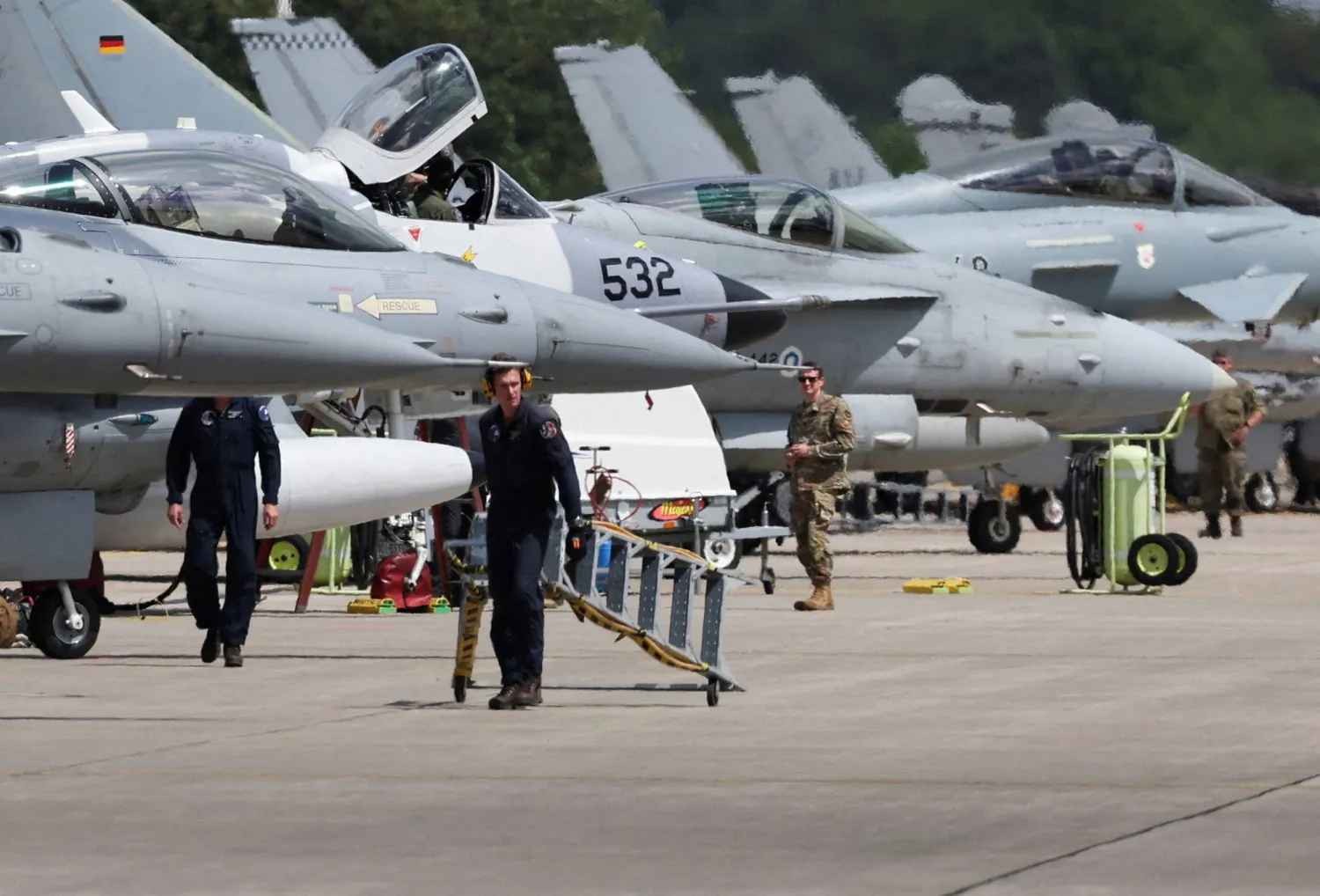
Combat aircraft from a NATO country stand in front of a hangar during a fighter plane maneuver exercise at the American military's Ramstein Air Base, near Ramstein-Miesenbach, Germany, June 6, 2024. (Reuters)
TT

Trump’s Germany Troop Cuts Show Limits of NATO Efforts to Keep US on Board

Combat aircraft from a NATO country stand in front of a hangar during a fighter plane maneuver exercise at the American military's Ramstein Air Base, near Ramstein-Miesenbach, Germany, June 6, 2024. (Reuters)

European officials have been working on ways to convince Donald Trump to keep the United States in NATO despite severe tensions over the Iran war. But his abrupt move to cut US forces in Germany is the latest sign that such efforts have their limits and are far from certain to succeed.

The substance of the decision announced on Friday to remove 5,000 troops from Germany did not come as a surprise to NATO officials. European leaders have agreed with the US president that Europeans will take over more responsibility for their own security from US forces.

Dropping a plan to deploy long-range US Tomahawk missiles to Germany was more concerning for Berlin. But even that was not a huge shock, as that deal was made by Trump’s predecessor, Joe Biden, and US Tomahawk stocks have been depleted by the US-Israeli war against Iran.

More alarming for European governments was how the move was made – with little prior notification or consultation and with US officials linking it to Trump’s displeasure at German Chancellor Friedrich Merz’s criticism of US conduct of the Iran war.

“What is worrying is not ‌the figure of ‌5,000 troops, but the political signal from Washington that longstanding, absolutely reliable partnerships no longer seem to count ‌for ⁠anything and appear to ⁠be subject to arbitrary decisions,” said Siemtje Moeller, a senior lawmaker from Germany’s Social Democrats, who are part of Merz’s governing coalition.

The move followed accusations by Trump that US allies have not been doing enough to support the US in the Iran war and suggestions by him that this meant Washington no longer needs to honor the alliance’s Article 5 mutual defense clause.

Trump also pushed the alliance to the brink by threatening to take Greenland from Denmark, a fellow NATO member. NATO Secretary General Mark Rutte helped to defuse that crisis but the underlying dispute has not been resolved.

European diplomats say they fear Trump may make further moves that could test the alliance before a summit of its 32 national leaders in Ankara in July, especially if the Iran war is not over by ⁠then and he is still venting anger at allies.

"The longer game for NATO and European allies ‌is getting through Ankara," said a European diplomat, speaking on condition of anonymity. "We need to do ‌things with the Americans if we can, and without them if we must.”

EUROPEANS PUSH BACK ON TRUMP CRITICISM

Defense experts say Europeans have little choice but to ‌try to keep the US on board, given their heavy reliance on the United States to deter any possible attack by Russia.

As part of ‌their efforts to convince Trump of the value of European allies, officials have said many European countries are honoring agreements to allow US forces to use bases on their soil and fly in their airspace during the Iran campaign - even if they are not keen to advertise the fact, given Trump and the war are deeply unpopular in much of Europe.

While Spain has banned the use of bases on its territory, Rutte said countries including Britain, Croatia, France, Germany, Greece, Italy, Montenegro, Portugal and ‌Romania were delivering on their commitments.

European officials are also working to make a broader case to Trump, other US officials, lawmakers and Republican-friendly think tanks that it is in their interests to stick with the North ⁠Atlantic Treaty Organization.

Their efforts include highlighting ⁠support for a post-war mission in the Strait of Hormuz, underlining the military and economic value of European allies and demonstrating that Europe is taking on a greater role within NATO, diplomats say.

DIFFERENCES AMONG NATO LEADERS ON IRAN WAR

While there is broad support for these efforts across the alliance, the crisis has also exposed stark differences among European NATO leaders over how to respond to the war on Iran.

Leaders of Western European countries such as Spain, France and Germany have voiced blunt criticism, reflecting domestic public opinion but risking Trump’s ire.

Rutte, by contrast, has made clear he sees anti-war rhetoric as unhelpful. Some eastern European countries, fearing any weakening of NATO will embolden Russia, have taken a similar view, diplomats say.

“When European countries are saying ‘this is not our war’, it irritated the hell out of me,” Rutte told "What the Hell is Going on", a podcast hosted by the American Enterprise Institute think tank, after meeting Trump in Washington last month.

On Monday, Rutte also said several countries were "pre-positioning essential logistical and other support" such as minehunters and minesweepers near the Gulf to be ready for a possible Strait of Hormuz mission after the war ends.

The Netherlands, Belgium and Germany have said they are sending ships that could be part of such a mission. France, which is leading planning of a potential mission with Britain, also has ships in the Middle East that could take part.

"European leaders have gotten the message, they’ve heard the message from the US loud and clear," Rutte told reporters at a summit of European leaders in Armenia.


Report: World Conflicts Hit Peak in 2025

Palestinians assess damage at the site of an Israeli airstrike in Khan Younis, southern Gaza Strip, on June 7, 2026. (AFP)
TT

Report: World Conflicts Hit Peak in 2025

Palestinians assess damage at the site of an Israeli airstrike in Khan Younis, southern Gaza Strip, on June 7, 2026. (AFP)

The world saw the highest number of state conflicts since the Second World War in 2025, a Norwegian study said on Tuesday, warning of a surge in attacks targeting civilians.

The annual "Conflict Trends" report from the Peace Research Institute Oslo (PRIO) said 65 conflicts involving at least one state were recorded worldwide last year, a new high since 1946.

Conflicts between states also hit a new 80-year peak, doubling from the year before to eight -- including border clashes between India and Pakistan, Afghanistan and Pakistan, and Cambodia and Thailand, as well as Russia's invasion of Ukraine and Israeli military operations against Syria.

"Unfortunately, there are not a lot of positive things," researcher Siri Aas Rustad told a group of media outlets, including AFP.

"Usually, I'm able to sort of squeeze something positive out of it, but this year it's shocking, the numbers."

Last year was the third deadliest since the end of the Cold War, with around 245,000 deaths directly related to fighting or political violence -- nearly 76,500 of them attributed to attacks directly targeting civilians, compared with 14,200 in 2024.

The sharp increase in civilian deaths is due to the conflict between the army and paramilitaries in Sudan, where the siege and massacres carried out in El-Fasher city in the Darfur region are estimated to have left some 60,000 people dead.

Since the end of the Cold War, only 1994 and 2021 have seen more bloodshed, due to the Rwanda genocide and the war in Ethiopia's Tigray region respectively.

- Africa worst affected -

"What has happened in the past five or six years is that we have several big conflicts going on at the same time and they seem to take over from each other. The world doesn't get any break," Rustad said.

"And that's different from previously -- this continuous high intensity level of conflict globally."

The PRIO study is based on figures compiled by the Uppsala Conflict Data Program (UCDP), attached to Uppsala University.

It distinguishes between three main types of organized violence: conflicts involving at least one state, non-state conflicts, and one-sided violence against civilians.

Africa remained the region most affected by the first type of conflict with 29, followed by Asia, the Middle East, the Americas, and Europe.

Rustad said Israel was "clearly one of the most aggressive countries in the world at the moment", pointing to its involvement in different types of conflicts in Gaza, Syria, Lebanon, against Iran, and against Houthi militants.

She also pointed to the United States, saying President Donald Trump's return to power had brought "not just attacking and increasing violence, but also the trade barriers they're putting up."

"We are putting a lid on collaboration. The (UN) Security Council doesn't work at the moment. We get a much more polarized world," she said.


Defying Trump with Brief Iran Fight, Israel Seeks Sway over Peace Talks

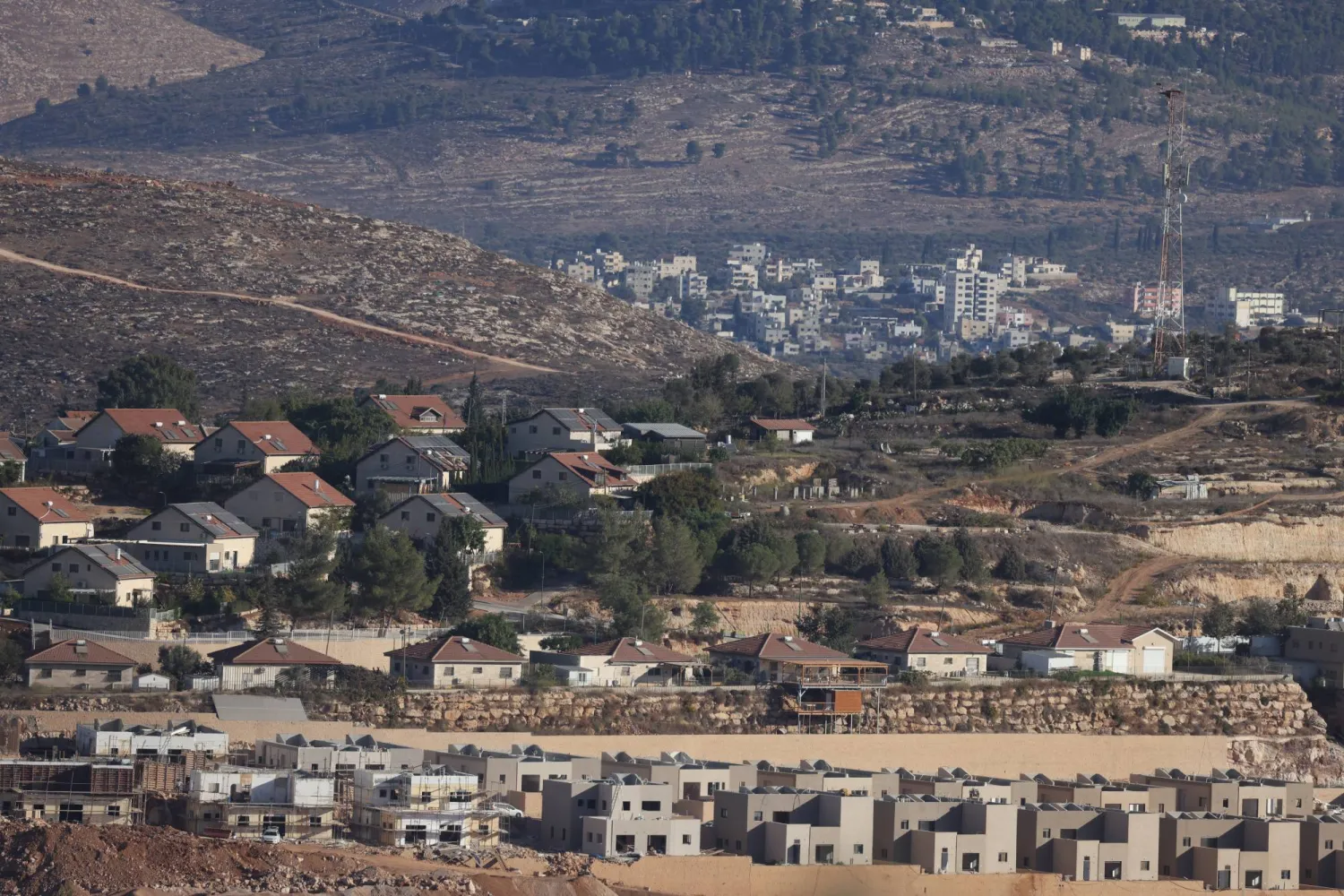
 An Israeli security personnel inspects an impact site, after Iran launched missiles towards Israel, in an Israeli settlement in the Israeli-occupied West Bank, June 8, 2026. (Reuters)
An Israeli security personnel inspects an impact site, after Iran launched missiles towards Israel, in an Israeli settlement in the Israeli-occupied West Bank, June 8, 2026. (Reuters)
TT

Defying Trump with Brief Iran Fight, Israel Seeks Sway over Peace Talks

 An Israeli security personnel inspects an impact site, after Iran launched missiles towards Israel, in an Israeli settlement in the Israeli-occupied West Bank, June 8, 2026. (Reuters)
An Israeli security personnel inspects an impact site, after Iran launched missiles towards Israel, in an Israeli settlement in the Israeli-occupied West Bank, June 8, 2026. (Reuters)

In launching renewed strikes on Iran on Monday in apparent open defiance of Donald Trump, Israel has tried to make its case to have a say at the peace negotiating table, where it has so far been kept at arm's length by the US president.

Despite Trump publicly calling for Israel to hold fire, it struck targets in Iran for the first time since a ceasefire in April, after Iran fired missiles at Israel in what Tehran said was retaliation for Israeli strikes on Lebanon's capital.

Israel and Iran both called a halt to the exchange on Monday shortly after Trump told them to stop shooting, although they each left the door open to a possible resumption.

But in launching the strikes, Israel had sent a message to Washington that no final ‌agreement with Iran ‌can be reached if Israel's interests are ignored, said Danny Orbach, a military historian at ‌Israel's ⁠Hebrew University.

"Because if ⁠it tramples too heavily on Israeli interests, Israel can overturn the table."

TRUMP EXCLUDES ISRAEL FROM NEGOTIATIONS

Trump, who launched the war alongside Israel in February, has been trying to reach a negotiated settlement with Iran, while excluding Israel from those talks.

He has publicly prodded Israeli Prime Minister Benjamin Netanyahu to refrain from actions that could scupper the talks, including by holding fire in Lebanon, which Israel invaded in March in pursuit of the Iran-aligned Hezbollah movement.

Iran says it will not agree to any peace deal with Washington unless a ceasefire also holds in Lebanon.

Last week Netanyahu called off airstrikes on Beirut after a phone call with Trump. Trump later confirmed he ⁠had called the Israeli leader "[expletive] crazy" in the heated exchange, although he also said they ‌still get along well.

Netanyahu's domestic critics accused him of effectively surrendering sovereignty by ‌restricting Israeli military actions to sustain US negotiations, without a seat at the table.

ISRAEL SEEKS TO RETAIN ABILITY TO ATTACK IN LEBANON

After ‌Israel's strike on Lebanon on Sunday, and Iran's decision to fire at Israel in response, Trump made clear he believed ‌that should be the end of the matter.

"Each of them had their fun," he told the Axios website. "Israel had its strike and Iran had its strike. We don't need another one," Trump said.

But Israel concluded that only by striking Iran itself in response could it establish that Iran should not be granted future say over Israeli actions in Lebanon.

Israel could not accept a scenario in which Iranian ‌strikes on Israel were considered a justifiable "tit-for-tat response" to Israeli strikes on Lebanon, a senior Israeli defense official told Reuters.

Before deciding to strike Iran, Netanyahu convened a meeting of top security ⁠and defense officials to discuss ⁠goals of a potential short-term escalation, according to the senior defense official and two other Israeli officials familiar with the deliberations.

One goal was to establish that any future US-Iran deal would not remove Israel's right to attack Hezbollah in southern Lebanon and keep its troops deployed there, the senior defense official said.

Netanyahu had raised this consideration in weekend phone calls with Trump, the senior defense official said.

Netanyahu has not made any public comments or appearances since resuming attacks on Iran early on Monday. His office did not immediately respond to a request for comment.

ISRAEL CANNOT SUSTAIN LONG IRAN AIR CAMPAIGN ALONE, ANALYSTS SAY

The brief resumption of Israel-Iran fighting and Netanyahu's defiance of Trump's demands are the latest episode to lay bare the strains that have at times emerged between the two conservative leaders.

In private, Netanyahu has acknowledged difficulty influencing Trump's thinking on Iran, telling aides he has "no maneuver" to steer the president's decision-making.

But although Israel has the capability to strike Iran without US support, it would still need Washington's blessing and support to sustain such an air campaign for more than a few weeks, say military experts.

"There's no doubt that Israel (cannot) go alone in this war for a long, long time, because (the) ammunition is consumable," said Yehoshua Kalisky, a senior researcher at Israel's Institute for National Security Studies.


A Timeline of the Escalating Tensions Between Iran and Israel over Lebanon

Pro-government Iranian demonstrators wave flags of Iran and Lebanon's Hezbollah movement after Israeli strikes on Beirut's southern suburbs in Tehran on June 7, 2026. (AFP)
TT

A Timeline of the Escalating Tensions Between Iran and Israel over Lebanon

Pro-government Iranian demonstrators wave flags of Iran and Lebanon's Hezbollah movement after Israeli strikes on Beirut's southern suburbs in Tehran on June 7, 2026. (AFP)

The Middle East is suddenly bracing for war again. Iran fired missiles at Israel late Sunday in the first such bombardment in the two months since a ceasefire. Israel launched airstrikes early Monday targeting central and western Iran in response.

The truce in the Iran war that was reached in April has not spread to Lebanon, where Israel has been battling the Iranian-backed Hezbollah group. Israel says it is defending its northern communities that face Hezbollah drone and rocket fire.

Iran sees Israel’s ground invasion, with thousands of troops, and airstrikes in Lebanon as a ceasefire violation. It insists that any deal with the United States must end the fighting there. Israel disagrees.

Here’s a timeline of key events.

Feb. 28 The United States and Israel attack Iran. War begins.

March 2 Hezbollah enters the war by firing rockets at Israel. Israel retaliates.

April 7 A fragile ceasefire in the Iran war is announced, with talks to continue. Israel is not included in them.

April 8 Israel bombards Lebanon’s capital, Beirut, killing over 300 people in a 10-minute attack.

April 14 Lebanon and Israel hold their first direct diplomatic talks in decades in Washington.

April 17 A fragile ceasefire is announced between Israel and Lebanon, but Hezbollah plays no part. Fighting soon resumes from both sides.

May 31 Israel’s ground invasion of Lebanon makes its deepest incursion in over a quarter-century.

June 1 Israeli Prime Minister Benjamin Netanyahu threatens to strike Beirut if Hezbollah attacks don’t stop. US President Donald Trump says Israel and Hezbollah agree to calm the fighting.

June 2 Israeli drone strikes in Lebanon kill 11 people.

June 3 Israel and Lebanon say they agree to renew the fragile ceasefire and create security zones that exclude Hezbollah.

June 4 Hezbollah’s leader rejects the ceasefire agreement and demands that Israel withdraw from Lebanon.

June 5 Iran’s paramilitary Revolutionary Guard says “there will be no calm in the region ” if Israel doesn’t withdraw.

June 6 Israeli airstrikes on southern Lebanon kill three members of the Lebanese military.

June 7 Hezbollah again fires at Israel. Israel strikes Beirut’s southern suburbs. Iran fires at Israel.

June 8 Israel launches airstrikes in the early morning targeting central and western Iran in response to Iranian missile fire. Iranian state television reports the sound of explosions being heard in Isfahan, Tabriz and Tehran, without elaborating.