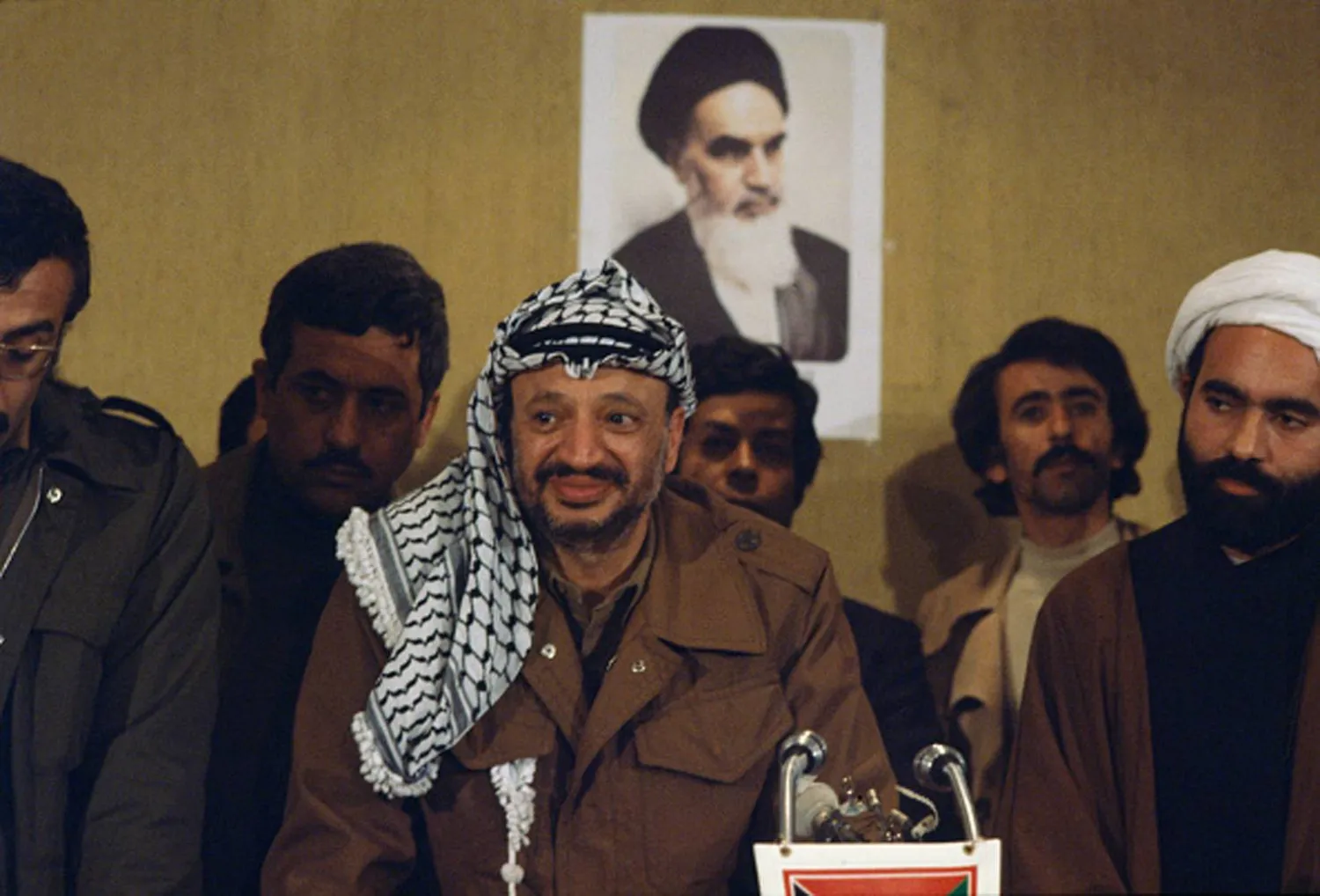

Yasser Arafat was the first foreign leader to visit Iran after Khomeini’s 1979 Iranian Revolution. At the time, he believed the Palestinian cause was gaining a powerful new ally in revolutionary Iran, which immediately closed the Israeli embassy and handed it over to the Palestine Liberation Organization (PLO). But Arafat soon discovered that Tehran’s public support for Palestine was neither unconditional nor straightforward. What began as a honeymoon quickly unraveled into a lasting rupture.88888
Associates of Arafat, who was known for his wit and political sharpness, recalled his surprise when Khomeini insisted on using a Persian translator during their meeting despite speaking fluent Arabic. Arafat was even more unsettled when Khomeini urged him to declare the Palestinian revolution an Islamic one. Those moments deepened Arafat’s suspicions that Iran’s support came with ideological and political conditions attached.
Arafat’s ties with Iranian revolutionaries had predated the revolution, and he responded cautiously. He told Khomeini that the Palestinian struggle was not an Islamic revolution but a national movement representing all Palestinians, Muslims and Christians alike. Later, he would joke about the irony of the leader of the Islamic Revolution pretending not to speak Arabic—the language of the Quran—even though the two men had previously spoken in Arabic before the revolution succeeded.
Arafat–Tehran: Open Hostility
Despite his reservations, Arafat initially maintained cordial relations with Tehran. But the relationship collapsed after the outbreak of the Iran-Iraq War in 1980. Iranian leaders demanded that Arafat publicly support them against Iraqi President Saddam Hussein. Instead, Arafat leaned toward Iraq. From that point on, relations spiraled into open confrontation.
Iran increasingly sought to weaken Arafat and the PLO by cultivating rival Palestinian factions. Palestinians still remember that Tehran did little to help Arafat during Israel’s siege of Beirut in 1982, while he was simultaneously confronting Syria, then one of Iran’s closest regional allies. Damascus supported and financed a major split within Fatah led by Said Moussa Muragha, better known as Abu Musa, who later founded the breakaway movement Fatah al-Intifada and settled in Syria. Tehran also encouraged divisions within other factions operating under the PLO umbrella.
Palestinians also remember the role played by Lebanese Shiite militias affiliated with the Amal Movement, which had pledged allegiance to Khomeini and later participated in massacres inside Palestinian refugee camps in Lebanon.
From that point onward, relations between Iran and the PLO, and later the Palestinian Authority, remained deeply strained. Mutual accusations continued even after Arafat’s death, eventually evolving into something close to declared hostility.
Between periods of tension and cautious rapprochement, Iran eventually found an opening with the establishment of the Palestinian Authority through its growing ties with Hamas and Palestinian Islamic Jihad. Tehran initially offered the two groups public political support, then financial and military backing, eventually integrating them into a broader regional axis. That axis remained intact until the Hamas-led October 2023 attack on Israel, which triggered devastating consequences not only for Hamas but for Iran’s entire regional network, ultimately reverberating back to Tehran itself.
Supporting Rival Factions to Undermine Fatah
Hamas and Palestinian Islamic Jihad established relations with Iran in the late 1980s, shortly after both movements were founded. Those ties deepened throughout the 1990s and intensified during the Second Intifada, which erupted in late 2000. Iranian support expanded further after Hamas seized control of Gaza in 2007.
That takeover gave Iran unprecedented influence inside the Palestinian territories. Tehran intensified military cooperation with Hamas and Islamic Jihad through joint meetings, strategic coordination, and training programs. Fighters from Gaza were sent to Iran and to Hezbollah camps in Lebanon for military training under the supervision of Iran’s Revolutionary Guard Corps (IRGC).
Iran poured money into both groups and trained their operatives to manufacture and launch rockets and other weapons, significantly strengthening their military capabilities. At the same time, the Palestinian Authority and Fatah accused Tehran of fueling Palestinian division through its limitless support for Islamist factions.
Two Hamas sources, one inside Gaza and one abroad, told Asharq Al-Awsat that Hamas’ takeover of Gaza opened the door to an entirely new relationship with Tehran. According to the source outside Gaza, Iran provided extensive financial and military support while helping improve the movement’s combat expertise.
A source inside Gaza said Iran proposed establishing training facilities inside the enclave, but Hamas rejected the idea and instead limited cooperation to sending selected operatives abroad for training. Even so, the relationship substantially enhanced Hamas’ military capabilities.
Islamic Jihad’s relationship with Tehran was even older and stronger. A source from the movement said Iran played a decisive role in arming Palestinian factions during that period, supplying ready-made Grad rockets and Iranian-made Fajr missiles before local production capabilities were later developed using Iranian technical expertise.
Iran’s influence became so visible in Gaza that smaller armed groups also received funding, while some organizations openly embraced Shiite ideology or even called themselves “Palestinian Hezbollah.”
Although Hamas and Islamic Jihad insisted that their political decisions remained independent, Iranian influence became impossible to conceal. Neither movement directly answered questions about whether Tehran had deliberately encouraged Palestinian fragmentation. Instead, sources maintained that Iran’s primary objective was to strengthen the “resistance” against Israel and reinforce Gaza’s front line.
The Turning Point of the Syrian Revolution
The Syrian uprising against President Bashar al-Assad in 2011 exposed the fragility of the Hamas-Iran alliance. Hamas sided against Assad and left Damascus in 2012, enraging Tehran. Iran sharply reduced its financial support to the movement, a fact later acknowledged publicly by Hamas political leader Khaled Meshaal.
Meshaal admitted that Hamas’ dispute with Assad severely damaged ties with Iran and that Tehran was no longer the movement’s primary financial backer. Iran had expected Hamas to support Assad during the uprising, and Hamas’s refusal cost the group both its Syrian base and substantial Iranian funding.
Still, Tehran did not abandon its efforts. Instead, it tried to cultivate influence within Hamas itself. Sources said Iran shifted toward providing limited support directly to Hamas’ armed wing, the Izz ad-Din al-Qassam Brigades, in an apparent attempt to create tension with the movement’s political leadership.
At minimum, Iran succeeded in deepening internal debates within Hamas over regional alliances and political loyalties. The period proved difficult for both sides, and repeated attempts at reconciliation angered Hamas’s Sunni support base because of Iran’s growing regional role.
Abu Marzouk Debunks Iran’s Claims
As Hezbollah worked behind the scenes to repair relations, a leaked phone call revealed unprecedented criticism from within Hamas itself. In January 2012, Asharq Al-Awsat obtained and published a recording of Mousa Abu Marzouk, then deputy head of Hamas’s political bureau, sharply attacking Iran and denying Iranian claims that it had significantly supported Palestinian resistance since 2009.
In the recording, Abu Marzouk criticized Tehran’s regional policies, including its role in Yemen, and described Iranian diplomacy as manipulative. He also claimed Iran conditioned its support on Hamas helping improve Tehran’s relations with countries such as Sudan, describing that as part of Iran’s pressure tactics. He accused Iranian officials of exaggerating their support, saying: “Every ship they lose, they claim was heading to Gaza. A ship was seized in Nigeria and they said it was for us. I told them: apparently every intercepted ship in the world belongs to us.”
A Hamas source abroad told Asharq Al-Awsat that the leaked recording infuriated Iran and forced Hamas leaders to provide explanations to Tehran during an already dangerous turning point in the relationship. The crisis was eventually contained, but it exposed the deep mistrust underlying the alliance.
Building the Axis and the “Unity of Fronts”
Within months of that incident, efforts to restore ties resumed. Relations steadily improved as Hamas’ Gaza leadership tightened its grip over the movement’s political bureau elected in 2017, headed by Ismail Haniyeh, with Yahya Sinwar leading in Gaza and the military wing gaining unprecedented influence.
A source said Iran had strong incentives to preserve the relationship with Hamas because it remained “the largest Sunni Islamist movement in Palestine, with broader reach and capabilities than any other faction.” The relationship, he noted, never completely broke down, and once Hamas’s military leadership gained prominence, ties deepened further in ways that served both sides’ interests.
Relations continued to improve as Hezbollah and Iranian officials worked to restore Hamas’ ties even with the Syrian regime, though reconciliation was never fully completed before Bashar al-Assad’s government collapsed.
Hamas regained Iranian backing, and Tehran consolidated a regional axis in which the movement became a central pillar. Iran also promoted the idea of the “unity of fronts,” convincing its allies that all arenas confronting Israel were interconnected. That appears to have helped persuade Sinwar that Tehran would stand firmly behind Hamas after the October 7 attack, something that did not happen.
Iran, which denied prior knowledge of the attack, chose not to intervene directly, raising serious doubts about the cohesion of the so-called “axis,” the credibility of the “unity of fronts,” and the true extent of coordination among its members.
Even Palestinian Islamic Jihad, despite receiving substantial Iranian support alongside Hamas, reportedly had no prior knowledge of the attack. The movement was generally viewed as more closely aligned with Tehran, or at least more willing to accommodate Iranian political priorities.
The October 7 Turning Point
Islamic Jihad was not immune to Iranian demands that went beyond support for “the resistance.” In 2015, the two sides entered a serious but short-lived crisis over Yemen after the Palestinian movement refused to issue a statement backing the Houthis and their seizure of large parts of the country, including the capital, Sanaa.
Iran responded by cutting support to Islamic Jihad, much as it had previously done with Hamas, and redirected funding to the Sabireen Movement, a splinter faction formed by former Islamic Jihad figures with Iranian backing.
A source from Islamic Jihad told Asharq Al-Awsat that the sharp decline in Iranian support marked one of the most difficult periods the movement had ever faced.
Ultimately, Iran could not escape paying a price itself. It found itself pulled into confrontation with the United States and Israel after wars had already engulfed Hamas and Hezbollah. Those cascading conflicts were set in motion by the October 7 attack, which reshaped not only Iran’s regional axis but the broader Middle East.
The War’s Endgame
The war is still ongoing, and it remains unclear whether Iran will eventually abandon Hamas, Islamic Jihad, Hezbollah, and the Houthis to protect itself. Tehran continues to assure the Palestinian factions that support will continue, although that support has slowed in recent months because of the war, regional instability, and intensified Israeli and American efforts targeting Iranian financial and logistical networks.
Israel has assassinated several Iranian officials responsible for managing ties with Palestinian factions, while Washington has increasingly demanded that Tehran halt support for its regional proxies.
The Palestinian Authority Cuts the Final Thread
Throughout the war, Hamas and Islamic Jihad publicly sided with Iran, signaling their desire to preserve the relationship, though it remained unclear how much control they truly had over that decision, or what the alliance’s future might look like.
The Palestinian Authority, however, appears to have decisively severed what Arabs often call the “Muawiya thread,” the final strand holding a relationship together.
During the Gaza war, the Authority not only attacked Iran’s supreme leader, Ali Khamenei, for praising Hamas’s October 7 operation — accusing him of sacrificing Palestinian lives and land to serve Iran’s agenda — but also said Hamas was serving Iranian interests rather than Palestinian national ones.
At the same time, the Palestinian Authority refrained from condemning the joint American-Israeli strikes on Iran while later condemning Iranian attacks on Arab countries.
The war pushed the Authority more firmly into alignment with the so-called “moderate Arab axis” in opposition to the Iranian-led camp, abandoning much of the ambiguity that had long characterized its political posture.
A well-informed source told Asharq Al-Awsat that the Palestinian Authority had not changed its position so much as clarified it. “Its stance is not new,” the source said, “but it is now more explicit. The Authority is strengthening its place within the moderate camp against the Iranian axis.”
The Palestinian Authority believes everything changed after October 7. But it also believes the wars unleashed by the attack will ultimately vindicate its own political strategy while weakening Iran and its regional allies.