
Syrian Hospitals Turned Into Torture Chambers, with Tishreen Military Hospital as a Model

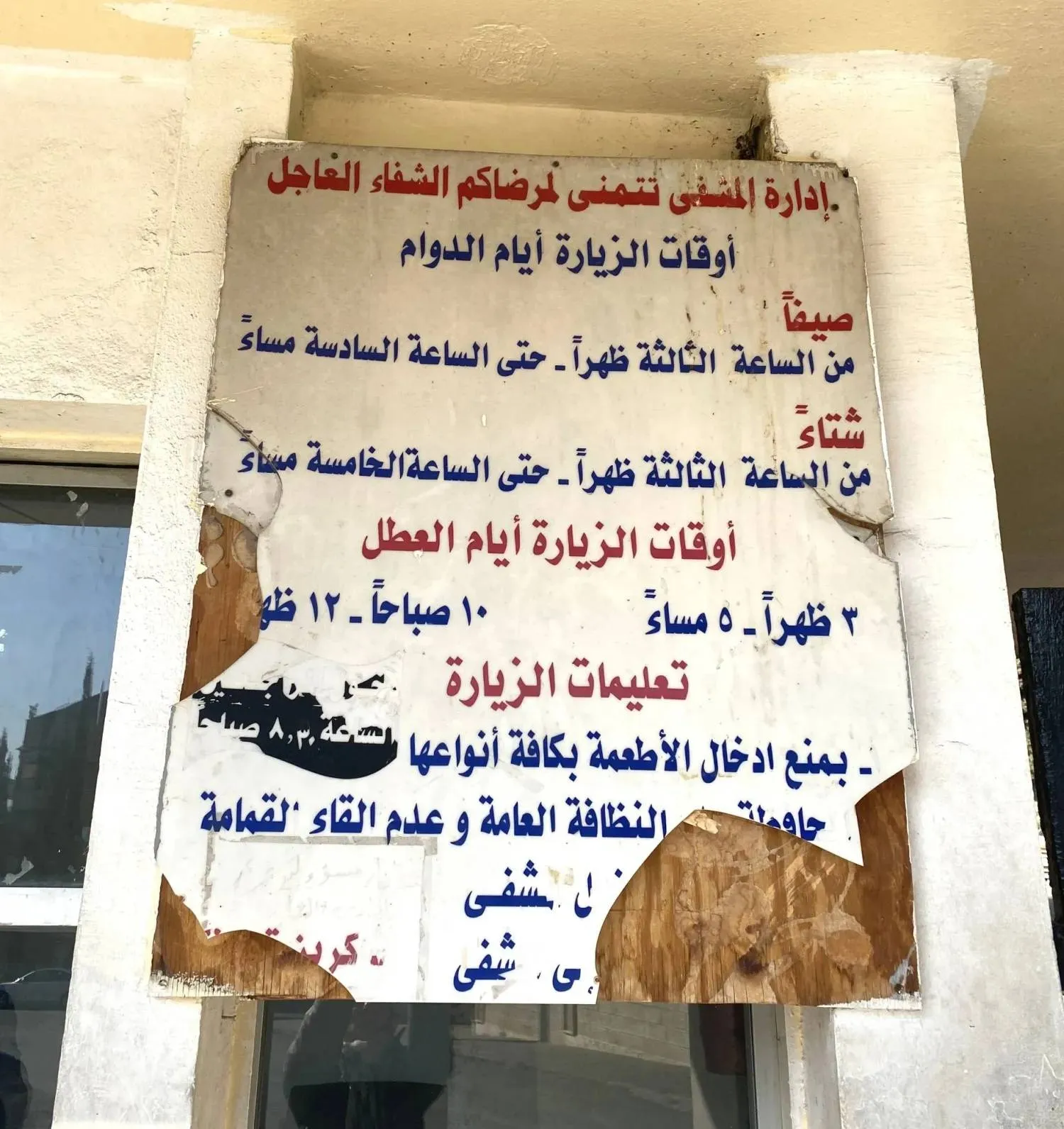
Reception sign at the entrance to Mezzeh Military Hospital 601 in Damascus, where torture and killings took place and where Caesar photos were taken (Asharq Al-Awsat)
TT

Syrian Hospitals Turned Into Torture Chambers, with Tishreen Military Hospital as a Model

Reception sign at the entrance to Mezzeh Military Hospital 601 in Damascus, where torture and killings took place and where Caesar photos were taken (Asharq Al-Awsat)

Asharq Al-Awsat collected harrowing testimonies from survivors of “deliberate liquidation” operations carried out against detained opponents at Tishreen Military Hospital in Damascus and other military hospitals during the years of the Syrian revolution.

They described torture methods and killing techniques, most notably “breaking the neck.”

Syrian security authorities have detained dozens of people for questioning over those crimes, while most of those responsible and those who carried them out remain at large.

The Syrian Network for Human Rights said the data it had collected indicated the existence of organized networks of doctors, nurses, and security personnel involved in the crimes, including organ removal and direct killings.

This comes amid continuing shock among most Syrians since the beginning of this month, after videos and leaked images documenting the torture of detainees inside several sites, including Tishreen Hospital, were published.

The largest medical complex

Tishreen Military Hospital, located in the Barzeh neighborhood northeast of Damascus, opened in 1982 as the largest medical complex in Syria. It included modern buildings and received civilians as well as military personnel.

The hospital became one of the country’s leading specialized centers, with more than 36 specialized medical departments and divisions, modern equipment, especially for kidney dialysis, and a staff of nearly 1,600 doctors, nurses, administrators and guards.

The hospital’s administrative structure consisted of a director general, an officer with the rank of brigadier general, and two deputies, usually with the rank of brigadier general or colonel, one for technical and medical affairs and the other for administrative affairs.

It also included a security officer, whose rank ranged from captain to colonel; heads of divisions and departments, with ranks from lieutenant colonel to brigadier general; specialists and resident doctors, with ranks from first lieutenant to colonel; nursing staff, who were noncommissioned officers; and conscripts and corporals.

The number of military hospitals and clinics under the former regime reached about 30. They were affiliated with the Military Medical Services Directorate and distributed across 14 provinces.

The most prominent included Tishreen, 601 and Harasta hospitals in Damascus and its countryside, as well as hospitals in Aleppo, Homs and Latakia.

Since the leak of old videos and images showing that military hospitals, including Tishreen, had turned into “human slaughterhouses” under the former regime, families have demanded that those who committed the crimes be identified, arrested and held accountable, and that the fate of their loved ones be disclosed.

Asharq Al-Awsat learned that about 40 doctors had been detained for questioning, including three heads of medical departments and divisions.

However, the defense and interior ministries did not respond to Asharq Al-Awsat’s questions about the medical staff involved and the number of those detained.

The liquidation section

Doctor Mahmoud Rahban was a colonel in the former Military Medical Services Directorate. A resident of Damascus, he served in several medical centers and military hospitals, the last of which was Aleppo Hospital.

Rahban told Asharq Al-Awsat that buildings inside military hospitals, including Tishreen, had, over the years of the revolution, turned into mini security branches that were not affiliated with the hospital administration but were overseen by military police personnel.

The small building in Tishreen Hospital, as in Aleppo Hospital, was completely separate from the main building where doctors worked and where ordinary citizens came for treatment.

During the first years of the revolution, Rahban worked with a group of activists to bring medicines and medical supplies into the Barzeh and Qaboun neighborhoods. He was active within the Barzeh Housing Coordination Committee for the Syrian Revolution and the Union of Damascus Coordination Committees.

Rahban was arrested on charges of “financing terrorist acts,” referred to the “terrorism court,” and then sent to the notorious Sednaya prison.

After 75 days in detention, he was released under a decision to “bar prosecution for lack of evidence,” after paying large bribes to investigators and the investigating judge to secure his release.

Rahban said that when detainees became ill, most of them were referred to the “special section” at Tishreen Hospital.

“The treatment was very bad. We were beaten severely and described as terrorists and traitors by doctors and medical staff, whose main concern at the beginning of the revolution was to demonstrate absolute loyalty to the regime,” he said.

Liquidation by breaking necks

Despite the severity of torture in those hospitals, especially Tishreen, some people managed to survive, including Brigadier General Mohammed Mansour Ammar, who was serving at al-Seen Military Airport in the Damascus countryside when the revolution began in 2011.

He was detained in Sednaya between 2014 and 2022 on charges of “providing terrorists with information.”

Ammar told Asharq Al-Awsat that he was transferred to Tishreen Hospital six times during those years. “Each time, the number of those transferred was about 20 detainees, but no more than three of us would return,” he said.

Ammar described how the killings took place.

“All the members of the military police detachment were thugs. Every day, they would choose 10 detainees and order them to lie on their backs. Then one of the members would come and step forcefully on the detainee’s neck, killing him within minutes, while those still alive were forced to collect the bodies at the door of the detachment,” he said.

He pointed to the forensic doctor’s indifference. “He would not enter the detachment or examine the patients. He would simply ask the assistant from the doorway, with disgust, about the number of bodies so he could record them,” Ammar said. He added that during four visits to Tishreen Hospital, he witnessed “the liquidation of about 45 detainees by breaking their necks.”

Among the survivors was also Ibrahim Ali al-Hamdan, who held the rank of conscripted first lieutenant in the former regime’s army in Daraa. He defected in mid-2012 and was arrested in Damascus in August 2012.

Hamdan spoke bitterly to Asharq Al-Awsat about the severe torture he endured for a month and a half at Harasta Hospital.

“My body was exhausted from torture for three weeks. An assistant named Abu al-Layth told me, ‘There is a recommendation from the head of the branch to slaughter you because you are an informant for the Free Syrian Army.’”

He added: “A medical committee came to the section. When the doctor examined me, he found that my feet were infected because of the severe beatings. He cut open the swelling with a scalpel, without any anesthesia or disinfectant, and began pressing on it.”

According to Hamdan, Abu al-Layth once brought in a detainee, accompanied by a doctor and two members of the security forces. They tortured him severely for hours. After resting briefly, they resumed torturing him until midnight, and he died at dawn.

In July 2013, Hamdan was transferred to Sednaya prison. During his detention, he was referred 47 times to Tishreen Hospital, where on one occasion he stayed for about four months while suffering from several illnesses.

“They gave me an IV drip, and I developed a severe fever. I felt I was dying, and I vomited blood, while the doctors were saying that I might die,” Hamdan said.

Because of his condition, a doctor requested that Hamdan be transferred to the intensive care unit. But the director of the medical section replied: “He will remain in the holding cell until he dies. Intensive care is for war wounded, not traitors.”

Hamdan, who was released from Sednaya in late 2020 after serving his sentence, said “the hospital was a place to finish off detainees, not treat them. During four months, I recited the shahada for 40 people before they died.”

Diab Serrih, executive director of the Association of Detainees and the Missing in Sednaya Prison, said: “It is not possible, given the current data and circumstances, to verify any figures for the number of victims at Tishreen Military Hospital. But we estimate that about 39,000 detainees entered Sednaya prison between 2011 and 2021, of whom about 6,000 remained alive.”

Serrih said in a report published in 2023 that a significant number of those who lost their lives were transferred alive to Tishreen Military Hospital, then died there. He added: “We were able to document only 80 cases of people who returned alive from the hospital to Sednaya prison, out of 1,160 documented cases inside the prison.”

The fate of the perpetrators

In this context, Rahban said the old Military Medical Services Directorate had been “completely dissolved, and most of those involved in those crimes are believed to have fled the country.”

He said Major General Dr. Ammar Suleiman, the former director of the Military Medical Services Directorate, who had close ties with Bashar al-Assad, was chiefly responsible for the liquidation operations carried out in those hospitals.

Rahban said Suleiman was believed to have “fled the country, while Brigadier General Dr. Nizar Ismail was arrested two or three months after liberation.” Ismail had held the posts of deputy director of the directorate, head of the supply branch and head of its therapeutic branch.

“Information indicates that the head of the officers’ department in the directorate, Colonel Lubna Ali, fled on the night of liberation from her office to her hometown, then abroad. As for the directorate’s security officer, Brigadier General Mazen Iskandar, there is no information about him,” Rahban said.

According to Rahban, Major General Dr. Mufid Darwish, who served as hospital director until the fall of the regime, knew all the details of what was happening in the hospital, whether in the main building or in the isolated building for sick detainees.

But his treatment was extremely harsh even toward the medical staff working in the main civilian building.

Darwish remained in the country for a short period after liberation, then left for the United Arab Emirates. Some doctors were detained and later released, including the security officer at Tishreen Hospital, Brigadier General Dr. Hani Salloum.

As for the heads of medical departments and divisions in the main building, Rahban said they “had no connection to what was happening in the isolated building.”

He said most of them had regularized their status and were granted settlement documents after it was confirmed that they were not involved in bloodshed and that no personal claims had been filed against them.

Travel ban notices were placed on their names at land, air, and sea crossings. Anyone wishing to travel must submit a request to the Ministry of Defense and may be allowed to do so once for a period of three months after a security review.

Distribution of roles and tasks

The role of the forensic medicine division in the hospital was to document the deaths of detainees and issue death certificates.

But its head would state in the death certificate that the death resulted from “cardiac and respiratory arrest” or “cardiovascular collapse,” even though detainees had in fact died under torture.

From 2011 until liberation in December 2024, Brigadier General Dr. Akram Fares al-Shaar, from the Hama countryside, headed the forensic medicine division at Tishreen Hospital.

The division also included his deputy, Brigadier General Ismail Kiwan from the city of Sweida; Lieutenant Colonel Ayman Khalo; Lieutenant Munqith Shammut; and seven noncommissioned officers who served as nurses and administrators.

Rahban said Shaar had been detained, and noted that Ayman Khalo had been detained for some time over a criminal case unrelated to Tishreen Hospital. Ismail Kiwan fled to areas controlled by Druze cleric Hikmat al-Hijri in Sweida province in southern Syria.

With the dissolution of the old Military Medical Services Directorate, Asharq Al-Awsat’s information indicates that the number of former medical staff members who returned, including doctors and nurses, “can be counted on one hand.”

A number of doctors who were not involved in crimes are practicing in private clinics, while others have left for Western, regional, and Arab countries.

An accelerated process is currently underway to evacuate and hand over the ready housing units affiliated with Tishreen Hospital. The move implements a decision issued by the Ministry of Defense at the beginning of this May, which set a one-month deadline from the date of issuance.

An organized network of killing and torture

The Syrian Network for Human Rights does not yet have a fully documented figure for the number of doctors and medical personnel involved in liquidation operations specifically inside Tishreen Hospital.

What can be confirmed, according to the network’s documentation methodology, is that the hospital included an organized network of doctors, nurses, and security officers who cooperated in killings and torture, and that the violations were not committed by isolated individuals.

Its director, Fadel Abdul Ghany, told Asharq Al-Awsat that “the data collected by the network indicate the existence of networks of doctors, nurses, and security personnel involved in these crimes, including organ removal in addition to direct killings.”

The available data point to three categories. The first includes detainees whom the new security authorities managed to arrest. The second includes those who fled Syria. The third includes those who remained inside the country with unresolved legal status.

Abdul Ghany said some medical staff members were still in the hospital housing units or in different parts of Syria, as revealed by the recent security operation conducted in the nurses’ housing units affiliated with the hospital.

Abdul Ghany said the escape of some of those individuals posed a serious challenge to accountability efforts, requiring immediate international coordination to issue Interpol notices and international arrest warrants against suspects.

Abdul Ghany noted that some suspects had been arrested, but said their number remained limited compared with the scale of documented crimes.

Among the most prominent cases documented by official Syrian sources was the Interior Ministry’s announcement in late 2025 that five former members of the medical, judicial, military, and security cadres had been arrested in the nurses’ housing units in early May 2026, while a number of former workers were detained.

A German court issued its ruling on June 16, 2025, sentencing Syrian doctor Alaa Mousa to life in prison on charges of committing crimes against humanity, including torturing detainees in military hospitals in Syria.

From Black Death to Covid, Ships Have Long Hosted Outbreaks

Passengers stand aboard the Bahamas-registered cruise ship Ambition after they were confined following the outbreak of a gastrointestinal illness onboard, at the Bordeaux port in Bordeaux, southwestern France on May 13, 2026. (AFP)
TT

From Black Death to Covid, Ships Have Long Hosted Outbreaks

Passengers stand aboard the Bahamas-registered cruise ship Ambition after they were confined following the outbreak of a gastrointestinal illness onboard, at the Bordeaux port in Bordeaux, southwestern France on May 13, 2026. (AFP)

A deadly outbreak on a cruise liner is just the latest in a long history of infectious diseases spreading rapidly in the cramped confines of ships, from the Black Death to Covid.

People around the world remain in quarantine or self-isolation after a rare outbreak of hantavirus on a cruise ship left three dead and infected at least seven more.

Another scare came on Wednesday, when more than 1,700 passengers were confined to a cruise ship docked in the French city of Bordeaux after an elderly passenger man died of a heart attack.

Dozens of passengers showed symptoms of a stomach bug, however initial tests ruled out norovirus -- a common infection on cruises -- and officials said there was no connection to hantavirus.

The latest incidents shone a light on how ships -- whether they are cruise liners, aircraft carriers or old wooden boats -- can be the ideal environment for viruses to spread.

"The worst place to have an epidemic, like a fire, is in close quarters far from help, such as a ship on the high seas," US historian Alfred Crosby once wrote about the Spanish influenza pandemic of 1918.

Jean-Pierre Auffray, the honorary president of the French Society of Maritime Medicine, told AFP that "the risk is twofold".

There is the danger that passengers and crew transmit the disease to each other on the ship -- and then the risk they transport their illness across the land, he explained.

"Ships remain enclosed environments where there is prolonged, repeated and close contact, which facilitates the spread of some outbreaks," he said.

This is particularly the case for viruses "transmitted through the air, such as influenza and Covid-19, and those transmitted through contact or food, such as norovirus," added Auffray, whose book about seafaring infections will be published next month.

The Andes strain of hantavirus, which spread onboard the MV Hondius cruise ship, can be spread via aerosols, research has suggested.

The World Health Organization has warned that more hantavirus cases could yet emerge, but also stressed there "is no sign that we are seeing the start of a larger outbreak".

- Sailors or retirees? -

At the height of the pandemic in 2020, Covid tore through many vessels.

The luxury cruise ship Zaandam and its many sick passengers were turned away by numerous Latin American countries before finally docking in the US state of Florida.

Hundreds of sailors onboard the French aircraft carrier Charles de Gaulle also contracted Covid.

While sailors on military ships are often young and fit, cruise ship passengers tend to be more elderly and vulnerable.

However the viruses spread in the same way: in close quarters where people regularly share equipment.

"We learned from the Covid pandemic, and there have been improvements on cruise ships," Auffray said.

"We've improved the ventilation systems, which allow us to better combat aerosol transmission."

"There is better training for the ship's doctors," Auffray added.

- 'Woe to us' -

The other threat comes when infected passengers disembark.

Before the MV Hondius docked in the Canary Islands on the weekend, the local government had initially opposed taking it in.

In previous centuries, quarantined ships were kept away from ports, sometimes forced to dock at tiny islands called lazarettos.

"The ethics were not the same. Quarantine meant: 'You'll die on your ship -- don't come and infect us'," Auffray said.

Now, the passengers of outbreak ships like the MV Hondius can be tracked, to ensure they do not spread disease to their home countries.

People who merely came in contact with passengers are currently being isolated and checked for hantavirus in several countries.

While diseases can now hop continents on airplanes, for most of human history they crossed seas on boats.

This was how the Black Death -- the most devastating pandemic in human history -- arrived on Europe's shores back in the 1340s.

Sailors from Genoa were laying siege to the ancient Crimean trading hub of Caffa when they became infected by plague-ridden corpses catapulted over the walls by the Mongol Golden Horde.

When the sailors journeyed back across the Mediterranean, they brought with them a plague that wiped out up to 60 percent of the population in parts of Europe.

"Woe to us for we cast at them the darts of death!" Italian notary Gabriel de Mussis wrote at the time.

"Whilst we spoke to them, whilst they embraced us and kissed us, we scattered the poison from our lips."


Grief Silenced, Suppressed as South Lebanon, Beirut Suburbs Are ‘Barred’ from Mourning War Dead

Women mourn during the funeral procession for three Lebanese Civil Defense members killed in an Israeli airstrike on the village of Majdal Zoun in southern Lebanon. (dpa)
TT

Grief Silenced, Suppressed as South Lebanon, Beirut Suburbs Are ‘Barred’ from Mourning War Dead

Women mourn during the funeral procession for three Lebanese Civil Defense members killed in an Israeli airstrike on the village of Majdal Zoun in southern Lebanon. (dpa)

Residents of South Lebanon and Beirut’s southern suburbs are caught between grief and resilience, a feeling unlike any other, and one that is suffocating most families.

Some have the courage to raise their voices and express the pain, grief, and regret they feel over their losses. Others feel ashamed to speak out because of social constraints imposed on them, which make their grief seem disgraceful or forbidden.

Comparisons over loss are always present, and the main justification remains that what people lose is nothing compared with the blood of those who fall defending their land.

In the largely devastated South today, grief is not allowed to take its natural space. A mother who loses her son or husband, a woman who loses her home, a father who loses his source of income, and others all find themselves facing a social system that forces them to suppress their emotions.

This suppression, in turn, becomes a form of self-censorship that prevents any citizen from grieving or crying. Silence becomes the only option, because expressing pain may be interpreted as weakness, lack of patience, or even a moral failing toward the “larger cause” championed by Hezbollah.

This is the reality now lived by almost every family that has lost, or continues to lose, homes and loved ones in Beirut’s southern suburbs, the Bekaa, and the South. Towns are being destroyed, memories are being erased, and any hope of return is fading.

Meanwhile, expressing pain has become an act of betrayal on social media, where it has become a social court that judges people’s feelings and emotions.

This is what happened to many people who dared to raise their voices in grief and blame those who made the decision to go to war, namely, Hezbollah.

A women grieves as she rests her head on one of nine people killed the day before in an Israeli airstrike on the southern Lebanese village of Jibchit, during their funeral in the city of Sidon on May 10, 2026. (AFP)

Accusations of treason

Nour, who remains displaced with her family in a school and lives each day hoping she will not receive news that her home in the South has been destroyed, said: “We are all doing our best to endure, but some people cannot bear more than they can handle.”

She said that expressing what a citizen from the South feels is now met with ready-made accusations. “He is considered against the resistance [Hezbollah], an agent and a traitor,” she revealed, adding: “People have started setting the standards and deciding what is right and what is wrong.”

“We have become a people left to our fate, and no one asks about us,” she lamented. “Those who criticize us for expressing our pain are the ones living comfortable lives and passing judgment from afar.”

“Those who see expressing our pain as a crime should live one day like the days we are living, and then talk about dignity and patriotism,” she added.

‘Forbidden from expressing our pain’

Zeinab also spoke of the pressure faced by those who express their pain.

“It is as if families who lose their livelihoods, their children, their homes and the work of years are expected to show patience and the morals of Ahl al-Bayt, morals that those accusing others of betrayal do not possess as they throw around charges of treason at random,” she said.

“I am a daughter of this environment, and I know very well what people say when they speak about their pain,” she declared. “But we are not allowed to express this pain out loud, or we are deemed traitors.”

“My house, which my husband and I built over 10 years in the South, was destroyed. My husband lost his shop, and today I look at my children and do not know where to take them, what their future will be, or who will compensate us for our losses.”

Organized suppression

Against this backdrop, sociologist Mona Fayyad told Asharq Al-Awsat: “What is happening today in the environment controlled by Hezbollah is a policy of silencing people, within a narrative that is being imposed by force.”

She said that in the past, Hezbollah had achieved a measure of success that covered up losses. The party also had organized bodies capable of providing psychological and financial support to families, helping contain losses and giving them meaning through slogans, such as the “liberation of Jerusalem” and others.

That, she said, pushed people to suppress their pain and express it only within that framework.

“Today, however, the situation has started to change little by little, and people have begun daring to raise their voices, which is why campaigns accusing them of betrayal are increasing,” Fayyad explained.

A man watches as rescuers work at the site of an Israeli strike that took place on May 6, in the southern suburbs of Beirut, Lebanon, May 7, 2026. (Reuters)

Pent-up feelings

Fayyad spoke of the suffering of Lebanese people in general, and residents of the South, Beirut’s southern suburbs, and areas under Israeli bombardment in particular.

“People are hurting on several levels, and all Lebanese are living in a difficult state of waiting, unable to plan for the future, which is one of the hardest things a person can experience,” she said.

“We are now in the unknown, and we are threatened in terms of security and the economy.”

She said residents of the South and Beirut's southern suburbs who lost their homes face double suffering, amid insecurity, displacement and tens of thousands of destroyed homes that leave them unable to know their fate.

“These people are carrying a heavy burden, and they are forbidden from expressing it, but the pressure will inevitably explode somewhere,” Fayyad remarked.

“The problem is that they have no horizon ahead of them, amid declining support, losses turning into numbers with no value, and a refusal to acknowledge defeat.”

“And yet, voices have begun to emerge. But shock is still dominant, and people have not yet absorbed what happened,” Fayyad went on to say.

“With time, and as the picture becomes clearer, this pain will unfortunately come out into the open in different forms, from psychological and physical illnesses to nervous breakdowns.”


Arafat and Tehran: From Revolutionary Embrace to Open Hostility

Yasser Arafat during a visit to Tehran on February 17, 1979. He was the first official figure to visit Iran after the "Islamic Revolution" (Getty).
TT

Arafat and Tehran: From Revolutionary Embrace to Open Hostility

Yasser Arafat during a visit to Tehran on February 17, 1979. He was the first official figure to visit Iran after the "Islamic Revolution" (Getty).

Yasser Arafat was the first foreign leader to visit Iran after Khomeini’s 1979 Iranian Revolution. At the time, he believed the Palestinian cause was gaining a powerful new ally in revolutionary Iran, which immediately closed the Israeli embassy and handed it over to the Palestine Liberation Organization (PLO). But Arafat soon discovered that Tehran’s public support for Palestine was neither unconditional nor straightforward. What began as a honeymoon quickly unraveled into a lasting rupture.88888

Associates of Arafat, who was known for his wit and political sharpness, recalled his surprise when Khomeini insisted on using a Persian translator during their meeting despite speaking fluent Arabic. Arafat was even more unsettled when Khomeini urged him to declare the Palestinian revolution an Islamic one. Those moments deepened Arafat’s suspicions that Iran’s support came with ideological and political conditions attached.

Arafat’s ties with Iranian revolutionaries had predated the revolution, and he responded cautiously. He told Khomeini that the Palestinian struggle was not an Islamic revolution but a national movement representing all Palestinians, Muslims and Christians alike. Later, he would joke about the irony of the leader of the Islamic Revolution pretending not to speak Arabic—the language of the Quran—even though the two men had previously spoken in Arabic before the revolution succeeded.

Arafat–Tehran: Open Hostility

Despite his reservations, Arafat initially maintained cordial relations with Tehran. But the relationship collapsed after the outbreak of the Iran-Iraq War in 1980. Iranian leaders demanded that Arafat publicly support them against Iraqi President Saddam Hussein. Instead, Arafat leaned toward Iraq. From that point on, relations spiraled into open confrontation.


Iran increasingly sought to weaken Arafat and the PLO by cultivating rival Palestinian factions. Palestinians still remember that Tehran did little to help Arafat during Israel’s siege of Beirut in 1982, while he was simultaneously confronting Syria, then one of Iran’s closest regional allies. Damascus supported and financed a major split within Fatah led by Said Moussa Muragha, better known as Abu Musa, who later founded the breakaway movement Fatah al-Intifada and settled in Syria. Tehran also encouraged divisions within other factions operating under the PLO umbrella.

Palestinians also remember the role played by Lebanese Shiite militias affiliated with the Amal Movement, which had pledged allegiance to Khomeini and later participated in massacres inside Palestinian refugee camps in Lebanon.

From that point onward, relations between Iran and the PLO, and later the Palestinian Authority, remained deeply strained. Mutual accusations continued even after Arafat’s death, eventually evolving into something close to declared hostility.

Between periods of tension and cautious rapprochement, Iran eventually found an opening with the establishment of the Palestinian Authority through its growing ties with Hamas and Palestinian Islamic Jihad. Tehran initially offered the two groups public political support, then financial and military backing, eventually integrating them into a broader regional axis. That axis remained intact until the Hamas-led October 2023 attack on Israel, which triggered devastating consequences not only for Hamas but for Iran’s entire regional network, ultimately reverberating back to Tehran itself.

Supporting Rival Factions to Undermine Fatah

Hamas and Palestinian Islamic Jihad established relations with Iran in the late 1980s, shortly after both movements were founded. Those ties deepened throughout the 1990s and intensified during the Second Intifada, which erupted in late 2000. Iranian support expanded further after Hamas seized control of Gaza in 2007.

That takeover gave Iran unprecedented influence inside the Palestinian territories. Tehran intensified military cooperation with Hamas and Islamic Jihad through joint meetings, strategic coordination, and training programs. Fighters from Gaza were sent to Iran and to Hezbollah camps in Lebanon for military training under the supervision of Iran’s Revolutionary Guard Corps (IRGC).

Iran poured money into both groups and trained their operatives to manufacture and launch rockets and other weapons, significantly strengthening their military capabilities. At the same time, the Palestinian Authority and Fatah accused Tehran of fueling Palestinian division through its limitless support for Islamist factions.

Two Hamas sources, one inside Gaza and one abroad, told Asharq Al-Awsat that Hamas’ takeover of Gaza opened the door to an entirely new relationship with Tehran. According to the source outside Gaza, Iran provided extensive financial and military support while helping improve the movement’s combat expertise.

A source inside Gaza said Iran proposed establishing training facilities inside the enclave, but Hamas rejected the idea and instead limited cooperation to sending selected operatives abroad for training. Even so, the relationship substantially enhanced Hamas’ military capabilities.

Islamic Jihad’s relationship with Tehran was even older and stronger. A source from the movement said Iran played a decisive role in arming Palestinian factions during that period, supplying ready-made Grad rockets and Iranian-made Fajr missiles before local production capabilities were later developed using Iranian technical expertise.

Iran’s influence became so visible in Gaza that smaller armed groups also received funding, while some organizations openly embraced Shiite ideology or even called themselves “Palestinian Hezbollah.”

Although Hamas and Islamic Jihad insisted that their political decisions remained independent, Iranian influence became impossible to conceal. Neither movement directly answered questions about whether Tehran had deliberately encouraged Palestinian fragmentation. Instead, sources maintained that Iran’s primary objective was to strengthen the “resistance” against Israel and reinforce Gaza’s front line.

The Turning Point of the Syrian Revolution

The Syrian uprising against President Bashar al-Assad in 2011 exposed the fragility of the Hamas-Iran alliance. Hamas sided against Assad and left Damascus in 2012, enraging Tehran. Iran sharply reduced its financial support to the movement, a fact later acknowledged publicly by Hamas political leader Khaled Meshaal.

Meshaal admitted that Hamas’ dispute with Assad severely damaged ties with Iran and that Tehran was no longer the movement’s primary financial backer. Iran had expected Hamas to support Assad during the uprising, and Hamas’s refusal cost the group both its Syrian base and substantial Iranian funding.

Still, Tehran did not abandon its efforts. Instead, it tried to cultivate influence within Hamas itself. Sources said Iran shifted toward providing limited support directly to Hamas’ armed wing, the Izz ad-Din al-Qassam Brigades, in an apparent attempt to create tension with the movement’s political leadership.

At minimum, Iran succeeded in deepening internal debates within Hamas over regional alliances and political loyalties. The period proved difficult for both sides, and repeated attempts at reconciliation angered Hamas’s Sunni support base because of Iran’s growing regional role.

Abu Marzouk Debunks Iran’s Claims

As Hezbollah worked behind the scenes to repair relations, a leaked phone call revealed unprecedented criticism from within Hamas itself. In January 2012, Asharq Al-Awsat obtained and published a recording of Mousa Abu Marzouk, then deputy head of Hamas’s political bureau, sharply attacking Iran and denying Iranian claims that it had significantly supported Palestinian resistance since 2009.

In the recording, Abu Marzouk criticized Tehran’s regional policies, including its role in Yemen, and described Iranian diplomacy as manipulative. He also claimed Iran conditioned its support on Hamas helping improve Tehran’s relations with countries such as Sudan, describing that as part of Iran’s pressure tactics. He accused Iranian officials of exaggerating their support, saying: “Every ship they lose, they claim was heading to Gaza. A ship was seized in Nigeria and they said it was for us. I told them: apparently every intercepted ship in the world belongs to us.”

A Hamas source abroad told Asharq Al-Awsat that the leaked recording infuriated Iran and forced Hamas leaders to provide explanations to Tehran during an already dangerous turning point in the relationship. The crisis was eventually contained, but it exposed the deep mistrust underlying the alliance.

Building the Axis and the “Unity of Fronts”

Within months of that incident, efforts to restore ties resumed. Relations steadily improved as Hamas’ Gaza leadership tightened its grip over the movement’s political bureau elected in 2017, headed by Ismail Haniyeh, with Yahya Sinwar leading in Gaza and the military wing gaining unprecedented influence.

A source said Iran had strong incentives to preserve the relationship with Hamas because it remained “the largest Sunni Islamist movement in Palestine, with broader reach and capabilities than any other faction.” The relationship, he noted, never completely broke down, and once Hamas’s military leadership gained prominence, ties deepened further in ways that served both sides’ interests.

Relations continued to improve as Hezbollah and Iranian officials worked to restore Hamas’ ties even with the Syrian regime, though reconciliation was never fully completed before Bashar al-Assad’s government collapsed.

Hamas regained Iranian backing, and Tehran consolidated a regional axis in which the movement became a central pillar. Iran also promoted the idea of the “unity of fronts,” convincing its allies that all arenas confronting Israel were interconnected. That appears to have helped persuade Sinwar that Tehran would stand firmly behind Hamas after the October 7 attack, something that did not happen.

Iran, which denied prior knowledge of the attack, chose not to intervene directly, raising serious doubts about the cohesion of the so-called “axis,” the credibility of the “unity of fronts,” and the true extent of coordination among its members.

Even Palestinian Islamic Jihad, despite receiving substantial Iranian support alongside Hamas, reportedly had no prior knowledge of the attack. The movement was generally viewed as more closely aligned with Tehran, or at least more willing to accommodate Iranian political priorities.

The October 7 Turning Point

Islamic Jihad was not immune to Iranian demands that went beyond support for “the resistance.” In 2015, the two sides entered a serious but short-lived crisis over Yemen after the Palestinian movement refused to issue a statement backing the Houthis and their seizure of large parts of the country, including the capital, Sanaa.

Iran responded by cutting support to Islamic Jihad, much as it had previously done with Hamas, and redirected funding to the Sabireen Movement, a splinter faction formed by former Islamic Jihad figures with Iranian backing.

A source from Islamic Jihad told Asharq Al-Awsat that the sharp decline in Iranian support marked one of the most difficult periods the movement had ever faced.

Ultimately, Iran could not escape paying a price itself. It found itself pulled into confrontation with the United States and Israel after wars had already engulfed Hamas and Hezbollah. Those cascading conflicts were set in motion by the October 7 attack, which reshaped not only Iran’s regional axis but the broader Middle East.

The War’s Endgame

The war is still ongoing, and it remains unclear whether Iran will eventually abandon Hamas, Islamic Jihad, Hezbollah, and the Houthis to protect itself. Tehran continues to assure the Palestinian factions that support will continue, although that support has slowed in recent months because of the war, regional instability, and intensified Israeli and American efforts targeting Iranian financial and logistical networks.

Israel has assassinated several Iranian officials responsible for managing ties with Palestinian factions, while Washington has increasingly demanded that Tehran halt support for its regional proxies.

The Palestinian Authority Cuts the Final Thread

Throughout the war, Hamas and Islamic Jihad publicly sided with Iran, signaling their desire to preserve the relationship, though it remained unclear how much control they truly had over that decision, or what the alliance’s future might look like.

The Palestinian Authority, however, appears to have decisively severed what Arabs often call the “Muawiya thread,” the final strand holding a relationship together.

During the Gaza war, the Authority not only attacked Iran’s supreme leader, Ali Khamenei, for praising Hamas’s October 7 operation — accusing him of sacrificing Palestinian lives and land to serve Iran’s agenda — but also said Hamas was serving Iranian interests rather than Palestinian national ones.

At the same time, the Palestinian Authority refrained from condemning the joint American-Israeli strikes on Iran while later condemning Iranian attacks on Arab countries.

The war pushed the Authority more firmly into alignment with the so-called “moderate Arab axis” in opposition to the Iranian-led camp, abandoning much of the ambiguity that had long characterized its political posture.

A well-informed source told Asharq Al-Awsat that the Palestinian Authority had not changed its position so much as clarified it. “Its stance is not new,” the source said, “but it is now more explicit. The Authority is strengthening its place within the moderate camp against the Iranian axis.”

The Palestinian Authority believes everything changed after October 7. But it also believes the wars unleashed by the attack will ultimately vindicate its own political strategy while weakening Iran and its regional allies.