
Three Precious Gifts to Tehran from Saddam Hussein, Osama bin Laden, and George W. Bush

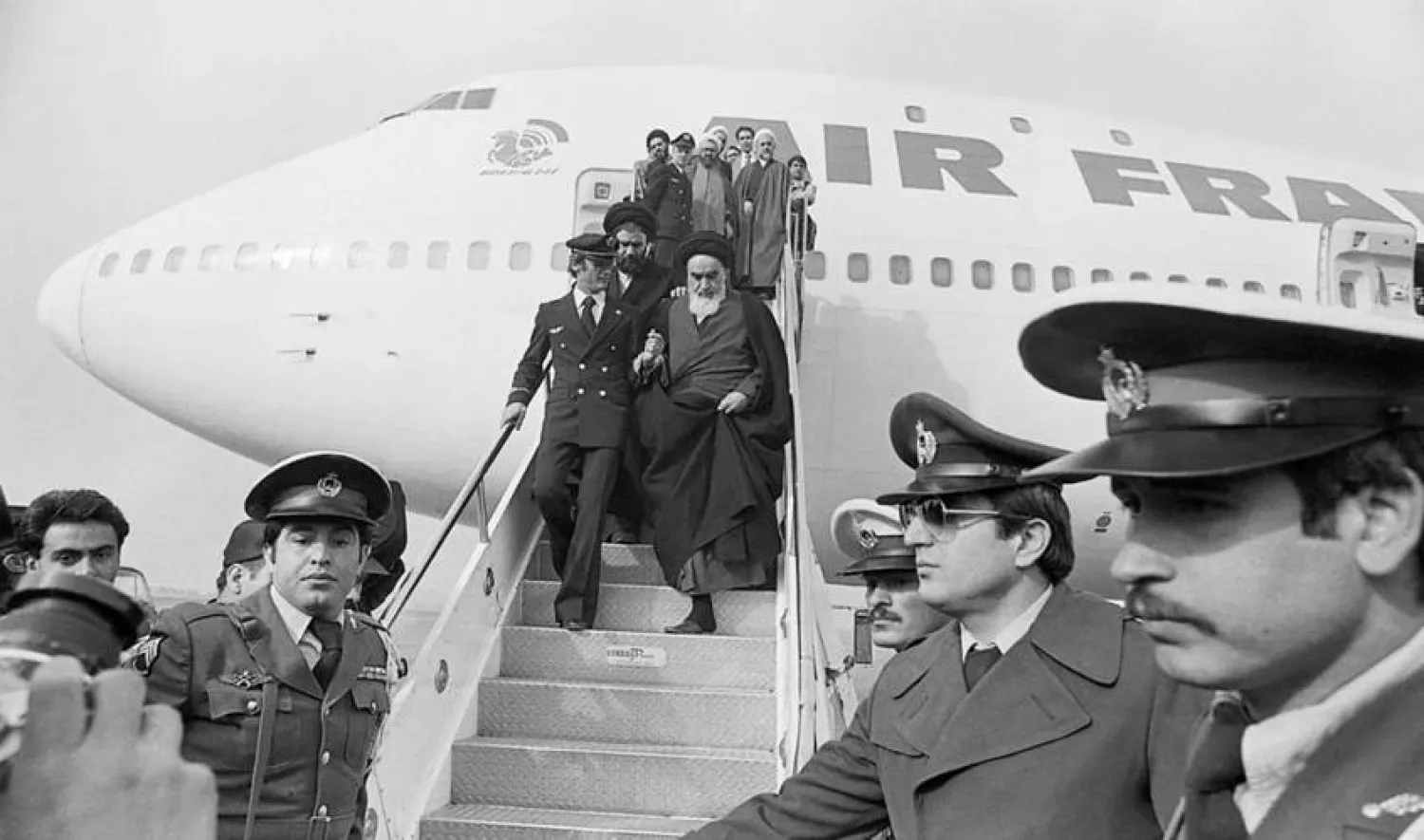
(FILES) Photo taken 01 February 1979 at Tehran airport of Ruhollah Khomeini (C) leaving the Air France Boeing 747 jumbo that flew him back from exile in France to Tehran. Getty Images
TT

Three Precious Gifts to Tehran from Saddam Hussein, Osama bin Laden, and George W. Bush

(FILES) Photo taken 01 February 1979 at Tehran airport of Ruhollah Khomeini (C) leaving the Air France Boeing 747 jumbo that flew him back from exile in France to Tehran. Getty Images

Most people in today’s Middle East were born after 1979. Yet they often overlook how profoundly that year shaped their countries, their stability, and their daily lives. It unleashed storms, wars, and leaders whose ambitions and dangers far exceeded the borders from which they emerged. Some observers even see a direct link between that pivotal year and what is unfolding today around the Strait of Hormuz following the recent US-Israeli war against Iran and its military arsenal.

Few years in modern history can rival 1979 in significance or consequence.

That year, Khomeini returned to Tehran from exile in Paris. The reactor of the Iranian Revolution quickly began emitting its political radiation, especially after the institutionalization of the doctrine of Wilayat al-Faqih, the Guardianship of the Islamic Jurist.

The same year, Iraq’s presidential palace effectively fell into the hands of the country’s strongman, Saddam Hussein, who eased President Ahmed Hassan al-Bakr into retirement under the burdens of age—and perhaps regret.

In 1979, Egyptian President Anwar Sadat also signed the Camp David Accords with Israeli Prime Minister Menachem Begin in Washington under the sponsorship of President Jimmy Carter.

These developments soon intersected with a major international event. Soviet leader Leonid Brezhnev committed what many would later regard as the grave error of invading Afghanistan. The Kremlin walked into a trap. From among the fighters who flocked to that battlefield would emerge Osama bin Laden, the man who would inaugurate the new century with the attacks on New York and Washington, unintentionally paving the way for the removal of Saddam Hussein’s regime.

On January 16, 1979, amid mounting protests and demonstrations, Shah Mohammad Reza Pahlavi left Iran, entrusting the country to the government of Shapour Bakhtiar. Those around him tried to portray the departure as a temporary vacation. In reality, it was a one-way journey. America had abandoned its ally.

The decisive turning point came swiftly. On February 1, a plane from Paris landed at Tehran’s Mehrabad Airport carrying an extraordinary passenger: Ayatollah Khomeini, returning after fourteen years in exile. The massive crowds that greeted him delivered an unmistakable message. The Shah’s regime had fallen. The revolution had triumphed.
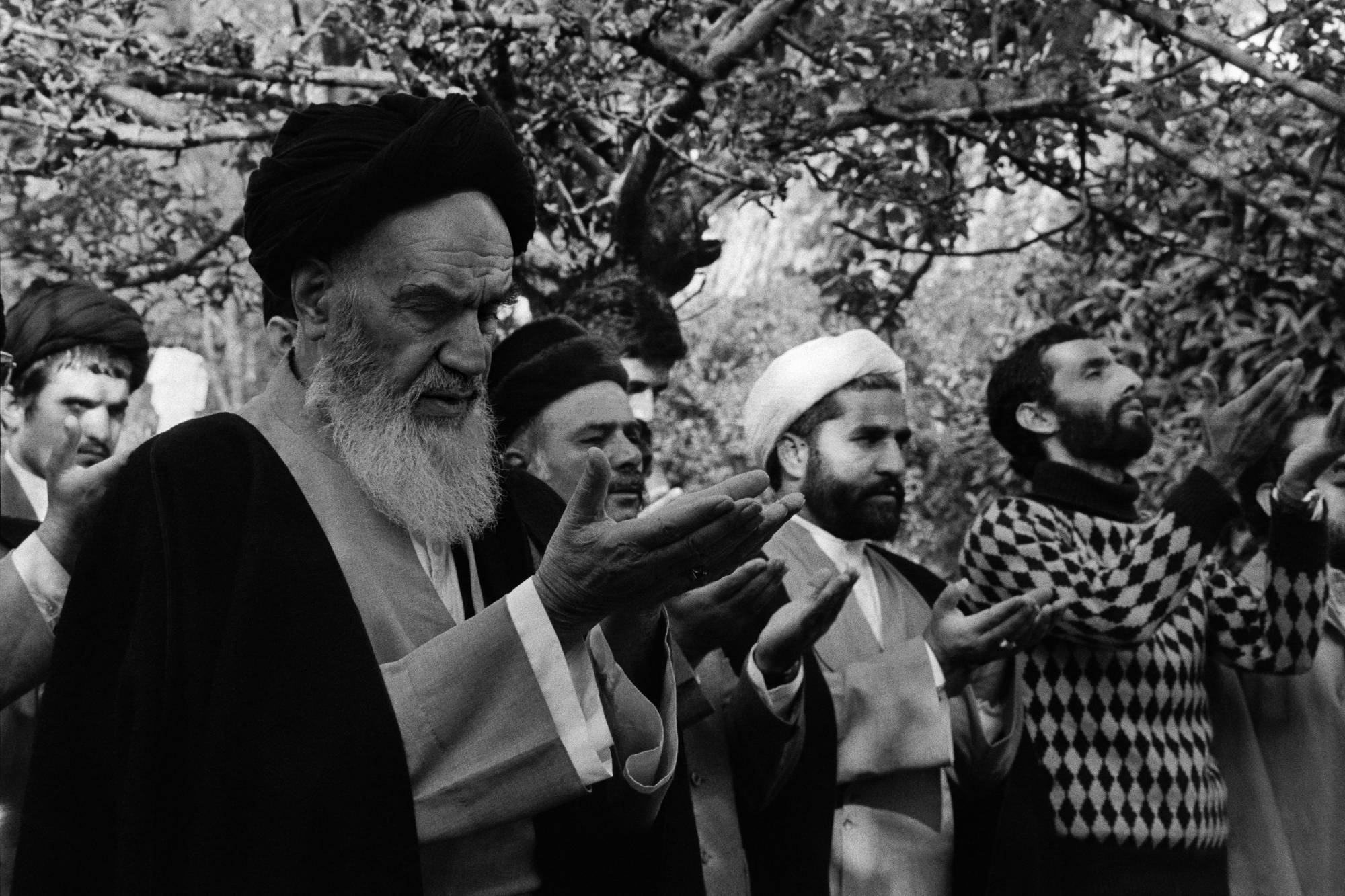
Ruhollah Khomeini (L) prays with the Iranian opposition leaders after receiving them at his Pontchartrain mansion, west of Paris, on November 6, 1978. (Photo by Joel ROBINE / AFP via Getty Images)

Decision-makers across the region watched carefully. Few were more alarmed than Saddam Hussein, then the powerful deputy leader of Baathist Iraq. Events in Tehran accelerated rapidly. The Islamic Republic was proclaimed. The doctrine of Wilayat al-Faqih was enshrined. The constitution incorporated language committing the new state to “exporting the revolution” under the banner of supporting the oppressed.

Saddam Refuses to Kill Khomeini

History could easily have unfolded differently.

During Khomeini’s years in Najaf, he was a difficult guest. Iraqi authorities frequently complained that he sought to evade the restrictions attached to his residency. After the Algiers Agreement of March 6, 1975, signed by the Shah and Saddam Hussein under the auspices of Algerian President Houari Boumédiène, both sides pledged to cease supporting each other’s opponents.

Iraqi officials repeatedly reminded Khomeini of the understanding. He effectively refused to commit himself to ending political activity against the Shah.

According to former Iraqi officials, Iraqi intelligence one day proposed arranging Khomeini’s assassination and blaming the Shah’s security services. Saddam’s response surprised them. He reportedly asked: “Do the people making this proposal not understand that Iraq does not betray its guests?”

Thus Khomeini remained alive.

Once the Iran-Iraq War began, however, eliminating him became an obsession for Saddam’s half-brother Barzan al-Tikriti, the head of Iraqi intelligence. Reaching Khomeini was difficult, though Iran in 1981 had not yet fully consolidated its security institutions.

Iraqi intelligence developed ties with the Kurdistan Democratic Party of Iran and with the Mujahedin-e Khalq. It helped coordinate operations that culminated in the devastating bombing of Iran’s parliament complex, killing dozens of senior figures. Soon afterward, Ali Khamenei was targeted by a bomb hidden inside a tape recorder, leaving him permanently injured in one arm.

Barzan remained determined to reach Khomeini himself. According to accounts from former Iraqi intelligence officials, Baghdad eventually recruited a cleric close to the Iranian leader and managed to plant a small explosive device inside Khomeini’s wool pillow. The bomb detonated when he was away from it. The attempt failed.

The Paris Interlude

Chance played an important role in Khomeini’s journey to power.

Forced to leave Iraq, he searched for a new place of exile. Years later in Paris, former Syrian Vice President Abdul Halim Khaddam recalled that Khomeini’s associates discreetly explored the possibility of relocating to Syria. President Hafez al-Assad was not interested.

Khaddam said Assad feared that hosting Khomeini could trigger not merely a political crisis with Iraq but perhaps even war between the two Baathist rivals. Khaddam advised Khomeini’s entourage to consider Algeria instead. They dismissed the idea, believing Algeria was too distant and likely to impose strict restrictions.

What surprised Khaddam was France’s willingness to receive Khomeini and provide him with a global platform.

During his stay in Neauphle-le-Château outside Paris, visitors streamed in from around the world.

Iraqi authorities sought to gauge his intentions. Khomeini had already demonstrated his ability to move Iranian public opinion through audio recordings that supporters distributed secretly inside Iran.

The Iraqi intelligence officer responsible for liaising with Khomeini during his years in Najaf was Ali Baweh, who had often facilitated his activities. Baghdad decided to send him to Paris. Former intelligence officials claim Baweh traveled with another man wearing a watch capable of recording conversations. Khomeini received them politely but showed no flexibility.

Asked about his plans after the Shah’s fall, he delivered an answer that landed like a bomb. After overthrowing the Shah, he said, the next objective would be “the overthrow of the infidel Baath regime.”

Saddam’s Obsession with Wilayat al-Faqih

When Khomeini appeared in Tehran surrounded by unprecedented crowds, Saddam understood that the storm would soon reach Iraq.

According to former presidential aides, the issue that troubled him most was not the revolution itself but the doctrine of Wilayat al-Faqih. Saddam believed it implied that a non-Iraqi cleric could demand the allegiance of Iraqi Shiites. To him, this represented a direct threat to Iraq’s sovereignty and cohesion.

He reportedly kept a booklet explaining the powers of the Supreme Jurist as understood by Khomeini and studied it carefully. By September 1980, Saddam had concluded that war was inevitable. He believed Khomeini intended to penetrate the Arab world by first bringing down Iraq. Waiting, in his view, meant eventually fighting Iran in the streets of Baghdad. Better to fight on the border.
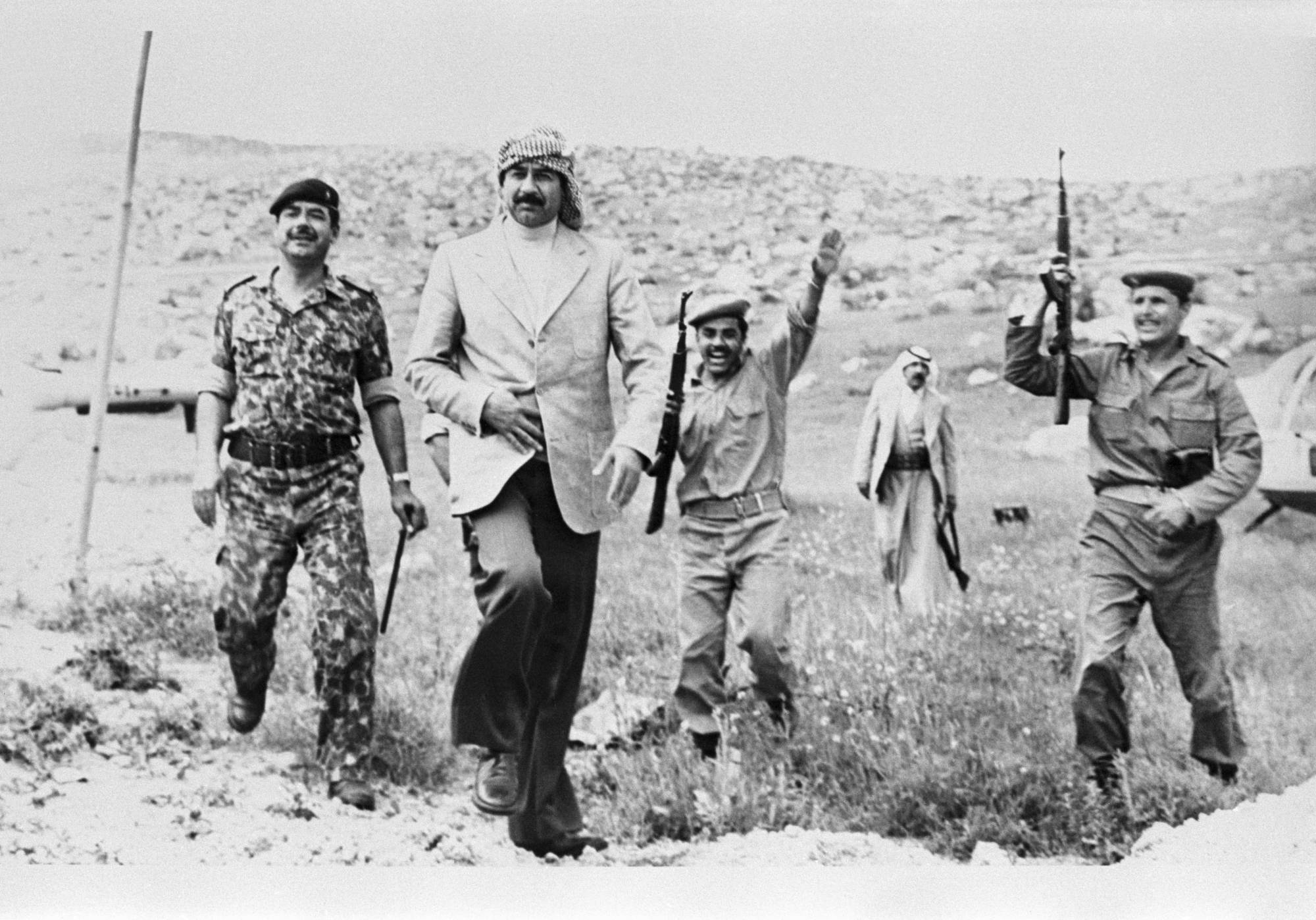
Iraqi leader Saddam Hussein visits soldiers in northern Iraq. (Photo by Jacques Pavlovsky/Sygma via Getty Images)

Many who knew him believe this conviction also strengthened his determination to remove Ahmed Hassan al-Bakr and assume full power. Since the Baath Party’s return to government in 1968, Saddam had chosen to remain formally second in command, benefiting from Bakr’s legitimacy while gradually reshaping the military and state institutions around himself.
On July 16, 1979, Bakr finally departed. The age of Saddam had begun.

Former Foreign Minister Hamed al-Jubouri later recounted a revealing conversation with Bakr. When Jubouri once attempted to resign, Bakr reportedly pointed to the presidential chair and declared: “I would urinate on the presidency if it cannot even preserve the dignity of the president.”

Then, with tears in his eyes, he added: “Forget resignation. I cannot accept yours. Who can accept mine? We are prisoners. We do not possess the right to resign.”

“We Will Smash the Iranians’ Heads”

Saddam’s decision to go to war preceded his formal assumption of the presidency.
Salah Omar al-Ali, one of the veteran Baathist leaders who helped bring the party to power in 1968, recalled a revealing conversation during the Non-Aligned Movement summit in Havana in September 1979.

Iraqi President Ahmed Hassan al-Bakr and Saddam met Iranian Foreign Minister Ebrahim Yazdi. Despite tensions along the border, the atmosphere was constructive.
Hoping to reinforce that mood, Salah Omar al-Ali later spoke privately with Saddam and stressed the importance of peaceful solutions and economic development.
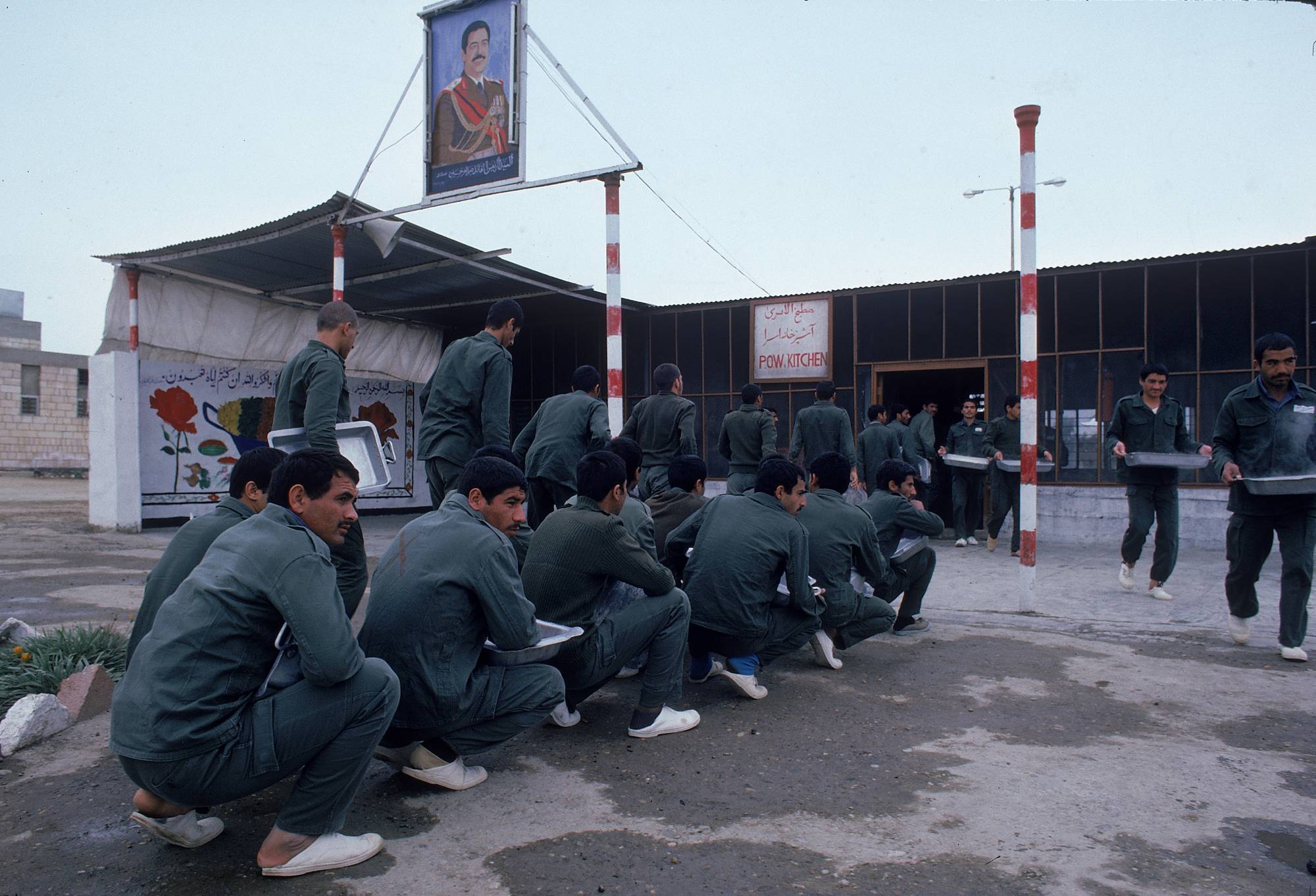
IRAQ - JANUARY 01: Iranian POW's waiting in line for food at the Ramadt detention camp under a smiling portrait of Iraq leader Saddam Hussein during the war between Iran Iraq. (Photo by Bill Foley/Getty Images)

Saddam listened attentively before responding.

“Pay attention, Salah,” he said. “This opportunity may come only once every hundred years. The opportunity exists today. We will smash the Iranians’ heads. We will recover every inch they occupied. We will restore the Shatt al-Arab.”

Then he added sharply: “I never want to hear you speak again about peaceful solutions, humanitarian solutions, or settling problems with Iran. Listen carefully. I will smash the Iranians’ heads and recover every inch from Khorramshahr to the Shatt al-Arab.”

A year later, he launched the war.

Saddam believed several factors worked in his favor. Khomeini’s revolution had turned America into Iran’s enemy. The Soviet Union feared revolutionary contagion among its Muslim republics. The Gulf monarchies felt threatened by Tehran’s ambitions.

He convinced himself that Iraq alone could break the revolutionary wave threatening regional stability. He miscalculated.

He assumed Iran’s post-revolutionary chaos would guarantee a quick victory. He failed to understand how rapidly Iranian nationalism would fuse with religious fervor once Iraqi troops crossed the border.

The war did not destroy the Islamic Republic. Instead, it strengthened it. Khomeini ruthlessly consolidated power and entrenched the rule of the Supreme Jurist. Saddam’s greatest achievement after eight years of war was a ceasefire. Iran survived. Iraq was exhausted.

The Kuwait Gift

In the years that followed, Tehran received another unexpected gift.

General Nizar al-Khazraji, Iraq’s chief of staff at the time, later described how he learned of the invasion of Kuwait in August 1990.

“I was asleep at home,” he recalled. “Early in the morning I received a call summoning me to General Headquarters. When I arrived, I was told: ‘We have completed the occupation of Kuwait.’”

Khazraji was stunned. Defense Minister Abdul Jabbar Shanshal was informed in exactly the same way.

Imagine, Khazraji said, an army being pushed into such an adventure without the knowledge of either its defense minister or its chief of staff.

A few days later Saddam explained that secrecy had been necessary to preserve surprise. He added that Kuwait had been liberated by forces reporting directly to him rather than to the regular chain of command.

Khazraji saw the decision as the product of arrogance born from Saddam’s belief that he had emerged victorious from the war with Iran.

The consequences were enormous.

The world’s attention shifted decisively from the “Iranian threat” to the “Iraqi threat.” Operation Desert Storm expelled Saddam from Kuwait and left Iraq wounded, isolated, and under sanctions.

Meanwhile, Iran caught its breath and resumed its long-term regional project.

The Gifts of Osama bin Laden and George W. Bush

Another chain of events that began in 1979 would transform the Middle East.

The Soviet invasion of Afghanistan triggered alarm throughout the West. Washington resolved to make Moscow pay dearly. Volunteers poured into Afghanistan from across the Arab and Muslim worlds. The United States encouraged the jihad against Soviet forces and supported many of the fighters.

Among them was a wealthy young Saudi named Osama bin Laden.

On Afghan soil, al-Qaeda was born.
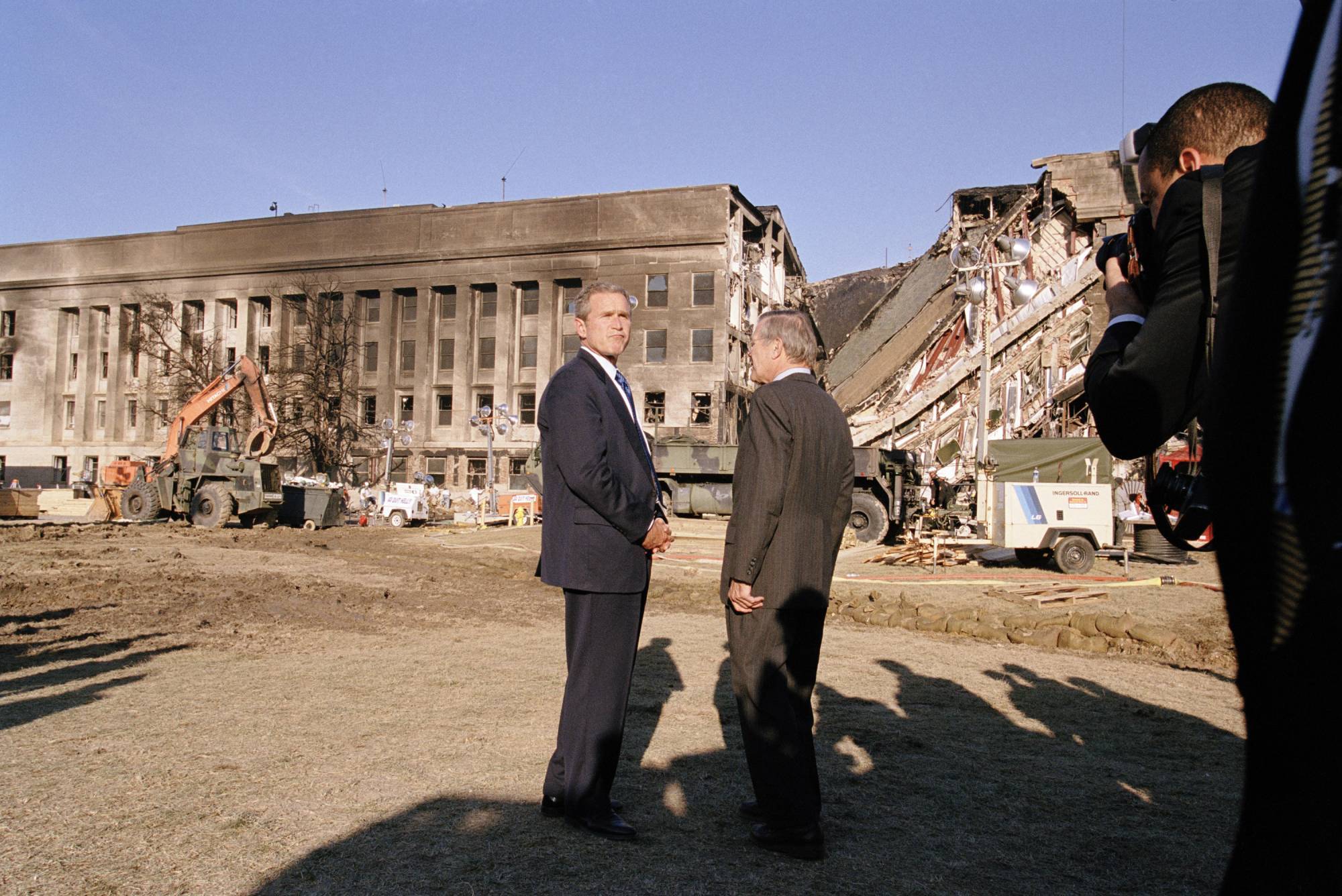
ARLINGTON, VA - SEPTEMBER 12: President George W. Bush and Secretary of Defense Donald Rumsfeld survey the damage at the Pentagon building September 12, 2001 in Arlington, VA. (Photo by David Hume Kennerly/Getty Images)

On September 11, 2001, bin Laden carried the conflict to the American mainland. Civilian airliners destroyed the towers of the World Trade Center. Thousands were killed.
America had been struck at the heart of its power and prestige. The world waited for the response.

Under President George W. Bush, encouraged by military and security institutions and by the neoconservative movement, the United States first overthrew the Taliban and then invaded Iraq, toppling Saddam Hussein.

For the generals of Iran’s Revolutionary Guard, the scene was almost unbelievable.

The Taliban regime, hostile to Tehran, had fallen at American hands. Saddam’s regime, which Iran had failed to overthrow during eight years of war, met the same fate.

Iran neither obstructed these outcomes nor mourned them. Yet Tehran also saw American forces deployed on both its eastern and western frontiers.

A new phase in US-Iran relations began.

Qassem Soleimani and officers of the Quds Force focused on undermining the American military presence, especially in Iraq, while avoiding direct confrontation with Washington.

Without intending to, bin Laden had delivered Iran another extraordinary gift.

After the attacks on New York and Washington, the world became obsessed with al-Qaeda. Soon afterward, attention shifted toward Saddam Hussein, whose danger was magnified relentlessly by Western political and media narratives.

The result was that Iran moved out of the center of the international spotlight.

The Bush administration advanced numerous arguments to justify war against Iraq: alleged weapons of mass destruction, obstruction of international inspectors, and suspicions that Saddam had never abandoned nuclear ambitions.

Most consequential was the effort to suggest a connection between Saddam Hussein and al-Qaeda.

No meaningful partnership ever emerged between the Iraqi regime and bin Laden’s organization. Yet Saddam did make the mistake of exploring the possibility.

While bin Laden was living in Khartoum, Iraqi intelligence officer Farouq Hijazi met him through the mediation of Sudanese Islamist leader Hassan al-Turabi. The discussion was lengthy and difficult. After returning to Baghdad, Hijazi advised Saddam to close the file. Contacts ended.

But the allegation lingered—and helped justify the invasion.

Syria, Soleimani, and the Iraqi Prize

Another event left a lasting mark on the region’s future. Days before the American invasion of Iraq, Syrian President Bashar al-Assad flew to Tehran. Anxiety about the coming war dominated his discussions with President Mohammad Khatami and Supreme Leader Ali Khamenei.
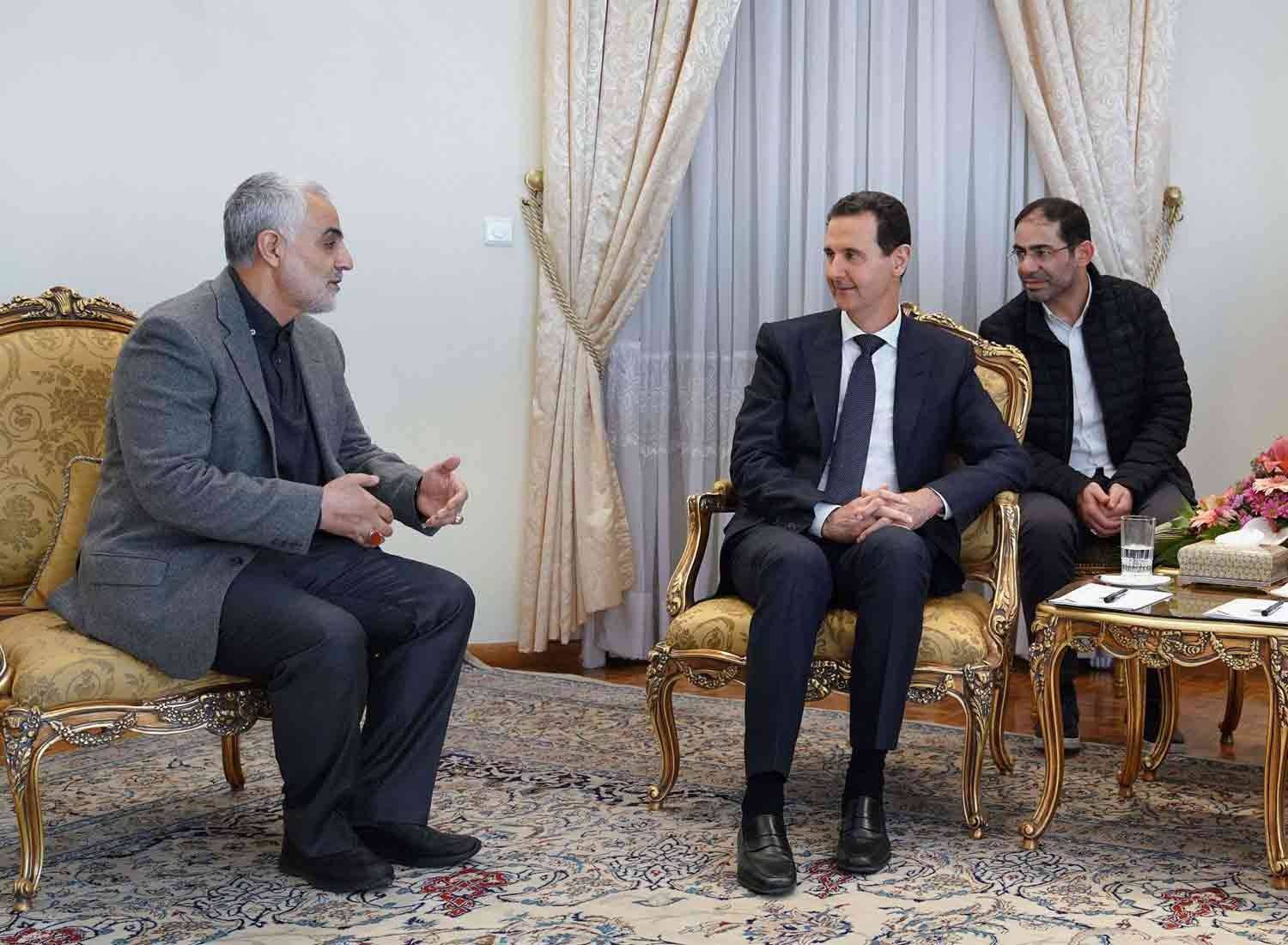
Bashar Assad meets with Qassem Soleimani

Both sides agreed that if American forces consolidated their position in Iraq, Syria or Iran could be next.

The answer, they concluded, was to bleed the American presence through resistance movements. Qassem Soleimani participated in some of those discussions.
Syria subsequently facilitated the movement of fighters into Iraq, while Soleimani methodically built resistance networks.

Iran wagered on geography—and won.

It encouraged its Iraqi allies to participate in governing institutions and successive governments, especially after executive power became concentrated in the office of the prime minister, a position conventionally held by a Shiite politician.

When the last American soldier left Iraq in December 2011, Iran had become an indispensable actor in Iraqi affairs.

The fingerprints of Soleimani were visible throughout the Iraqi state. After his death, many of those networks remained under the stewardship of his successor, Esmail Qaani.

Then came another opportunity. In July 2014, Abu Bakr al-Baghdadi appeared in Mosul after the dramatic collapse of Iraqi army units. Soleimani moved immediately, dispatching weapons to both Baghdad and Erbil.

Grand Ayatollah Ali al-Sistani issued his famous call to arms. Iran later helped transform the resulting mobilization into the Popular Mobilization Forces, which eventually became an official institution under the authority of the Iraqi prime minister.

Iranian influence now extended across parliament, government, the military, and the PMF. From Iraq to Lebanon, from the Palestinian arena to Yemen, Tehran steadily expanded its reach.

The cumulative result is difficult to miss. Khomeini survived. Saddam’s war failed. Saddam’s invasion of Kuwait redirected international attention. Bin Laden’s attacks transformed global priorities. George W. Bush’s invasion removed Iran’s most formidable Arab rival. Each actor pursued his own objectives. Together, however, Saddam Hussein, Osama bin Laden, and George W. Bush delivered three of the most valuable strategic gifts the Islamic Republic of Iran has ever received.
Atef Najib in Court: Reconstructing the Story of the ‘First Spark’ in Syria’s Uprising

Atef Najib at the Damascus courthouse on April 26, 2026. (Reuters)
TT

Atef Najib in Court: Reconstructing the Story of the ‘First Spark’ in Syria’s Uprising

Atef Najib at the Damascus courthouse on April 26, 2026. (Reuters)

The arrest of schoolchildren in the southern Syrian city of Daraa in March 2011 is widely regarded as the spark that ignited the Syrian uprising. What began as a local incident evolved into nationwide protests and, eventually, a devastating civil war.

Fifteen years later, the case has resurfaced as Syrian authorities pursue accountability for abuses committed under Bashar al-Assad's regime, placing former Daraa Political Security Department chief Atef Najib at the center of one of the conflict’s defining episodes.

As transitional justice efforts gather pace under President Ahmed al-Sharaa’s government, the “Daraa children case” has become a key test of whether Syria’s judicial institutions can confront the legacy of arbitrary detention, systematic torture, and repression.

Asharq Al-Awsat interviewed two of the children detained at the time, now adults, whose testimonies revisit the events behind the slogan, “It’s your turn, Doctor”—a reference to Assad—that was scrawled by children on a school wall and became synonymous with the uprising’s beginning.

Fifteen years later, they said that the central question is no longer who wrote the slogan, but how it became the pretext for mass arrests and the torture of children.

Their accounts reconstruct the sequence of events while reinforcing the broader conclusion that what happened inside Syria’s security branches transformed a local incident into a turning point in the country’s history.

Naif Abazeed: Childhood in the interrogation cells

Naif Abazeed was 13 when he was arrested. His name has long been associated with writing the famous phrase, but he firmly rejects that claim.

He told Asharq Al-Awsat that the only graffiti he ever wrote was his own name and that of a friend on a wall at Daraa al-Balad Preparatory School in 2009.

He also disputed the widely circulated account placing the graffiti at Al-Arbaeen School, saying others appropriated his story while changing the location and timeline.

Abazeed said he never met Atef Najib. Instead, he identifies then-Col. Louay al-Ali as the officer who interrogated and tortured him.

While his testimony shifts attention to al-Ali’s direct role during the investigation, it does not absolve Najib. Rather, it distinguishes between the officer who conducted the interrogations and the security chief who commanded the apparatus responsible for the children’s detention.

Under international law, command responsibility extends beyond those who personally commit abuses to include superiors who knew, or should have known, about the violations and failed to prevent or punish them.

One of the children, now an adult, seen at the Al-Arbaeen School. (Getty Images)

Arrested at school

Abazeed recalled security officers arriving at his school after police had searched his home earlier that morning.

Al-Ali introduced himself as an education official investigating graffiti supposedly bearing the student’s name alongside that of a girlfriend.

Instead, the interrogation centered on the phrase, “It’s your turn, Doctor,” which had already been erased.

The boy was told he would be questioned briefly. Instead, he was taken to a Political Security Branch detention facility, where he said he was confronted with instruments of torture, beaten with cables and sticks, suspended, and forced into the “tire” stress position.

“I told them I had written nothing except my name in 2009,” he said. “The officer insisted I had written something else.”

Unable to withstand the abuse, Abazeed said he eventually confessed to something he had not done. He added that he only learned after his release that another student had actually written the phrase.

He also recounted being handed paper and ordered to write down everything that had appeared on the school walls. When the phrase was missing, the interrogator allegedly dictated it word by word while continuing to beat him until he repeated it in full. Only then did he understand that “Doctor” referred to President Bashar al-Assad.

The interrogation did not end there. Abazeed revealed that he was pressured to identify accomplices and, under torture, named classmates and neighbors, drawing more children into the investigation.

Demonstrators hold posters on the day Atef Najib, a brigadier general and former head of the Political Security Department in Daraa during Syria's ousted President Bashar al-Assad's rule, who is accused of committing war crimes, attends a trial session at the Palace of Justice, in Damascus, Syria, April 26, 2026. (Reuters)

Another victim’s testimony

Samer Ali al-Sayasneh, another child detained in 2011 after being accused of burning a police kiosk near Al-Arbaeen School, has also testified against Najib in court.

He holds Najib fully responsible for the escalation in Daraa, from arbitrary arrests to orders that led to the deadly shootings at Omari Mosque and a nearby gas station.

According to al-Sayasneh, no security branch would have acted without Najib’s authorization, making any attempt to exonerate him implausible.

The legal case

Lawyer Noha al-Masri told Asharq Al-Awsat that prosecutors are relying primarily on Syrian law, including Law No. 16 of 2022, provisions of the Syrian Penal Code, and Legislative Decree No. 20 of 2013.

She said the abuses committed in Daraa in March 2011 could also meet the international definition of crimes against humanity because they formed part of a widespread and systematic attack against civilians.

Al-Masri stressed that criminal responsibility extends beyond direct perpetrators to those who planned, ordered, supervised, or knowingly allowed the abuses to occur, reflecting the established principle of command responsibility under international humanitarian law.

She added that victims’ testimony, videos, medical reports, and official documents together could provide the foundation for one of the most significant trials in modern Syrian history - one likely to shape future accountability cases.

Syrian law also allows victims to seek compensation for the physical, psychological, material, and moral harm they suffered.

Strengthening the evidentiary record, she underlined, depends on corroborating witness testimony with videos, official documents, and medical and human rights reports.


Israel Struck an Iranian Steel Facility. Was it a Valid Military Target?

This video grab taken on April 3, 2026, from undated UGC images shared on social media on April 1, 2026, shows thick plumes of smoke rising following airstrikes in Baharestan, in Iran's central Isfahan province. (Photo by various sources / AFP)
TT

Israel Struck an Iranian Steel Facility. Was it a Valid Military Target?

This video grab taken on April 3, 2026, from undated UGC images shared on social media on April 1, 2026, shows thick plumes of smoke rising following airstrikes in Baharestan, in Iran's central Isfahan province. (Photo by various sources / AFP)

Washington: Yeganeh Torbati

Over the course of the Iran war, US and Israeli warplanes hit missile depots and launchers, security forces’ headquarters and air defense systems.

Yet not all of the targets during the six-week campaign were traditional military sites.

On March 27, and again a few days later, Israeli airstrikes pounded a vast steel complex just outside Isfahan called Mobarakeh Steel, and another one in the southwest of the country.

Israeli Prime Minister Benjamin Netanyahu asserted that his country’s strikes had slashed Iran’s steel production capacity and eliminated revenue for the powerful Revolutionary Guards, whose repression underpins the Iranian government.

Companies like Mobarakeh illustrate the complexities inherent to Iran’s economy. While Iran’s clerical leadership and security forces are deeply enmeshed in the country’s most profitable and important businesses, those same companies are vital to the livelihoods of millions of ordinary Iranians, regardless of whether they have deep ideological allegiance to the government.

The attacks shut down major parts of the Isfahan plant for weeks, idling over 20,000 workers and choking off the supply of steel to domestic manufacturers. “I felt like my own home had been destroyed,” said Mostafa, a former employee, who asked to speak on condition of anonymity to avoid retribution by the government.

The United States and Iran have lurched between peace talks and exchanges of fire in recent weeks. Their negotiations were expected to cover the economic benefits Iran might receive in return for long-term limits on its nuclear program.

The interim ceasefire agreement, signed last month, could result in as much as $300 billion for Iran’s reconstruction and economic development. But that now seems a distant prospect, after Trump said this week that he believed the temporary truce was “over.”

If any investment does flow to Iran, companies like Mobarakeh will undoubtedly come into focus because of their importance to Iran’s economy, as well as their affiliation with Iran’s most powerful security forces.

Trump has frequently threatened to attack Iranian infrastructure, and if war restarts, there will be scrutiny over any such strikes.

On Thursday, Iran’s Revolutionary Guards Corps accused the United States of striking a railway bridge that connected the country with Turkmenistan.

A spokesman for US Central Command confirmed that the United States struck the railway bridge, describing it as military logistics infrastructure that enabled a flow of weapons and other military supplies to key areas.

Mobarakeh has provided revenue to an investment fund belonging to a state-run militia, the Basij, which answers to the Guards, according to the US Treasury.

A 2021 report by Iran’s Parliament identified the investment fund as a major shareholder of Mobarakeh.

Recent financial statements from Mobarakeh show that its shareholders include an investment fund ultimately controlled by Iran’s supreme leader.

Although the statements do not show a link to the Guards, they often obscure their ownership through proxy investors.

In justifying the strikes on steel facilities, Netanyahu said they would deprive the regime “of both financial resources and the ability to produce many weapons.”

Mobarakeh executives did not respond to a request for comment, and it is unclear if the steel produced at Mobarakeh was used in making Iran’s weapon systems.

“Mobarakeh Steel products might not be directly used in missile production, but the company is most probably engaged in research and development of modern high-strength steel alloys for future large-scale production,” said Farzin Nadimi, a senior fellow with the Washington Institute and an expert on Iranian military affairs.

He added, “Mobarakeh Steel products, though, are more likely used in producing missile transporter-launcher vehicles.”

International law prohibits strikes on industrial sites that serve civilians, unless the facility makes an effective contribution to military action and striking it confers a definite military advantage, international law experts said.

The dominant international view rejects the idea that generating revenue for military operations is enough to qualify a civilian site as a military target, said Susana SaCouto, director of the War Crimes Research Office at American University’s Washington College of Law.

Miad Maleki, a former US Treasury official, said that while he believed the complex was a legitimate target for sanctions, he doubted that it should have been hit in military strikes.

“These are the Iranian people’s assets, and it’s going to hurt the economy even way beyond the Islamic republic,” he said.

“It does employ many people and pay salaries for many people,” Maleki added. “But at the same time, it’s really just a major source of revenue for a lot of corrupt actors.”

Opaque ownership

Built by an Italian business group, Mobarakeh became operational in 1992 and was a symbol of Iran’s industrial development and rebuilding after the Iran-Iraq War of the 1980s.

People with ties to the Revolutionary Guards moved into leadership positions at the plant starting in the late 1990s, two former employees said, declining to be named to avoid repercussions from Iran’s government.

For instance, Mehdi Taj, a former senior Guards commander, served on the complex’s board of directors and held an executive position there in the early 2000s.

Taj is now the director of Iran’s soccer federation, which did not respond to a request for comment.

And a privatization drive carried out in the mid-2000s transferred portions of state-owned companies, like Mobarakeh, to powerful and opaque players such as the Guards and conglomerates that answer to Iran’s clerical leadership.

In 2008, a consortium led by Mehr Eghtesad Iranian Investment Company, an outfit belonging to the Basij, purchased 45% of Mobarakeh’s shares.

As of 2021, Mehr Eghtesad was one of Mobarakeh’s largest shareholders, with a nearly 14% stake, according to a parliamentary report written that year.

The Basij is one of the primary forces that the regime deploys to suppress protests, including the recent nationwide demonstrations in December and January. Those protests arose over discontent with Iran’s currency crisis and perceived economic mismanagement by the government.

Mehr Eghtesad’s owner, a bank, in 2020 merged with another Iranian bank, Bank Sepah, which did not respond to a request for comment.

Mobarakeh earned roughly $1.6 billion in net profit in 2024-2025. The US Treasury said in 2018 that the company “has provided millions of dollars” annually to Mehr Eghtesad.

“Some part of the economy is run through the government, but some larger part of the economy is run through the shadow government or Revolutionary Guards,” said Mahdi Ghodsi, an economist at the Vienna Institute for International Economic Studies.

One relatively new shareholder of Mobarakeh, according to documents filed with the Tehran Stock Exchange, is a company belonging to Astan-e Quds-e Razavi, an Iranian foundation that the United States put sanctions on in 2021 for being controlled by Iran’s former supreme leader, Ali Khamenei. The company owned 1.79% of Mobarakeh as of last year.

Other major owners include several state-owned pension funds. Iran’s pension funds have been struggling for years to make payments to retirees, and the destruction of key sectors of the economy is likely to worsen that problem.

Iranian legislators investigated possible corruption by managers at Mobarakeh in 2021 and blamed many of its issues on the flawed process of privatization, saying it was “now governed by completely opaque ownership alongside entirely state-controlled management.”

A ‘beloved’ company

Interviews with some of the people who used to work at Mobarakeh present another image of the company.

For aspiring engineers growing up in Isfahan, working at Mobarakeh was a “dream job,” said Maryam, who now lives outside Iran. She and some other former employees whom The New York Times spoke to requested that they not be fully identified, for fear of repercussions for speaking publicly.

Some said they felt they were at a prestigious, state-of-the-art company that was contributing to the country and cared about their well-being.

“Even before I was born, my father was working in steel,” said Maziyar Shokrani, who, like his father, worked at Mobarakeh.

Shokrani began working there as a lawyer in the mid-2000s, taking a bus each day to the sprawling plant 40 miles outside Isfahan. “I know my entire life and existence to be from steel,” he said.

Mobarakeh also donated funds to build stadiums and educational institutions and supported poor families in the area surrounding the complex, said Mostafa, the former employee, who now lives outside Iran.

“It was beloved in that region,” Mostafa said. “Any industry that hit a snag, or any group that had a problem, they had some hope that Mobarakeh Steel would arrange for some kind of support.”

The Iranian news outlet Rouydad24 reported in early May that of 27,000 workers, just 2,000 were still working at the plant. Iranian officials have said that Mobarakeh is being rebuilt more quickly than expected, and in early June the company relaunched a furnace that had been damaged in the strikes.

In interviews, former employees had differing views about who was to blame for the strikes on Mobarakeh.

“More of the blame should be cast with the Guards, because it deliberately and consciously took the country’s economy down this path,” said Shokrani, who now lives outside Iran.

In the minds of Iranians, the United States and Israel were closely linked in their conduct of the war, said Abbas Kamranian-Marnani, a mechanical engineer who worked at Mobarakeh or its contractors for a decade and now lives in Europe. “They worked mostly toward the destruction of infrastructure and the destruction of Iran,” he said.

Kamranian-Marnani said strikes like the one on the steel plant had caused Iranians to lose hope in the idea of better relations with the United States.

A senior US military official, speaking on condition of anonymity to discuss operational matters, said they did not know of any US role in the steel strikes.

The New York Times


Sheikh Hamad bin Khalifa: The Emir Who Transformed Qatar

Former Qatari Emir Sheikh Hamad bin Khalifa Al Thani (Asharq Al-Awsat)
TT

Sheikh Hamad bin Khalifa: The Emir Who Transformed Qatar

Former Qatari Emir Sheikh Hamad bin Khalifa Al Thani (Asharq Al-Awsat)

With the passing of the Father Emir, Hamad bin Khalifa Al Thani, Qatar closes the chapter on one of the Gulf region's most significant political and development success stories of recent decades. His name became synonymous with the most profound transformation in the country's modern history, as Qatar evolved during his reign from a state with a limited international profile into an influential player in regional and global politics, economics, and media.

Sheikh Hamad is widely regarded as one of Qatar's defining leaders and the architect of its modern renaissance. Under his leadership, the country underwent sweeping economic, social, and cultural transformation. During his reign, Qatar's gross domestic product expanded more than twenty-fourfold, while GDP per capita increased nearly sixfold.

Born in Doha in 1952, Sheikh Hamad graduated from the Royal Military Academy Sandhurst in 1971. He then joined the armed forces, rising through the military ranks before being appointed Crown Prince and Minister of Defense in 1977. On June 27, 1995, he assumed power, and in June 2013 handed authority to his son, Tamim bin Hamad Al Thani, in a smooth transfer of power widely regarded as one of the region's rare peaceful successions.

A Strong Economy

Sheikh Hamad's economic strategy centered on harnessing Qatar's vast natural gas wealth to build a strong and diversified economy. During his years in power, the country's GDP grew dramatically, average incomes rose sharply, and exports of liquefied natural gas ushered in a new era in Qatar's history. Following the first LNG shipment in 1996, Qatar became the world's largest exporter of liquefied natural gas by 2006, generating enormous revenues that financed major investments in infrastructure, education, healthcare, and public services.

Expanding Qatar's International Role

On the international stage, Qatar adopted a far more active foreign policy, positioning itself as a mediator in a number of regional and international conflicts. Among its most prominent diplomatic efforts were its role in Lebanon during the 2006 war and the country's political crisis in 2008.

Qatar also took a leading role in supporting the Palestinian cause, particularly through economic assistance to the Gaza Strip and by providing a platform for negotiations aimed at ending the conflict there. In 2012, Sheikh Hamad became the first Arab leader to visit Gaza after Hamas took control of the territory.

He also forged close strategic ties with the United States. During his reign, Al Udeid Air Base was established in 1996. Qatar financed almost the entire construction of the base, at a cost exceeding $1 billion, as part of a strategy to strengthen its defense capabilities and deepen military cooperation with the United States following the Gulf War. By 2002, it had become one of the most important US. military bases outside the United States.

Qatar also participated in the international conference supporting post-Gaddafi Libya in Paris. During Sheikh Hamad's rule, Doha became a major supporter of the Syrian cause, providing extensive political and humanitarian backing to the Syrian opposition, an approach that continued in subsequent years.

Beginning in the mid-1990s, Qatar pursued a foreign policy built on relative neutrality and open channels with opposing parties, allowing it to serve as a mediator in regional and international disputes. Over time, this approach became one of the country's most effective instruments of soft power, transforming Doha into a permanent venue for negotiations and political dialogue.

Today, the Qatari capital is widely recognized as one of the world's leading hubs for mediation and conflict resolution, a role first established under Sheikh Hamad and later expanded during the reign of Sheikh Tamim.

Soft Power

Just one year after assuming power, Sheikh Hamad launched the Al Jazeera Media Network in 1996. The network quickly became one of the Arab world's most influential media platforms, giving Qatar an outsized voice in regional political discourse. As the Arab world underwent profound political change, Al Jazeera emerged as one of Qatar's most powerful instruments of influence, elevating the country's international profile far beyond its geographic size.

The World Cup

Qatar's hosting of the 2022 FIFA World Cup was far more than a sporting event. It was a strategic national project and a defining milestone that reshaped the country's standing on the global stage.

By hosting football's biggest tournament, Qatar became both the first Arab nation and the first Middle Eastern country to stage the World Cup, earning unprecedented global visibility across the media, political, and economic spheres while reinforcing its image as a nation capable of organizing events of the highest international caliber.

The tournament also became one of Qatar's most effective soft power tools. Rather than relying solely on traditional forms of influence, Doha used sport to strengthen its international image, showcase its organizational capabilities, and capture the world's attention.

Sheikh Hamad bin Khalifa Al Thani leaves behind a lasting legacy in Qatar's modern history. His name is inseparable from the country's transformation from an economy largely dependent on natural resources into a state wielding influence through a diverse set of instruments, including economic strength, global investment, media, diplomacy, and sport.

Many of the defining features of Qatar's current policies remain rooted in the foundations he laid during his years in power, making his legacy one of the Gulf region's most significant political and developmental transformations in recent decades.