Mojtaba Khamenei: Iran’s New Supreme Leader Lurking in the Shadows

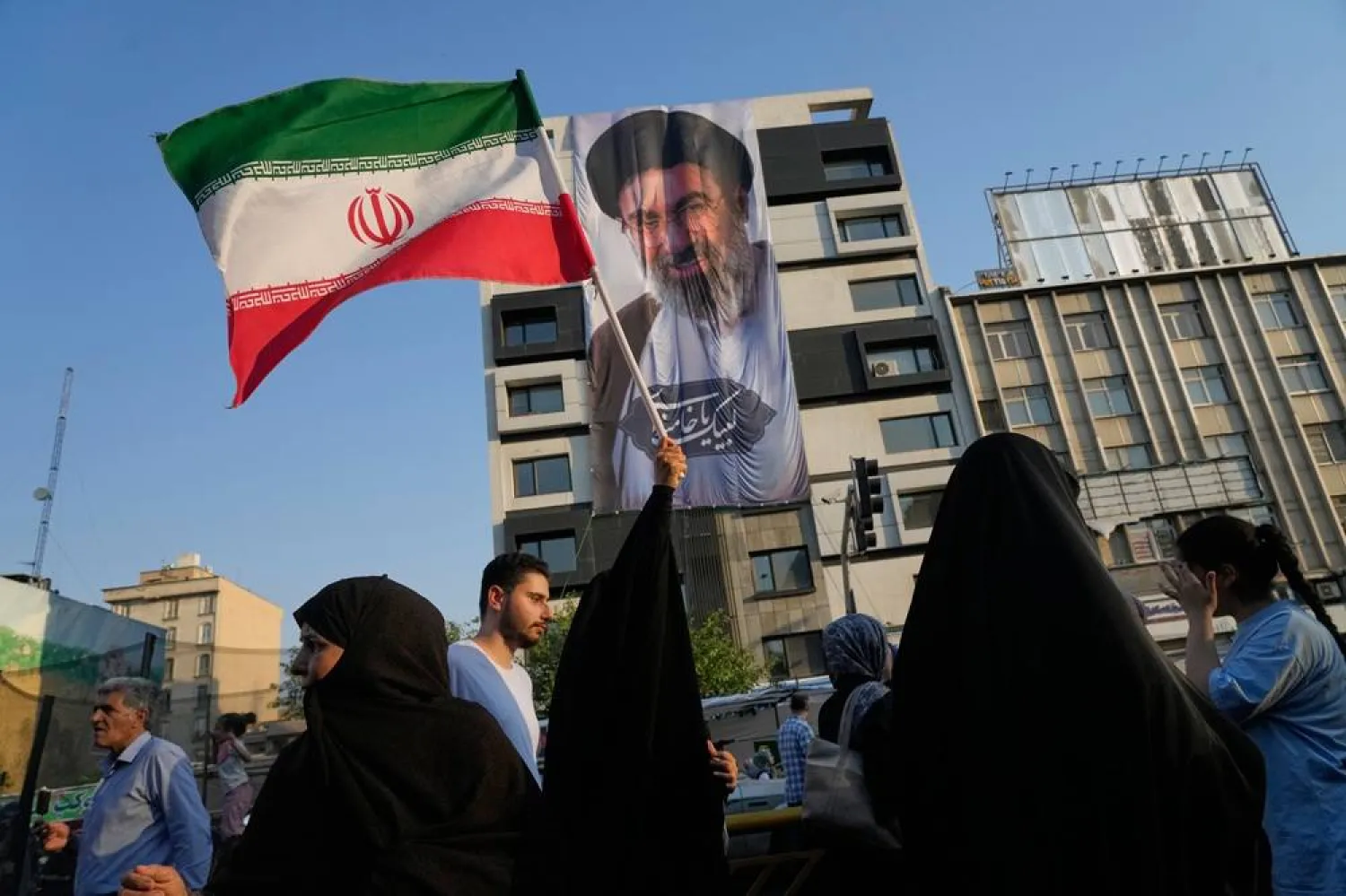
A woman holds up an Iranian flag in front of a banner showing a portrait of Supreme Leader Mojtaba Khamenei during a religious festival in Tehran, Iran, Thursday, June 4, 2026. (AP)
TT

Mojtaba Khamenei: Iran’s New Supreme Leader Lurking in the Shadows

A woman holds up an Iranian flag in front of a banner showing a portrait of Supreme Leader Mojtaba Khamenei during a religious festival in Tehran, Iran, Thursday, June 4, 2026. (AP)

Iranian supreme leader Mojtaba Khamenei, appointed after a career entirely out of the spotlight as a behind-the-scenes figure, faces the challenge of occupying a role incarnated by his father for most of the regime’s existence.

Mojtaba Khamenei was barely known to Iranians when he was named shortly after the killing of his father and longstanding supreme leader, Ali Khamenei, who had been in the post-for-life since 1989, in a US-Israeli airstrike at the start of the Middle East war.

Unseen in public since being named and said to have been wounded in a US-Israeli strike, Mojtaba Khamenei has issued a dozen written messages as leader that have reprised the confrontational ideology of his father.

In a statement read out on Thursday taking aim at Israel and the United States, Mojtaba Khamenei said "the malicious enemy" was seeking to "plant the seeds of doubt, despair, fear, mistrust and division".

Unlike his father, a prominent opponent of the shah who was president in the first decade of the republic from 1981-1989 before becoming leader, Mojtaba Khamenei has until now held no government position.

But he was believed by observers to be the second-in-command at the office of the supreme leader under the longstanding chief gatekeeper Mohammad Golpayegani.

He is also seen as close to the leadership of the powerful Revolutionary Guards, a connection that may have proved crucial in his selection by the Assembly of Experts clerical body.

- Sanctioned by US -

One of the few official insights into the importance of Mojtaba Khamenei came in November 2019 when the US Treasury announced sanctions against him and other senior Iranian officials, including Golpayegani, on the grounds they were pushing Iran's "radical" agenda around the world.

It said he was designated for representing Ali Khamenei "in an official capacity despite never being elected or appointed to a government position aside from work in the office of his father".

It added: "The Supreme Leader has delegated a part of his leadership responsibilities to Mojtaba Khamenei."

It said Mojtaba Khamenei had "worked closely" with the commanders of the Quds Force -- the branch of the Revolutionary Guards ideological army responsible for operations outside Iran -- and the Basij militia "to advance his father's destabilizing regional ambitions and oppressive domestic objectives".

A sign of his potential behind-the-scenes sway came in 2005 presidential elections, when former parliament speaker Mehdi Karroubi wrote a letter to the supreme leader complaining that Mojtaba Khamenei had been intervening on behalf of his ultra-conservative rival Mahmoud Ahmadinejad.

Ahmadinejad went on to cause a sensation by defeating former president Hashemi Rafsanjani. Mojtaba was again seen by some commentators as coordinating the crackdown on protests that followed Ahmadinejad's disputed 2009 election victory.

Leaked US diplomatic cables published by Wikileaks said in 2011 that Mojtaba was "seen by many second only to Golpayegani within the office of the supreme leader".

According to an investigation by Bloomberg, which cited anonymous sources and Western intelligence agency reports, Mojtaba Khamenei has amassed wealth estimated at more than $100 million.

It reported he has earned money from oil sales channeled into investments in luxury British real estate, hotels in Europe and property in Dubai through shell companies in tax havens.

Born in his father's home city of Mashhad in northeastern Iran, Mojtaba Khamenei studied theology in the clerical hub of Qom where he also taught.

Mojtaba Khamenei's wife, Zahra Haddad Adel, the daughter of former parliament speaker Gholam Ali Haddad Adel, died in the US-Israeli strikes that killed ex-supreme leader Khamenei, according to the Iranian authorities.


Israel's Election May Change Its Leader, But Not Iran War Policy

21 October 2026, Israel, Mitzpe Ramon: Israeli Prime Minister Benjamin Netanyahu delivers an address during the Israeli army officer course graduation ceremony at the Bahad 1 Officers School. Photo: Kobi Gideon/Israel Gpo via ZUMA Press Wire/dpa
TT

Israel's Election May Change Its Leader, But Not Iran War Policy

21 October 2026, Israel, Mitzpe Ramon: Israeli Prime Minister Benjamin Netanyahu delivers an address during the Israeli army officer course graduation ceremony at the Bahad 1 Officers School. Photo: Kobi Gideon/Israel Gpo via ZUMA Press Wire/dpa

Israel's election next week may change its leader, but not its strategy: Iran will remain its chief adversary, military force will continue to be its preferred tool and Palestinian statehood a distant prospect, regional policymakers and analysts say.

That is because the strategic assumptions underpinning Israeli policy were hardened by the October 7, 2023, attacks on southern Israeli communities by Palestinian group Hamas and by the wars in Gaza, Lebanon and Iran.

If anything, Israel could toughen its security policy, the analysts said, as victory for Prime Minister Benjamin Netanyahu with the backing of far-right coalition partners could embolden him to step up the war with Iran, tighten Israel's grip on the occupied West Bank and push diplomacy further to the margins.

Israel's security doctrine now rests on three pillars: breaking Iran, holding buffer zones beyond its borders and using force to deter enemies.

The real divide is one of degree rather than direction — how aggressively Israel fights its wars, how far it expands Jewish settlements in the West Bank and whether any leader opts for diplomacy, the analysts said.

From Tehran to Riyadh, Tuesday's election is not seen as a potential turning point but as a test of whether the Middle East is settling into a long confrontation, where wars ‌ebb and flow while ‌the underlying conflicts are unresolved.

"If Netanyahu is elected, he'll do whatever he thinks he wants to do," said Aviv ‌Bushinsky, a ⁠former adviser to Netanyahu. "Expansion ⁠of the settlements will continue. The wars against Iran, Hamas and Hezbollah will continue."

"What you see now is what you'll see after the election, maybe even more aggressively," he said. "As long as Iran is in such a situation, it's a waste of time talking about Palestine.”

Netanyahu said on Sunday that Israel must prioritize “prevention and offence over containment and defense”, including pre-emptive strikes to thwart emerging threats, while establishing Israel as a regional power and maximizing its independence in armaments.

WHY THE COURSE IS UNLIKELY TO CHANGE

The election pits Netanyahu's right-wing Likud and its ultranationalist allies against an opposition led by former military chief Gadi Eisenkot's Yashar party. Palestinian analyst Ghassan al-Khatib sees no prospect of a fundamental shift in policy towards the Palestinians, with Israeli political parties competing to project harder-line positions as public opinion moves further to the right.

“The substance of the policy remains the same: No to a Palestinian state and yes to further ⁠settlement expansion. On this, they are all in agreement,” he said.

A government led by Netanyahu's opponents might seek to repair ‌Israel's international standing by curbing some settler violence or pursuing settlement expansion with less fanfare. But such changes would ‌be a shift in style rather than substance, al-Khatib said.

In response to Reuters questions on Iran and the West Bank, a State Department spokesperson said Washington would continue to pressure Tehran "as long ‌as Iran devotes its energy revenues to financing attacks on our allies, supporting terrorism around the world, and pursuing other destabilizing actions, we will use all the tools ‌at our disposal to hold the regime accountable."

The spokesperson also said the  United States did not support Israel annexing the West Bank.

"A stable West Bank keeps Israel secure and is in line with this administration’s goal to achieve peace in the region," they said.

Michael Young of the Carnegie Middle East Center said Israel's security establishment and much of its political class share a common strategic outlook, centered on confronting Iran, maintaining "forward defense" and preserving military deterrence, reducing the scope for big policy shifts.

Joost Hiltermann of the International Crisis Group, who has conducted research in the West Bank, said ‌growing settler violence, mounting Palestinian frustration and the absence of a "political horizon" had created combustible conditions, where even a minor trigger could spark a wider uprising.

'VENOMOUS OCTOPUS'

Some regional policymakers ask whether Israel's confrontation with Iran has become the organizing ⁠principle of Middle East security, regardless of who ⁠wins the election.

US President Donald Trump's praise of Netanyahu as a "great warrior prime minister" has reinforced expectations that the Israeli leader will try to finish the campaign against Tehran if he retains power.

Netanyahu has made clear his ambitions extend beyond containing Iran to toppling its clerical rulers.

"There is only one way to remove this threat once and for all: overthrow the regime in Iran," he said at a military officer graduation ceremony on Wednesday, adding it was his directive to the military, Mossad and other security agencies.

“Completing the task means toppling the terrorist regime in Iran, the head of the venomous octopus,” he said in another speech this week.

But military and political analysts question whether anything short of a US-Israeli ground invasion would force Tehran to abandon what it views as its core security interests in what it sees as an existential fight. After surviving months of war, Iran may be betting it can outlast its opponents while continuing to exert pressure through regional allies.

"This is a quagmire," Young said. "The Iranians can outlast Trump."

Hezbollah in Lebanon and Hamas in Gaza have been weakened, but the broader network of Iran-aligned groups has survived and the conflict could strengthen Tehran's determination to pursue a nuclear deterrent, the analysts said.


A Look at the Major Candidates in Israel’s Election Next Week

21 October 2026, Israel, Tel Aviv: An election campaign poster for the Gadi Eisenkot, is displayed in the street. (dpa)
TT

A Look at the Major Candidates in Israel’s Election Next Week

21 October 2026, Israel, Tel Aviv: An election campaign poster for the Gadi Eisenkot, is displayed in the street. (dpa)

Three years after the Hamas-led attacks on Israel that triggered the war in Gaza, Israeli voters will decide next week whether to grant Benjamin Netanyahu yet another term as prime minister — or usher in a new era of Israeli politics.

Polling suggests a tight race between Netanyahu, leader of the nationalist Likud party, and his chief rival, Gadi Eisenkot, who leads the centrist Yashar! for control of the government.

Israelis vote for parties, which then form alliances to create a majority coalition. No single party has ever won a majority in the 120-member parliament, or Knesset.

Here is a look at some of the most important leaders of the major parties ahead of the election:

Benjamin Netanyahu, prime minister

Netanyahu, 77, is Israel’s longest-serving prime minister and the most dominant force in Israeli politics, having persevered through wars, crises, scandals and the Oct. 7, 2023 attack — the deadliest in Israel's history. He is the longtime leader of the Likud party, and supporters point to his record on security and the economy, as well as his close ties with US President Donald Trump, who has endorsed Netanyahu.

Netanyahu's opponents say he's responsible for the policy and security failures that preceded the Oct. 7, 2023, attack and accuse him of mismanaging the wars that followed. In 2024, the International Criminal Court issued a warrant for Netanyahu's arrest over allegations of war crimes and crimes against humanity. He is also embroiled in a years-long legal scandal at home, having been charged with fraud, breach of trust and accepting bribes. Netanyahu denies any wrongdoing.

Gadi Eisenkot, former military chief of staff

Eisenkot, 66, comes from a working-class family of Jewish Moroccan immigrants. He spent four decades rising through the ranks of Israel's military, eventually becoming the chief of staff. The general currently leads the largest opposition party — the centrist Yashar! — after entering politics in 2022. His son and two nephews were all killed in combat in Gaza following the Oct. 7 attacks.

Eisenkot also served as an observer in Netanyahu's war cabinet, but resigned after eight months, when he accused the prime minister of lacking a clear strategy. He has since positioned himself as a moderate alternative to Netanyahu, but remains hawkish on security. Eisenkot is credited with formulating Israel’s so‑called “Dahiyeh Doctrine,” a military strategy calling for the use of disproportionate power in areas from which militants launch attacks.

If he succeeds in forming a coalition, Eisenkot could become the first Israeli prime minister of Mizrahi descent. Israel's Mizrahim, who come from North Africa and the Middle East, have historically faced discrimination from the country's European-descended elite.

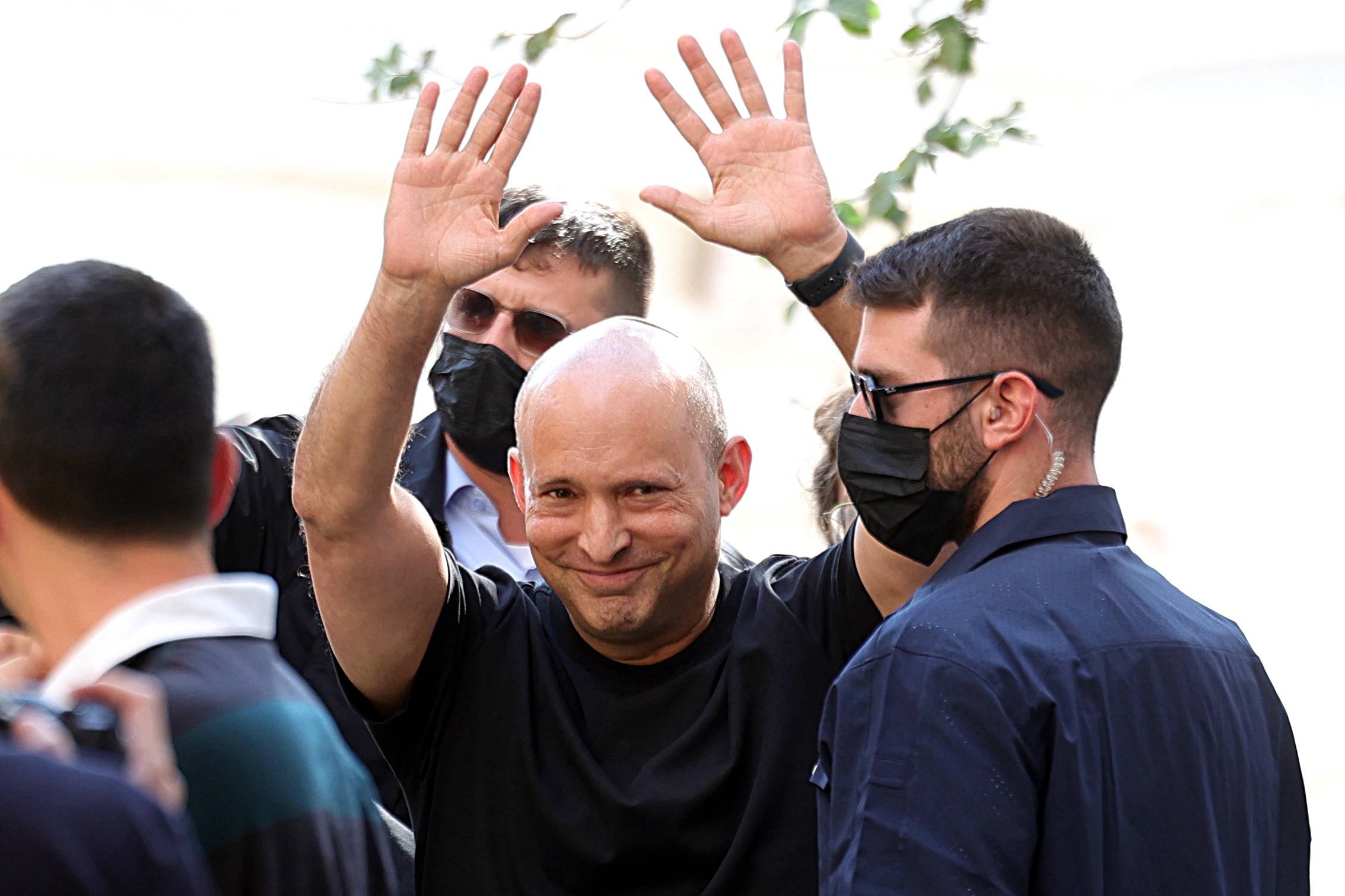
Former Israeli Prime Minister and candidate for Knesset, Naftali Bennett (C) reacts as he campaigns in Jerusalem, 19 October 2026. (EPA)

Naftali Bennett, former prime minister

Bennett, 54, is the right-wing and religiously observant leader of Beyachad (Together), a joint ticket with centrist politician Yair Lapid. He opposes Palestinian independence and supports settlement-building in the occupied West Bank.

Before entering the Knesset in 2013, Bennett served as Netanyahu's chief of staff and also was head of the Yesha Council, an umbrella organization of local authorities inside Israeli settlements. His conservative Yamina party won seven seats, which helped him cobble together a coalition of both left-wing and Arab parties. He then briefly served as prime minister in 2021, the result of a power-sharing agreement, also with Lapid.

While Bennett, like Netanyahu, takes a hard line toward the Palestinians, the two men have deep disagreements over Netanyahu's handling of security issues and his battle against the Israeli legal system.

Itamar Ben-Gvir, national security minister

Ben-Gvir, 50, is Israel's national security minister and a far-right provocateur with multiple convictions, including for supporting a terrorist organization. He leads Otzma Yehudit (Jewish Power), an ultra-nationalist party whose strong showing in the last election secured him his Cabinet post and helped push Netanyahu's coalition further to the right.

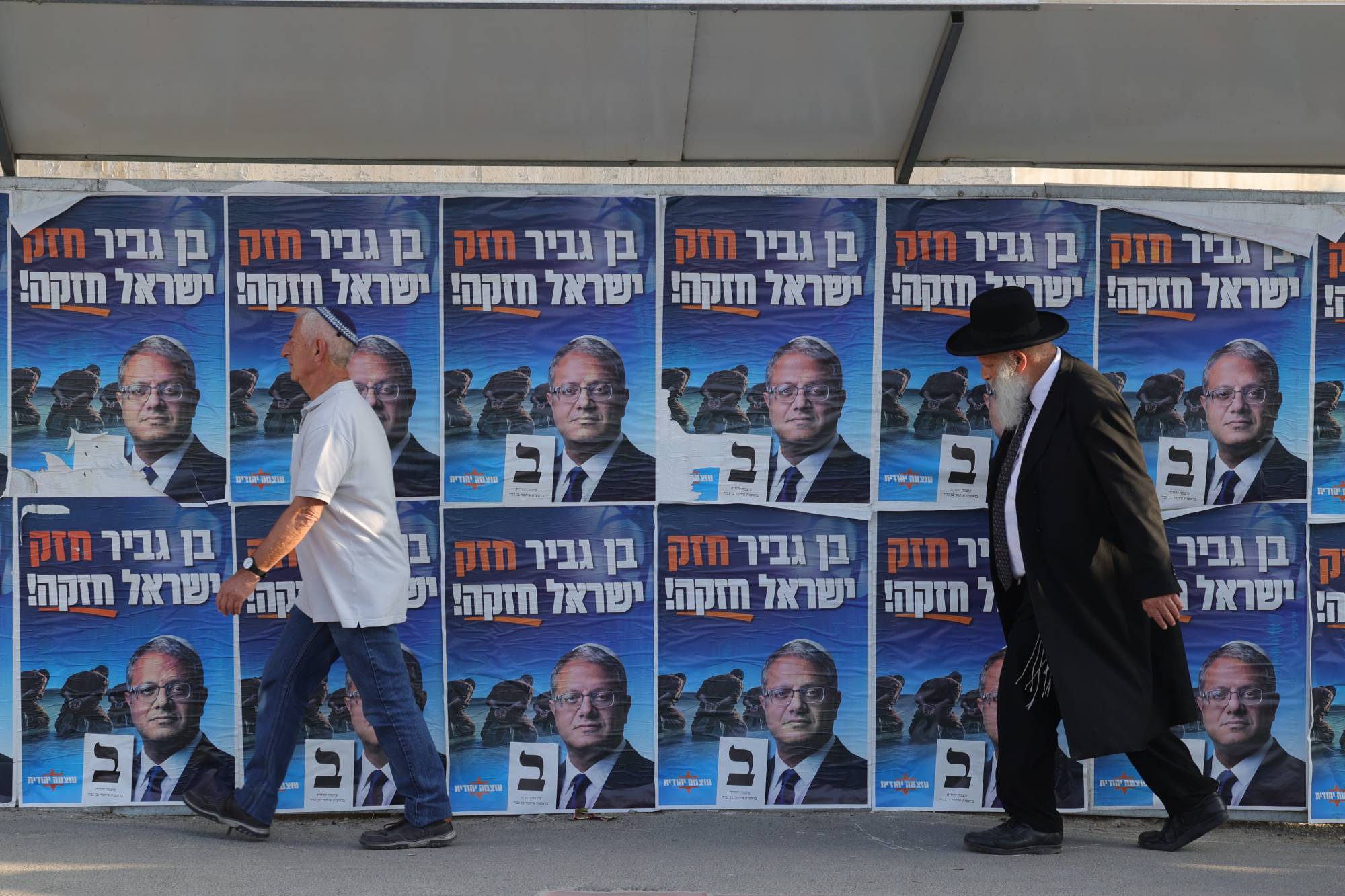
Ultra-Orthodox Jews pass an election billboard of Minister of National Security and leader of the Otzma Yehudit party, Itamar Ben-Gvir, with a Hebrew slogan reading "Ben-Gvir strong, Israel strong", in an ultra-Orthodox neighborhood in Jerusalem, 21 October 2026. (EPA)

He is a trained lawyer who gained recognition by successfully defending right-wing Jewish extremists accused of violence against Palestinians. When Ben-Gvir was a teenager, the military refused to draft him because of his extreme views. He was also a follower of Meir Kahane, the violently racist rabbi who advocated for expelling Palestinians from Israel, Gaza and the West Bank.

Ben-Gvir has also laid out plans for what he says would be the “voluntary” emigration of roughly 2 million Palestinians from the Gaza Strip, where he has advocated for re-building Jewish settlements.

Mansour Abbas, Knesset member and leader of Ra'am

Abbas, 52, is a Palestinian Arab politician and dentist from northern Israel. He leads Ra'am, an Islamist party that was the first Arab-led party to join a governing coalition in 2021.

His strategy has been to focus on more local issues, such as crime in Arab communities, rather than the larger Israeli-Palestinian conflict, in the hopes it will win Ra'am more seats in the Knesset and court potential coalition partners.

As part of this push, Abbas named former police commander and centrist Jewish politician Yoav Segalovitz as the number two candidate on Ra'am's electoral list. Abbas has served in the Knesset since 2019.


Israel’s Election May Change Its Leader, but Not Iran War Policy

A woman passes by an election billboard of Israeli Prime Minister Benjamin Netanyahu with Hebrew slogan reading "will not surrender" in Jerusalem, 21 October 2026. (EPA)
TT

Israel’s Election May Change Its Leader, but Not Iran War Policy

A woman passes by an election billboard of Israeli Prime Minister Benjamin Netanyahu with Hebrew slogan reading "will not surrender" in Jerusalem, 21 October 2026. (EPA)

Israel's election next week may change its leader, but not its strategy: Iran will remain its chief adversary, military force will continue to be its preferred tool and Palestinian statehood a distant prospect, regional policymakers and analysts say.

That is because the strategic assumptions underpinning Israeli policy were hardened by the October 7, 2023, attacks on southern Israeli communities by Palestinian group Hamas and by the wars in Gaza, Lebanon and Iran.

If anything, Israel could toughen its security policy, the analysts said, as victory for Prime Minister Benjamin Netanyahu with the backing of far-right coalition partners could embolden him to step up the war with Iran, tighten Israel's grip on the occupied West Bank and push diplomacy further to the margins.

Israel's security doctrine now rests on three pillars: breaking Iran, holding buffer zones beyond its borders and using force to deter enemies.

The real divide is one of degree rather than direction — how aggressively Israel fights its wars, how far it expands Jewish settlements in the West Bank and whether any leader opts for diplomacy, the analysts said.

From Tehran to ‌Riyadh, Tuesday's election ‌is not seen as a potential turning point but as a test of whether the Middle East is ‌settling ⁠into a long ⁠confrontation, where wars ebb and flow while the underlying conflicts are unresolved.

"If Netanyahu is elected, he'll do whatever he thinks he wants to do," said Aviv Bushinsky, a former adviser to Netanyahu. "Expansion of the settlements will continue. The wars against Iran, Hamas and Hezbollah will continue."

"What you see now is what you'll see after the election, maybe even more aggressively," he said. "As long as Iran is in such a situation, it's a waste of time talking about Palestine.”

Netanyahu said on Sunday that Israel must prioritize “prevention and offence over containment and defense”, including pre-emptive strikes to thwart emerging threats, while establishing Israel as a regional power and maximizing its independence in armaments.

WHY THE COURSE IS UNLIKELY TO CHANGE

The election pits Netanyahu's right-wing Likud and its ultranationalist allies against an opposition led ⁠by former military chief Gadi Eisenkot's Yashar party.

Palestinian analyst Ghassan al-Khatib sees no prospect of a fundamental shift ‌in policy towards the Palestinians, with Israeli political parties competing to project harder-line positions as public opinion ‌moves further to the right.

“The substance of the policy remains the same: No to a Palestinian state and yes to further settlement expansion. On this, they ‌are all in agreement,” he said.

A government led by Netanyahu's opponents might seek to repair Israel's international standing by curbing some settler violence or ‌pursuing settlement expansion with less fanfare. But such changes would be a shift in style rather than substance, al-Khatib said.

Michael Young of the Carnegie Middle East Center said Israel's security establishment and much of its political class share a common strategic outlook, centered on confronting Iran, maintaining "forward defense" and preserving military deterrence, reducing the scope for big policy shifts.

Joost Hiltermann of the International Crisis Group, who has conducted research in the West Bank, said growing settler violence, mounting Palestinian frustration and the absence ‌of a "political horizon" had created combustible conditions, where even a minor trigger could spark a wider uprising.

'VENOMOUS OCTOPUS'

Some regional policymakers ask whether Israel's confrontation with Iran has become the organizing principle of Middle East security, ⁠regardless of who wins the ⁠election.

US President Donald Trump's praise of Netanyahu as a "great warrior prime minister" has reinforced expectations that the Israeli leader will try to finish the campaign against Tehran if he retains power.

Netanyahu has made clear his ambitions extend beyond containing Iran to toppling its clerical rulers.

“Completing the task means toppling the terrorist regime in Iran, the head of the venomous octopus,” he said in a speech this week.

But military and political analysts question whether anything short of a US-Israeli ground invasion would force Tehran to abandon what it views as its core security interests in what it sees as an existential fight.

After surviving months of war, Iran may be betting it can outlast its opponents while continuing to exert pressure through regional allies.

"This is a quagmire," Young said. "The Iranians can outlast Trump."

Hezbollah in Lebanon and Hamas in Gaza have been weakened, but the broader network of Iran-aligned groups has survived and the conflict could strengthen Tehran's determination to pursue a nuclear deterrent, the analysts said.

"Netanyahu's policies in Gaza, the West Bank, Syria and Lebanon are damaging," said Abdulaziz Sager, chairman of the Gulf Research Center. "As for Iran, a settlement is needed before the conflict escalates further. If Iran's role is not curbed, the region could be heading toward 50 years of Iranian hegemony."