
Floods that swept northern and eastern Syria in early June, along with a rise in the Euphrates River after heavy rain and increased flows from Türkiye, have revived questions about the water crisis in Syria and Iraq, and whether Türkiye is using the Tigris and Euphrates as a political and security pressure card.
The crisis between Türkiye, Iraq and Syria centers on how to share the waters of the two rivers. Türkiye, the upstream state, controls the main tributaries. Its water policies and expanding dam network have sharply reduced flows, worsened drought and pushed water levels to near-catastrophic lows, especially in Iraq, which has faced its worst drought in more than 80 years.
Türkiye says the Tigris and Euphrates are transboundary rivers and that it has the right to manage them under its territorial sovereignty. Iraq and Syria want them classified as international rivers, with fair-sharing rules and international law applied under historic agreements, including the 1923 Treaty of Lausanne and joint cooperation protocols.
Mismanagement or resource depletion?
Türkiye has been accused of using water as leverage against Iraq and Syria for security reasons, mainly linked to the Kurdistan Workers Party, or PKK, and its extensions inside both countries. Those tensions later widened into Turkish air and ground operations in the two neighboring states, leaving a Turkish military presence that has long caused friction, especially between Ankara and Baghdad.
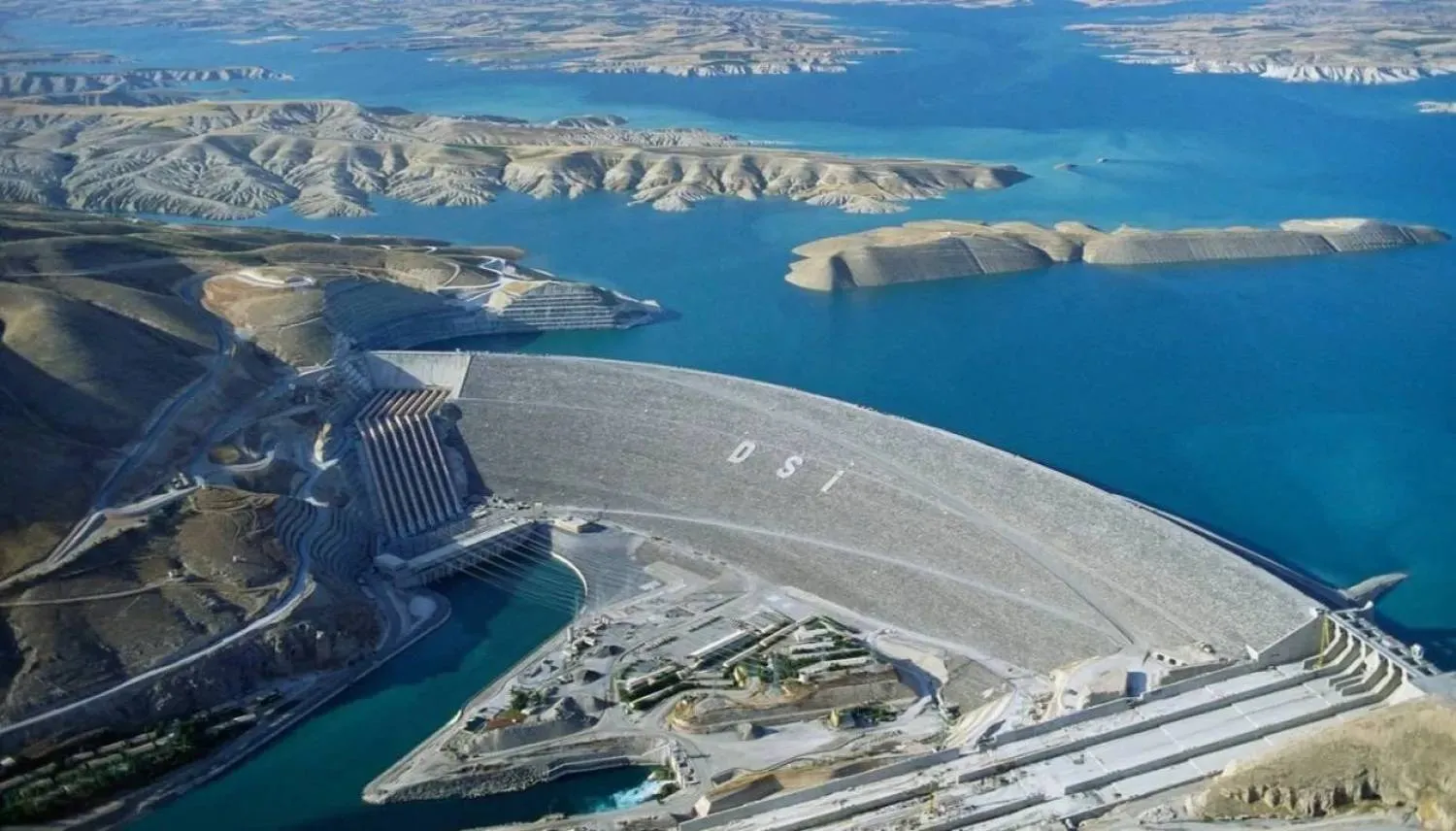
Several issues drive the crisis. The most important is Türkiye’s Southeastern Anatolia Project, designed to develop eastern and southeastern Türkiye. Under the project, Türkiye built major dams and reservoirs, including the Ataturk, Keban and Ilisu dams, to regulate irrigation and generate power. That sharply reduced the water reaching Syria and Iraq, the transit and downstream states.
The impact has been especially severe in Iraq. Water scarcity has battered agriculture, shrunk farmland, damaged the southern marshes listed as a World Heritage site and triggered repeated social and environmental crises.
Lower flows have also hit hydroelectric power generation and drinking water supplies for millions of people. In Syria, drought periods have raised the risks of pollution and disease.
Diplomatic efforts have surfaced from time to time. The countries have reached understandings, joint agreements and bilateral, and sometimes trilateral, memorandums of understanding to secure the minimum vital needs of each state. During severe droughts, Iraq and Syria have also tried to persuade Türkiye to increase flows. Türkiye insists it is a water-poor country and says Iraq’s crisis stems from local mismanagement and poor resource use, not from Turkish dams.
In Mesopotamia, water has rarely been just a natural resource. It has been a foundation of civilization, a source of conflict and, at times, a key to reconstruction and joint development. That was reflected in the Iraq-Türkiye framework agreement on water and development signed in November 2025.
What the Tigris brings together, the Euphrates drives apart
Turkish writer and water affairs researcher Bilgay Duman said the agreement, whose full terms have not been disclosed, marked an important development not only in Ankara-Baghdad relations, but also in redefining how shared resources are managed in the Middle East.
Duman said that after Türkiye, Iraq and Syria emerged as states, regulating the use of resources became a political and legal necessity. It also became a permanent source of dispute. The Euphrates turned into a three-way issue, while the Tigris became central to Turkish-Iraqi relations.
Early attempts were made to agree on water shares. The 1921 Ankara Agreement and the 1946 agreement between Türkiye and Iraq laid technical foundations for cooperation, including data sharing and flood control.
Later came the 1987 Syrian-Turkish agreement, a temporary deal to share Euphrates waters during the five-year filling of the Ataturk Dam reservoir.
Signed on July 17, 1987, the agreement committed Türkiye to provide an annual average of more than 500 cubic meters per second at the Turkish-Syrian border until a final arrangement was reached among the three Euphrates states.
On April 17, 1989, Syria and Iraq signed an agreement setting Iraq’s share at 9.106 billion cubic meters a year through the Syrian border, Syria’s share at 6.627 billion cubic meters and Türkiye’s at 15.700 billion cubic meters.
Syria registered its agreement with Türkiye at the United Nations in 1994 to secure its minimum share, and Iraq’s, of Euphrates waters. But that did not solve the problem.
Water for the PKK
As accusations grew that Türkiye was using water to pressure its neighbors, squeeze Kurds in Syria and push Iraq to act against the PKK and classify it as a terrorist organization, the 1997 UN Convention on the Law of the Non-Navigational Uses of International Watercourses set out the principles of no harm and equitable distribution.
It also required states to consider the water, economic and social needs of all riparian countries, as well as the needs of populations dependent on the watercourse and its direct and possible effects.
The convention strengthened Iraq and Syria’s legal position against Türkiye because both countries have large areas along the Tigris and Euphrates. Syria was among the first states to ratify it. Türkiye did not join, saying it harmed its interests and water rights, and voted against its adoption.
Syria, where the Euphrates irrigates more than 640,000 hectares, did not turn to international arbitration to secure its water rights from Türkiye. International law remains inconclusive in such cases, and arbitration requires both sides to agree.
Syrian support for the PKK, and its decision to allow the group’s fighters to use northern Syria as a rear base, pushed Türkiye into a harder position and led Ankara to link that support to the water dispute.
In 1993, Turkish-Syrian talks were held in Ankara to reach a final agreement on water shares. They produced nothing beyond the temporary 1987 arrangement, which was tied only to the filling of Lake Ataturk.
The same period saw Syria and Türkiye sign a joint development agreement on the Orontes River, which rises in Lebanon’s upper Bekaa Valley. Türkiye had been excluded from sharing the river with Syria and Lebanon in 1994. Giving up its share was a small price for greater benefit from the Euphrates.
Only 10% of the Orontes reached Türkiye’s Hatay province, and by then it was polluted and unusable. For decades, residents of the province bordering Syria, historically known as the Sanjak of Alexandretta, saw central government policies as unfair and blamed them for marginalizing the area and depriving it of a natural resource for political, ethnic and religious reasons.
Syrian revolution, Turkish opportunity
After the Syrian uprising against Bashar al-Assad began, Türkiye moved quickly to complete the Sanliurfa water canals project in 2012. The canals allowed water held at the Ataturk Dam to irrigate the border plains with Syria in Harran, Mardin and Ceylanpinar. The Silvan Dam was also filled in 2011. Syria took no countermeasure because Assad’s authorities were busy suppressing the uprising.
Syria’s approach to the water file showed that its main strategy against Türkiye had been to exploit internal security and the PKK threat, a strategy that ended with the Adana Agreement. Other options seemed impossible because of Türkiye’s military strength, external alliances and control of the Euphrates source.
Iraq: Drought and unrest
Iraq, which gets 60% of its water needs from Türkiye, has been the hardest hit by shortages. It faced successive severe crises across its territory, especially after the Ilisu Dam, built on the upper Tigris in Türkiye, began operating in 2020. Other dams on smaller tributaries added to the pressure. Tensions with Türkiye over water reached their peak.
Other environmental issues, including tree-cutting in northern Iraq during a Turkish military campaign against PKK militants, deepened tensions with Ankara. Pressure on the Turkish government produced little beyond a slight delay in filling Ilisu, postponing the problem rather than solving it.
In the summer of 2018, dwindling water resources and pollution caused fish to die in the Euphrates. Water shortages then became a major cause of social unrest across Iraq in the following years, culminating in the worst drought in 80 years in 2025.
The Ilisu Dam reduced Iraq’s share of Tigris waters to nearly 60% because of power generation.
In June 2025, Iraq called for water not to be used as a political pressure card and urged a joint regional vision based on fair distribution of transboundary waters. At the same time, it noted progress in negotiations and in the work of joint committees with Türkiye and Iran.
Despite this, Iraq and Türkiye kept positive relations, which expanded under Iraqi Prime Minister Mohammed Shia al-Sudani. The two sides reached understandings on security, the economy, trade, water and energy, while focusing on cooperation over the Development Road project.
Water disputes, also tied to security as in the Syrian case, became a route to cooperation after Iraq’s National Security Council declared the PKK a banned group in 2024.
Development Road runs through politics
On Nov. 2, 2025, Turkish Foreign Minister Hakan Fidan and Iraqi Foreign Minister Fuad Hussein signed a document establishing a mechanism to finance projects under a framework agreement for water cooperation. The mechanism implements the water cooperation framework agreement signed in 2024 during Turkish President Tayyip Erdogan’s visit to Iraq.
The agreement set a framework for water projects worth billions of dollars. Turkish companies will build new infrastructure to improve water-use efficiency and storage in Iraq. The projects will be financed from Iraqi oil revenues, in an attempt to turn crude exports into water security.
According to details that have emerged but have not been formally announced by either side, the first projects include water-collection dams and land-reclamation initiatives.
Ankara described the initiative as mutually beneficial for regional stability and economic cooperation.
“We in Türkiye are keen to support Iraq’s security, development and safety, and our support in this regard is absolute,” Fidan said at the signing ceremony.
Hussein said the agreement was needed to protect water security, food production and economic stability. He said Baghdad had long suffered from a weak position because of the absence of formal treaties regulating the use of Tigris and Euphrates waters.
Securing Erdogan’s presidency in 2028?
The agreement stirred doubts and fears among some Iraqi politicians and water experts. Some said it serves Türkiye more than Iraq and supports Erdogan’s effort to remain president after 2028.
Some Iraqi political forces reject the agreements with Türkiye, including those linked to the Development Road project and water cooperation. They say the deals could make Iraq dependent on Türkiye.
Allocating oil revenues to contracts with Turkish companies also raises legal and constitutional questions, along with concerns about corruption, weak transparency and possible obstacles caused by relying on one funding source, oil, which is exposed to global price swings.
Some opponents point to the absence of a final, binding legal framework agreed by both sides that defines the water share Türkiye must release to Iraq from the Tigris and Euphrates.
Although Türkiye and the PKK have begun a process to end the group’s activity, the PKK file and the presence of its members in northern Iraq, in areas beyond Baghdad’s control, could still obstruct implementation of the agreement.
The issue is not limited to Iraq’s domestic situation. It also touches the regional balance, with some parties seeing stronger Iraq-Türkiye ties as a source of pressure. That could turn Iraq into an arena for regional competition and influence struggles.
The Ottoman legacy
Duman said the agreement serves the interests of both Türkiye and Iraq. He said the water problem between the two countries did not emerge in recent decades, but dates back to the collapse of the Ottoman Empire, when the Tigris and Euphrates changed from internal rivers inside one political entity into transboundary rivers between independent states.
What marks the current phase in Turkish-Iraqi relations, he said, is the gradual shift from conflict over water shares to managing mutual benefit, and a broader rethinking of transboundary resources as a driver of integration, not a permanent source of tension.
He said the agreement’s most important new feature is the direct link between water and energy. Revenues from oil Türkiye imports from Iraq will finance water projects inside Iraq.
Turkish companies specializing in dams, modern irrigation networks, water treatment and waste reduction will carry them out. That bypasses one of Iraq’s biggest development obstacles, lack of funding, without turning to foreign loans or the conditions of international financial institutions.
In an article on the Turkish platform Fikir Turu, Duman said the model gives Türkiye a new role, not just as a state that controls water sources but as a partner in rebuilding Iraq’s infrastructure. That strengthens Türkiye’s regional influence through economic and development tools rather than hard-power tools.
The model could also expand regionally and become a practical reference for future cooperation with Syria, especially on Euphrates water management, if the right political conditions emerge.
Water diplomacy in the Levant could then shift from a source of fragility and chronic conflict into a platform for trust-building and regional integration, by linking natural resources to economic development rather than reducing them to sovereignty and conflict.
Prominent Turkish transboundary water researcher Dr. Tugba Evrim Maden told Asharq Al-Awsat that shared water resources need joint management based on technological solutions, not conflict or legal disputes.
She said the problems of downstream countries mostly stem from political instability, destroyed infrastructure, poor resource use and waste.
Türkiye is not rich in water
Contrary to common belief, Türkiye is not rich in water resources. It is not water-abundant compared with its region. It lies in a semi-arid climate zone and has less annual water per person than its neighbors, North America and water-rich northern Europe.
In water-rich countries, the annual per capita share of usable water exceeds 10,000 cubic meters. In Türkiye, it is about 1,350 cubic meters, according to Turkish Foreign Ministry data.
If the population reaches 100 million in 2030, Türkiye’s per capita water share is expected to fall to about 1,000 cubic meters. Because Türkiye’s water resources vary by region and season, they cannot meet current and expected needs everywhere. Some areas have abundant water that is not suitable for use, while densely populated industrial areas lack enough water.
Türkiye’s arid and semi-arid regions receive rain for only four or five months a year. That makes water development projects, including dams and reservoirs that store rainwater for year-round use, vital to sustainable social and economic development.
At the same time, Türkiye’s energy consumption is rising because of rapid urbanization and industrialization. Its per capita energy use is only one-sixth of the European Union average. Türkiye has no major oil or natural gas resources, so it is pursuing domestic resources to meet rising energy needs, including renewable, cheap and environmentally friendly hydropower.
The UN Convention to Combat Desertification’s report, “Global Drought Hotspots 2023-2025,” placed Türkiye among critical areas in the drought belt stretching from southern Europe to the Middle East.
The report warned that current trends could push Türkiye into severe water scarcity by 2030, with nearly 80% of its farmland potentially exposed to repeated and severe drought waves over the next decade.
As climate change intensifies, Türkiye is nearing a crisis that threatens its water security. Turkish and international experts say it is approaching the critical threshold of water poverty and could be officially classified as water-poor by 2030 if current conditions continue.
Türkiye’s per capita share of renewable water has fallen from about 1,650 cubic meters at the start of the millennium to below 1,300 cubic meters now, nearing the UN red line of 1,000 cubic meters a year.
The 19% decline in two decades reflects not only a resource crisis, but also an unsustainable consumption pattern and a water management system facing a serious structural challenge, water experts say.
Türkiye suffered severe drought in 2025, marked by scarce rain, record temperatures and dried-up lakes and water bodies. It recorded its hottest December in more than half a century, with rainfall more than 50% below seasonal averages, according to the Turkish State Meteorological Service.
Lack of response
Experts say that despite growing warnings about water poverty, the authorities’ response remains below the scale of the challenge.
Mustafa Chashmaz, a climate professor at Karadeniz Technical University, warned that evaporation caused by rising temperatures has become one of the main drivers of water loss. He said that storing water in broad-surface dams without accounting for climate conditions makes reservoirs more vulnerable to evaporation as heat waves intensify.
He called for urgent technical solutions, including deeper reservoirs less exposed to sunlight, covered basins in sensitive areas, and a ban on the use of freshwater in private swimming pools at coastal resorts, replacing it with treated saltwater.
He also said state institutions are part of the problem because public facilities consume large amounts of water without effective conservation systems or modern saving technologies.
Türkiye faces one of the most complex environmental challenges in its modern history: widening desertification, worsening drought and rising environmental stress. Recent years have brought repeated severe heat waves and forest fires, including about 3,000 fires in the summer of 2025.
Türkiye’s water crisis extends beyond its borders and affects regional water security, especially in Syria and Iraq. Türkiye controls about 90% of Euphrates waters and a large share of Tigris waters.
At the opening of water projects in October 2025, Erdogan said Türkiye was not water-rich, as some believe. Annual average rainfall does not exceed 574 millimeters, he said, far below the global average.
Experts say agriculture consumes 70% to 75% of total water withdrawals, while cities lose 20% to 35% through leaking networks. Dam efficiency is also weakened by evaporation and sediment buildup.
The Turkish government recently announced a program to restore shrinking or dried-up lakes, including Lake Marmara in western Türkiye. It also plans to invest in wastewater recycling plants for irrigation, agriculture and industry, and to build new desalination plants in areas with chronic freshwater shortages, especially western Anatolia and the Mediterranean coast.
Urgent priorities include cutting urban water losses to below 15%, expanding high-efficiency irrigation systems to save up to 30% of agricultural consumption, reducing evaporation by improving reservoir design and expanding underground storage, raising treated-water reuse to 20% of urban demand, adjusting water tariffs, shifting to less water-intensive crops and adopting mandatory drought management plans.