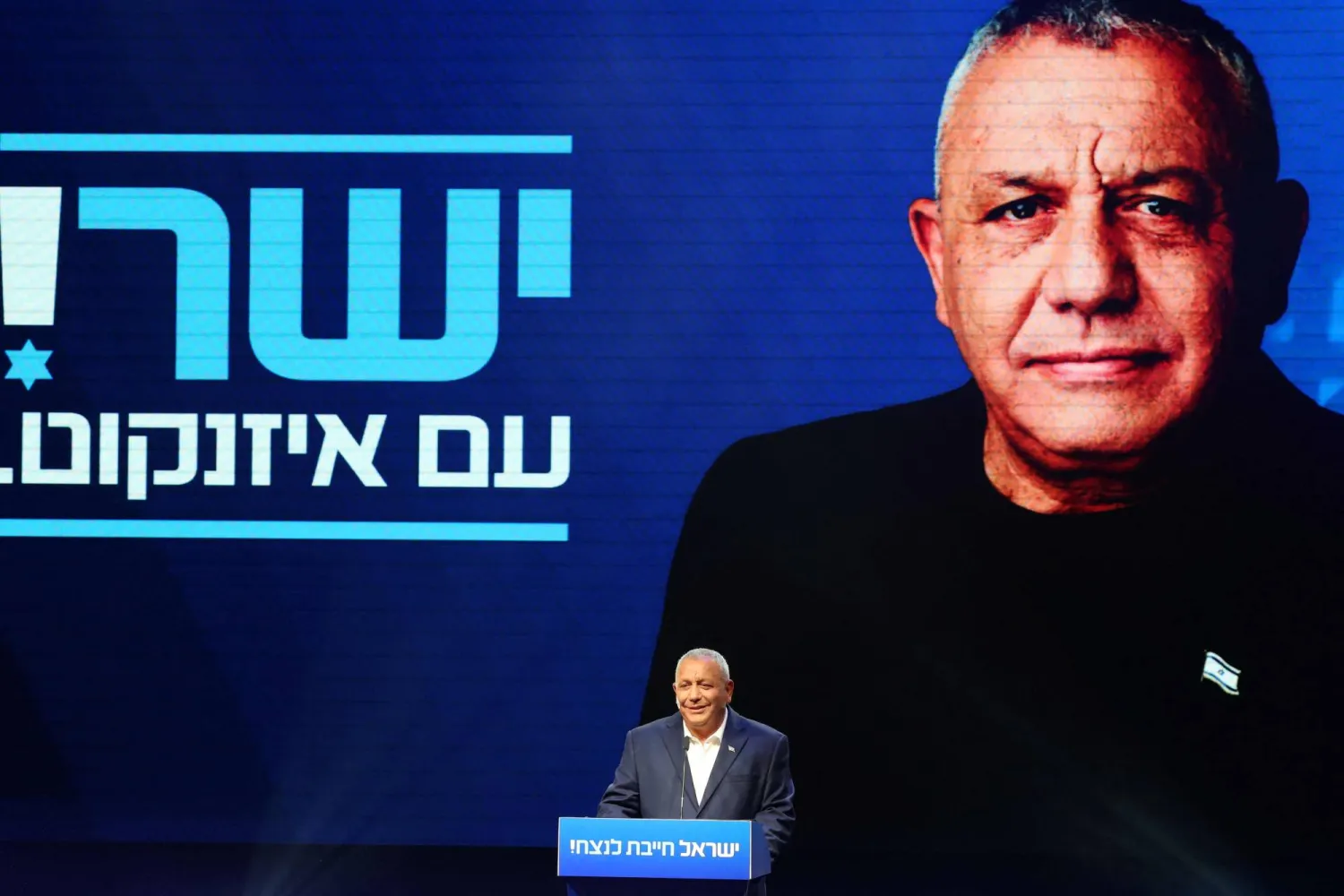
In Israel Vote, Ex-Army Chief Emerges Main Rival to Netanyahu

Former Israeli army chief of staff Gadi Eizenkot speaks during the launch of the Yashar party's election campaign in Hod Aharon, in central Israel on June 30, 2026. (AFP)
TT

In Israel Vote, Ex-Army Chief Emerges Main Rival to Netanyahu

Former Israeli army chief of staff Gadi Eizenkot speaks during the launch of the Yashar party's election campaign in Hod Aharon, in central Israel on June 30, 2026. (AFP)

As Israel heads into a fiercely contested general election on October 27, former military chief Gadi Eisenkot has emerged as the principal challenger to Prime Minister Benjamin Netanyahu.

Eisenkot's rise comes at a pivotal moment in Israeli politics, with the election widely viewed as a referendum on the long-serving premier's leadership in the violent aftermath of Hamas's October 7, 2023, attack on Israel.

A recent Channel 12 poll put Eisenkot's new party, Yashar (Hebrew for "Straight" or "Upright"), ahead of Netanyahu's Likud, projecting 23 seats to Likud's 22 in the 120-member Knesset.

The same survey found that 43 percent of respondents considered Eisenkot, 66, the most suitable candidate for prime minister, compared with 34 percent for Netanyahu.

Eisenkot -- who has dismissed calls for a future Palestinian state as irrelevant after the October 7 attacks and pioneered Israel's strategy of disproportionate military responses in Lebanon -- has built his campaign around a 10-point platform that he says will restore Israel's security, unity and democratic institutions.

Chief of staff of the Israeli military between 2015 and 2019, Eisenkot was among those credited with developing the "Dahieh Doctrine", named after Beirut's southern suburbs that is a Hezbollah stronghold.

Advanced on the premise that Hezbollah conceals fighters and weapons among civilian homes and infrastructure, the doctrine calls for a devastating Israeli response against enemy population centers when Israeli communities come under long-range attack.

At the top of his civilian manifesto is a pledge to establish a state commission of inquiry into Hamas's bloody 2023 cross-border attack, which triggered the Gaza war and quickly expanded into a broader regional conflict, and which led to Netanyahu's government being accused of overseeing an intelligence failure.

Tens of thousands of Israelis have repeatedly demonstrated in support of such an inquiry, but Netanyahu's coalition has instead proposed a commission whose members would be chosen by politicians.

Eisenkot also promises a "new long-term national security doctrine" aimed at strengthening the military and reinforcing Israel's borders.

A central plank of this is a "universal national service law" that would extend compulsory service to ultra-Orthodox Jews and Arab citizens.

He has also pledged to "protect judicial independence, the rule of law, minority rights and a free press."

"Through these steps, we will ensure that Israel is a Jewish, democratic, powerful, advanced and secure state," Eisenkot's campaign says.

His overall position on the Palestinian-Israeli conflict, however, remains less clearly defined.

"The only signal that he sent was that Israel should be a state of law," said Tal Elovits, a researcher at Israeli think tank Molad. "Therefore, illegal settlements and settlers' violence will be dealt with."

Relatively new to politics, Eisenkot has attracted widespread public sympathy after his son, Gal, and two nephews were killed fighting in Gaza.

Eisenkot's call for universal military service has become a defining issue of his campaign, putting him at the forefront of opposition to Netanyahu's alliance with ultra-Orthodox parties.

Eisenkot has repeatedly attacked Netanyahu's agreement with his coalition partners to advance legislation exempting many Haredi men from military service.

"This is a government that chooses to weaken the army in the midst of a brutal war, while the finest sons and daughters of this nation are deployed across all fronts," he wrote, in a social media post.

- 'Different generation' -

Unlike Netanyahu, who comes from one of Israel's elite families, Eisenkot is the son of Moroccan immigrants and grew up on the country's geographic periphery.

"In a political universe full of Netanyahu wannabes ... Eisenkot reads as a man of a different generation, far more connected to the traditional security narratives of Zionism," columnist Nadav Eyal wrote in a recent blog.

Eisenkot's understated style could prove to be one of his strongest political assets, said Elovits.

"The middle class and upper middle class... look for someone that will look responsible, boring, and I think that Eisenkot has that appeal," he said.

Although opposition leaders Yair Lapid and Naftali Bennett remain in contention, current polling suggests neither is as well positioned as Eisenkot to defeat Netanyahu.

Lapid and Bennett governed together between 2021 and 2022 in a coalition that included an Arab party.

- Strategic option -

According to Elovits, many disillusioned right-wing voters still see that alliance as a "betrayal", making them unlikely to return to Bennett.

"Many voters of the right wing who do not like what Netanyahu is doing... are looking for a home. And a reasonable house for them today is Gadi Eisenkot," said Gayil Talshir, a political science professor at the Hebrew University in Jerusalem.

For liberal centrist voters, Eisenkot increasingly represents the opposition candidate with the strongest chance of unseating Netanyahu.

"Once Eisenkot began to rise above Bennett in the polls, the strategic voters of the liberal camp went with Eisenkot," Talshir said.


Israel’s Far-Right Ben-Gvir Seeks New Ground in Election

In this picture taken on October 20, 2026, a torn up election banner for Israel's national security minister's Itamar Ben Gvir far-right Otzma Yehudit (Jewish Power) party is displayed along the side of a highway outside Beit Shemesh in Israel's southern district. (AFP)
TT

Israel’s Far-Right Ben-Gvir Seeks New Ground in Election

In this picture taken on October 20, 2026, a torn up election banner for Israel's national security minister's Itamar Ben Gvir far-right Otzma Yehudit (Jewish Power) party is displayed along the side of a highway outside Beit Shemesh in Israel's southern district. (AFP)

A turbo-charged election campaign by Israel's far-right national security minister has seen gun-shaped keychains distributed to high school students and a promotional video threatening to "put to death" a Palestinian inmate.

His policy pledges include encouraging Palestinians to leave the occupied West Bank and war-ravaged Gaza, as well as enforcing the death penalty on Palestinians convicted of deadly attacks against Israelis.

Days ahead of polls which many Israelis consider crucial to deciding the future character of their country, the divisive influence of Itamar Ben-Gvir -- once considered a provocateur on Israel's extremist fringes -- shows no sign of dimming.

Polls show his Otzma Yehudit, or Jewish Power, party winning eight or nine seats in the 120-member parliament, making it the first time it will win a mandate running as a standalone entity.

In 2022, it was allocated six seats after running on a joint list with other far-right parties.

Ben-Gvir, who has been convicted at least eight times in Israeli courts before becoming minister, on charges including supporting a terror organization and incitement to racism, has become the firebrand face of Israel's far-right -- whose political clout has skyrocketed since joining Prime Minister Benjamin Netanyahu's coalition four years ago.

"In short, he speaks straight. We really love him," 23-year-old Or Nahman told AFP in Jerusalem's bustling Mahane Yehuda market, where a huge banner bearing Ben-Gvir's face hangs over shop stalls.

"We want to fight and vote for a person like this, who serves our ideology and the things we believe in, whether it's the Jewish character of the country, the victory of Israel, strong economic security, whether it's a country where everyone can walk here freely in their land without any fear of anyone," he added.

Nahman's friend, armed with an automatic weapon, smiled in agreement beside him.

As national security minister with responsibility over the police, Ben-Gvir has helped more than 200,000 Israelis gain access to firearms and boasts frequently about the worsening conditions for Palestinian detainees in Israeli jails.

And he has used his place in the cabinet to push the government to take more maximalist positions in Israel's multi-front wars.

He proudly sports a lapel pin in the shape of a hangman's noose after spearheading a death penalty law tailored to apply to Palestinians, popping champagne upon its approval in parliament and celebrating his 50th birthday with a noose-adorned cake.

The lawyer-turned-politician was barred from serving in the military in his youth over his support for extremist right-wing groups.

Now, he says he will demand the defense minister post if Netanyahu's bloc wins again on October 27.

- 'Not a stupid man' -

The upcoming vote is expected to be close, with more than half a million young Israelis due to vote for the first time. Surveys show they overwhelmingly identify as center-right or right-wing.

A poll of 543 first-time voters published by Israeli outlet Ynet showed some 16 percent supporting either Ben-Gvir's Otzma Yehudit or the far-right Religious Zionism party of Finance Minister Bezalel Smotrich.

At a mock election event attended by Ben-Gvir and other candidates at a high school near Tel Aviv in September, Otzma Yehudit activists handed out gun-shaped keychains to students -- evoking his liberalization of gun licensing rules.

Footage shared by Ben-Gvir showed dozens of teenage boys dressed in black, cheering and waving the party's flag.

In the run-up to the vote, Ben-Gvir -- who lives in the radical West Bank settlement of Kiryat Arba -- has campaigned in areas outside his traditional support base.

"When you behave like the boss, people respect you," he said at a recent event for English speakers in Tel Aviv, considered Israel's secular, liberal heartland.

Making a heart gesture after walking onto the stage to whistles and applause, Ben-Gvir boasted of demolishing Bedouin homes and cutting food for Palestinian detainees.

"They come in fat and they come out skinny," he bragged, smiling and making a joke about his own weight.

Ben-Gvir recently deleted a heavily criticized AI-generated video showing smiling Palestinians entering an Israeli prison on a conveyor belt, before exiting crying and emaciated.

In October, Israel's elections committee fined the minister over another video showing him confronting a convicted Hamas official in prison and saying he wanted to kill him, ruling that the footage was electoral propaganda.

His latest slew of AI videos included one showing an elderly Palestinian man sitting in the rubble of Gaza before a genie in the form of Ben-Gvir grants his wish to move to Paris. The French government rebuked the video and noted that Ben-Gvir is banned from France.

For punters at the Jerusalem market, the far-right seemed an appealing prospect, although some were concerned by Ben-Gvir's provocative stunts.

"He's too violent," said 42-year-old Shlomo from Ramat Gan, who previously voted for Netanyahu, but this year said he might cast his ballot for Smotrich.

"We need somebody like him," he said, but cautioned that Israel still needed to work with the rest of the world.

Michael, a 37-year-old from Jerusalem, agreed.

"I believe he's not a stupid man, but the fact is he says stupid things to get votes," he said. "It's very effective but it does a lot of damage to Israel's economy and diplomacy."


How Are Ukraine Strikes, Middle East War Driving US Fuel Prices?

A truck is filled with diesel fuel at a gas station on October 16, 2026, in Bayonne, New Jersey. (Getty Images/AFP)
TT

How Are Ukraine Strikes, Middle East War Driving US Fuel Prices?

A truck is filled with diesel fuel at a gas station on October 16, 2026, in Bayonne, New Jersey. (Getty Images/AFP)

Ahead of next month's midterm US elections, Donald Trump has increasingly blamed Ukrainian strikes on Russian refineries for surging energy prices back home, which are causing the president political headaches.

However, analysts say the main driver of higher fuel prices remains the US-Iran war.

- Which Russian sites have been targeted? -

Ukraine has intensified its drone attacks on Russia's energy industry over the past 18 months, seeking to cut the Kremlin's revenues and undermine its ability to finance the war.

The strikes have targeted "mostly refineries", Julien Mathonniere, an economist at Energy Intelligence, told AFP.

On average, one Russian refinery was hit every three days during the first eight months of the year, according to the International Energy Agency.

"Russia's net diesel exports fell by approximately 80 percent year on year in the third quarter of 2026, from around 1.05 million barrels per day to just 200,000 barrels per day," said Viktor Kurilov, an analyst at Rystad Energy.

In response to the disruption in domestic fuel supplies, Moscow introduced a ban on diesel exports from July until the end of October.

- Why does this concern Trump? -

Trump has repeatedly condemned the attacks on Russian refineries, saying Ukrainian leader Volodymyr Zelensky disobeyed his orders to halt the strikes.

By contrast, Trump has not commented on the intensification in recent months of Russian strikes against Ukrainian territory, which have caused a surge in civilian casualties.

Trump's frustrations come as the Republicans face dim prospects in the November midterm elections, partly because of soaring fuel prices.

US diesel prices at the pump climbed to a record of $6.53 per gallon at the end of September, up from $3.75 per gallon before the war, according to the American Automobile Association.

Energy price rises are also fueling inflation across the economy.

- What is the Middle East role? -

Ukraine's strikes explain "about one-third of the global diesel shortfall, currently estimated at 1.7 to 1.8 million barrels per day", said Mathonniere.

But "the impact of previous drone strikes (by Kyiv) on global product prices before the Middle East crisis was minimal", James Henderson, a researcher at the Oxford Institute for Energy Studies, told AFP.

Energy exports from the Gulf have plunged since US-Israeli strikes on Iran from February caused Tehran to respond by choking off the Strait of Hormuz, a vital waterway for oil and gas transit.

At the same time, maritime freight costs have soared and major refining capacity in the Middle East has been hit, adding to upward pressure on oil prices.

- Can prices fall before midterms? -

Relations between Kyiv and Washington soured further this month after Trump announced a controversial agreement with Moscow to lift certain sanctions and allow Russian diesel imports, supposedly to ease prices.

The US president said Wednesday that he believed an end to the Russia-Ukraine war could be closer than ever, as the Kremlin said it was willing to restart trilateral talks with Kyiv and Washington next month.

For now, however, the strikes continue.

"There's not much that can be done in the very short term to lower diesel prices," said Jorge Leon, an analyst at Rystad Energy.

Even if the Russia conflict ended or an energy ceasefire was reached, the impact "wouldn't really move the needle massively for the US midterm elections", he added.

Repairs to damaged infrastructure take time, while continued hostilities in the Middle East drive energy prices higher.


‘Generational Rage’: Young Europeans Fight to Be Heard

 Demonstrators take part in a protest organized by student collectives and trade unions in Paris, France, October 22, 2026. (Reuters)
Demonstrators take part in a protest organized by student collectives and trade unions in Paris, France, October 22, 2026. (Reuters)
TT

‘Generational Rage’: Young Europeans Fight to Be Heard

 Demonstrators take part in a protest organized by student collectives and trade unions in Paris, France, October 22, 2026. (Reuters)
Demonstrators take part in a protest organized by student collectives and trade unions in Paris, France, October 22, 2026. (Reuters)

From blockaded schools in Rome to tent camps in Madrid and street protests in France, young people across Europe are turning their anger on a political class they say is not listening.

Their demands vary, but they are united in wanting to make their often marginalized voices heard, sometimes even with radical methods in the face of heavy-handed policing.

"We are fighting and taking our future in our hands," said Damiano Fusa, 18, a student at Rome's Cavour high school, the first to be occupied in a wave of student takeovers that has spread across the Italian capital.

"We're not represented by anyone," Fusa told AFP, criticizing both Prime Minister Giorgia Meloni's hard-right coalition and previous center-left governments for cutting education funding and ignoring young people's needs.

Hundreds of thousands of high school and university students have rallied in France, Italy, Spain and other European countries in recent weeks, with some protests descending into violence.

Governments have largely focused on restoring order, with France imposing partial curfews and Italy deploying soldiers, responses protesters say obscure their demands and could make things even worse.

"Politicians are responding in ways that are completely disconnected from reality, completely absurd," said Luis Marques, a 19-year-old psychology student in Lisbon.

Students are demanding action on soaring rents, more spending on education instead of defense and more job opportunities for young people.

But experts say the unrest reflects a broader sense among many young Europeans that they have been shut out of politics and sidelined.

"These young people do not just feel like they do not have a place in politics, they feel they are not being heard at all," said Geoffrey Pleyers, president of the International Sociological Association.

Rosario Forlenza, a professor at Rome's Luiss University, called it a "European generational revolt" rooted in a social and economic crisis "to which politicians cannot give a substantive response".

"Young people are a minority of the population that is shrinking and so their social, economic, cultural, political and electoral weight is becoming ever more irrelevant," he said.

- 'Inspiring other people' -

The anger has been particularly palpable in France and Italy, where fresh demonstrations are planned for Saturday.

"People are very angry, they've had enough. Working hard all day and still not being able to fill up their shopping cart," a 20-year-old student who gave his name as Eddy told AFP at a protest in Bordeaux last weekend.

"Will smashing everything change anything? I think it can be a jolt to wake up the politicians. We don't know what else to do to make ourselves heard. The ballot box? We don't believe in it anymore," he said.

Protest movements across Europe are increasingly drawing inspiration from one another, and even looking to youth-led movements further afield in places like Bangladesh, India and Nepal.

In Italy, one student slogan last week urged protesters to "do as in France", while shared symbols, including the Jolly Roger pirate flag, have become common across youth rallies.

Marcos Navarro, 22, a laboratory quality-control technician from Madrid, said protesters across Europe were meeting to share tactics.

"They've come to ask us: 'How did you do it? How do you organize yourselves?' We've already exchanged ideas," said Navarro, who has been camping with hundreds of others in Madrid's central Puerta del Sol square since September to protest housing costs and evictions.

Ayla Herrero, a 26-year-old anthropologist helping at the camp's infirmary, said it was "inspiring for us to know that we're inspiring other people, that it doesn't just stay here".

- 'Not acceptable' -

Concern about the rise in military spending in Europe following the Russian invasion of Ukraine has also been a rallying point.

Nikos Mavroudis, a 17-year-old high school student in Athens' Exarchia neighborhood, said the money could be better spent on his school, where chunks of plaster are falling.

"It's not acceptable for classrooms to be dangerous," said Mavroudis, who hopes to become a cook and plans to move elsewhere in Europe to "countries where things are better".

At Rome's occupied Morgagni high school, where students have barricaded entrances with desks, protesters pointed to the crumbling infrastructure as evidence of neglect.

An 18-year-old, who did not want to be named, said the media and politicians in Italy were focusing too heavily on looting and vandalism by some protesters.

"It turns hatred against the students who are victims of this system," he said.

Asked about the violence, Sabrina Brizzola, 24, coordinator of the Italian University Students' Union, said organizations like hers should "organize and channel this generational rage".

"We have shared concerns, even if our ways of protesting differ," she said.