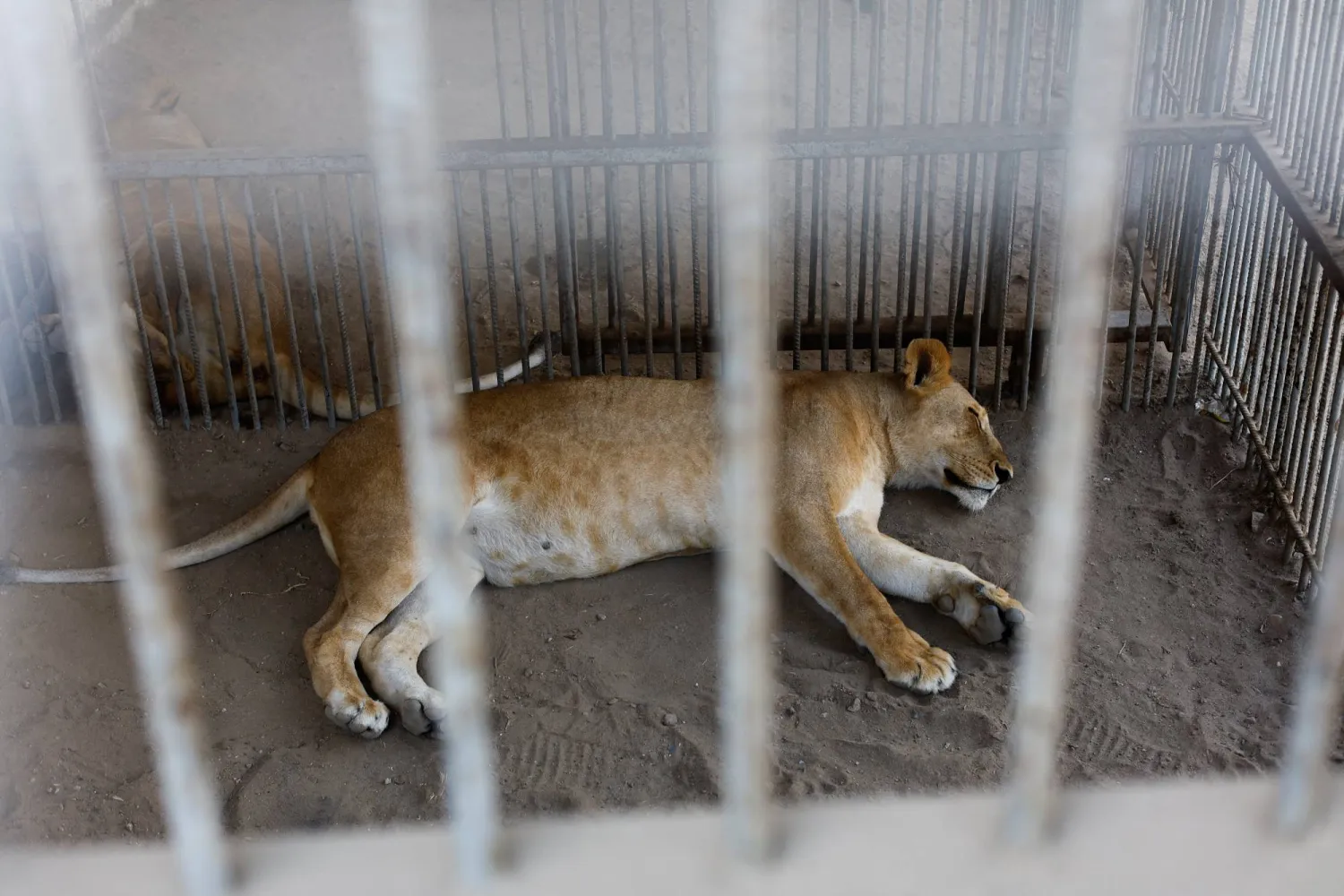
A female lion sleeps inside a cage at a zoo in Nuseirat, in the central Gaza Strip, August 12, 2026. (Reuters)
TT
TT
At a Gaza Zoo, War Takes Its Toll on the Animals
A female lion sleeps inside a cage at a zoo in Nuseirat, in the central Gaza Strip, August 12, 2026. (Reuters)
As children walked into the zoo near Gaza's Nuseirat refugee camp, they found a lion barely looking back at them through the bars of its cage and chimpanzees sitting listlessly in their enclosure.
Many of the animals were malnourished, weakened by shortages of food, medicine and vaccines. But they were still alive, largely thanks to the efforts of zoo owner Mahmoud Gomaa.
He originally ran the attraction in the southern city of Rafah, but said he had to flee when Israeli troops attacked and occupied part of the area in 2024.
As the conflict raged, he moved the surviving animals from town to town before finding a place in Nuseirat in central Gaza earlier this year.
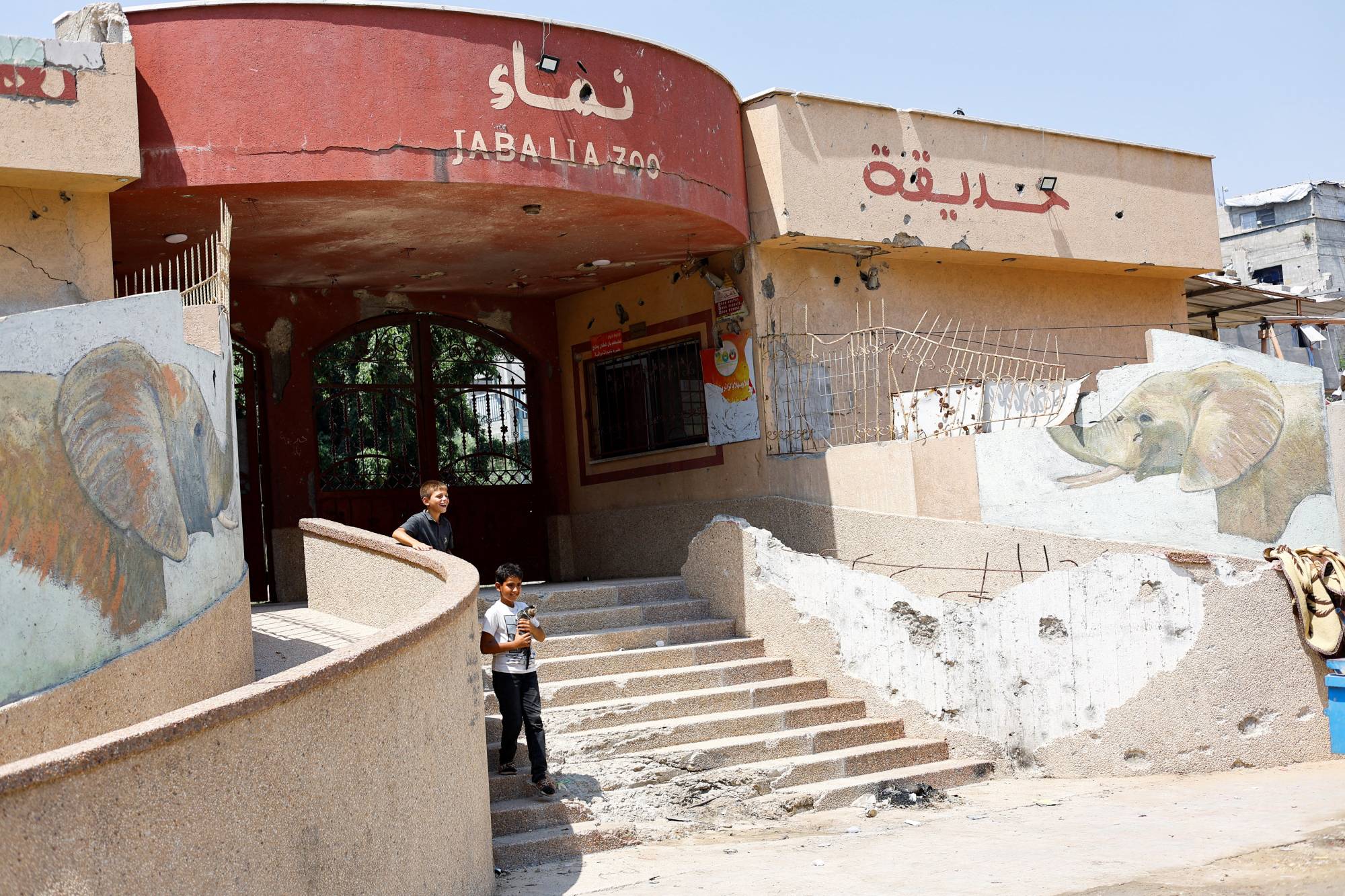
There, he reopened the zoo, hoping to give traumatized youngsters something to enjoy after nearly three years of destruction.
ZOOKEEPER RETURNED TO FIND ANIMAL BONES
"In the beginning of the war people were looking for a way to survive ... and I was looking for a way to save the animals more than saving myself," Gomaa told Reuters.
There were a number of zoos in Gaza before the conflict between Israel and Hamas erupted, displaying exotic and wild animals including lions and eagles, municipal records show.
Anyone trying to keep one open now faces enormous challenges, vets and animal experts said, not least in getting food in a territory struggling to feed its human population.
"Owners are currently feeding them frozen meat," veterinarian Nidal Fadel said. "This is a catastrophe and a wrong nutritional plan because in nature they eat fresh prey."
Palestinian children play outside a zoo damaged during the war, in Gaza City, August 15, 2026. (Reuters)
The animals themselves are bearing the brunt of the war — sometimes directly.
When Gomaa fled Rafah, he said he had to leave behind three lions, several crocodiles and some African ostriches.
A few months later, Gomaa returned and only found the bones of the crocodiles and the ostriches. Those three lions, which he had locked in their cages, had disappeared.
There is also the trauma caused by the sound and sight of the conflict raging around them.
"Lions can detect sounds and disturbances that humans may not notice," said Amir Khalil, a veterinarian who has led several trips to Gaza by the animal welfare organization Four Paws and rescued other zoos' animals.
"Bombing and constant conflict create enormous stress and fear for them," he added.
In Nuseirat, the surviving lion barely looked up at the visitors. But the children had better luck with some of the other animals, letting parrots ride on their shoulders and petting smaller monkeys.
It was a rare chance to relax in an enclave still facing regular airstrikes, despite a fragile ceasefire. Israel's military, which says its attacks are aimed at militant targets, did not immediately respond to questions about the conflict's impact on civilian facilities like zoos and their animals.
"Today there is no avenue for children to play," said visitor Karam Al-Mazin, 42.
"There is nothing except rubble, stones and tents, so children today are bored and are in a difficult situation."
War in the Heart of Hebron: 500 Settlers Share Daily Life with Thousands of Palestinianshttps://english.aawsat.com/features/5329945-war-heart-hebron-500-settlers-share-daily-life-thousands-palestinians
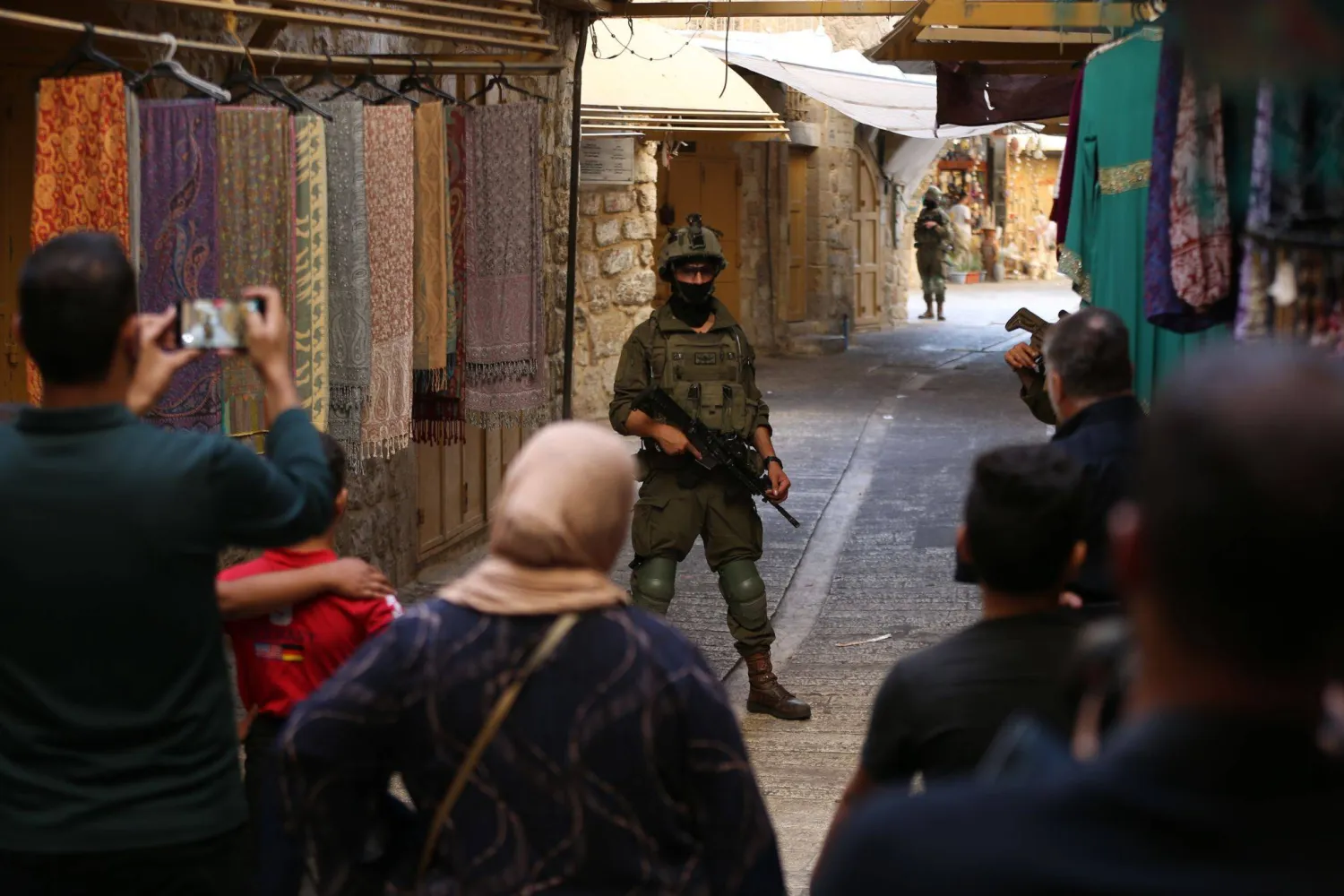
10 October 2026, Palestinian Territories, Hebron: Israeli soldiers stand guard during a tour by Israeli settlers in the Old City of Hebron. Photo: Mamoun Wazwaz/APA Images via ZUMA Press Wire/dpa
War in the Heart of Hebron: 500 Settlers Share Daily Life with Thousands of Palestinians
10 October 2026, Palestinian Territories, Hebron: Israeli soldiers stand guard during a tour by Israeli settlers in the Old City of Hebron. Photo: Mamoun Wazwaz/APA Images via ZUMA Press Wire/dpa
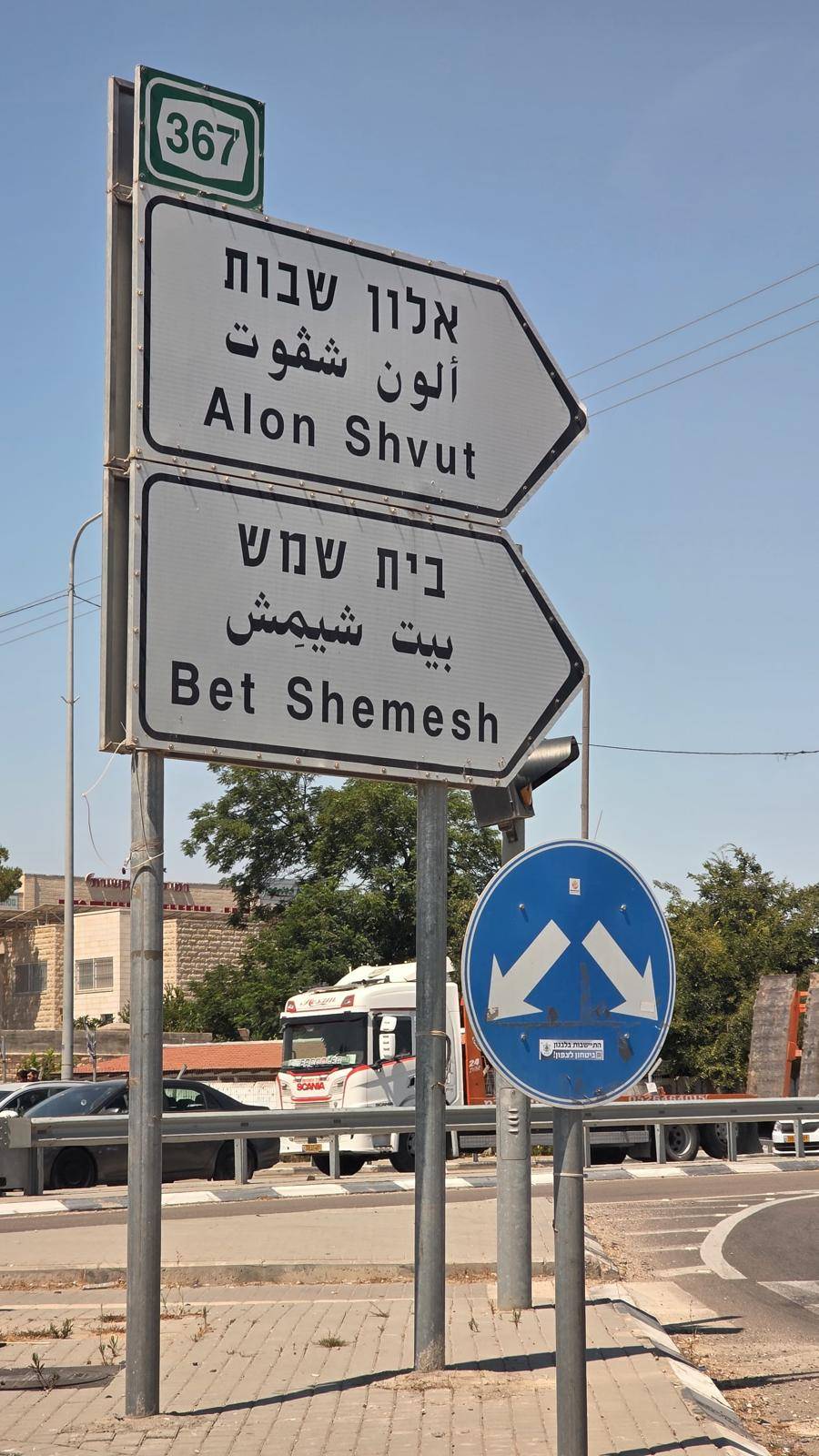
Before reaching the city of Hebron, about 35 kilometers south of Jerusalem in the West Bank, travelers on the fast bypass road known as Route 60 encounter numerous road signs directing people of different nationalities, religions and denominations to their destinations. Written in Hebrew, English and Arabic, the signs point to Palestinian and Israeli destinations, and sometimes places farther afield: Karmei Tzur, Halhul, Beit Ummar, Kiryat Gat, Al-Arroub refugee camp, Kiryat Arba, the Ibrahimi Mosque and others.
No Entry
Shortly before the city's main entrance, a large sign warns Israelis against entering Area A, which is designated off-limits and "dangerous" to them. Yet the warning ignores the fact that 500 settlers live within it, occupying the heart of the West Bank's largest city, its Old City, where they share streets, houses, shops, squares, balcony views and the Ibrahimi Mosque with Palestinian residents.
Every day, the settlers attempt to drive out their neighbors in a long and exhausting struggle that has become considerably more intense since October 7, 2023.
At the beginning of Shuhada Street, near the bustling Bab al-Zawiya district, known for its crowds and commercial activity, Israeli soldiers stand on alert. Their mission is to prevent Palestinians from entering the area, except for the few who still live in its old, dilapidated and surrounded houses and have refused to leave.
Even these residents face thorough searches every day as they enter and leave, treated as perpetual suspects.
Before and After October 7
Before October 7, we had entered the street after receiving permission from the soldiers. But just 100 meters farther along, a soldier stopped us and said we could go no farther because of our "Arab appearance," claiming he could not guarantee our safety.
Today, entry is prohibited from the very first meter.
Intersection in the city of Hebron (Asharq Al-Awsat)
We entered the Old City through other routes that remained open, only to find that many of its streets had been closed. We could not reach several areas, including Al-Sahla Street behind the Ibrahimi Mosque, which, like Shuhada Street, had been closed to all Palestinians except the few "troublesome" residents who still lived there.
Islam al-Fakhouri came out to meet us in streets that were not closed off, including the once-busy Laban Market, which stood deserted. Shops were shuttered, with no merchants, residents or shoppers in sight. The market is part of a network of interconnected streets in the Old City.
Al-Fakhouri told Asharq Al-Awsat that he prefers to leave his home only once a day before returning for the last time, to avoid the numerous humiliating and difficult procedures.
"They treat us as suspects all the time. Your name has to be on a special list, and you undergo a search when you leave and when you return. They check your identity documents before allowing you through," he explained.
Al-Fakhouri is among the few Palestinians who have remained in their homes on Al-Sahla Street, near the Ibrahimi Mosque, which lies at the center of the conflict for both Palestinians and Israelis.
He said he stayed because he could not accept the idea of abandoning his home and because he "does not want to leave it to them."
"If I leave the house, they will immediately take it over. That is exactly what they want. Everything happening here is designed to force us out of our homes. Why does the army make our lives so difficult? Why all these restrictions? Why do settlers attack us? Because they want the entire place," he said.
Al-Fakhouri described how he and other residents had repeatedly been subjected to attacks and assaults, but insisted that he would not give up.
"I'm not leaving, and I'm not giving up my home," he said.
His determination did not waver after October 7, even as the struggle to remain became more difficult and costly.
Since that date, settlers across the West Bank have intensified their hostile actions, carrying out deadly attacks across large areas, killing Palestinians, burning their homes, properties and places of worship, destroying crops, and seizing land, houses, hilltops and even livestock.
"After October 7, every settler became a government unto himself," Al-Fakhouri said.
"We used to move around more freely, and there was less friction. But after October 7, everything changed. They closed the gates and increased the checkpoints. Every movement here is now restricted. On top of that, we face constant attacks and assaults without any accountability or oversight. They attack homes and assault us in the streets. Every day there is a problem. Every single day."
Al-Fakhouri's account helps explain why large parts of the Old City have lost their residents and why so many shops remain closed.
A Battle That Began in 1978
The closures did not begin after October 7. They date back much further. The settlers' struggle is decades old, although it has intensified significantly since that date.
According to the Palestinian National Information Center, the first settlement outposts inside the Old City were established in 1978, when a group of settlers occupied the Al-Dabouya building in the city center. They later renamed it Beit Hadassah.
Following the well-known 1980 Al-Dabouya attack, Israeli authorities demolished dozens of homes to expand the strategically located settlement outpost.
In 1983, another outpost, known as Beit Romano, was established near the Al-Dabouya building after settlers took control of the Osama ibn Munqidh School, claiming it was Jewish property.
In 1984, a new settlement outpost, Avraham Avinu, was established on an archaeological site in Tel Rumeida. Israeli authorities also closed the Old City's central vegetable market, which was later handed over to settlers to establish another outpost. Other outposts included Beit Chason and Beit Schneerson.
The Palestinian National Information Center said Israel was seeking to take control of the area and expand the settlement outposts. To achieve this, it said, Israeli authorities had adopted discriminatory policies against Arab residents, installing dozens of barriers and checkpoints and completely closing certain streets and markets in an effort to pressure residents into leaving.
The center estimated that approximately 1,829 commercial establishments had closed, including 520 shut by specific military orders. The remainder were closed by their owners because roads had been blocked and barriers and checkpoints installed throughout the narrow streets.
Residents of the Old City whom we met briefly said the struggle with settlers was longstanding but had intensified during two pivotal periods: after the Second Intifada in 2000 and following October 7, 2023.
To date, most of the Old City's 40,000 residents have left.
The Ibrahimi Mosque, Just a Stone's Throw Away
The Ibrahimi Mosque, which Palestinians describe as the oldest sacred site in the world, was just a stone's throw away.
As we approached, signs of life began to emerge. A handful of shops were open, with artisans and craftspeople displaying jewelry, pottery, wood carvings, maps of Palestine, embroidered items, decorated mugs, incense and Turkish delight produced in an exceptionally old factory, one that predates the occupation itself.
One shop window featured a portrait of the late Palestinian poet Mahmoud Darwish painted on a piece of mother-of-pearl, accompanied by his famous words: "On this earth, there is what makes life worth living."
Beside it was a portrait of the Lebanese singer Fairuz, with the lyrics "I belong to my beloved, and my beloved belongs to me." Other pieces of pottery seemed almost disconnected from the present moment.
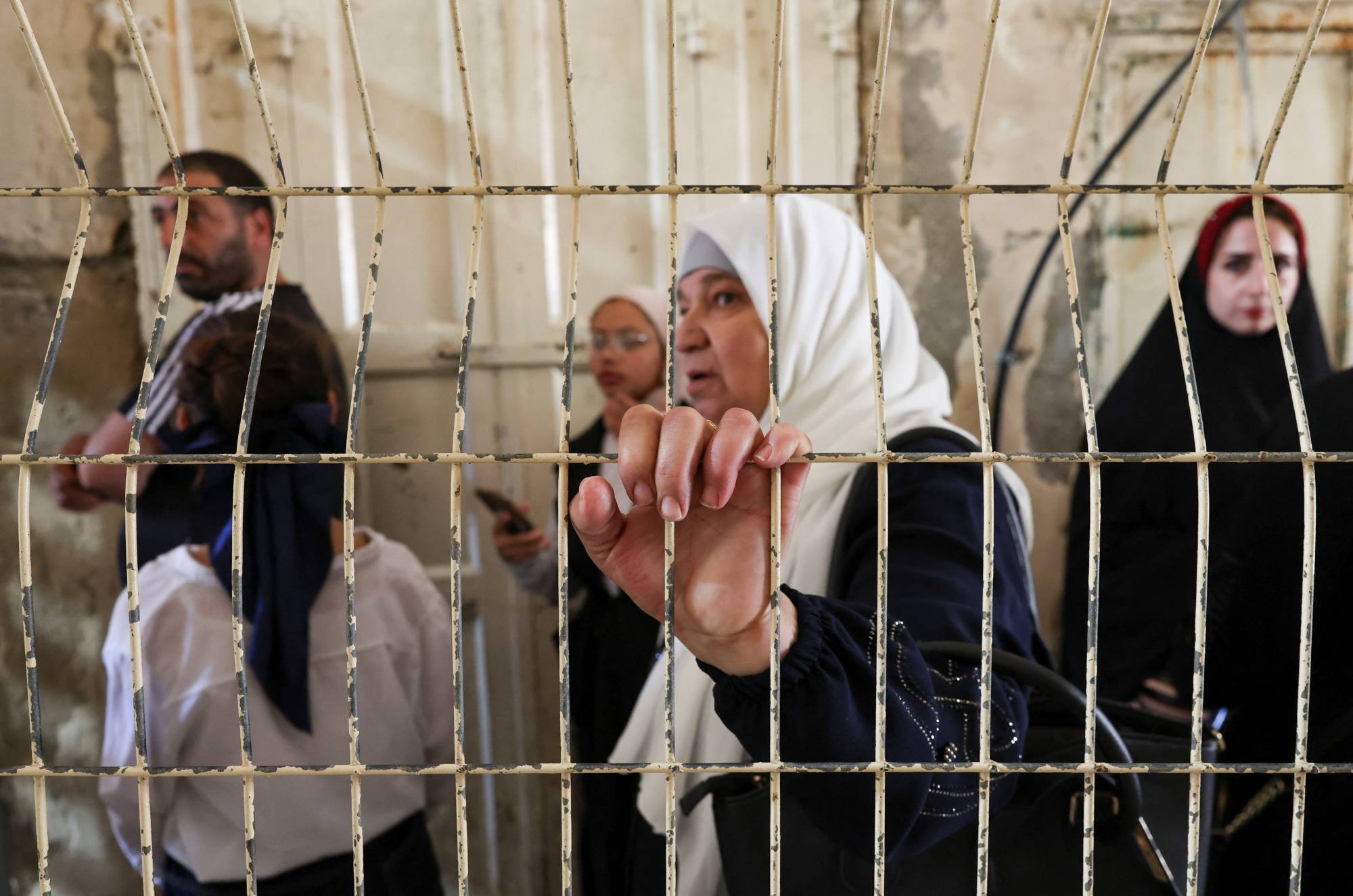
But across from the Ibrahimi Mosque, an armed Israeli soldier stood alert behind security gates, monitoring those who wished to pray and allowing them through only when a green light appeared.
We passed through turnstiles, which Palestinians sarcastically call "the wringers," and then electronic security gates. A soldier checked each person's identification before we proceeded to security booths under surveillance cameras and the watch of armed guards. There, a female soldier inspected our identification documents once again before permitting us to enter the mosque.
The few steps felt more like crossing an international border or entering a defense ministry headquarters than approaching a mosque for prayer.
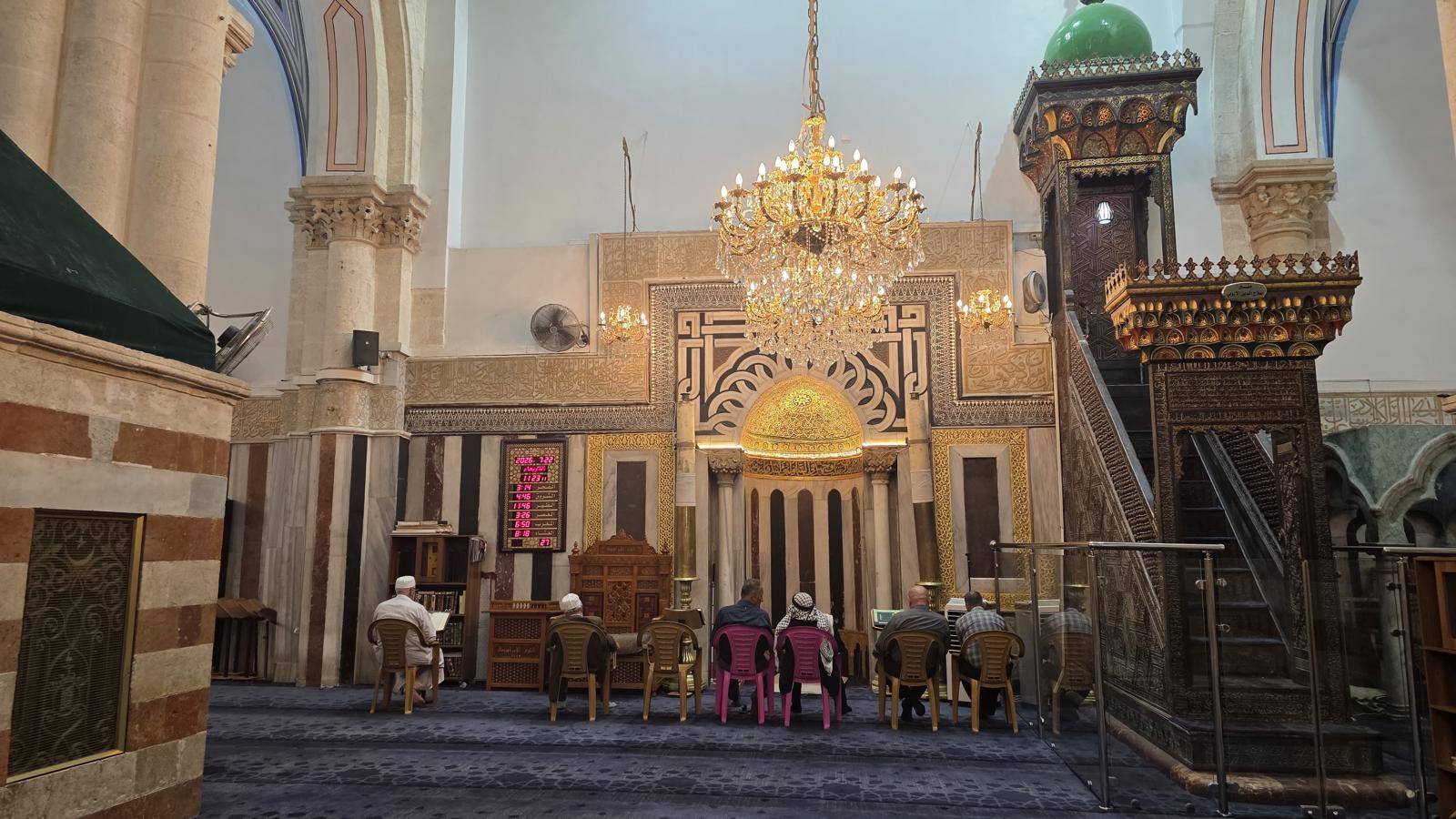
The site, deeply sacred to Muslims, retained its solemn atmosphere, but only a few worshippers were present.
Some visitors were entering for the first time in their lives. They examined the tombs of the prophets with astonishment, discovering ancient corners of the building under the watchful eyes of Israeli cameras.
Cameras were everywhere. Wherever you turned, another camera recorded every movement and every word.
Palestinians wait at an Israeli checkpoint as they head for prayer at the Ibrahimi Mosque, also known as the Cave of Patriarchs, in the old city of Hebron, in the Israeli-occupied West Bank, June 17, 2026. REUTERS/Ammar Awad
Mosque Director: They Instill Fear in Us
Sheikh Mutaz Abu Sneineh, director of the Ibrahimi Mosque, was reluctant to give us a tour, even without cameras or filming, for fear that Israeli forces might use it as a pretext to enter the site.
We had, of course, arrived without cameras or microphones, since bringing such equipment would have meant hours of questioning and waiting for approvals that might never come.
Israeli authorities had expanded the mosque's surveillance system to cover every corner with audio and video recording. They had also compelled the mosque administration to install designated pathways over the carpets so soldiers could enter the mosque quickly at any time.
"You can see for yourself. Anyone entering here feels as though they are entering a military barracks, under surveillance," Abu Sneineh told Asharq Al-Awsat.
"Checkpoints, gates, thorough inspections, searches and identity checks. These are daily procedures imposed on everyone entering the Ibrahimi Mosque, and people are sometimes subjected to humiliation and degrading treatment.
"That includes the mosque's custodians, employees and administration. Everyone who enters this place is under intense audio and video surveillance."
For the mosque director, these measures are part of a broader policy intended to impose a new reality, empty the mosque of worshippers and turn it into a place for Jews.
The mosque was indeed largely empty, and Abu Sneineh confirmed that conditions had changed dramatically since October 7, to the point that Palestinians under the age of 25 were now completely prohibited from entering.
"They instill fear and terror in those who come here," he said.
Worshippers inside the Ibrahimi Mosque (Asharq Al-Awsat)
Division by Time and Space
Another section of the mosque remained entirely off-limits to us, much like parts of the Old City.
Following the 1994 Ibrahimi Mosque massacre, in which Baruch Goldstein, an Israeli army doctor and settler, killed 29 Muslim worshippers, Israel took control of 63 percent of the mosque and designated it exclusively for Jewish use.
Goldstein was an activist in the extremist Kach movement, founded by Meir Kahane.
"Sixty-three percent has been off-limits to Muslims ever since," Abu Sneineh said.
Behind a separating door, Jewish religious prayers and noisy celebrations take place, accompanied by the blowing of the shofar.
Muslims are allowed into that section on only ten days each year, including Fridays during Ramadan, Laylat al-Qadr, Eid al-Fitr, Eid al-Adha, the Prophet Muhammad's birthday, the anniversary of the Hijra and the commemoration of Isra and Mi'raj.
Conversely, Muslims are entirely barred from the mosque for ten days associated with Jewish religious holidays.
This arrangement is known as the division of the site by time and space, a model Palestinians fear could also be imposed at Al-Aqsa
Mosque in Jerusalem.
The muezzin rose to lead the call to prayer before the small congregation, having previously been prevented from reaching his room, which is located in the section controlled by Israeli authorities.
He had also been prohibited from broadcasting the call to prayer through loudspeakers outside the mosque.
Previously, the muezzin had to wait for Israeli soldiers to arrive and escort him to his room. After issuing the call to prayer, he would leave under their escort, completing a short journey fraught with danger.
Even this arrangement does not apply to every prayer. He is barred from reaching the room during specified periods on Saturdays and Fridays and at certain hours of the night.
Shared Tombs and a Battle Over Historical Narratives
The tombs of Abraham, Jacob, Isaac and Joseph were among the most visited places and popular spots for commemorative photographs.
Jews regard these tombs as evidence that the site belongs to them as well. The conflict here is therefore not only about occupation, but also about competing historical and religious narratives and the identities they represent.
"They are trying to erase our narrative and identity," Abu Sneineh said.
"They say this place is theirs. We say it is an exclusively Islamic site. They believe they are descended from Abraham and claim that, as descendants of his son, they have a right to this place. But we have a greater claim to the prophets. Abraham was not Jewish."
The mosque director's account reflects the Palestinian and Muslim narrative, but it is not accepted in Israel.
Israelis also revere the Ibrahimi Mosque, which they call the Cave of the Patriarchs, or the Cave of Machpelah, because it contains the burial place of the Prophet Abraham and his wife Sarah in a cave beneath the present building.
Smotrich Declares Mosque 'Sovereign Property'
Shortly after our visit, far-right Israeli Finance Minister Bezalel Smotrich visited the Ibrahimi Mosque and declared it the "first sovereign property of the Jewish people."
At the site, where he had come to inaugurate the roofed areas previously mentioned by Abu Sneineh, Smotrich asserted that the mosque would forever remain a symbol of Israeli sovereignty in the West Bank.
Israel's Channel 14 reported that Smotrich, who presided over an event marking the completion of extensive roofing and restoration work at the site, was taking a historic step following his earlier decision to terminate the Hebron agreements and withdraw the Palestinian municipality's relevant powers in Hebron's Old City.
Smotrich had announced last June the cancellation of the Hebron Agreement governing the city, which he calls the land of the patriarchs.
Speaking at a ceremony inaugurating the new Doron settlement in the Hebron Hills at the time, he said:
"We have canceled the Hebron agreements. For many years, one of the most absurd provisions of Oslo remained in effect, under which authority over Jewish settlements in Hebron and the holy sites was granted to the Hebron municipality."
The decision announced by Smotrich, following its approval by the Higher Planning Council of the Israeli military's Civil Administration, stripped the Hebron municipality of its planning and construction powers in Area H2, which includes the Old City.
Hebron Turns the Page on Oslo
Hebron is the only Palestinian city in the West Bank to have been subject to a special agreement in 1997 that divided it into two areas, H1 and H2.
Known as the Protocol Concerning the Redeployment in Hebron, the arrangement followed the 1995 Oslo II Accord and the Israeli-Palestinian peace process launched under the Oslo Accords in 1993.
Under the Hebron agreement, Israel withdrew its forces from Area H1, which accounts for approximately 80 percent of the city, and the Palestinian Authority assumed responsibility for security and civilian affairs there.
In return, Israel retained security control over Area H2, comprising the remaining 20 percent of the city, including the Old City, the Ibrahimi Mosque and the Jewish settlement in Hebron, while civilian powers were transferred to the Palestinian Authority.
"This is much more than a planning measure. It is a historic correction," Smotrich said.
"We are continuing the settlement revolution, strengthening governance and deepening Israeli sovereignty in Judea and Samaria," he added, using the Israeli term for the West Bank.
According to Smotrich, the measure applies to all religious and historical sites in Hebron.
In effect, the move marked the end of the Oslo era in the Old City, at the heart of Hebron.
Palestinians rejected the decision. The Palestinian presidency warned of its dangers, saying it undermined Hebron's political and legal status and the bilateral agreements signed concerning the city.
Hebron's municipality also rejected the move and said it would not accept it.
On the ground, however, a different reality has emerged. Israel now exercises greater control over virtually everything in central Hebron, including the Ibrahimi Mosque.
Just one day after Smotrich announced the "cancellation of the Hebron agreements," a major construction project for a Jewish religious school near the mosque was approved.
Israel's Yedioth Ahronoth newspaper reported that the project had been approved without requiring authorization from the Palestinian municipality, for the first time in decades.
Speaking at the Ibrahimi Mosque during a celebration marking the roofing work, Smotrich said:
"The Cave of Machpelah, the Ibrahimi Mosque, is the first sovereign property of the people of Israel. The place purchased by our forefather Abraham has become a symbol of our sovereignty over this land."
Visits to Preserve Historical Memory
But not everything can be imposed by force.
Outside the main prayer hall, a group of schoolchildren was visiting the mosque as their teachers explained its history, religious significance and the massacre that took place there.
Teacher Sharifa Dweik told Asharq Al-Awsat that she had decided to take the risk of bringing the children to the mosque after realizing they knew almost nothing about it.
The children were excited, as though embarking on an adventure. They eagerly described how they had passed the soldiers without being searched and said they would return.
Dweik said it was essential for the children to visit a place that, in her view, Jews wanted every Palestinian to forget.
Hajj Abdulaziz Abu Haltam said he had traveled from the distant town of Tarqumiya to visit the mosque and the Old City.
"I don't come often because of the risks and the long hours of waiting. But I decided to take the chance, and I really did spend a long and exhausting time waiting before reaching the mosque," he told Asharq Al-Awsat.
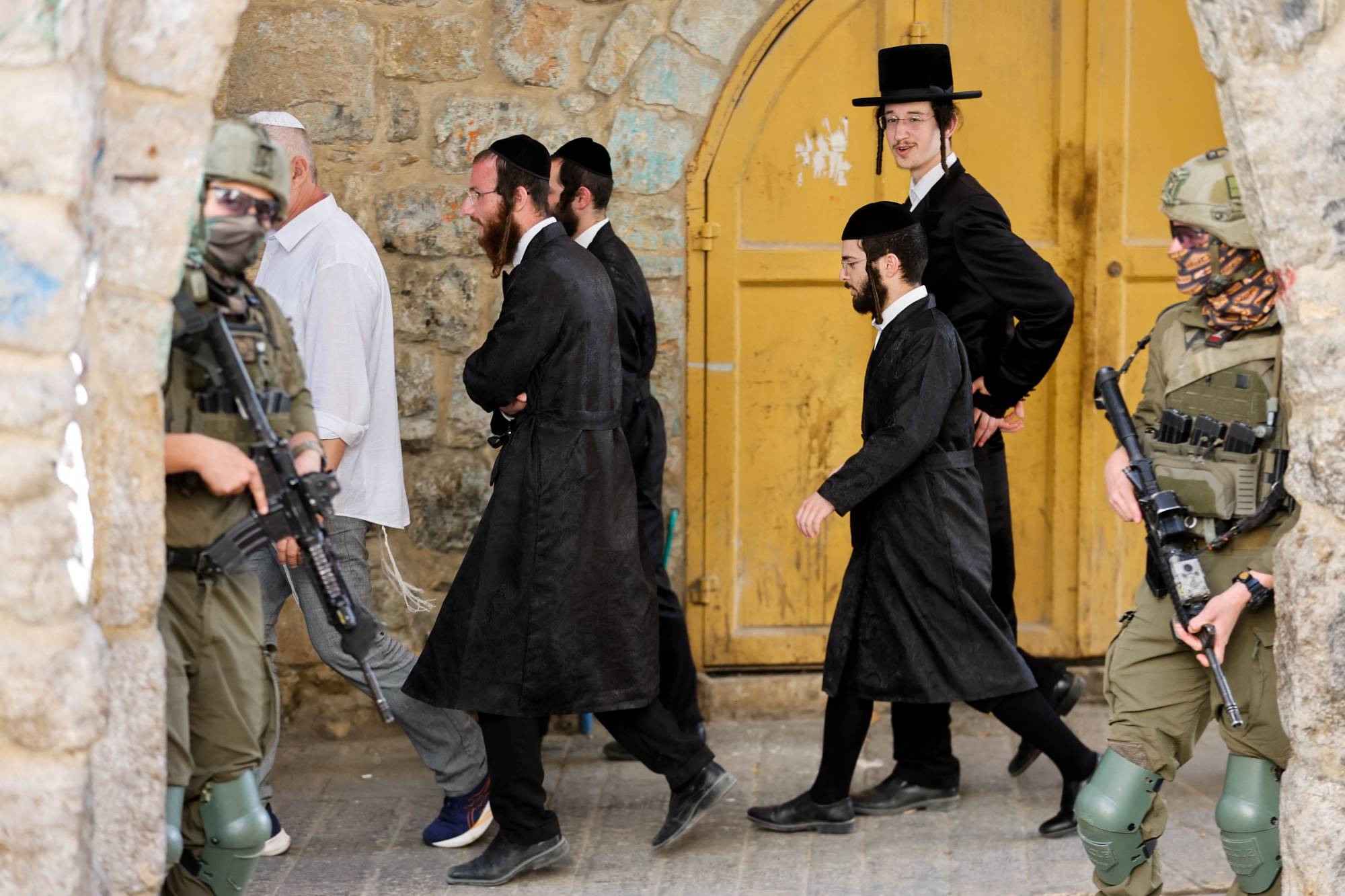
Jewish visitors face none of these difficulties. Instead, they arrive accompanied by extensive security protection in what is presented as an effort to emphasize the site's Jewish identity.
Approximately 1,500 Israeli soldiers guard the 500 settlers living in central Hebron.
Israeli flags also surround the walls of the Ibrahimi Mosque, another attempt to reinforce the Israeli narrative through visual symbols wherever possible.
Many of these flags can also be seen throughout large parts of the city's Arab neighborhoods.
Israeli soldiers stand guard during a weekly settlers' tour in Hebron, in the Israeli-occupied West Bank, May 16, 2026. REUTERS/Mussa Qawasma
Neighbors and Enemies
From a vantage point overlooking an area not far from the mosque, the extent to which the two communities occupy the same spaces in large parts of the Old City was striking.
Jewish settlers live above shops that once belonged to Arabs, while only walls separate their homes from those of Palestinians.
Before October 7, when Palestinians were still able to open their shops, shopkeepers had been forced to install wire mesh above the street to protect themselves from objects thrown down by settlers living overhead.
Today, all those shops have closed.
While settlers in Beit Avraham, Beit Hadassah, Beit Romano and Tel Rumeida enjoy extensive protection, many Palestinians have been killed in the area over previous years on allegations that they had stabbed, or intended to stab, soldiers and settlers.
Despite this, Mahmoud Mahamra has refused to leave his home, behind which a tightly secured wooden gate has been installed to separate it from Shuhada Street.
Israeli authorities wanted to prevent any possible contact.
That gate was part of a wider network of barriers closing off Old City streets, alongside checkpoints and security cameras.
Mahamra, who describes himself as the closest Palestinian neighbor to the settlers in his area, said he lives in constant anxiety, which has turned into a nightmare since October 7.
"They always used to harass us, but after October 7, life became unbearable," he told Asharq Al-Awsat.
He recalled a period of relative prosperity before the Second Intifada, although it did not last long.
"We used to live alongside one another. There was life here. But not anymore," he said.
Standing on the roof of his home, Mahamra looked out over neighborhoods that had once been entirely Arab and were now entirely Jewish.
Settlers take over homes and raise Israeli flags above them.
Yet Mahamra has no intention of leaving.
"I'm not leaving this place," he said.
"We are not leaving" has become a slogan embraced by Palestinians across the West Bank. But not everyone is able to live up to it, as they face what the article describes as the most extreme Israeli government and the most violent settlers in the history of the conflict.
The Israeli government is now working to implement what is known as the Decisive Plan, which is based on the premise that the territory between the Jordan River and the Mediterranean Sea has room for only one legitimate national claim: the Zionist claim to full Jewish sovereignty.
Israeli human rights organization B'Tselem has accused Israel of implementing a series of simultaneous policies in the West Bank as part of a broader project aimed at erasing Palestinians as a people.
All of this is unfolding today in Hebron's Old City. For Israel, Hebron may represent a rehearsal for what could happen across the rest of the West Bank.
We left the mosque and the Old City, passing one of the oldest shops, where a large map of Palestine was displayed.
Inscribed on it were Mahmoud Darwish's familiar words:
"She used to be called Palestine. And she is still called Palestine."
Sudan’s Day Laborers Struggle to Survive as War Devastates Livelihoodshttps://english.aawsat.com/features/5329643-sudan%E2%80%99s-day-laborers-struggle-survive-war-devastates-livelihoods
Sudan’s Day Laborers Struggle to Survive as War Devastates Livelihoods
Farmers harvest arugula in Khartoum on Oct. 5, 2026. (AP)
In Khartoum, where life is struggling to regain its rhythm after years of war, many doors remain closed to day laborers who once lived on each day's earnings.
A day without work can leave a family without food, a child without money for school or a patient forced to stop treatment because medicine is out of reach.
On sidewalks, in markets and at workshops, day laborers search for any job to get them through the day. More people are competing for fewer jobs, while rising prices and a weakening Sudanese pound erode their wages.
As the gap between earnings and living costs widens, many face a stark choice: accept less pay or go home empty-handed.
Compounding burdens
Labor unionist Abdullah Youssef says the vast majority of workers "lost their jobs because of war, displacement and homelessness." Daily work available before the war is now scarce.
Most workers support families with five or six children at different stages of schooling, he told Asharq Al-Awsat. Economic hardship has pushed some families into debt. Some people have been jailed for failing to meet their financial obligations.
For day laborers, a wage is measured not just in hours worked but in the needs of an entire family. With food and service prices climbing, their earnings have lost much of their purchasing power before they reach home.
Babiker Khalifa, a day laborer and father of three, says the war "destroyed the economy." His family gets by mainly on small meals of fava beans and lentils. Meat, fruit and vegetables are beyond their reach much of the time.
His children need money each day for school, but there is not enough food at home to meet their needs, he told Asharq Al-Awsat. On some nights, they "cry from hunger."
Babiker al-Taher faces much the same hardship. He fled to Gedaref after the war broke out, then returned to Khartoum to find even harsher economic conditions.
"Sometimes we eat, and other times we don't," he said of his family, which includes four children. Rising prices and inflation have sharply cut the real value of a day laborer's pay.
With more people seeking work, laborers often have to accept lower wages to avoid returning to their families empty-handed, he said.
“We need a miracle”
Even tradespeople and craftspeople still in work face shrinking purchasing power and rising living and production costs.
Abdul Karim Ibrahim, a tailor supporting two sons and two daughters, says his daily earnings no longer meet his family's needs.
The economic situation "needs a miracle," he said. Food is now unaffordable for many families, and medical treatment adds to the burden.
Young barber Othman Ali says rising prices and a weakening currency have left his income insufficient for basic needs.
Long power outages and disruptions to the banking apps his customers use for transfers also make it harder to collect payments.
The war forced Ali to leave secondary school and work to help support his large family. He is part of a generation whose education has paid a direct price for the conflict.
The war is no longer the only source of pressure on citizens, Youssef said. Higher levies and fees, a higher exchange rate used to calculate customs duties and bans on some imported goods have compounded the strain and widened the gap in markets, he said.
He called for higher wages and better conditions for pensioners. Some employees receive very little pay, while some retirees receive sums that do not reflect their years of service, he said.
Youssef urged the government to act quickly to help workers and their families. The persistent gap between wages and prices is leaving millions of families facing severe hardship, he said.
“The most vulnerable”
Day laborers are among those hardest hit by Sudan's war, economist Mohammed al-Nayer said. Halted construction and declining craft activity have stripped large numbers of their livelihoods.
"These groups face extremely difficult living conditions amid lost job opportunities and unprecedented increases in the prices of goods and services, alongside a decline in the national currency's value and rising inflation, unemployment and poverty," he told Asharq Al-Awsat.
A comprehensive reconstruction program could employ large numbers of day laborers in construction and related activities, he said. But they remain among the hardest hit as their sources of income remain disrupted.
Al-Nayer said the state must fulfill its responsibility to protect vulnerable and poor people. He called for a comprehensive social protection program to address current economic challenges and support those most affected by the war.
These accounts echo International Labor Organization warnings about the war's deep impact on Sudan's labor market: lost jobs, shrinking economic activity and disrupted livelihoods. Workers in the informal economy are among the most vulnerable.
Olive Trees in S. Lebanon Under Israeli Fire: Deprivation of Harvest Seasons Erodes Village Memoryhttps://english.aawsat.com/features/5329008-olive-trees-s-lebanon-under-israeli-fire-deprivation-harvest-seasons-erodes
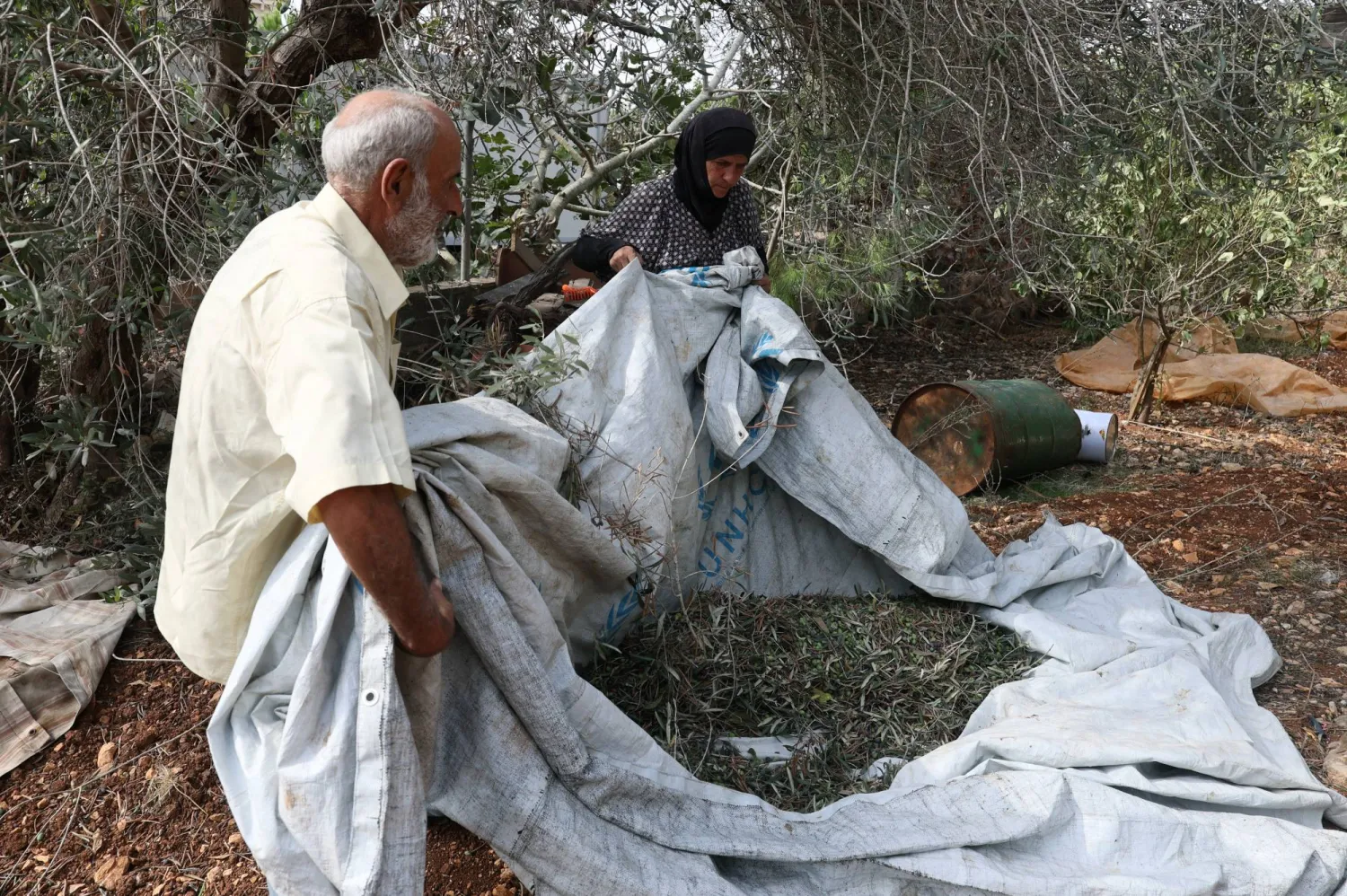
Lebanese farmers pick olives in the southern Lebanese village of Zawtar al-Gharbiyah, near the neighboring village of Zawtar al-Sharqiyah, where Israeli forces are stationed, in southern Lebanon, 10 October 2026. EPA/WAEL HAMZEH
Olive Trees in S. Lebanon Under Israeli Fire: Deprivation of Harvest Seasons Erodes Village Memory
Lebanese farmers pick olives in the southern Lebanese village of Zawtar al-Gharbiyah, near the neighboring village of Zawtar al-Sharqiyah, where Israeli forces are stationed, in southern Lebanon, 10 October 2026. EPA/WAEL HAMZEH
The killing of a retired Lebanese Army chief warrant officer by Israeli tank fire in Yater has underscored the perilous reality for southern farmers. Targeted while inspecting his home and olive grove, his death has turned this year's harvest season into a stark symbol of the dangers facing those attempting to reach their land.
The incident comes as residents of border villages continue to be deprived of their harvests for nearly three years. It also coincides with a lawsuit filed in France accusing the Israeli military of uprooting around 600 ancient olive trees in Zawtar al-Sharqiyah. Local officials warn of economic and social repercussions that extend far beyond the loss of crops.
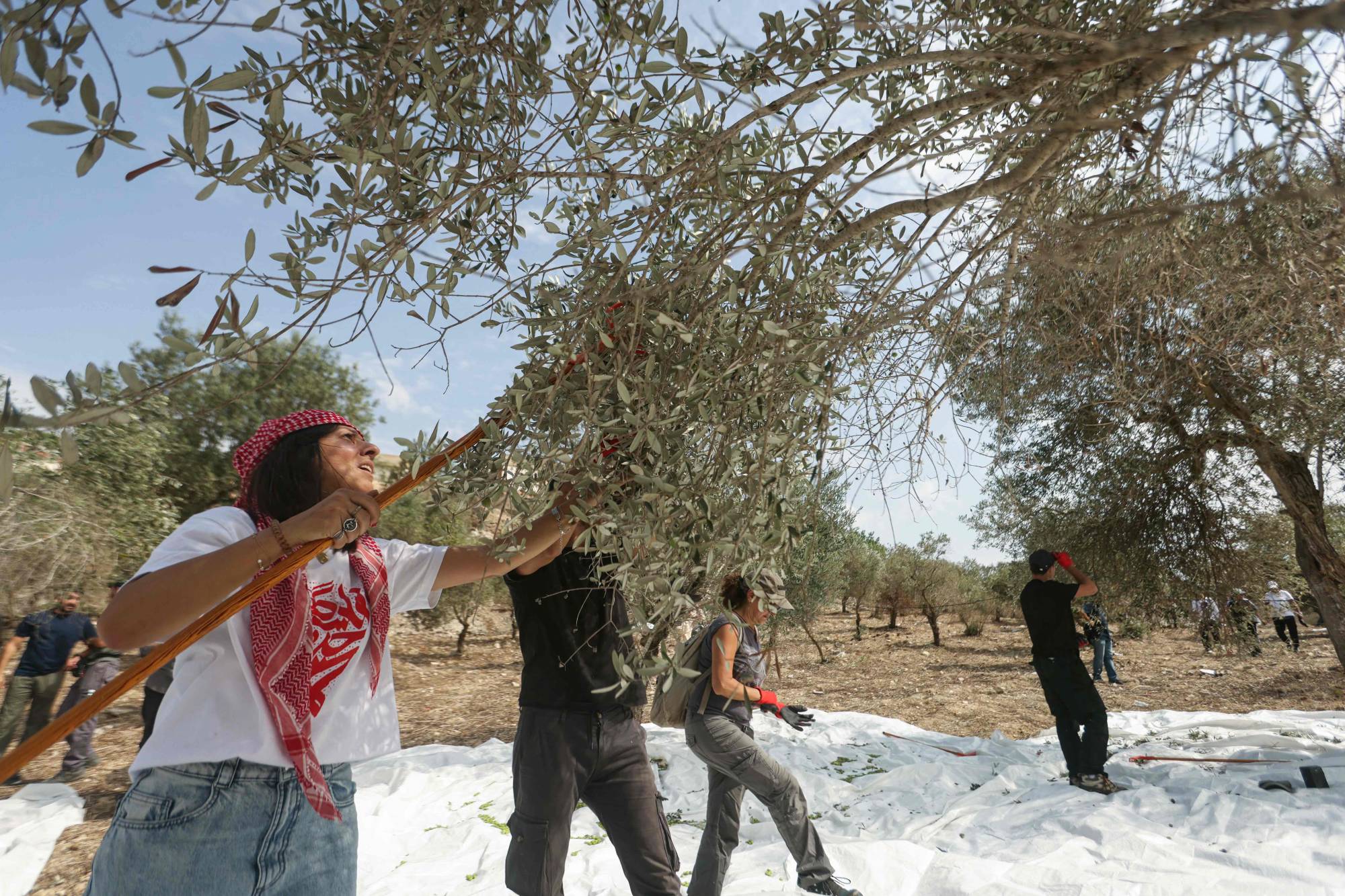
Volunteers from Lebanon's northernmost province of Akkar and the city of Sidon take part in an olive-picking initiative in the southern Lebanese village of Jibshit near Nabatieh on October 11, 2026, in a show of solidarity with Southern Lebanon and its farmers. (Photo by MAHMOUD ZAYYAT / AFP)
Targeted While Inspecting His Land
The Lebanese Army announced on Sunday the death of retired Chief Warrant Officer Ali Abdel Hassan Sweidan after being directly targeted by Israeli tank fire while inspecting his property in Yater in the Bint Jbeil district.
The army said a military unit supervised the recovery of his body after contact with him was lost. The municipality of Yater stated that he had been checking on his home and olive grove on the outskirts of the town when he came under fire from the direction of Sarbine, warning residents against approaching unsafe areas.
The incident once again highlights the obstacles facing farmers during a season when families traditionally head to their groves to gather their harvests, as access to parts of agricultural land has become fraught with ongoing security risks.
600 Trees at the Center of a Lawsuit
In Paris, a 37-year-old French businessman of Lebanese origin filed a complaint against unknown persons on September 22, accusing the Israeli military of uprooting roughly 600 olive trees from his family's land in Zawtar al-Sharqiyah.
According to his lawyers, cited by Agence France Presse (AFP), some of the trees are approximately 500 years old, while the family has cultivated the land for about 250 years.
The complaint includes allegations of theft, destruction, and damage to property as potential war crimes. The complainant suspects that the trees were transported to Israel, though this has not been established judicially. He stated that his family home was destroyed in an Israeli strike in April, before the trees were uprooted following Israeli control of the area.
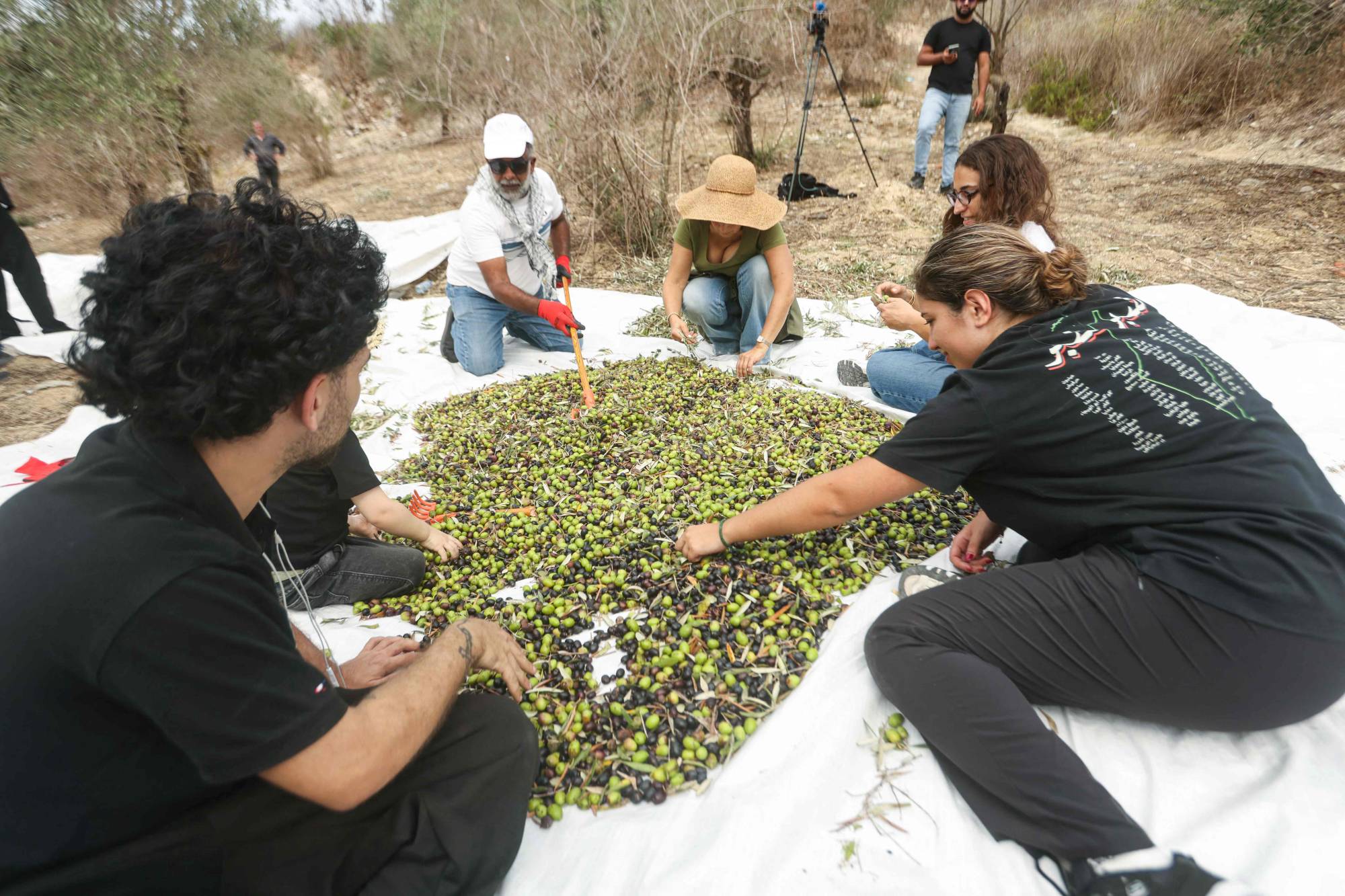
Volunteers from Lebanon's northernmost province of Akkar and the city of Sidon sort olives during an olive-picking initiative in the southern Lebanese village of Jibshit near Nabatieh on October 11, 2026, in a show of solidarity with Southern Lebanon and its farmers. (Photo by MAHMOUD ZAYYAT / AFP)
Half the Fields Out of Reach
Hanna Al-Amil, head of the municipality of Rmeish, told Asharq Al-Awsat that since the beginning of the war nearly three years ago, residents have been deprived of access to a large part of their olive fields “because most of them lie along the border, where security conditions do not permit locals to reach them and harvest their crops.”
“Even today, we do not know whether we will be able to harvest olives this year, especially since the season has not yet started and security risks continue to prevent access to the land."
He explained that roughly three-quarters of Rmeish's territory lies along the border and that more than 50 percent of its olive groves have remained unharvested for the past three years.
This deprives families of a basic source of income, he added.
Al-Amil stressed that agricultural losses are not limited to olives but also affect tobacco cultivation, the town's primary agricultural activity. "This year's tobacco production reached only about 60 percent of pre-war levels, meaning families have lost a significant portion of the income on which they relied."
A Memory Shared by Families and Generations
Mohammad Ismail, head of the municipality of Zawtar al-Sharqiyah, told Asharq Al-Awsat that the town's olive groves are “more than just trees or a source of income. They are heritage, history, and the memories of generations. They embrace the hills and fields, shade the alleys of Zawtar, and provide cool breezes that ease the summer heat."
He noted that olive trees also provide heating wood for many residents.
According to Ismail, the olive harvest is an annual occasion that brings entire families together. "Not merely to gather the crop, but to renew their connection to the land and to the ancestors who planted and cared for these trees, keeping a shared memory alive across generations."
"Today, the occupier seeks to strip us of our spirit and sever our connection to history, our ancestors, and life itself. It seeks to erase the traces of life from our hearts and minds and wipe away its fragrance from our memory,” he said.
"What is happening is not merely the uprooting of trees. It is the uprooting of hearts from chests and an attempt to erase the people's memory and their bond with the land,” he added.
Olive Trees as Part of Southern Identity
Ibrahim Sweidan, deputy head of the municipality of Yater, told Asharq Al-Awsat that "olive groves have become part of the identity of southern Lebanon. For southerners, the olive tree is not merely a tree but part of who they are and their attachment to the land."
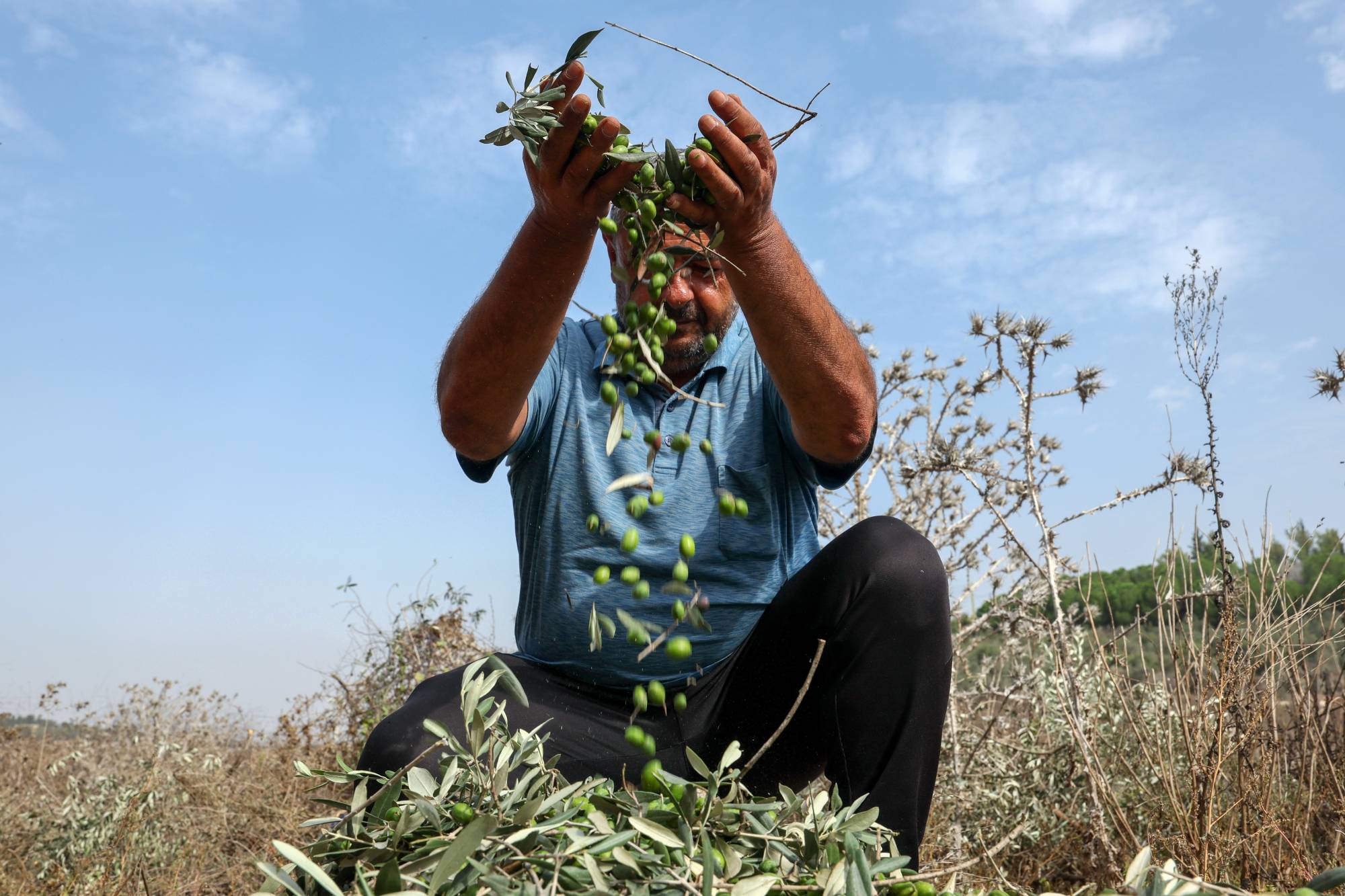
A Lebanese farmer shows harvested olives in the southern Lebanese village of Zawtar al-Gharbiyah, near the neighboring village of Zawtar al-Sharqiyah, where Israeli forces are stationed, in southern Lebanon, 10 October 2026. EPA/WAEL HAMZEH
He said the strongest evidence of that attachment is the return of residents to their villages and homes despite difficult security conditions and their determination to remain on their land.
According to Sweidan, attacks on agricultural land, public facilities, and homes all form part of the same pattern: "A strategy aimed at undermining the foundations that allow people to remain in their villages and weakening everything that connects southerners to their land and identity."
لم تشترك بعد
انشئ حساباً خاصاً بك لتحصل على أخبار مخصصة لك ولتتمتع بخاصية حفظ المقالات وتتلقى نشراتنا البريدية المتنوعة