
Killing of Palestinian Children and Teens by Israel Surges in West Bank

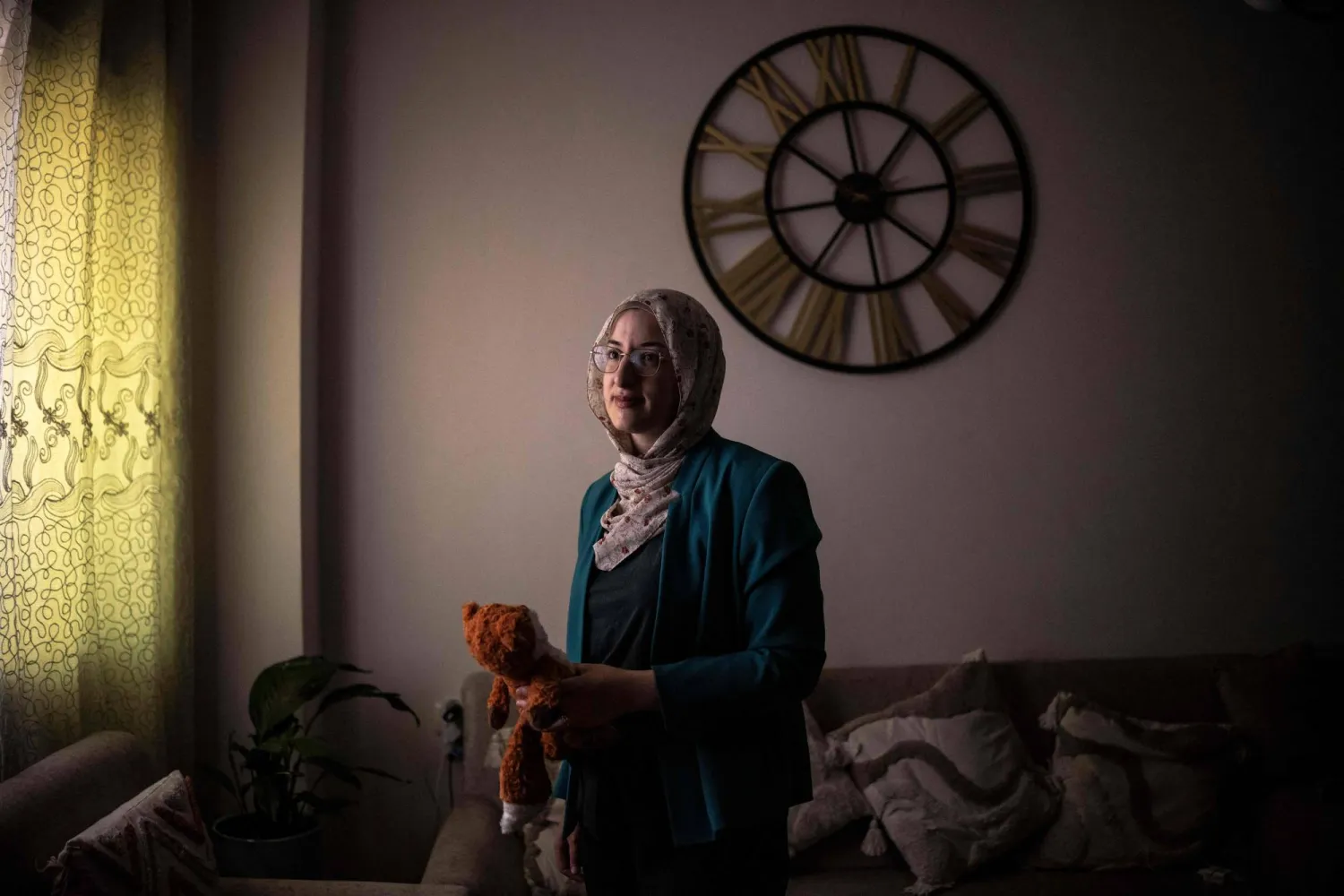
This photo taken on August 7, 2026 shows Palestinian woman Dania Abu Haikal, mother of seven-month-old Sam, who was killed by Israeli forces whilst sitting on his mother's lap in the car, stands for portrait while holding her late son's teddy bear in Bethlehem, in the Israeli-occupied West Bank. (AFP)
TT

Killing of Palestinian Children and Teens by Israel Surges in West Bank

This photo taken on August 7, 2026 shows Palestinian woman Dania Abu Haikal, mother of seven-month-old Sam, who was killed by Israeli forces whilst sitting on his mother's lap in the car, stands for portrait while holding her late son's teddy bear in Bethlehem, in the Israeli-occupied West Bank. (AFP)

Alia al-Hallaq's son Mohammed was nine when he was killed by an Israeli army bullet last October, but the Palestinian homemaker still speaks of herself as a mother of five, not four.

"I still haven't accepted the idea of the loss. I often sit in the courtyard of the house and look at Mohammed's grave below, and I cry while making sure that my children don't see me," she told AFP.

She said Mohammed was killed after running away from soldiers patrolling their village of Al-Rihiya, in the south of the occupied West Bank.

Hallaq's uncle, also named Mohammed Hallaq, told AFP that his nephew was killed by a stray bullet during a confrontation between the army patrol and a group of older youths.

The bullet travelled through Mohammed's abdomen, according to emergency services.

"Mohammed's killing was the end," his mother said.

The Israeli military, contacted by AFP for comment on Mohammed's death, said at the time that soldiers opened fire during an altercation while deployed in Al-Rihaya.

"Soldiers responded with fire toward the suspects in the rock-hurling. Hits were identified," it said, using language it generally employs to say troops shot and hit someone.

The killing of Palestinian children and teenagers by Israel has become increasingly common since the start of the war in Gaza.

B'Tselem, an Israeli rights group, reported 235 children and teenagers killed by Israeli forces in the West Bank since October 7, 2023 -- when Hamas launched a massive attack on Israel from the Gaza Strip -- through June 2026, including five killed by Israeli settlers.

The Palestinian Authority's Colonization and Wall Resistance Commission, a Palestinian government institution, reported 250 such deaths over the same time period.

In the 17 years between 2005 and 2021, an average of roughly one Palestinian child or teenager was killed by Israeli forces every month, according to B'Tselem, a frequent but much lower rate.

For the period since the October 7 attack, the average using B'Tselem figures is around seven killed per month.

- Bullets for stones -

AFP spoke to 12 women who lost children since October 7, 2023.

Although the details of each case differ, all spoke of family life stopped in its tracks and a lack of accountability.

Last year, of the 54 Palestinian children or teenagers killed according to B'Tselem, the youngest was just two years old, while the majority were aged between 14 and 17.

Teenagers are often killed when Israeli forces engage with Palestinian youths throwing rocks, whom they routinely label terrorists, and shoot them.

The Israeli military commander for the West Bank, Major General Avi Bluth, said in early 2026 that the army had killed 42 Palestinians for throwing stones in 2025, not specifying how many were minors.

In several other cases, usually involving younger children such as Mohammed, witnesses said the army had fired indiscriminately at Palestinians and killed children who were present.

One such casualty was seven-month-old Sam Abu Haikal, shot in the face by Israeli troops in the West Bank city of Hebron in June 2026.

- 'Palestinians don't get justice' -

His mother, Dania Abu Haikal, 28, told AFP she was also wounded when the troops fired at their car while Sam was on her lap, with a bullet entering through her cheek and exiting through her ear.

She bore a large scar on her face when she met with AFP at her home in Bethlehem, holding a stuffed fox that had belonged to her son.

"Why would anyone shoot an infant? What did a little baby, a seven-month-old infant, do to harm the soldiers?" Abu Haikal, a university lecturer, said.

After a preliminary investigation, the army said one of its soldiers had opened fire on "uninvolved civilians" after their vehicle accelerated in the direction of the troops.

Abu Haikal disputes this, and said her husband had brought their car to a stop before the soldiers started shooting.

She carries the agony of losing her only child on top of the physical pain from the shooting.

"I cry every day; now my life is empty without him," she said.

Like others whom AFP spoke to, Abu Haikal consulted a lawyer to push the army to investigate the incident fully.

"Palestinians don't get justice for being killed by Israelis. But we hope that we get justice."


Data Center Backlash Scrambles US Midterm Politics

In an aerial view, the Stargate Oracle AI data center campus is seen on August 26, 2026 in Abilene, Texas. (Getty Images/AFP)
TT

Data Center Backlash Scrambles US Midterm Politics

In an aerial view, the Stargate Oracle AI data center campus is seen on August 26, 2026 in Abilene, Texas. (Getty Images/AFP)

The data centers powering America's artificial intelligence boom have become an unlikely target in November's midterm elections, as anger over rising electricity bills and noise turns Democrats -- and a growing number of Republicans -- against Big Tech.

Candidates in at least 21 races across 18 states have aired television advertisements mentioning data centers this cycle, according to marketing data cited by US media, almost evenly divided between both parties.

On the grid serving Senate battleground Ohio, as well as 12 other states, demand from data centers drove up capacity costs by $9.3 billion in a single year, a 174 percent increase, according to an independent market monitor.

Anger over household bills has merged with a broader populist distrust of Silicon Valley, exposing lawmakers who, until recently, were courting the sprawling server farms with tax breaks and promises of jobs and investment.

In Texas, Republican Governor Greg Abbott has frozen new projects while regulators weigh their impact on power and water supplies. It was Abbott who, not long ago, called his state the "epicenter of AI development."

His Democratic challenger wants a moratorium until lawmakers pass stronger safeguards, and accuses Abbott of putting wealthy interests ahead of ordinary Texans.

In Brazoria -- between Houston and the Gulf Coast -- 44-year-old Melissa Burnett told AFP the serenity of her quiet neighborhood had been shattered by a 17-megawatt center last year that is "like a freight train always coming at you."

"We were not supposed to hear it, nor was it supposed to affect our quality of life, and it's just done the opposite, you know?" she said.

Almost alone among Republicans, President Donald Trump has not moved. He still calls the industry essential to beating China on AI, leaving him at odds with candidates running under his own banner.

- 'Sleeper issue' -

The midwestern former manufacturing hub of Ohio offers perhaps the sharpest test of the politics of data centers.

Sherrod Brown, a Democrat who lost his Senate berth in 2024, is running for the Buckeye State's other seat. Brown has run at least four ads attacking Republican Jon Husted for courting data center investment as lieutenant governor.

They brand Husted "the face of data centers," and Brown has promised to make operators pay the full cost of the power they use.

Senate Republicans have warned that the issue could cost Husted the race. Their campaign arm called data centers a "sleeper issue" and said a defeat blamed on them would chill political support for the industry nationwide.

The same argument is turning up in races that have little else in common: a Republican running for governor in Florida promising to shield families from facilities that push up utility bills; a Pennsylvania Democrat demanding that tech companies cover their own costs; a Wyoming Republican who won a House primary on advertisements attacking Silicon Valley billionaires.

In Michigan, the issue toppled two better-connected Democrats in a primary won by a leftist who said opposition had united committed Republicans, Trump voters, independents and Democrats.

- Both parties turn -

In Wisconsin, Republican gubernatorial nominee Tom Tiffany has taken to calling his Democratic opponent "Data Center David Crowley." Earlier this year Tiffany was praising the technology and voting to speed AI infrastructure through.

Tiffany now wants the state's tax incentives scrapped and the industry more tightly regulated, though he stops short of a ban.

Democratic governors are moving the same way.

New York has imposed a year-long moratorium on new hyperscale facilities, and Pennsylvania now requires developers to cover infrastructure costs and meet tougher standards on water use, hiring and community consultation.

Trump has not moved with them.

"America must remain dominant in the AI race that is the future. I think the American people understand that, and this president certainly does," his spokeswoman Karoline Leavitt said on Thursday.

His administration has signed up Google, Microsoft, Meta, Oracle, xAI, OpenAI and Amazon to a voluntary "Ratepayer Protection Pledge."

Under it, the companies undertake not to leave consumers paying for the power plants and grid upgrades their facilities require.

The pledge has not stopped the advertisements.


Pro-Israel Lobby Spends Big on US Midterms as Backlash Grows

Israeli Prime Minister Benjamin Netanyahu speaks at the AIPAC policy conference in Washington, DC, US, March 6, 2018. (Reuters)
TT

Pro-Israel Lobby Spends Big on US Midterms as Backlash Grows

Israeli Prime Minister Benjamin Netanyahu speaks at the AIPAC policy conference in Washington, DC, US, March 6, 2018. (Reuters)

The most powerful pro-Israel lobby in the United States is spending more than any other outside group on the 2026 midterms -- even as its once-coveted backing becomes an increasingly potent weapon for political opponents.

The American Israel Public Affairs Committee (AIPAC) has poured tens of millions of dollars into races nationwide through its main election-spending vehicle, the United Democracy Project (UDP).

The so-called "super PAC" -- a group allowed to lavish unlimited sums to influence elections, provided it operates independently of candidates -- has spent $54 million on congressional races, according to campaign finance monitor OpenSecrets.

That has made it the single largest outside spender of the cycle, OpenSecrets said, while the wider pro-Israel donor network spent $71 million -- placing it second only to the cryptocurrency industry.

The extraordinary financial firepower underscores AIPAC's continued influence in Washington -- but also a growing backlash over US policy toward Israel and the role of wealthy interest groups in American elections.

AIPAC has concentrated much of its spending on Democratic primaries, supporting candidates strongly committed to Israel and trying to defeat critics of unconditional US military aid.

It didn't respond to a request for comment, but it has rejected suggestions that its influence is collapsing, saying hundreds of candidates it backed have won their primaries.

Its money has indeed delivered victories this year, but also some expensive failures.

- Money meets resistance -

In Michigan, AIPAC and allied groups spent around $30 million in an unsuccessful effort to prevent progressive former health official Abdul El-Sayed from winning the Democratic Senate nomination over establishment-backed Congresswoman Haley Stevens.

Progressives have also defeated candidates supported by AIPAC-linked money in congressional contests in California, Illinois and New York, often turning the group's spending itself into a campaign issue.

Eli Clifton, of US foreign policy think tank the Quincy Institute, said UDP was the biggest spender in Michigan, although 97 percent of its large contributions came from outside the state -- and its biggest donors are Republican billionaires.

"This is a special interest that participates outside of the partisan framework, and it's really all about advancing the interests of a foreign country," he told AFP.

Unease over the group is no longer confined to Democrats.

Allies of Mike Rogers, the Republican Senate nominee in Michigan, recently asked AIPAC not to run advertisements publicly on his behalf, US media reported, fearing its overt involvement would benefit El-Sayed in the Arab-American heartland.

- Shifting opinion -

The discomfort reflects a broader transformation in US attitudes toward Israel following years of war in Gaza and widening conflict across the Middle East.

A June Quinnipiac University poll found 48 percent of American voters believed Washington was too supportive of Israel, including 66 percent of Democrats -- the highest overall figure in nine years of the survey.

The change has been clearest on the Democratic left, where candidates increasingly portray AIPAC as too closely aligned with Israeli Prime Minister Benjamin Netanyahu and emblematic of big-money interests overwhelming ordinary voters.

But criticism has spread to the populist right, where some "America First" conservatives have attacked Washington's support for Israel and blamed pro-Israel lobbying for drawing the United States deeper into foreign conflicts.

AIPAC's financial strength, meanwhile, continues to grow. OpenSecrets says the organization itself has contributed $30 million to UDP.

And its political power remains formidable, with US military aid to Israel continuing to attract broad support in Congress.

But the primaries have demonstrated that record spending cannot guarantee victory -- and a once-prized endorsement can now, in some races, be something candidates would rather their opponents talked less about.

"That's precisely why they never mention US foreign policy and Israel in their ads," Casey Kennedy, co-founder of the Track AIPAC advocacy platform, told AFP.

"AIPAC knows AIPAC is toxic, and the more they spend, the more toxic they become with voters across the political spectrum."


Satellite Images Show Bedrock and Glacier Collapsed on Nepal-China Border, Then Rivers Flooded

 This satellite image provided by Vantor shows destruction at Syapru Besi, Nepal on Thursday, Aug. 27, 2026. (Satellite image ©2026 Vantor via AP)
This satellite image provided by Vantor shows destruction at Syapru Besi, Nepal on Thursday, Aug. 27, 2026. (Satellite image ©2026 Vantor via AP)
TT

Satellite Images Show Bedrock and Glacier Collapsed on Nepal-China Border, Then Rivers Flooded

 This satellite image provided by Vantor shows destruction at Syapru Besi, Nepal on Thursday, Aug. 27, 2026. (Satellite image ©2026 Vantor via AP)
This satellite image provided by Vantor shows destruction at Syapru Besi, Nepal on Thursday, Aug. 27, 2026. (Satellite image ©2026 Vantor via AP)

As rescue teams searched for missing people following catastrophic flooding along the Nepal-China border, Earth scientists reviewed satellite imagery for clues to the cause and assessed the devastation.

The flooding Wednesday killed hundreds of people in Nepal and Tibet, and hundreds more are missing, including foreigners and pilgrims.

Geomorphologists Kristen Cook and Dan Shugar said initial images from Nepal were obscured by clouds and dust from the debris, so they could only see that part of a glacier had broken off from Langtang Lirung peak, near the border with Tibet. In clearer images from Thursday, they said they could see that the bedrock underneath the glacier had collapsed, taking the massive chunk of ice down with it and sending boulders and ice into the valley.

“It shows the whole area without anything hidden, and we could see that, yes, it looked like there was not only this glacier that had failed, but a much larger chunk of the bedrock of the mountainside itself that had given way,” said Shugar, associate professor at the University of Calgary. “You have this big bedrock failure that took part of the glacier with it.”

This satellite image provided by Vantor shows Syapru Besi, Nepal on Oct. 18, 2023. (Satellite image ©2026 Vantor via AP)

Shugar said it’s heart-wrenching to look downstream from there on the images, to where people were living, and see how the debris has buried villages.

After slamming to the valley floor, the debris maintained its momentum through the steep, narrow valley as ice melted, said Cook, at the Université Grenoble Alpes in France. Water and mud several stories high swept through communities.

The Trishuli River surged during the flooding. Before and after satellite images of the Kolpurtar, Betrawati and Syapru Besi areas of Nepal show that the river is now much wider, and brown and black, because it overtopped its banks in some areas and filled with debris in others. The change in the color of the water shows how much sediment the flow was carrying, turning from greenish to very brown because it's full of mud, Cook said.

Towns and villages that were devastated along the river banks are submerged in debris and mud. They appear as areas of brown. Some houses are still poking through in an image of the Betrawati area.

The flooding toppled and swept away buildings in Syapru Besi, a popular tourist spot where a famous trek to Langtang begins. In before and after images, a side river is now wider too, because the flow was so powerful it pushed upstream.

The flooding “left a wasteland in its wake” that will take many years to recover from, said Alton Byers, a mountain geographer at the University of Colorado at Boulder. Byers lived in Nepal and now returns there yearly to study glacial hazards and work with communities to prepare. This is the largest glacier flood he has seen, by far.

This satellite image provided by Vantor shows destruction at Syapru Besi, Nepal on Thursday, Aug. 27, 2026. (Satellite image ©2026 Vantor via AP)

Byers, faculty research scientist at the university's Institute of Arctic and Alpine Research, said he thinks Wednesday's flooding is related to climate change. The Earth's warming is melting glaciers and permafrost, causing instability and the breakage of massive amounts of snow and ice at high altitudes. That can be a catalyst for a series of cascading events, he said.

“All the indicators, to me, point to the impacts of warming trends,” he said. “In this case, the permafrost that for millennia has helped to hold together high-altitude rock and ice and soil and glaciers is now weakening and becoming unstable."

Cook and Shugar said that at this point, they can't say for sure there's a direct link to climate change. Slopes fail and landslides happen, Cook said, though permafrost is melting and that is destabilizing mountainsides.

“While we cannot at this point directly link this collapse to climate change, it is not unexpected to see more events of this type with a warming climate,” Cook said. “Not this big, hopefully not this big.”