


Netanyahu, 'Dodging Responsibility,' Battles the Curses of October 7

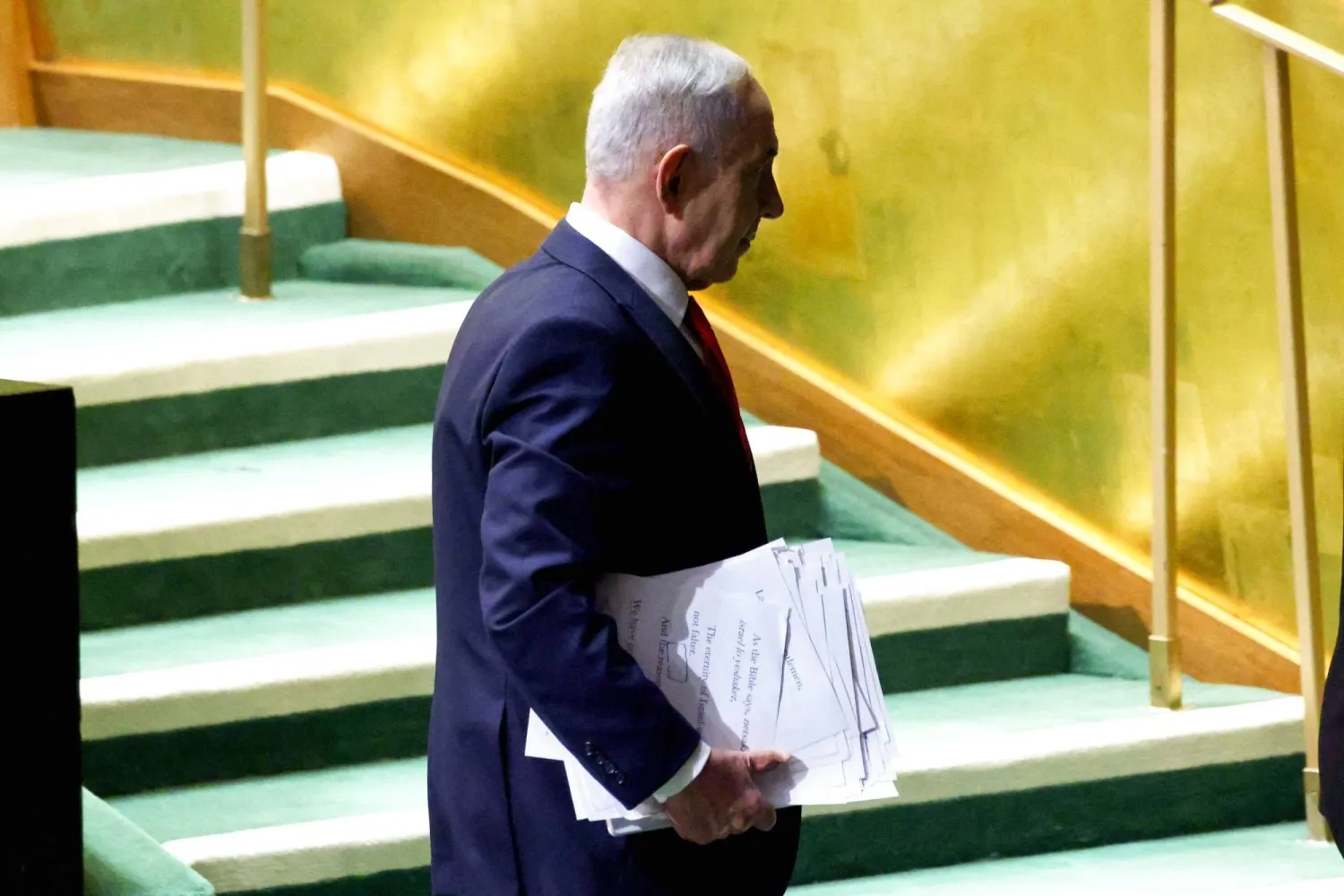
 Israel's Prime Minister Benjamin Netanyahu leaves after addressing the 81st United Nations General Assembly at UN headquarters in New York on September 24, 2026. (Photo by Leonardo Munoz / AFP)
Israel's Prime Minister Benjamin Netanyahu leaves after addressing the 81st United Nations General Assembly at UN headquarters in New York on September 24, 2026. (Photo by Leonardo Munoz / AFP)
TT

Netanyahu, 'Dodging Responsibility,' Battles the Curses of October 7

 Israel's Prime Minister Benjamin Netanyahu leaves after addressing the 81st United Nations General Assembly at UN headquarters in New York on September 24, 2026. (Photo by Leonardo Munoz / AFP)
Israel's Prime Minister Benjamin Netanyahu leaves after addressing the 81st United Nations General Assembly at UN headquarters in New York on September 24, 2026. (Photo by Leonardo Munoz / AFP)

If Israeli Prime Minister Benjamin Netanyahu could erase October 7 from the calendar and wipe it from history, he would not hesitate for a moment. That date began as a curse that turned his life and many of the ideas surrounding him upside down. As it returned year after year, it became a series of accumulated curses that would require a divine miracle to escape.

On that day, three years ago, the sky fell on his head. When he was awakened at 6:40 a.m., 11 minutes after the Hamas attack on Israeli communities and military positions in the south began, and was told what had happened, he could not comprehend it. When he was given the initial details, that “a large number of people had been killed and wounded, and hostages had been taken to Gaza,” he was psychologically shocked.

In testimonies published by Ben Caspit, a writer for Maariv, people close to Netanyahu who saw him firsthand during those hours said that “Netanyahu’s lower jaw seemed slack, his face was pale, he spoke little, and something obsessive and delirious had entered his behavior.” “Why did they do this?” he asked, referring to Hamas’s leaders.

Even Gadi Eisenkot, who met Netanyahu four days after the attack, testified that he saw him frustrated and stunned.

He Devoted Himself to “Erasing Gaza”

In practice, Netanyahu left the management of the state’s response to the attack and the retaliation to the army and the other security agencies. The positions he announced when he appeared before the media were little more than parroted repetitions of what he was hearing from those commanders.

The army chief of staff at the time, Herzi Halevi, revealed that when he was about to leave his home at 6:30 a.m., his wife asked him where he was going. He replied: “To erase Gaza completely.” The phrase became an operational plan, and then a new military doctrine for the army and the entire Israeli state. Netanyahu began translating it into political language.

But according to an investigation by Ilana Dayan on the Israeli Channel 12 television program Uvda, the initial reactions were panicked and showed that Netanyahu’s first concern was to distance himself from responsibility for the October 7 failure. The investigation quoted his aide Eliezer Feldstein, who described Netanyahu’s state during the first days of the attack as “panicked” and “extremely frustrated.” Rather than focusing on the broader strategic implications of the event and issuing appropriate directives, he assigned his media team its “first and immediate task”: to devise an immediate plan to contain the media storm and evade political responsibility, repeatedly asking in frustration whether the news was still talking about his personal responsibility for the failure.

The Moment He Woke Up

Many observers of Netanyahu’s personality say that what pulled him out of his own frustration was the frustration he saw among his staff and close ministers, turning him into a roaring lion. It was no coincidence that he embraced the names “A People Like a Lion” and “The Lion’s Roar” for the two wars against Iran. He considers himself Israel’s “Mr. Security.” He feared that the public would discover the weakness that had afflicted him and his team and demand his removal. He began shouting at them: “Get out of this mindset. Read what they are writing about us,” meaning “about me,” “and respond to them. Terrible things are being written here instead of blaming the army and intelligence.”

From that point on, the government’s political line became one of blaming the military leadership for having been asleep on guard duty and failing to gather intelligence and prevent Hamas from attacking. The security agencies tried to defend themselves. They acknowledged part of the responsibility, conducted internal investigations, and punished some officials. All the heads of these agencies resigned, including Halevi from the army, Ronen Bar, head of the Shin Bet, and David Barnea, head of the Mossad, along with dozens of other generals.

On the Israeli street, there is a widespread belief that the army and the other security agencies do bear responsibility for the failure, but people also want Netanyahu to bear responsibility for it. He refuses. Not only that, he has also refused to establish an official commission of inquiry headed by a judge to investigate what happened. He insists that he is “the inspired leader whom God blessed the people of Israel with at the right time,” as his wife said in several media interviews.

Deep Sleep

Today, Netanyahu sees the general election scheduled for October 27, 2026, as decisive, not for the people of Israel, as political and media circles say, but for him personally. October 7 is the central issue. Despite all his attempts to move beyond it, his many opponents in politics, the media, academia, and the deep state insist on reminding the public of that date.

He has yielded to their pressure and begun addressing their accusations. He says: “If they had woken me half an hour earlier, the outcome would have been different.” Ben Caspit wrote about this on September 8, 2026: “Today, three years later, he dares to say: ‘If they had woken me, this would have looked completely different.’ But in reality, it can be said that even if they had actually woken him that night, nothing would have happened. Absolutely nothing.”

It is not difficult to reach this conclusion. Sadly, no one could have woken him in the middle of the night and told him that Hamas was about to launch an unprecedented attack on the south, with 6,000 militants crossing the barrier and taking over communities and bases. But, unfortunately, they did not know. It was an unprecedented intelligence and operational failure. Everyone responsible took responsibility for it and resigned.

In reality, they had tried to wake him for weeks and months. Who did not warn him? The army chief of staff tried to warn him, but he did not want to listen. The head of the Military Intelligence Directorate, Aman, sent him three letters, but he did not want to read them. (“There is exaggeration in this,” said Linnon Megil.) Avigdor Lieberman warned him. Yair Lapid warned him. His defense minister, Yoav Gallant, tried to wake him. Gadi Eisenkot sent him a letter saying that the situation was more dangerous than it had been on the eve of the Yom Kippur War. Nothing worked. Now he complains that they did not wake him that morning. No alarm bell went unheard. He simply did not want to wake up.

The Pitfall of a “Decisive Election”

Netanyahu believes he can convince voters of his position and win the election. He tells himself and his team: “I must win the election. Losing is not an option. It cannot happen. This is extremely dangerous.” What he means is that if he loses the election, the first consequence will be the establishment of an official commission of inquiry.

More than anyone else, and more than the investigators themselves, he knows that an impartial investigation would reveal how deeply he was involved in the failure. He was the one who forced the security agencies to accept the transfer of millions of dollars in cash to Hamas. He was the one who used to say that “Hamas is a treasure. By maintaining it and keeping it strong, we prevent the establishment of a Palestinian state.” He even convinced the most extreme members of his government of this theory, including Minister Bezalel Smotrich.

If he loses power, he will face the ongoing corruption trial against him, another corruption trial concerning the submarines that may follow, and perhaps a third trial over his role in the failures of October 7. His fate could be prison.

For that reason, Netanyahu will do everything in his power to prevent this danger, even if it means a war that would postpone the election.



How Israel’s New Parliament Can Make Netanyahu’s Life Difficult

A combination picture shows Israeli Prime Minister Benjamin Netanyahu as he attends a memorial service held for Ran Gvili, an off-duty police officer who was killed fighting militants that had infiltrated Israel during the deadly October 7, 2023, attack by Hamas, and the last hostage recovered from Gaza, in Meitar, Israel, January 28, 2026, and Israeli opposition leader and former military chief, Gadi Eisenkot, as he launches an election campaign for Yashar, his new political party, at an event near Hod Hasharon, Israel, June 30, 2026. (Reuters)
TT

How Israel’s New Parliament Can Make Netanyahu’s Life Difficult

A combination picture shows Israeli Prime Minister Benjamin Netanyahu as he attends a memorial service held for Ran Gvili, an off-duty police officer who was killed fighting militants that had infiltrated Israel during the deadly October 7, 2023, attack by Hamas, and the last hostage recovered from Gaza, in Meitar, Israel, January 28, 2026, and Israeli opposition leader and former military chief, Gadi Eisenkot, as he launches an election campaign for Yashar, his new political party, at an event near Hod Hasharon, Israel, June 30, 2026. (Reuters)

Benjamin Netanyahu remains Israel's prime minister when the new parliament takes office Tuesday but its new, less friendly composition could make his life much more difficult.

Gadi Eisenkot, a former military chief seeking to move Israel to the center, was given the mandate Sunday by President Isaac Herzog to form a new government, a complicated task as neither he nor Netanyahu command a majority.

Until then Netanyahu, Israel's longest-serving leader, remains caretaker prime minister -- but the new 120-member parliament can still go to battle against him.

The lack of a new government "does not infringe upon the Knesset's prerogatives", said Assaf Shapira, a political expert at the Israel Democracy Institute.

Eisenkot has also warned military chiefs that Netanyahu does not have a mandate to resume war against Iran -- although the statement was more about politics than the law, with Netanyahu still in charge of national security.

Netanyahu's bloc slipped to 53 seats in the new parliament, down from the decisive 68 it commanded previously.

Eisenkot's core opposition bloc has fewer seats than Netanyahu at 48 but the new parliament also has a record 19 lawmakers from Arab-majority parties that are vehemently opposed to Netanyahu and his hard-right government -- although it remains unclear if Eisenkot will seek to work with Israeli-Arabs directly.

Here are ways in which the new parliament could turn on Netanyahu:

- Commission on October 7 attacks -

One of the opposition's main campaign promises has been to set up a commission of inquiry to probe failures in the famously high-security country that allowed Hamas's October 7, 2023, attack, the deadliest ever day for Israel.

While Netanyahu denies any wrongdoing on his part, his government has consistently opposed the creation of a national, independent commission of inquiry that would have broad investigative authority, with Netanyahu instead supporting a review by political appointees.

Even before a new government is formed, the incoming parliament could set up a special committee on the attack which would hand over its findings to an eventual commission of inquiry, Shapira said.

Eisenkot declared after the election that forming a commission would be an immediate priority.

- Repealing Netanyahu-era laws -

The new parliament could also move quickly to repeal some of the most controversial laws under Netanyahu, including his efforts to revamp the judiciary -- seen by the prime minister as an enemy after he was charged with corruption.

The judicial revamp triggered some of Israel's largest ever protests, with liberals worried about the future of democracy, although the Hamas attack and subsequent wars quickly shifted public attention.

The new parliament could aim to repeal the last coalition's laws that limited the powers of the Supreme Court and made it easier to remove the country's attorney general.

Lawmakers could also roll back exemptions for ultra-Orthodox Jews from serving in the military. The exemption has angered many Israelis at a time that the military is stretched thin, although the laws did not go far enough for ultra-Orthodox parties, who are being wooed by at least one opposition figure.

Shapira said repealing Netanyahu-era laws was as simple as calling a vote and reverting to previous policies. But the process to pass new laws could take weeks as the opposition coordinates its priorities.

- Electing new speaker -

The first political clash will concern electing a new parliament speaker. The incumbent is Amir Ohana, a Netanyahu loyalist from his Likud Party.

According to parliamentary rules, the vote for speaker can take place as early as during the inaugural session and must happen before a new government is sworn in.

An initial clash took place Thursday when three parties in the Eisenkot bloc sent letters to the outgoing speaker requesting that his successor be elected at the opening session -- a timing that Shapira agreed was more common.

Ohana responded that it was customary to elect the speaker on the day a new government is sworn in.

Naftali Bennett, a key opposition figure, vowed to act "urgently" on the bloc's priorities.

"We will take control of the Knesset as quickly as possible."


Two Years in, Women Leaving Top Roles in Trump Admin

Susie Wiles has left the powerful chief of staff role inside the White House. Kent NISHIMURA / AFP
TT

Two Years in, Women Leaving Top Roles in Trump Admin

Susie Wiles has left the powerful chief of staff role inside the White House. Kent NISHIMURA / AFP

The abrupt exit of White House Chief of Staff Susie Wiles, one day after Republicans were stomped in midterm elections, adds her to a growing list of women who have departed top roles in President Donald Trump's administration since the year began.

At the beginning of his second term, the 80-year-old Republican boasted that he was "thrilled to say that we have more women in our cabinet than any Republican president in the history of our country."

At that point, there were eight women in top roles, out of more than 20 such positions.

Eighteen months later, there are only three left: Agriculture Secretary Brooke Rollins, Education Secretary Linda McMahon and Kelly Loeffler, who heads the Small Business Administration.

Half the women were pushed out over three months in the spring, AFP said.

First went Homeland Security Secretary Kristi Noem, who became the face of Trump's violent anti-immigration offensive.

She was followed by Trump's top federal prosecutor Pam Bondi, Labor Secretary Lori Chavez-DeRemer and Tulsi Gabbard, director of national intelligence.

Most recently, one day after Republicans lost in the midterms, Wiles announced her departure.

- Double standard -

"Is he out of women?" Democrat Alexandria Ocasio-Cortez said last spring, after being asked who would be next to meet that fate.

"Trump only seems to have the capability to fire female secretaries," the congresswoman said, adding: "If you're a man in the Trump administration, it seems that they reward misconduct."

For Trump, a former beauty pageant organizer, women are about appearances, Colorado State University professor Karrin Vasby Anderson told AFP.

"Trump hires and appoints women who he thinks will make him look good. The minute they don't, they are gone," she said.

"He continues to defend (Defense Secretary) Pete Hegseth, despite the fact that nearly everyone agrees that the Iran war has been a catastrophe," Anderson said.

"I think it's telling that the men he defends most vociferously are those who promote a particular kind of sexist MAGA masculinity. It's clear that Trump feels comfortable surrounding himself with that type of man."

Trump has stood by men in his administration despite national outcry against chief of staff Stephen Miller's vocal support for the violent immigration policy and the taint of scandal dogging FBI Director Kash Patel over allegations of a taxpayer-funded slush fund to reward loyalists and other missteps.

- Male successors -

The only man not spared was Mike Waltz, who was removed from his post as national security adviser in May 2025 after he inadvertently added a journalist to a leadership discussion group where they chatted about US strikes in Yemen.

But Waltz rebounded quickly and was appointed to be ambassador to the United Nations soon after.

In every case where a woman was sidelined, a man invariably replaced her.

Todd Blanche took over Bondi's role at the Justice Department after working as Trump's personal lawyer.

And Wiles -- the first woman to hold the strategic position of White House chief of staff -- has just been replaced by hard-right ideologue Miller, a longtime Trump loyalist.

Anderson said Wiles was a rare hire for Trump because she was recruited for her expertise.

But after Democratic blue wave's crushing victory in the midterm elections, the Republican president may think "Stephen Miller will defend Trump better than Susie Wiles would."

Trump, however, appears to be struggling to replace one prominent female face of his presidency: Karoline Leavitt, the youngest White House press secretary ever who left her post at the end of August.

The president jokingly called on UFC chief Dana White to take on the role instead, but the fighting executive demurred on Monday, saying: "I do not want to be in politics."


COP31 in Antalya: Climate Divisions and US Absence Test Global Consensus

Delegates from Kazakhstan pose for photographs by their pavilion on the opening day of the COP31 annual UN climate conference in Antalya, Türkiye, 09 November 2026.  EPA/TOLGA AKMEN
Delegates from Kazakhstan pose for photographs by their pavilion on the opening day of the COP31 annual UN climate conference in Antalya, Türkiye, 09 November 2026. EPA/TOLGA AKMEN
TT

COP31 in Antalya: Climate Divisions and US Absence Test Global Consensus

Delegates from Kazakhstan pose for photographs by their pavilion on the opening day of the COP31 annual UN climate conference in Antalya, Türkiye, 09 November 2026.  EPA/TOLGA AKMEN
Delegates from Kazakhstan pose for photographs by their pavilion on the opening day of the COP31 annual UN climate conference in Antalya, Türkiye, 09 November 2026. EPA/TOLGA AKMEN

Climate negotiations in Antalya, Türkiye, face a fresh test as unresolved disputes from last year's summit in Brazil carry over into the 31st United Nations Climate Change Conference (COP31), particularly over adaptation finance for developing countries.

The talks are taking place without a US delegation for the second consecutive year, amid mounting geopolitical tensions, turmoil in energy markets and rising electricity demand driven by artificial intelligence. Together, these pressures are making it harder for governments to reach international agreements on accelerating climate action.

COP30, held last year in Belém, Brazil, ended with a compromise that failed to establish a roadmap for transitioning away from fossil fuels or fully resolve disagreements over adaptation finance.

Countries have returned to the negotiating table as the United Nations increasingly warns of a widening gap between climate commitments and the pace of action needed to curb global warming.

Türkiye is hosting COP31 from November 9 to 20, with Australia serving as President of Negotiations under an arrangement that gives Ankara the conference presidency and Canberra responsibility for leading the negotiations.

The agenda focuses on cutting greenhouse gas emissions, securing climate finance for developing countries, strengthening their ability to adapt to climate change and accelerating the transition to cleaner energy systems.

Simon Stiell, executive secretary of the United Nations Framework Convention on Climate Change (UNFCCC), told delegates that "the urgency of this moment must drive us forward."

He warned that progress remained far too slow to meet the scale of the climate crisis and urged governments to prioritize climate action despite the numerous international crises competing for their attention.

Scientific findings underscore the challenge facing negotiators.

A report published in October by the United Nations Environment Programme (UNEP) warned that global temperatures were on course to exceed 1.5 degrees Celsius above preindustrial levels, the threshold established under the 2015 Paris Agreement to avert the worst consequences of global warming.

Another UN report released Monday indicated that 2026 was likely to rank among the four hottest years on record, with a powerful El Niño contributing to rising temperatures.

Several regions have experienced severe heat waves, particularly Western Europe, while a glacier collapse in Nepal triggered catastrophic flooding that killed more than 1,450 people and left thousands missing, according to the reports.

Climate Finance and Adaptation Top the Agenda

Financing for developing countries remains among the most contentious issues in international climate negotiations as their investment needs continue to grow.

These countries require funding not only to reduce emissions but also to adapt to the consequences of climate change, including floods, droughts, extreme heat and rising sea levels.

The issue extends beyond financing clean energy projects to strengthening the resilience of communities most vulnerable to climate-related disasters and reducing losses and damage caused by extreme weather.

The widening gap between the scale of these threats and the financial resources available to address them has become a central concern.

Negotiators are expected to debate how climate finance should be incorporated into the conference agenda and how the necessary funding should be mobilized and distributed, amid continuing disagreements over financial responsibilities, the scale of contributions and the mechanisms for delivering assistance.

Against this backdrop, Turkish President Recep Tayyip Erdogan said: "The world is our home, and we have no right to pollute it."

He added that Türkiye would use COP31 to discuss practical steps toward securing humanity's shared future.

Speaking to reporters aboard his plane on Sunday evening as he returned from Azerbaijan, Erdogan emphasized Türkiye's commitment to climate justice.

He said the conference agenda would address a range of issues, from raising awareness to developing cities capable of withstanding the effects of climate change.

Electrifying the Economy by 2035

Alongside negotiations on financing and emissions reductions, the Turkish presidency is promoting an ambitious target to increase electricity's share of global final energy consumption to 35% by 2035, up from just over 20% today.

The initiative, known as the "35-by-35 Global Electrification Pledge," calls on countries to support the expansion of electricity use across transportation, buildings and industry while developing renewable energy sources, electricity grids and storage technologies.

COP31 President Murat Kurum, Türkiye's Minister of Environment, Urbanization and Climate Change, said the country wanted people to see the benefits of climate negotiations in their everyday lives through more energy-efficient buildings, clean public transportation, affordable energy and new jobs.

The initiative is based on the premise that replacing fossil fuel-powered equipment, including vehicles, heating systems, boilers and cooking appliances, with electric alternatives could help reduce emissions, provided the transition is accompanied by increased electricity generation from low-carbon sources.

Wars Bring Energy Security Back Into Focus

Geopolitical developments are casting a shadow over the negotiations, particularly the continuing war in Iran, which has disrupted oil shipments through the Strait of Hormuz and driven up fuel prices worldwide.

The repercussions of the Russia-Ukraine war on global energy markets have added to these pressures.

Stiell warned that turmoil in fossil fuel prices had placed additional strain on households and contributed to rising inflation.

He argued that renewable energy offered a clear path toward stronger energy security, noting that the expansion of renewable power installations had already saved the global economy hundreds of billions of dollars.

The United States is absent from international climate negotiations for the second consecutive year, underscoring persistent differences among countries over climate transition priorities and the role of various energy sources in meeting economic needs.

Artificial Intelligence Adds Another Challenge

The challenges facing COP31 extend beyond wars and energy market disruptions.

The rapid expansion of artificial intelligence is placing additional pressure on global electricity demand as data centers and the infrastructure supporting digital applications continue to grow, bringing increased energy consumption and associated emissions.

The Turkish presidency plans to invite governments, companies and institutions to endorse a pledge establishing principles for the sustainable development and deployment of artificial intelligence.

The initiative, known as the "Antalya Pledge on Artificial Intelligence," seeks to align digital transformation with climate objectives and prevent technological expansion from placing further strain on energy systems and the environment.

At the same time, clean energy technologies are becoming more widely available, supported by growing exports of low-cost equipment from China.

This trend could accelerate the deployment of renewable energy solutions and encourage greater investment in the sector.

A Test of International Cooperation

Australian Minister for Climate Change and Energy Chris Bowen, who serves as COP31 President of Negotiations, described the conference as an opportunity to demonstrate that multilateral cooperation can deliver progress on shared challenges.

"Let's show future generations that this generation was equal to the moment, equal to the challenge," Bowen told delegates, urging countries to work together in confronting the climate crisis.

His appeal comes as climate challenges increasingly extend beyond environmental policy to encompass energy security, industrial competition, inflation and technological innovation.

Reaching international consensus on emissions reductions, financing arrangements and the future energy mix will therefore be a critical test of the conference's success.

With Türkiye seeking to accelerate global electrification, the United Nations calling for faster emissions cuts and developing countries demanding greater funding for adaptation and resilience, attention is turning to whether the Antalya negotiations can translate commitments into concrete, actionable measures.

The challenge is becoming more urgent as the gap continues to widen between the pace of climate change and the international response.