



Scars from Oct. 7 Fuel Deep Divisions Over Netanyahu Ahead of Israeli Election

People walk past an election billboard showing Israeli Prime Minister Benjamin Netanyahu with the Hebrew phrase "We will not surrender" in Tel Aviv, Israel, 06 October 2026. (EPA)
TT

Scars from Oct. 7 Fuel Deep Divisions Over Netanyahu Ahead of Israeli Election

People walk past an election billboard showing Israeli Prime Minister Benjamin Netanyahu with the Hebrew phrase "We will not surrender" in Tel Aviv, Israel, 06 October 2026. (EPA)

As Israel gears up for its first elections since the Hamas-led Oct. 7, 2023 attack, Prime Minister Benjamin Netanyahu and his opponents are putting it at the heart of their campaigns.

Nearly every poster, stump speech or televised debate seems to reference the attack, which has scarred the country and remains fresh in the minds of voters. Three years on, the worst security failure in Israel’s history now threatens to end the career of its longest-serving prime minister.

“October 7 is kind of a framework for the entire political discussion that is going on,” said Tamar Hermann, an expert on Israeli public opinion at the Israel Democracy Institute, a Jerusalem think tank. “All of us are post-traumatic in a way.”

Netanyahu’s opponents want him to pay for the failures that led to the deadliest day in Israel’s 78-year history and plunged the country into a series of inconclusive wars. His defenders say Netanyahu was betrayed by the military establishment and that he has led Israel through a dramatic rebound from its darkest hour.

A loss in the Oct. 27 election would likely end the career of the soon-to-be 77-year-old Netanyahu. A victory would mark the greatest turnaround yet for a man who has defied naysayers for three decades.

A deadly day that has shaken an entire region

On the morning of Oct. 7, Hamas militants fired several thousand rockets into Israel and thousands of fighters attacked through holes blown in the border fence or with boats or motorized paragliders. Some 1,200 people were killed and 251 others taken hostage.

Israel responded with a military offensive that has killed over 74,000 Palestinians in the Gaza Strip, according to local health authorities, left the territory in ruins and sparked an ongoing humanitarian catastrophe. Israel later went to war against Hezbollah in Lebanon, seized a chunk of Syria, attacked targets in Yemen and joined the US in two wars against Iran.

Hundreds of Israelis, mostly young soldiers, have died, and nearly every household has been touched by the violence. Netanyahu promised “total victory,” but Hamas, Hezbollah and Iran’s theocratic government all remain intact.

Israel’s international standing has plummeted, a number of foreign governments have accused it of genocide — a charge it vehemently rejects — and Netanyahu is now wanted by the International Criminal Court.

After a string of resignations by top security officials, Netanyahu is the only senior figure from Oct. 7 still in office, making this month’s election in many ways a referendum on his leadership.

It's the focus of the campaign for both sides Netanyahu and his opponents have put Oct. 7 at the forefront of their campaigns — for different reasons.
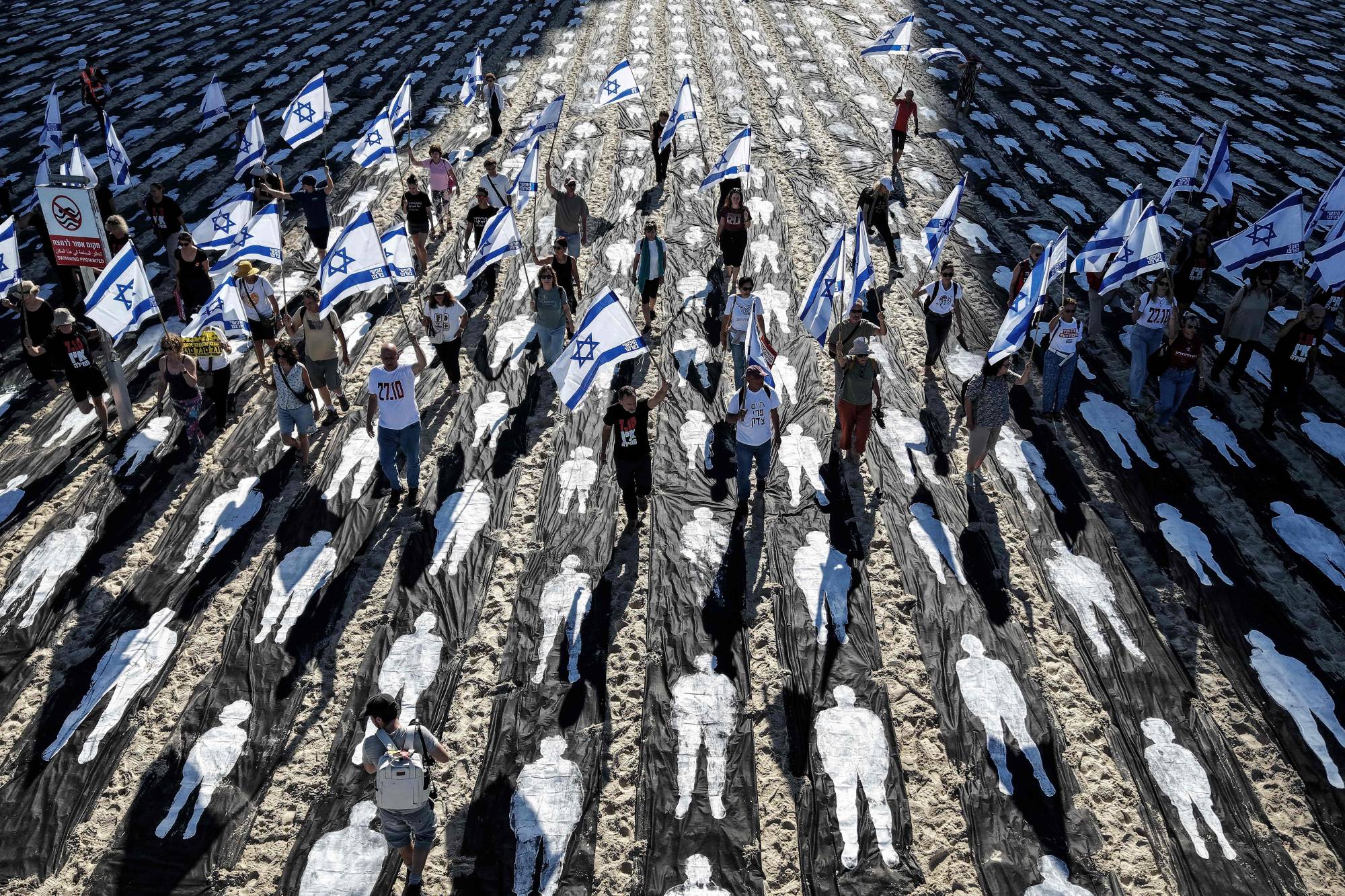
An aerial view shows people waving Israeli flags as they stand on a commemorative installation set up on the beach to mark the third anniversary of Hamas's October 7 attack on Israel, in Tel Aviv on October 7, 2026. (AFP)

His opponents — from across the political spectrum — call his outgoing coalition “the massacre government,” a reference to the Oct. 7 attack occurring on their watch. Netanyahu says he has led a “war of redemption.”

His chief rival is Gadi Eisenkot, a former military chief whose son and nephew were killed in battle in Gaza. The opponents have pledged to form a government of “repair and reconstruction” — beginning with the formation of an official commission of inquiry into Oct. 7.

They also have vowed to end draft exemptions for ultra-Orthodox religious men, a long-standing policy that has outraged the secular majority at a time of war, and accuse Netanyahu of threatening Israel's democratic institutions.

“The most fateful elections in the history of the State of Israel are between evasion and enlistment,” Eisenkot wrote on X. “Between taking responsibility and fleeing from responsibility.”

Netanyahu has repeatedly rejected calls for a commission of inquiry while trying to shift the blame to security officials. He recently accused the then-head of the Shin Bet security service, Ronen Bar, of withholding information ahead of the attack. Bar has vowed to file a defamation lawsuit.

Netanyahu insists the country is stronger than ever.

“Our enemies expected us to collapse,” he said in a recent address to the United Nations. “Well, we didn’t collapse. Instead, we rose and fought like lions.”

Oct. 7 victims are seeking seats in parliament

Eisenkot’s new Yashar party list includes two parents who lost children on Oct. 7. Netanyahu’s Likud party also includes two grieving parents, among them the mother of a policeman killed in battle on Oct. 7 whose remains were the last to be returned to Israel as part of a ceasefire. Another Likud candidate lost both legs while serving in Gaza.

The leader of the dovish Democrats party, Yair Golan, is a retired general who put on his uniform and rushed to the southern border to fight on Oct. 7. The centrist Together party’s list has another former general, Noam Tibon, who also battled militants as he rescued his son’s family, and the mother of a soldier killed that day.

Other parties have also added people directly impacted by the attack.

Organizers, including victims' relatives, say they are keeping politics out of a mass memorial service in Tel Aviv on Wednesday. But they have hardly concealed their anger at the country’s leadership.

“We will not let anyone evade responsibility,” Yonatan Shamriz, whose brother was taken hostage and mistakenly killed by Israeli soldiers after escaping captivity, said in a radio interview.
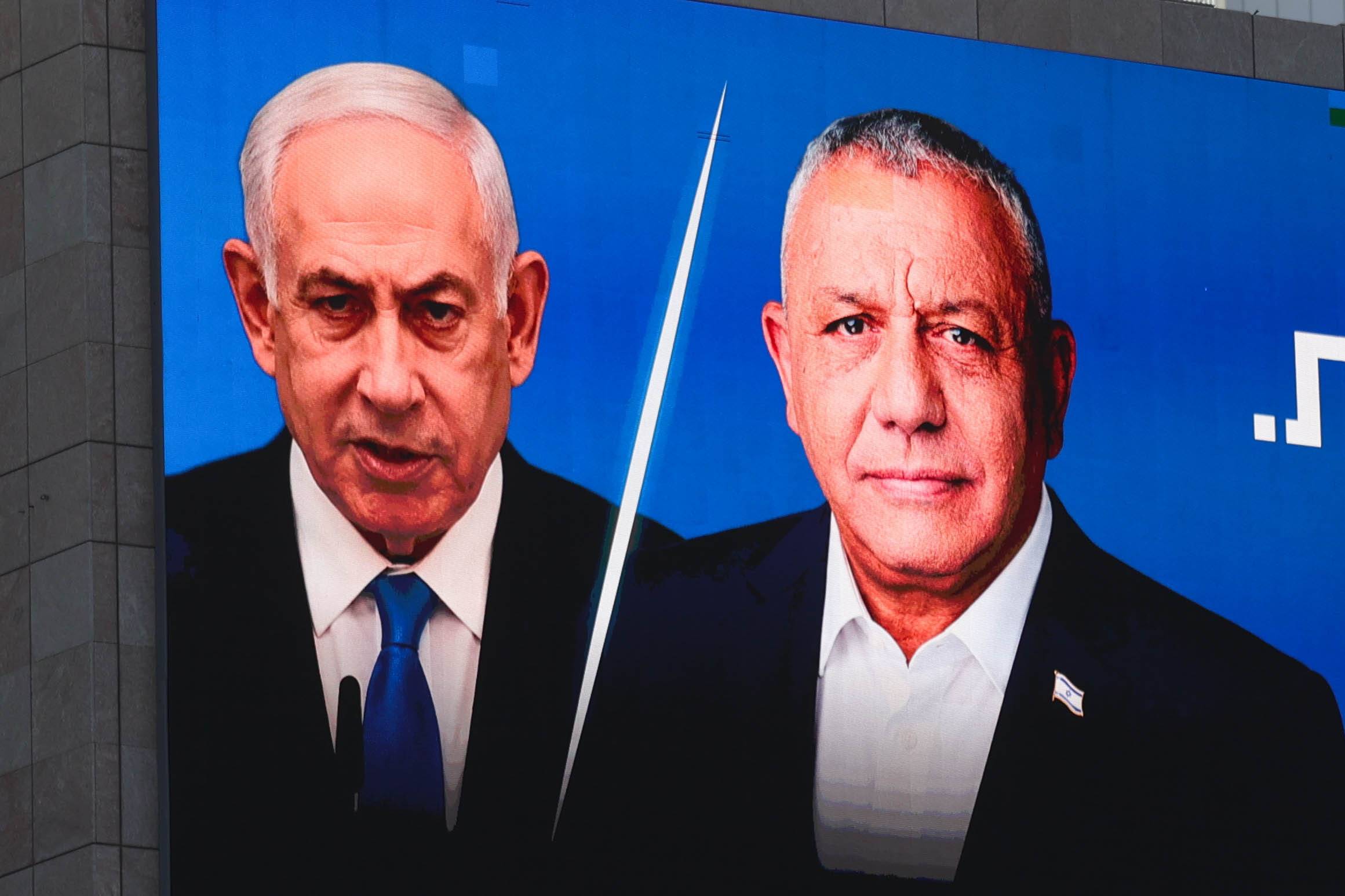
A large election billboard shows Israeli Prime Minister Benjamin Netanyahu (C-L) and leader of the Yashar party, Gadi Eisenkot (C-R), in Tel Aviv, Israel, 06 October 2026. (EPA)

There is little discussion of the Palestinians

Largely missing from the Israeli public discourse is any discussion of the dire situation in Gaza or the fate of the Palestinians.

Israeli leaders have said little about the unprecedented death toll in Gaza, the humanitarian catastrophe and the lack of reconstruction. Instead, they have focused largely on the country’s pain over Oct. 7.

There is almost no mention of peace talks, and even Netanyahu’s challengers largely oppose the establishment of a Palestinian state alongside Israel, the international community's preferred solution for the decades-old conflict.

When a pair of Israeli filmmakers released a documentary last month about civilian deaths in Gaza, party leaders across the spectrum, including Eisenkot, accused them of treason.

Oct. 7 has hardened the bitter split over Netanyahu

Polling suggests a close race between Netanyahu and his chief rival, Eisenkot, with an uncertain outcome.

According to the Israel Democracy Institute, over 60% of Israelis say their attitudes toward Oct. 7 are a central factor in whom to vote for. That number jumps to 68% among the Jewish majority; Arab voters are most concerned with a crime wave in their communities.

But Hermann, the IDI polling expert, said this doesn’t necessarily mean bad news for Netanyahu. She says the past three years have hardened attitudes on both sides.

Just because everyone says Oct. 7 is important, she said, “doesn’t mean that they will come out with the same conclusion.”



Israel Faces New Era of Sinking US Support After Election

Republican presidential nominee and former US President Donald Trump appears on a congratulatory billboard for the 2024 US Presidential Election, in Tel Aviv, Israel, November 6, 2024. (Reuters)
TT

Israel Faces New Era of Sinking US Support After Election

Republican presidential nominee and former US President Donald Trump appears on a congratulatory billboard for the 2024 US Presidential Election, in Tel Aviv, Israel, November 6, 2024. (Reuters)

Prime Minister Benjamin Netanyahu's brash campaign posters are still up on Israeli public buses -- images of him, US President Donald Trump and soaring warjets that laud the two leaders attacking Iran together.

Neither is now advertising the state of the two countries' alliance.

A week after an inconclusive election for Netanyahu, Americans overwhelmingly rejected Trump and chose a Congress led by Democrats who want a tougher approach to Israel, whether on Iran, Gaza or settler violence in the occupied West Bank.

The back-to-back elections look to many observers like a turning point, with Israel no longer able to take for granted the cover of the world's most powerful country.

"This is a new era. The confluence of the Gaza war and the war with Iran have really changed how mainstream Americans -- not people particularly concerned with the Israeli-Palestinian conflict -- see Israel," said Yael Sternhell, an expert on the United States at Tel Aviv University.

Vice President JD Vance, assessing why his Republicans fared poorly, listed four ways to bring voters back, including ending the Iran war and changing "our relationship with Israel".

Trump did not disagree. Just as voting was underway Tuesday, Trump said he had agreed with Netanyahu to end the $3.8 billion in annual US military aid to Israel by the end of this year, explicitly tying the decision to the US political mood.

Netanyahu, Israel's longest-serving prime minister who has served on and off for nearly two decades, had eagerly sought Trump's endorsement but also acknowledged his country's growing isolation.

In the final days of the campaign, he suggested Israel turn to cryptocurrencies to circumvent international sanctions he expected would intensify.

Netanyahu has not commented on the US election or Trump's aid remarks.

Amit Segal, a journalist known for his proximity to Netanyahu, posted that the political situation in the United States marked a "catastrophe" for Israel.

- Can Eisenkot restore the alliance? -

Opposition contender Gadi Eisenkot, who is trying to cobble together a coalition to oust Netanyahu, has cast himself as capable of repairing relations.

In an English-language statement, the former military chief said he believed in "liberal values" and also wanted to work "closely and constructively" with Trump.

Yair Golan, the main left-wing leader inside Eisenkot's bloc, called for Israel to restore a bipartisan approach destroyed by Netanyahu who he said promoted a "destructive Israeli narrative of eternal war and authoritarian rule".

Netanyahu boasted in his campaign about standing up to Democratic presidents including Barack Obama, who remains a hero for many Democrats. Netanyahu openly aligned with Republicans a decade ago to attack Obama's diplomacy on Iran.

"Netanyahu certainly rubs Democrats the wrong way and has made every effort to alienate them," Sternhell said.

"But Eisenkot can't just be a nicer man to receive a softer approach from this new Congress," she added. "He's going to need new policies."

She said Eisenkot would likely enjoy Israeli public support for cracking down on extremist settlers, who have attacked Palestinians in the West Bank with virtual impunity.

But Israel has shifted to the right, with wide initial support for the Gaza war.

- Broadening criticism of Israel -

The new Congress will include progressive Democrats such as Abdul El-Sayed, the first Muslim elected to the Senate, who describe the devastation in Gaza as genocide, an assertion rejected by Israel.

Netanyahu "made a bet not only on the Republicans but almost personally on Trump", said Eli Kowaz, senior policy director of the Economic Cooperation Foundation, an Israeli think tank that backs a two-state solution with the Palestinians.

"These results show that bet had an expiry date," Kowaz said. "Also, for the first time, really, I think there's a realization that it isn't only about the Democrats. It's a problem with the relationship with America."

Without US assistance, Israel still has its own major arms industry and retains a clear edge fighting non-state actors such as Hamas and Hezbollah, said Ehud Eilam, a former researcher for the Israeli defense ministry.

But he said Israel would need to rely more on cheaper artillery or non-sophisticated bombs, further increasing risks of civilian casualties that have enraged international opinion.

"Israel can adjust to a new strategic reality of losing much and even all US military aid, but it will be tough for Israel. It will require Israel to consider hard choices such as taking huge loans or raising taxes," Eilam said.

Kowaz said that Eisenkot, aware of politics in Washington, was trying to show he is interested in regional stability and strategic agreements and not just "an indefinite state of war".

"He is definitely laying out a different vision for Israel's relationship with the United States."


Trump Could Woo North Korea After Midterm Setback, but Kim May Not Respond

US President Donald Trump meets with North Korean leader Kim Jong Un at the demilitarized zone separating the two Koreas, in Panmunjom, South Korea, June 30, 2019. (Reuters)
TT

Trump Could Woo North Korea After Midterm Setback, but Kim May Not Respond

US President Donald Trump meets with North Korean leader Kim Jong Un at the demilitarized zone separating the two Koreas, in Panmunjom, South Korea, June 30, 2019. (Reuters)

The rebuke President Donald Trump suffered in the US midterm elections could prompt him to step up efforts to re-engage North Korea, but any willingness to make major concessions risks creating friction with regional allies.

Analysts and officials in Asia expect Trump to focus on foreign policy as he seeks to build his legacy in the final two years of his term. With efforts to resolve the wars in Ukraine and Iran yet to produce breakthroughs, he is likely to turn to Asia, where he believes he has room to maneuver.

North Korean leader Kim Jong Un, with whom Trump has been eager to restart talks, is likely to be a key part of that effort, they say.

"Trump is likely to devote significant effort to achieving foreign policy successes, especially if he faces greater constraints on the domestic front," said Ban Kil-joo, international relations professor at the Korea National Diplomatic Academy in Seoul.

"Given Trump would want a successor to win in 2028, there is a strong possibility that engagement with North Korea would be part of that agenda," he ‌said.

But there is ‌little incentive at the moment for Kim to respond, analysts say.

Asked about Trump's plans for diplomacy with North ‌Korea, the White ⁠House said Trump ⁠has restored American strength on the global stage and strengthened ties with world leaders.

"His foreign policy decisions have never been motivated by politics," White House spokeswoman Anna Kelly said in emailed comments to Reuters.

"The Commander-in-Chief will always act in the best interest of the American people and our national security."

Trump met Kim three times during his first term after a war of words that raised fears of military conflict.

But their 2019 summit ended without agreement after they failed to reach a deal on North Korea's nuclear weapons program and sanctions relief.

Seven years later, the stakes are higher. North Korea has expanded its nuclear and missile arsenal, while Pyongyang's ties with Russia and China are the best in years, giving Kim less incentive to negotiate and potentially increasing pressure on Trump to offer concessions.

TRUMP CALLS KIM 'GREAT GUY'

Trump has touted his relationship with Kim, ⁠calling him a "great guy" and saying that they "get along very well."

Nonetheless, US and South Korean officials see ‌fading chances of a meeting this year, with Washington receiving no response from Pyongyang ahead of a regional ‌summit in China this month where they might have met.

Kim's influential sister, Kim Yo Jong, has said dialogue remains a path to peace, but Pyongyang sees no need ‌for talks now. She denounced what she called Washington's "hostile policy" while denying US accusations that North Korea stole more than $6 billion in virtual assets from Binance ‌last week.

Her brother has previously said he was open to talks if Washington stopped insisting his country give up nuclear weapons. Regional allies South Korea and Japan are opposed to any such concession.

"A summit that shelves denuclearization would undermine deterrence and create policy friction among Washington, Seoul and Tokyo," said Leif-Eric Easley, professor of international studies at Ewha Womans University in Seoul.

Officials in Japan and South Korea are concerned they could be "cut out of the loop" if Trump deals directly with Kim, with the quiet blessing of Beijing and Moscow, a ‌senior Japanese official said, speaking on the condition of anonymity.

"(Japanese officials) are concerned about the lengths he will go to get a summit with North Korea’s Kim Jong Un, such as dropping the issue of denuclearization."

'BIGGEST CHANGE ⁠SINCE WORLD WAR TWO'

Trump has referred ⁠to North Korea as a nuclear power, a status that allies in the region and the West have refused to recognize despite the dozens of nuclear warheads Pyongyang is believed to have built and its stockpile of fissile material.

"If US-North Korea talks lead Washington to accept North Korea's nuclear status, the security environment in Asia would change dramatically," said Professor Kazuhiro Maeshima at Sophia University in Japan.

"The biggest change since World War Two could occur in the remaining two years of the Trump administration. It is a serious situation."

Kim now has a vastly more advanced arsenal than at the time of the 2018-2019 summits, including more weapons and missiles, hypersonic glide vehicles, a growing fleet of modern warships and submarines, and improved drone capabilities.

If Trump were to bring Kim back to the table, he might need to offer more than partial sanctions relief.

Such concessions could face hurdles at home from a Democratic-controlled Congress and Trump's limited time in office, said Moon Chung-in, a Yonsei University Professor in Seoul who served as a presidential adviser on national security.

"And what is important is North Korea's perception and calculation; if North Korea thinks that Trump has entered a lame-duck period and he cannot get the support from Congress... there's no reason for Kim Jong Un to come to dialogue," he said.

Former US Deputy Secretary of State Stephen Biegun, who led US negotiations with North Korea during Trump's first term, also said there were few incentives for Pyongyang currently.

"The North Koreans, I think, have very little upside to a meeting like this right now, and potentially some downside."


Is the MAGA Era Over?

President Donald Trump gestures while boarding Air Force One at Morristown Airport, Monday, Sept. 7, 2026, in Morristown, N.J. (AP Photo/Julia Demaree Nikhinson)
TT

Is the MAGA Era Over?

President Donald Trump gestures while boarding Air Force One at Morristown Airport, Monday, Sept. 7, 2026, in Morristown, N.J. (AP Photo/Julia Demaree Nikhinson)

Has MAGA fever finally begun to fade? Will the American right abandon the Make America Great Again slogan and Donald Trump's populist ideology in favor of a more traditional brand of conservatism?

Following a crushing defeat in midterm elections that revolved almost entirely around one man, many Republicans have begun questioning the party's future and what role, if any, Trump should play in shaping it.

The Wall Street Journal, whose editorial pages have long represented the establishment right, called for "soul-searching" and urged Republicans to move away from the ultranationalist, identity-driven rhetoric that helped return the 80-year-old Trump to power.

In an editorial titled "The Trump Reckoning Arrives," the newspaper argued that tariffs and mass deportations were no substitute for higher real incomes.

It added: "Playing to the bro MAGA base is no substitute for persuading Hispanics, independents and suburban swing voters who abandoned the party on Tuesday."

"Still Your President"

The White House, however, appeared far less inclined toward introspection.

Its first post on X on Wednesday featured a stern-looking Trump accompanied by the words "Trump is still your president," a reminder that he will remain in office until January 2029.

But the American political calendar never stands still. Wednesday also effectively marked the beginning of the 2028 presidential campaign, which will culminate in the election of Trump's successor.

The US Constitution bars Trump from seeking a third term.

There was no realistic scenario in which Trump could have emerged from the midterm elections in a stronger political position.

The scale of the Republican defeat on Tuesday night, which exceeded even some of the Democrats' most optimistic expectations, has accelerated the erosion of his political influence.

Eyes on 2028

Vice President JD Vance, widely regarded as a potential contender for the White House in 2028, was careful not to confront his boss directly.

In a lengthy, essay-like post on X on Wednesday, Vance wrote: "The reason we lost is the war."

He immediately added: "The president himself said so last night."

That was not entirely accurate. Trump had attributed the defeat partly to the war in the Middle East, while also arguing that Republicans had fielded weak candidates.

Florida Governor Ron DeSantis described the outcome as an "extinction-level event" for the Republican Party, suggesting Republicans might have to wait until 2032 to regain control of Congress.

Republican lawmaker Don Bacon wrote on X that the party "needs to reclaim our Reagan principles."

He added: "Voters rejected populism, chaos, Putin and tariffs."

Former congresswoman Marjorie Taylor Greene, a far-right figure who has turned against Trump, went further.

"If the GOP wants any chance in the future, it will have to kick Donald Trump out of the party," she said.

Matthew Boyle, a prominent figure at the far-right news outlet Breitbart, wrote on X that "Republicans need to get back to basics."

"No more endless wars," he said.

On the economy, which he identified as the top issue, Boyle called for policies that benefit ordinary Americans rather than special interests.

He also urged Republicans to "be sane with immigration enforcement."

Criticism Without Naming Trump

For now, however, criticism remains relatively muted. Only a handful of conservative figures, whether moderates or hardliners, have been willing to attack Trump by name.

After all, the Republican Party has tied its political fortunes almost entirely to Trump since 2016.

"The big question is, are some of these Republican leaders in the House and Senate going to distance themselves from Trump?" Amy Dacey, a former Democratic official who is now an expert at American University, told AFP.

The same question applies to far-right influencers whose prominence and financial success have been closely linked to Trump's popularity.

Dacey said a devastating electoral defeat could diminish their influence, but it would by no means eliminate those associated with the MAGA movement.

Some of MAGA's online supporters have already attempted to shift the blame elsewhere.

"Great work, neocons," Jack Posobiec wrote sarcastically on X, referring to the neoconservative wing of the Republican Party, known for its interventionist foreign policy and hawkish stance toward Iran.

Nevertheless, it may only be a matter of time before the divisions become more pronounced.

Former congressman Bob Good wrote on the same platform: "Gotta start by acknowledging that Trump was and is the problem. Quietly whispering it won't do it."