Israel’s Scorn of Nobel Peace Prize Laureate Highlights its Combative Relationship with UN Bodies

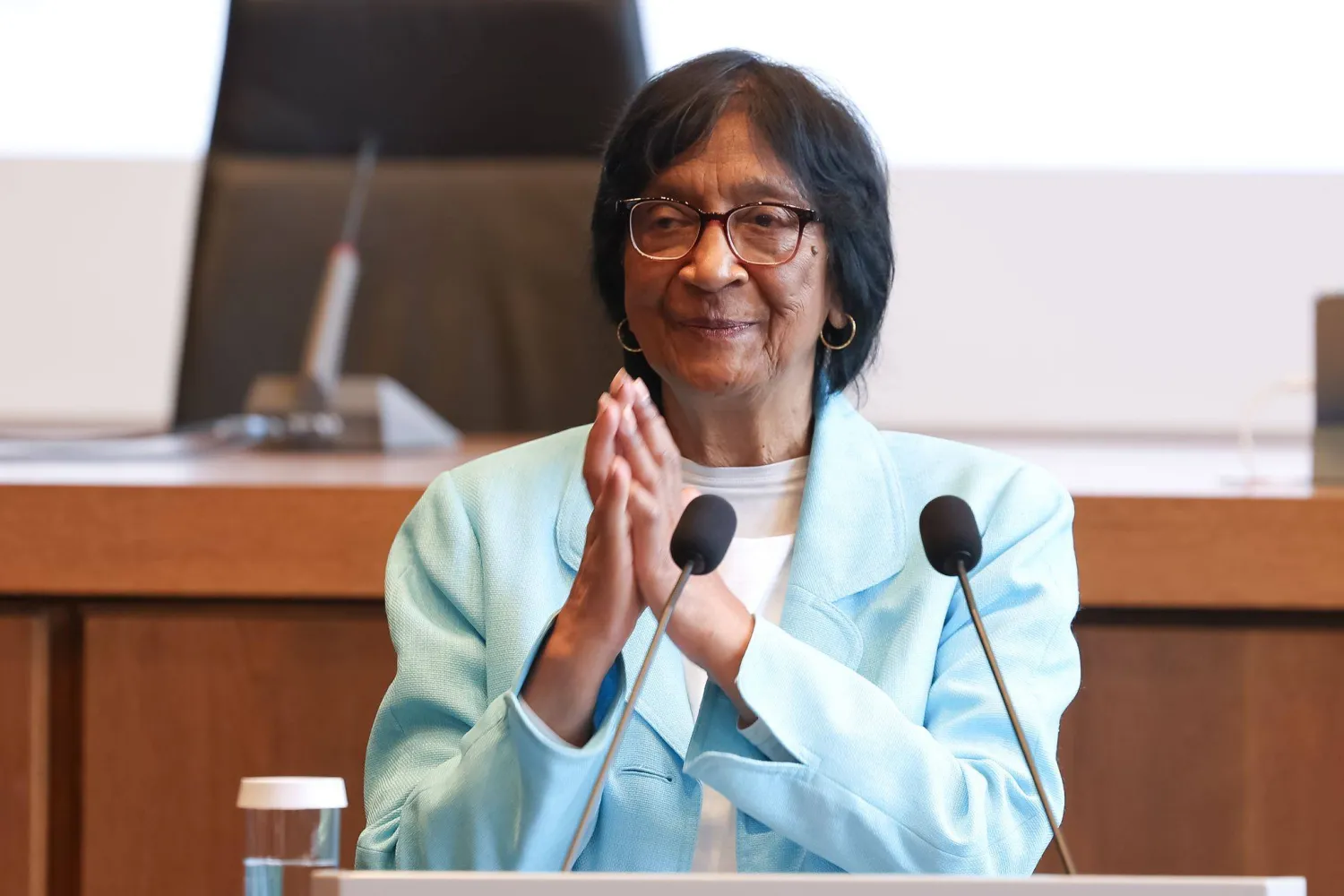
 09 October 2026, Bavaria, Nürnberg: South African lawyer Navanethem "Navi" Pillay speaks at the Nuremberg Forum in Nuremberg following the announcement that she is the recipient of the 2026 Nobel Peace Prize. (dpa)
09 October 2026, Bavaria, Nürnberg: South African lawyer Navanethem "Navi" Pillay speaks at the Nuremberg Forum in Nuremberg following the announcement that she is the recipient of the 2026 Nobel Peace Prize. (dpa)
TT

Israel’s Scorn of Nobel Peace Prize Laureate Highlights its Combative Relationship with UN Bodies

 09 October 2026, Bavaria, Nürnberg: South African lawyer Navanethem "Navi" Pillay speaks at the Nuremberg Forum in Nuremberg following the announcement that she is the recipient of the 2026 Nobel Peace Prize. (dpa)
09 October 2026, Bavaria, Nürnberg: South African lawyer Navanethem "Navi" Pillay speaks at the Nuremberg Forum in Nuremberg following the announcement that she is the recipient of the 2026 Nobel Peace Prize. (dpa)

The decision to award this year's Nobel Peace Prize to veteran jurist Navi Pillay has exposed the vast gulf between Israel and global institutions charged with upholding international law, a rift that has widened over the war in Gaza.

Over a decades-long career, Pillay served at the highest levels of international organizations created in the wake of World War II to prevent a recurrence of its horrors. As a young lawyer in her native South Africa, she campaigned against apartheid and for the release of Nelson Mandela, and as an international jurist she helped sentence dozens of people convicted of taking part in the 1994 Rwandan genocide.

But her leadership of a UN-backed panel that determined Israel committed genocide in Gaza — allegations it vehemently denies — has led many in Israel to see the Nobel nod as a high-profile rebuke of the country just days after the anniversary of the Oct. 7, 2023, Hamas attack that triggered the war.

Allegations of genocide are particularly explosive in Israel, which was founded in part as a refuge for survivors of the Nazi Holocaust.

“Awarding Pillay the Nobel Peace Prize isn’t a recognition of justice. It’s the grotesque weaponization of an award to legitimize anti-Israel hatred and prejudice,” Israel's Foreign Ministry said on X. “Joseph Goebbels is certainly applauding from hell,” it added, referring to the Nazi propagandist.

The vitriol comes from the widespread perception in Israel that the United Nations and other international bodies are biased against it. The United States has echoed that criticism and announced a raft of sanctions aimed at dismantling the International Criminal Court hours after the Nobel Prize announcement.

But Pillay's findings over the years were largely consistent with those of major human rights groups and other international bodies, and the facts she cited in reaching her conclusions had been widely reported.

Pillay led a panel that accused Israel of genocide in Gaza

Pillay led a three-member expert panel commissioned by the UN Human Rights Council that concluded last year that Israel had committed genocide in Gaza.

Their 22-page report cited the death toll; Israeli restrictions on humanitarian aid that led to widespread hunger; a policy of “systematically destroying” the healthcare system; the direct targeting of children and “explicit statements” of intent by Israeli civilian and military authorities.

Human rights groups and many experts on genocide have reached similar conclusions.

The commission has also issued reports accusing Hamas of war crimes during its Oct. 7, 2023, attack, when gunmen killed some 1,200 people and abducted 251 others. Israel’s retaliatory offensive has killed over 74,000 Palestinians, according to Gaza’s Health Ministry. The ministry, part of the Hamas-run government, maintains detailed records seen as generally reliable by UN agencies and many independent experts.

Israel has vehemently denied the allegations, casting them as an antisemitic blood libel. The Israeli military says it takes extraordinary measures to prevent harm to civilians and blames their deaths on Hamas because it operates in densely populated areas.

The International Court of Justice, the UN's top court, is investigating genocide allegations brought by South Africa, and the International Criminal Court has issued an arrest warrant for Israeli Prime Minister Benjamin Netanyahu, for war crimes and crimes against humanity.

Pillay currently serves as an ad hoc judge in the ICJ's ongoing genocide case against Myanmar and served as an ICC judge from 2003-2008.

Israel has rejected the commission since its inception

The commission was created after the 2021 Israel-Hamas war and is the first to have an open-ended mandate. Critics say such permanent scrutiny shows anti-Israel bias, while supporters say it's needed to keep tabs on injustices faced by Palestinians under decades of Israeli rule.

Israel has refused to cooperate with the commission or other UN-endorsed investigations. It has pointed to the presence of notoriously repressive countries on the 47-member Human Rights Council and accused it of relentlessly singling out Israel while ignoring violations elsewhere.

A member of the commission, Indian jurist Miloon Kothari, sparked controversy in 2022 when he referred to a “Jewish lobby” in a media interview and questioned Israel's UN membership, citing its alleged violations of member state obligations.

Pillay issued a letter at the time saying Kothari had been misquoted and that the commission does not question Israel's status or UN membership.

She addressed the wider criticism in an interview with The Associated Press last year after she and the other commission members resigned, citing personal reasons and the need for change. They have since been replaced.

“We’re an independent panel,” she said. “People who accuse us of being antisemitic ... they twist the facts, they invent facts, falsify facts. I would like to see them challenge the report: Which of the facts that we have set out are incorrect?” she said.

Pillay also investigated Israel's decades-long occupation of the West Bank

Even before the latest Israel-Hamas war, Pillay had repeatedly taken Israel to task over its open-ended military rule over millions of Palestinians.

In a report released more than a year before the Oct. 7 attack, the commission accused Israel of de facto annexation of the West Bank, which it captured alongside Gaza and east Jerusalem in the 1967 Middle East war. The Palestinians want an independent state encompassing all three territories.

The International Court of Justice later issued a landmark ruling that Israel's occupation of the territories was unlawful.

The commission had said Israel's continuous expansion of Jewish settlements, its demolition of Palestinian homes and its fragmentation of Palestinian life were aimed at securing permanent rule over the territory, which is home to some 3 million Palestinians and 500,000 Israeli settlers.

Palestinians in the West Bank live under Israeli military rule, with the Palestinian Authority administering population centers. The settlers have Israeli citizenship, including freedom of movement and the right to vote.

Israel's UN mission rejected the report at the time of its release, calling it part of an “anti-Israel agenda” at the international body.

But Israel's current government and most of its political class is opposed to Palestinian statehood, and Netanyahu has repeatedly said Israel will maintain permanent control over the territories.

Israel views the West Bank as the biblical and historical cradle of Judaism, and says its withdrawal would pave the way for a Hamas-run state that would threaten its existence. The last substantive Israeli-Palestinian peace talks broke down in 2009, after Netanyahu returned to office.

Pillay's commission had also raised concerns about Israel's potential annexation of Gaza, saying its efforts to carve out buffer zones and military corridors were “vastly disproportionate to any reasonable military objective.”

It said calls by Israeli officials for the “voluntary migration” of much of Gaza's population from the war-ravaged territory, if implemented, would amount to forcible transfer, a crime against humanity.


How Israel’s New Parliament Can Make Netanyahu’s Life Difficult

A combination picture shows Israeli Prime Minister Benjamin Netanyahu as he attends a memorial service held for Ran Gvili, an off-duty police officer who was killed fighting militants that had infiltrated Israel during the deadly October 7, 2023, attack by Hamas, and the last hostage recovered from Gaza, in Meitar, Israel, January 28, 2026, and Israeli opposition leader and former military chief, Gadi Eisenkot, as he launches an election campaign for Yashar, his new political party, at an event near Hod Hasharon, Israel, June 30, 2026. (Reuters)
TT

How Israel’s New Parliament Can Make Netanyahu’s Life Difficult

A combination picture shows Israeli Prime Minister Benjamin Netanyahu as he attends a memorial service held for Ran Gvili, an off-duty police officer who was killed fighting militants that had infiltrated Israel during the deadly October 7, 2023, attack by Hamas, and the last hostage recovered from Gaza, in Meitar, Israel, January 28, 2026, and Israeli opposition leader and former military chief, Gadi Eisenkot, as he launches an election campaign for Yashar, his new political party, at an event near Hod Hasharon, Israel, June 30, 2026. (Reuters)

Benjamin Netanyahu remains Israel's prime minister when the new parliament takes office Tuesday but its new, less friendly composition could make his life much more difficult.

Gadi Eisenkot, a former military chief seeking to move Israel to the center, was given the mandate Sunday by President Isaac Herzog to form a new government, a complicated task as neither he nor Netanyahu command a majority.

Until then Netanyahu, Israel's longest-serving leader, remains caretaker prime minister -- but the new 120-member parliament can still go to battle against him.

The lack of a new government "does not infringe upon the Knesset's prerogatives", said Assaf Shapira, a political expert at the Israel Democracy Institute.

Eisenkot has also warned military chiefs that Netanyahu does not have a mandate to resume war against Iran -- although the statement was more about politics than the law, with Netanyahu still in charge of national security.

Netanyahu's bloc slipped to 53 seats in the new parliament, down from the decisive 68 it commanded previously.

Eisenkot's core opposition bloc has fewer seats than Netanyahu at 48 but the new parliament also has a record 19 lawmakers from Arab-majority parties that are vehemently opposed to Netanyahu and his hard-right government -- although it remains unclear if Eisenkot will seek to work with Israeli-Arabs directly.

Here are ways in which the new parliament could turn on Netanyahu:

- Commission on October 7 attacks -

One of the opposition's main campaign promises has been to set up a commission of inquiry to probe failures in the famously high-security country that allowed Hamas's October 7, 2023, attack, the deadliest ever day for Israel.

While Netanyahu denies any wrongdoing on his part, his government has consistently opposed the creation of a national, independent commission of inquiry that would have broad investigative authority, with Netanyahu instead supporting a review by political appointees.

Even before a new government is formed, the incoming parliament could set up a special committee on the attack which would hand over its findings to an eventual commission of inquiry, Shapira said.

Eisenkot declared after the election that forming a commission would be an immediate priority.

- Repealing Netanyahu-era laws -

The new parliament could also move quickly to repeal some of the most controversial laws under Netanyahu, including his efforts to revamp the judiciary -- seen by the prime minister as an enemy after he was charged with corruption.

The judicial revamp triggered some of Israel's largest ever protests, with liberals worried about the future of democracy, although the Hamas attack and subsequent wars quickly shifted public attention.

The new parliament could aim to repeal the last coalition's laws that limited the powers of the Supreme Court and made it easier to remove the country's attorney general.

Lawmakers could also roll back exemptions for ultra-Orthodox Jews from serving in the military. The exemption has angered many Israelis at a time that the military is stretched thin, although the laws did not go far enough for ultra-Orthodox parties, who are being wooed by at least one opposition figure.

Shapira said repealing Netanyahu-era laws was as simple as calling a vote and reverting to previous policies. But the process to pass new laws could take weeks as the opposition coordinates its priorities.

- Electing new speaker -

The first political clash will concern electing a new parliament speaker. The incumbent is Amir Ohana, a Netanyahu loyalist from his Likud Party.

According to parliamentary rules, the vote for speaker can take place as early as during the inaugural session and must happen before a new government is sworn in.

An initial clash took place Thursday when three parties in the Eisenkot bloc sent letters to the outgoing speaker requesting that his successor be elected at the opening session -- a timing that Shapira agreed was more common.

Ohana responded that it was customary to elect the speaker on the day a new government is sworn in.

Naftali Bennett, a key opposition figure, vowed to act "urgently" on the bloc's priorities.

"We will take control of the Knesset as quickly as possible."


Two Years in, Women Leaving Top Roles in Trump Admin

Susie Wiles has left the powerful chief of staff role inside the White House. Kent NISHIMURA / AFP
TT

Two Years in, Women Leaving Top Roles in Trump Admin

Susie Wiles has left the powerful chief of staff role inside the White House. Kent NISHIMURA / AFP

The abrupt exit of White House Chief of Staff Susie Wiles, one day after Republicans were stomped in midterm elections, adds her to a growing list of women who have departed top roles in President Donald Trump's administration since the year began.

At the beginning of his second term, the 80-year-old Republican boasted that he was "thrilled to say that we have more women in our cabinet than any Republican president in the history of our country."

At that point, there were eight women in top roles, out of more than 20 such positions.

Eighteen months later, there are only three left: Agriculture Secretary Brooke Rollins, Education Secretary Linda McMahon and Kelly Loeffler, who heads the Small Business Administration.

Half the women were pushed out over three months in the spring, AFP said.

First went Homeland Security Secretary Kristi Noem, who became the face of Trump's violent anti-immigration offensive.

She was followed by Trump's top federal prosecutor Pam Bondi, Labor Secretary Lori Chavez-DeRemer and Tulsi Gabbard, director of national intelligence.

Most recently, one day after Republicans lost in the midterms, Wiles announced her departure.

- Double standard -

"Is he out of women?" Democrat Alexandria Ocasio-Cortez said last spring, after being asked who would be next to meet that fate.

"Trump only seems to have the capability to fire female secretaries," the congresswoman said, adding: "If you're a man in the Trump administration, it seems that they reward misconduct."

For Trump, a former beauty pageant organizer, women are about appearances, Colorado State University professor Karrin Vasby Anderson told AFP.

"Trump hires and appoints women who he thinks will make him look good. The minute they don't, they are gone," she said.

"He continues to defend (Defense Secretary) Pete Hegseth, despite the fact that nearly everyone agrees that the Iran war has been a catastrophe," Anderson said.

"I think it's telling that the men he defends most vociferously are those who promote a particular kind of sexist MAGA masculinity. It's clear that Trump feels comfortable surrounding himself with that type of man."

Trump has stood by men in his administration despite national outcry against chief of staff Stephen Miller's vocal support for the violent immigration policy and the taint of scandal dogging FBI Director Kash Patel over allegations of a taxpayer-funded slush fund to reward loyalists and other missteps.

- Male successors -

The only man not spared was Mike Waltz, who was removed from his post as national security adviser in May 2025 after he inadvertently added a journalist to a leadership discussion group where they chatted about US strikes in Yemen.

But Waltz rebounded quickly and was appointed to be ambassador to the United Nations soon after.

In every case where a woman was sidelined, a man invariably replaced her.

Todd Blanche took over Bondi's role at the Justice Department after working as Trump's personal lawyer.

And Wiles -- the first woman to hold the strategic position of White House chief of staff -- has just been replaced by hard-right ideologue Miller, a longtime Trump loyalist.

Anderson said Wiles was a rare hire for Trump because she was recruited for her expertise.

But after Democratic blue wave's crushing victory in the midterm elections, the Republican president may think "Stephen Miller will defend Trump better than Susie Wiles would."

Trump, however, appears to be struggling to replace one prominent female face of his presidency: Karoline Leavitt, the youngest White House press secretary ever who left her post at the end of August.

The president jokingly called on UFC chief Dana White to take on the role instead, but the fighting executive demurred on Monday, saying: "I do not want to be in politics."


COP31 in Antalya: Climate Divisions and US Absence Test Global Consensus

Delegates from Kazakhstan pose for photographs by their pavilion on the opening day of the COP31 annual UN climate conference in Antalya, Türkiye, 09 November 2026.  EPA/TOLGA AKMEN
Delegates from Kazakhstan pose for photographs by their pavilion on the opening day of the COP31 annual UN climate conference in Antalya, Türkiye, 09 November 2026. EPA/TOLGA AKMEN
TT

COP31 in Antalya: Climate Divisions and US Absence Test Global Consensus

Delegates from Kazakhstan pose for photographs by their pavilion on the opening day of the COP31 annual UN climate conference in Antalya, Türkiye, 09 November 2026.  EPA/TOLGA AKMEN
Delegates from Kazakhstan pose for photographs by their pavilion on the opening day of the COP31 annual UN climate conference in Antalya, Türkiye, 09 November 2026. EPA/TOLGA AKMEN

Climate negotiations in Antalya, Türkiye, face a fresh test as unresolved disputes from last year's summit in Brazil carry over into the 31st United Nations Climate Change Conference (COP31), particularly over adaptation finance for developing countries.

The talks are taking place without a US delegation for the second consecutive year, amid mounting geopolitical tensions, turmoil in energy markets and rising electricity demand driven by artificial intelligence. Together, these pressures are making it harder for governments to reach international agreements on accelerating climate action.

COP30, held last year in Belém, Brazil, ended with a compromise that failed to establish a roadmap for transitioning away from fossil fuels or fully resolve disagreements over adaptation finance.

Countries have returned to the negotiating table as the United Nations increasingly warns of a widening gap between climate commitments and the pace of action needed to curb global warming.

Türkiye is hosting COP31 from November 9 to 20, with Australia serving as President of Negotiations under an arrangement that gives Ankara the conference presidency and Canberra responsibility for leading the negotiations.

The agenda focuses on cutting greenhouse gas emissions, securing climate finance for developing countries, strengthening their ability to adapt to climate change and accelerating the transition to cleaner energy systems.

Simon Stiell, executive secretary of the United Nations Framework Convention on Climate Change (UNFCCC), told delegates that "the urgency of this moment must drive us forward."

He warned that progress remained far too slow to meet the scale of the climate crisis and urged governments to prioritize climate action despite the numerous international crises competing for their attention.

Scientific findings underscore the challenge facing negotiators.

A report published in October by the United Nations Environment Programme (UNEP) warned that global temperatures were on course to exceed 1.5 degrees Celsius above preindustrial levels, the threshold established under the 2015 Paris Agreement to avert the worst consequences of global warming.

Another UN report released Monday indicated that 2026 was likely to rank among the four hottest years on record, with a powerful El Niño contributing to rising temperatures.

Several regions have experienced severe heat waves, particularly Western Europe, while a glacier collapse in Nepal triggered catastrophic flooding that killed more than 1,450 people and left thousands missing, according to the reports.

Climate Finance and Adaptation Top the Agenda

Financing for developing countries remains among the most contentious issues in international climate negotiations as their investment needs continue to grow.

These countries require funding not only to reduce emissions but also to adapt to the consequences of climate change, including floods, droughts, extreme heat and rising sea levels.

The issue extends beyond financing clean energy projects to strengthening the resilience of communities most vulnerable to climate-related disasters and reducing losses and damage caused by extreme weather.

The widening gap between the scale of these threats and the financial resources available to address them has become a central concern.

Negotiators are expected to debate how climate finance should be incorporated into the conference agenda and how the necessary funding should be mobilized and distributed, amid continuing disagreements over financial responsibilities, the scale of contributions and the mechanisms for delivering assistance.

Against this backdrop, Turkish President Recep Tayyip Erdogan said: "The world is our home, and we have no right to pollute it."

He added that Türkiye would use COP31 to discuss practical steps toward securing humanity's shared future.

Speaking to reporters aboard his plane on Sunday evening as he returned from Azerbaijan, Erdogan emphasized Türkiye's commitment to climate justice.

He said the conference agenda would address a range of issues, from raising awareness to developing cities capable of withstanding the effects of climate change.

Electrifying the Economy by 2035

Alongside negotiations on financing and emissions reductions, the Turkish presidency is promoting an ambitious target to increase electricity's share of global final energy consumption to 35% by 2035, up from just over 20% today.

The initiative, known as the "35-by-35 Global Electrification Pledge," calls on countries to support the expansion of electricity use across transportation, buildings and industry while developing renewable energy sources, electricity grids and storage technologies.

COP31 President Murat Kurum, Türkiye's Minister of Environment, Urbanization and Climate Change, said the country wanted people to see the benefits of climate negotiations in their everyday lives through more energy-efficient buildings, clean public transportation, affordable energy and new jobs.

The initiative is based on the premise that replacing fossil fuel-powered equipment, including vehicles, heating systems, boilers and cooking appliances, with electric alternatives could help reduce emissions, provided the transition is accompanied by increased electricity generation from low-carbon sources.

Wars Bring Energy Security Back Into Focus

Geopolitical developments are casting a shadow over the negotiations, particularly the continuing war in Iran, which has disrupted oil shipments through the Strait of Hormuz and driven up fuel prices worldwide.

The repercussions of the Russia-Ukraine war on global energy markets have added to these pressures.

Stiell warned that turmoil in fossil fuel prices had placed additional strain on households and contributed to rising inflation.

He argued that renewable energy offered a clear path toward stronger energy security, noting that the expansion of renewable power installations had already saved the global economy hundreds of billions of dollars.

The United States is absent from international climate negotiations for the second consecutive year, underscoring persistent differences among countries over climate transition priorities and the role of various energy sources in meeting economic needs.

Artificial Intelligence Adds Another Challenge

The challenges facing COP31 extend beyond wars and energy market disruptions.

The rapid expansion of artificial intelligence is placing additional pressure on global electricity demand as data centers and the infrastructure supporting digital applications continue to grow, bringing increased energy consumption and associated emissions.

The Turkish presidency plans to invite governments, companies and institutions to endorse a pledge establishing principles for the sustainable development and deployment of artificial intelligence.

The initiative, known as the "Antalya Pledge on Artificial Intelligence," seeks to align digital transformation with climate objectives and prevent technological expansion from placing further strain on energy systems and the environment.

At the same time, clean energy technologies are becoming more widely available, supported by growing exports of low-cost equipment from China.

This trend could accelerate the deployment of renewable energy solutions and encourage greater investment in the sector.

A Test of International Cooperation

Australian Minister for Climate Change and Energy Chris Bowen, who serves as COP31 President of Negotiations, described the conference as an opportunity to demonstrate that multilateral cooperation can deliver progress on shared challenges.

"Let's show future generations that this generation was equal to the moment, equal to the challenge," Bowen told delegates, urging countries to work together in confronting the climate crisis.

His appeal comes as climate challenges increasingly extend beyond environmental policy to encompass energy security, industrial competition, inflation and technological innovation.

Reaching international consensus on emissions reductions, financing arrangements and the future energy mix will therefore be a critical test of the conference's success.

With Türkiye seeking to accelerate global electrification, the United Nations calling for faster emissions cuts and developing countries demanding greater funding for adaptation and resilience, attention is turning to whether the Antalya negotiations can translate commitments into concrete, actionable measures.

The challenge is becoming more urgent as the gap continues to widen between the pace of climate change and the international response.