In Shadow of War, Israelis to Decide if Hard-Right Turn Is Permanent

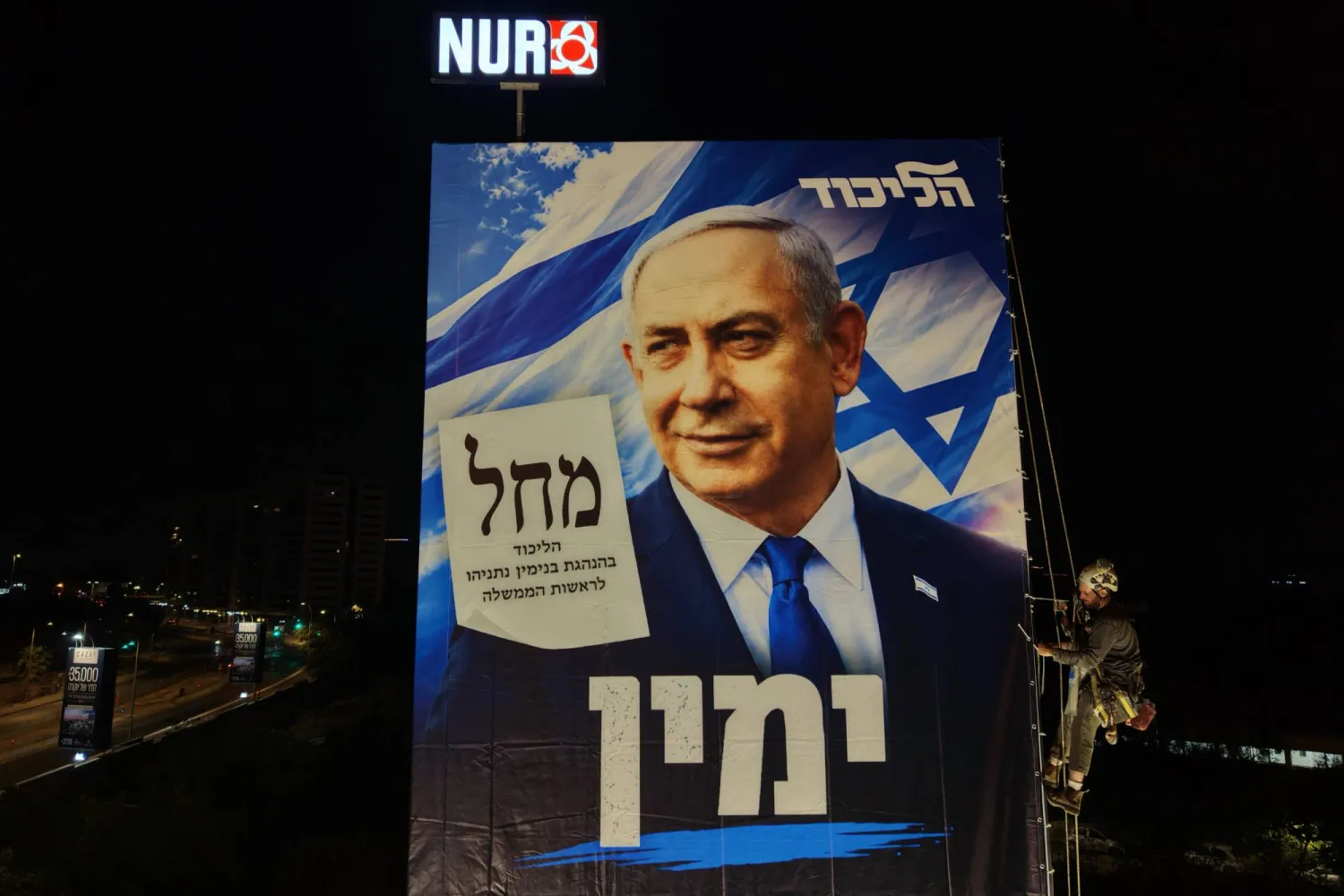
Rappelling workers install an election billboard featuring an image of Israeli Prime Minister Benjamin Netanyahu, and reading in Hebrew "It's either the Right or Palestine," in Ramat Gan near Tel Aviv, Israel, 18 October 2026. (EPA)
TT

In Shadow of War, Israelis to Decide if Hard-Right Turn Is Permanent

Rappelling workers install an election billboard featuring an image of Israeli Prime Minister Benjamin Netanyahu, and reading in Hebrew "It's either the Right or Palestine," in Ramat Gan near Tel Aviv, Israel, 18 October 2026. (EPA)

Three years after suffering their deadliest single attack, Israelis will deliver their verdict on veteran Prime Minister Benjamin Netanyahu in an October 27 election that could decide if the country moves definitively into hard-right nationalism.

The trauma of October 7, 2023 remains raw across Israel. Faded stickers bearing the smiles of young people killed by Hamas cover station walls and lampposts, and at bustling restaurants, no one bats an eye as patrons dine with their assault rifles, now liberally allowed.

Netanyahu, Israel's longest-serving prime minister who polls show is in a tight race, is seeking a new mandate after leading a multi-front regional war in response to October 7, with Israel reducing Gaza to rubble, occupying part of Lebanon and, with US help, bombarding Iran.

The relentless Gaza campaign has brought pariah status to Israel in many once-friendly Western countries, and Netanyahu himself faces an arrest warrant from the International Criminal Court.

Even if the public broadly has supported the war's aims, the effects at home have been much more divisive, including emboldening Netanyahu's far-right allies bent on reshaping Israel into a religious-nationalist Jewish state.

"I really think that these elections are about the future of the state in a literal sense," said Gideon Rahat, a political scientist at the Hebrew University of Jerusalem and the Israel Democracy Institute.

Netanyahu's government has ramped up settlements in the occupied West Bank where settlers armed with the blessing of far-right National Security Minister Itamar Ben-Gvir have been attacking Palestinians on their lands with only occasional pushback from authorities.

"The state without a monopoly on the use of force is a failed state," Rahat said.

Netanyahu, who turns 77 on October 21, has served as prime minister on and off for more than 19 years.

The wily political operator returned to power in December 2022 bringing in once-shunned ultra-nationalists and quickly tried to rein in the judiciary, which is examining corruption charges that could land him in jail.

The proposed reforms brought out some of the largest protests in Israel's history in the months before the Hamas attack.

"Everyone in the country has a strong opinion about Netanyahu. People either hate him or adore him," said Alon Yakter, a political scientist at Tel Aviv University.

"When you want to see who people vote for, the first question you have to ask is their emotional feelings about Netanyahu."

- Anti-Netanyahu in style, not stance -

Seeking to unseat Netanyahu is an informal bloc of parties united mostly around their distaste for him.

Netanyahu's most formidable rival, according to polls, is former military chief Gadi Eisenkot, who is in many ways his antithesis -- a political novice who wants to unite centrists rather than rally a base, and a phlegmatic speaker with halting English and none of the American-raised Netanyahu's flair for blistering, headline-grabbing speeches.

Eisenkot, as well as other opposition leaders, have zeroed in on why Netanyahu failed to prevent October 7.

Netanyahu has been rocked by reports he ignored warnings. He vehemently denies the charges, blaming security chiefs who he said failed to wake him up that morning.

Netanyahu "may have his perfect English, but even with perfect English he got us October 7", Eisenkot, in Hebrew, told a security conference at Reichman University.

Eisenkot's son died in the Gaza war -- offering an unspoken contrast to Netanyahu's son Yair, a globe-trotting social media provocateur.

The working-class son of Moroccan Jewish immigrants, Eisenkot would be the first prime minister of Middle Eastern ancestry, a watershed in a country politically dominated since its founding by an elite of European descent.

Opposition leaders have not criticized Netanyahu's decision to wage war, likely a losing stance in a country where a recent survey found that only 21 percent of the population identifies as anywhere left of center.

Eisenkot, as military chief during the 2006 Lebanon war, promoted the Israeli doctrine of using massive force even against civilian infrastructure when in areas used by militants, such as Hezbollah.

The opposition has instead heavily focused on social issues including Netanyahu's tight alliance with ultra-Orthodox Jews, a fast-growing segment of the population due to high birth rates that has promoted religious priorities, such as keeping public transit closed on Saturdays.

Netanyahu, while personally secular, has allowed religious students to remain exempt from military service, a source of particular resentment when stretched reservists have served multiple tours.

Opposition figure Naftali Bennett, prime minister in a short-lived 2021-22 government, has vowed to end all exemptions to military service and said that social divisions were putting Israel on a "slow-motion suicide mission".

- Hardline appeal -

While the opposition attacks Netanyahu over October 7, for some Israelis, the aftermath of the attack shows the government has brought stability.

While Israelis have died in Iranian and Hezbollah retaliatory attacks, fire has stopped from Gaza, even as Israel keeps striking the territory and Hamas remains.

Israel's economy has boomed since October 7, with construction sites dotting the major cities and the stock market soaring, led by the technology and defense sectors.

Neriah Yarchi, 19, a barber from Bat Yam near Tel Aviv, came of political age after October 7. He said he would vote for far-right Finance Minister Bezalel Smotrich, who wants the "voluntary" removal of Gaza's two million Palestinians.

"If Gaza had been ours, they wouldn't have had a place to infiltrate from and there wouldn't have been a massacre," Yarchi said.

Netanyahu has sought to seize on his international notoriety, with his Likud party putting up posters of leaders including New York Mayor Zohran Mamdani, an outspoken critic of Israeli policies, that read, "They want Netanyahu to lose. Don't let them win."

Netanyahu has also vowed loudly never to align with parties representing Arab Israelis, who make up around one-fifth of the population and who some expect to turn out in higher numbers after the intense anti-Arab stances of some of Netanyahu's ministers.

Arab lawmakers broke precedent to be kingmakers in the 2021-2022 government.

If the new election's results are as close as expected, it could take weeks or months to form a government. Eisenkot has said he would not ally with Arab parties or Netanyahu, but some critics do not believe he would refuse.

Uriel Reichman, a former lawmaker who founded the university bearing his name, told the conference addressed by Eisenkot that a Netanyahu triumph could permanently entrench Israel's right-wing turn.

He drew a parallel to countries where an elected populist packs the government with loyalists and transforms once-independent institutions.

"Experience shows that once such a system is put in place, it would be extremely difficult to dismantle it," he said.


Israel Faces New Era of Sinking US Support After Election

Republican presidential nominee and former US President Donald Trump appears on a congratulatory billboard for the 2024 US Presidential Election, in Tel Aviv, Israel, November 6, 2024. (Reuters)
TT

Israel Faces New Era of Sinking US Support After Election

Republican presidential nominee and former US President Donald Trump appears on a congratulatory billboard for the 2024 US Presidential Election, in Tel Aviv, Israel, November 6, 2024. (Reuters)

Prime Minister Benjamin Netanyahu's brash campaign posters are still up on Israeli public buses -- images of him, US President Donald Trump and soaring warjets that laud the two leaders attacking Iran together.

Neither is now advertising the state of the two countries' alliance.

A week after an inconclusive election for Netanyahu, Americans overwhelmingly rejected Trump and chose a Congress led by Democrats who want a tougher approach to Israel, whether on Iran, Gaza or settler violence in the occupied West Bank.

The back-to-back elections look to many observers like a turning point, with Israel no longer able to take for granted the cover of the world's most powerful country.

"This is a new era. The confluence of the Gaza war and the war with Iran have really changed how mainstream Americans -- not people particularly concerned with the Israeli-Palestinian conflict -- see Israel," said Yael Sternhell, an expert on the United States at Tel Aviv University.

Vice President JD Vance, assessing why his Republicans fared poorly, listed four ways to bring voters back, including ending the Iran war and changing "our relationship with Israel".

Trump did not disagree. Just as voting was underway Tuesday, Trump said he had agreed with Netanyahu to end the $3.8 billion in annual US military aid to Israel by the end of this year, explicitly tying the decision to the US political mood.

Netanyahu, Israel's longest-serving prime minister who has served on and off for nearly two decades, had eagerly sought Trump's endorsement but also acknowledged his country's growing isolation.

In the final days of the campaign, he suggested Israel turn to cryptocurrencies to circumvent international sanctions he expected would intensify.

Netanyahu has not commented on the US election or Trump's aid remarks.

Amit Segal, a journalist known for his proximity to Netanyahu, posted that the political situation in the United States marked a "catastrophe" for Israel.

- Can Eisenkot restore the alliance? -

Opposition contender Gadi Eisenkot, who is trying to cobble together a coalition to oust Netanyahu, has cast himself as capable of repairing relations.

In an English-language statement, the former military chief said he believed in "liberal values" and also wanted to work "closely and constructively" with Trump.

Yair Golan, the main left-wing leader inside Eisenkot's bloc, called for Israel to restore a bipartisan approach destroyed by Netanyahu who he said promoted a "destructive Israeli narrative of eternal war and authoritarian rule".

Netanyahu boasted in his campaign about standing up to Democratic presidents including Barack Obama, who remains a hero for many Democrats. Netanyahu openly aligned with Republicans a decade ago to attack Obama's diplomacy on Iran.

"Netanyahu certainly rubs Democrats the wrong way and has made every effort to alienate them," Sternhell said.

"But Eisenkot can't just be a nicer man to receive a softer approach from this new Congress," she added. "He's going to need new policies."

She said Eisenkot would likely enjoy Israeli public support for cracking down on extremist settlers, who have attacked Palestinians in the West Bank with virtual impunity.

But Israel has shifted to the right, with wide initial support for the Gaza war.

- Broadening criticism of Israel -

The new Congress will include progressive Democrats such as Abdul El-Sayed, the first Muslim elected to the Senate, who describe the devastation in Gaza as genocide, an assertion rejected by Israel.

Netanyahu "made a bet not only on the Republicans but almost personally on Trump", said Eli Kowaz, senior policy director of the Economic Cooperation Foundation, an Israeli think tank that backs a two-state solution with the Palestinians.

"These results show that bet had an expiry date," Kowaz said. "Also, for the first time, really, I think there's a realization that it isn't only about the Democrats. It's a problem with the relationship with America."

Without US assistance, Israel still has its own major arms industry and retains a clear edge fighting non-state actors such as Hamas and Hezbollah, said Ehud Eilam, a former researcher for the Israeli defense ministry.

But he said Israel would need to rely more on cheaper artillery or non-sophisticated bombs, further increasing risks of civilian casualties that have enraged international opinion.

"Israel can adjust to a new strategic reality of losing much and even all US military aid, but it will be tough for Israel. It will require Israel to consider hard choices such as taking huge loans or raising taxes," Eilam said.

Kowaz said that Eisenkot, aware of politics in Washington, was trying to show he is interested in regional stability and strategic agreements and not just "an indefinite state of war".

"He is definitely laying out a different vision for Israel's relationship with the United States."


Trump Could Woo North Korea After Midterm Setback, but Kim May Not Respond

US President Donald Trump meets with North Korean leader Kim Jong Un at the demilitarized zone separating the two Koreas, in Panmunjom, South Korea, June 30, 2019. (Reuters)
TT

Trump Could Woo North Korea After Midterm Setback, but Kim May Not Respond

US President Donald Trump meets with North Korean leader Kim Jong Un at the demilitarized zone separating the two Koreas, in Panmunjom, South Korea, June 30, 2019. (Reuters)

The rebuke President Donald Trump suffered in the US midterm elections could prompt him to step up efforts to re-engage North Korea, but any willingness to make major concessions risks creating friction with regional allies.

Analysts and officials in Asia expect Trump to focus on foreign policy as he seeks to build his legacy in the final two years of his term. With efforts to resolve the wars in Ukraine and Iran yet to produce breakthroughs, he is likely to turn to Asia, where he believes he has room to maneuver.

North Korean leader Kim Jong Un, with whom Trump has been eager to restart talks, is likely to be a key part of that effort, they say.

"Trump is likely to devote significant effort to achieving foreign policy successes, especially if he faces greater constraints on the domestic front," said Ban Kil-joo, international relations professor at the Korea National Diplomatic Academy in Seoul.

"Given Trump would want a successor to win in 2028, there is a strong possibility that engagement with North Korea would be part of that agenda," he ‌said.

But there is ‌little incentive at the moment for Kim to respond, analysts say.

Asked about Trump's plans for diplomacy with North ‌Korea, the White ⁠House said Trump ⁠has restored American strength on the global stage and strengthened ties with world leaders.

"His foreign policy decisions have never been motivated by politics," White House spokeswoman Anna Kelly said in emailed comments to Reuters.

"The Commander-in-Chief will always act in the best interest of the American people and our national security."

Trump met Kim three times during his first term after a war of words that raised fears of military conflict.

But their 2019 summit ended without agreement after they failed to reach a deal on North Korea's nuclear weapons program and sanctions relief.

Seven years later, the stakes are higher. North Korea has expanded its nuclear and missile arsenal, while Pyongyang's ties with Russia and China are the best in years, giving Kim less incentive to negotiate and potentially increasing pressure on Trump to offer concessions.

TRUMP CALLS KIM 'GREAT GUY'

Trump has touted his relationship with Kim, ⁠calling him a "great guy" and saying that they "get along very well."

Nonetheless, US and South Korean officials see ‌fading chances of a meeting this year, with Washington receiving no response from Pyongyang ahead of a regional ‌summit in China this month where they might have met.

Kim's influential sister, Kim Yo Jong, has said dialogue remains a path to peace, but Pyongyang sees no need ‌for talks now. She denounced what she called Washington's "hostile policy" while denying US accusations that North Korea stole more than $6 billion in virtual assets from Binance ‌last week.

Her brother has previously said he was open to talks if Washington stopped insisting his country give up nuclear weapons. Regional allies South Korea and Japan are opposed to any such concession.

"A summit that shelves denuclearization would undermine deterrence and create policy friction among Washington, Seoul and Tokyo," said Leif-Eric Easley, professor of international studies at Ewha Womans University in Seoul.

Officials in Japan and South Korea are concerned they could be "cut out of the loop" if Trump deals directly with Kim, with the quiet blessing of Beijing and Moscow, a ‌senior Japanese official said, speaking on the condition of anonymity.

"(Japanese officials) are concerned about the lengths he will go to get a summit with North Korea’s Kim Jong Un, such as dropping the issue of denuclearization."

'BIGGEST CHANGE ⁠SINCE WORLD WAR TWO'

Trump has referred ⁠to North Korea as a nuclear power, a status that allies in the region and the West have refused to recognize despite the dozens of nuclear warheads Pyongyang is believed to have built and its stockpile of fissile material.

"If US-North Korea talks lead Washington to accept North Korea's nuclear status, the security environment in Asia would change dramatically," said Professor Kazuhiro Maeshima at Sophia University in Japan.

"The biggest change since World War Two could occur in the remaining two years of the Trump administration. It is a serious situation."

Kim now has a vastly more advanced arsenal than at the time of the 2018-2019 summits, including more weapons and missiles, hypersonic glide vehicles, a growing fleet of modern warships and submarines, and improved drone capabilities.

If Trump were to bring Kim back to the table, he might need to offer more than partial sanctions relief.

Such concessions could face hurdles at home from a Democratic-controlled Congress and Trump's limited time in office, said Moon Chung-in, a Yonsei University Professor in Seoul who served as a presidential adviser on national security.

"And what is important is North Korea's perception and calculation; if North Korea thinks that Trump has entered a lame-duck period and he cannot get the support from Congress... there's no reason for Kim Jong Un to come to dialogue," he said.

Former US Deputy Secretary of State Stephen Biegun, who led US negotiations with North Korea during Trump's first term, also said there were few incentives for Pyongyang currently.

"The North Koreans, I think, have very little upside to a meeting like this right now, and potentially some downside."


Is the MAGA Era Over?

President Donald Trump gestures while boarding Air Force One at Morristown Airport, Monday, Sept. 7, 2026, in Morristown, N.J. (AP Photo/Julia Demaree Nikhinson)
TT

Is the MAGA Era Over?

President Donald Trump gestures while boarding Air Force One at Morristown Airport, Monday, Sept. 7, 2026, in Morristown, N.J. (AP Photo/Julia Demaree Nikhinson)

Has MAGA fever finally begun to fade? Will the American right abandon the Make America Great Again slogan and Donald Trump's populist ideology in favor of a more traditional brand of conservatism?

Following a crushing defeat in midterm elections that revolved almost entirely around one man, many Republicans have begun questioning the party's future and what role, if any, Trump should play in shaping it.

The Wall Street Journal, whose editorial pages have long represented the establishment right, called for "soul-searching" and urged Republicans to move away from the ultranationalist, identity-driven rhetoric that helped return the 80-year-old Trump to power.

In an editorial titled "The Trump Reckoning Arrives," the newspaper argued that tariffs and mass deportations were no substitute for higher real incomes.

It added: "Playing to the bro MAGA base is no substitute for persuading Hispanics, independents and suburban swing voters who abandoned the party on Tuesday."

"Still Your President"

The White House, however, appeared far less inclined toward introspection.

Its first post on X on Wednesday featured a stern-looking Trump accompanied by the words "Trump is still your president," a reminder that he will remain in office until January 2029.

But the American political calendar never stands still. Wednesday also effectively marked the beginning of the 2028 presidential campaign, which will culminate in the election of Trump's successor.

The US Constitution bars Trump from seeking a third term.

There was no realistic scenario in which Trump could have emerged from the midterm elections in a stronger political position.

The scale of the Republican defeat on Tuesday night, which exceeded even some of the Democrats' most optimistic expectations, has accelerated the erosion of his political influence.

Eyes on 2028

Vice President JD Vance, widely regarded as a potential contender for the White House in 2028, was careful not to confront his boss directly.

In a lengthy, essay-like post on X on Wednesday, Vance wrote: "The reason we lost is the war."

He immediately added: "The president himself said so last night."

That was not entirely accurate. Trump had attributed the defeat partly to the war in the Middle East, while also arguing that Republicans had fielded weak candidates.

Florida Governor Ron DeSantis described the outcome as an "extinction-level event" for the Republican Party, suggesting Republicans might have to wait until 2032 to regain control of Congress.

Republican lawmaker Don Bacon wrote on X that the party "needs to reclaim our Reagan principles."

He added: "Voters rejected populism, chaos, Putin and tariffs."

Former congresswoman Marjorie Taylor Greene, a far-right figure who has turned against Trump, went further.

"If the GOP wants any chance in the future, it will have to kick Donald Trump out of the party," she said.

Matthew Boyle, a prominent figure at the far-right news outlet Breitbart, wrote on X that "Republicans need to get back to basics."

"No more endless wars," he said.

On the economy, which he identified as the top issue, Boyle called for policies that benefit ordinary Americans rather than special interests.

He also urged Republicans to "be sane with immigration enforcement."

Criticism Without Naming Trump

For now, however, criticism remains relatively muted. Only a handful of conservative figures, whether moderates or hardliners, have been willing to attack Trump by name.

After all, the Republican Party has tied its political fortunes almost entirely to Trump since 2016.

"The big question is, are some of these Republican leaders in the House and Senate going to distance themselves from Trump?" Amy Dacey, a former Democratic official who is now an expert at American University, told AFP.

The same question applies to far-right influencers whose prominence and financial success have been closely linked to Trump's popularity.

Dacey said a devastating electoral defeat could diminish their influence, but it would by no means eliminate those associated with the MAGA movement.

Some of MAGA's online supporters have already attempted to shift the blame elsewhere.

"Great work, neocons," Jack Posobiec wrote sarcastically on X, referring to the neoconservative wing of the Republican Party, known for its interventionist foreign policy and hawkish stance toward Iran.

Nevertheless, it may only be a matter of time before the divisions become more pronounced.

Former congressman Bob Good wrote on the same platform: "Gotta start by acknowledging that Trump was and is the problem. Quietly whispering it won't do it."