Netanyahu Might Be Finished but His Policies Toward the Palestinians Will Largely Endure

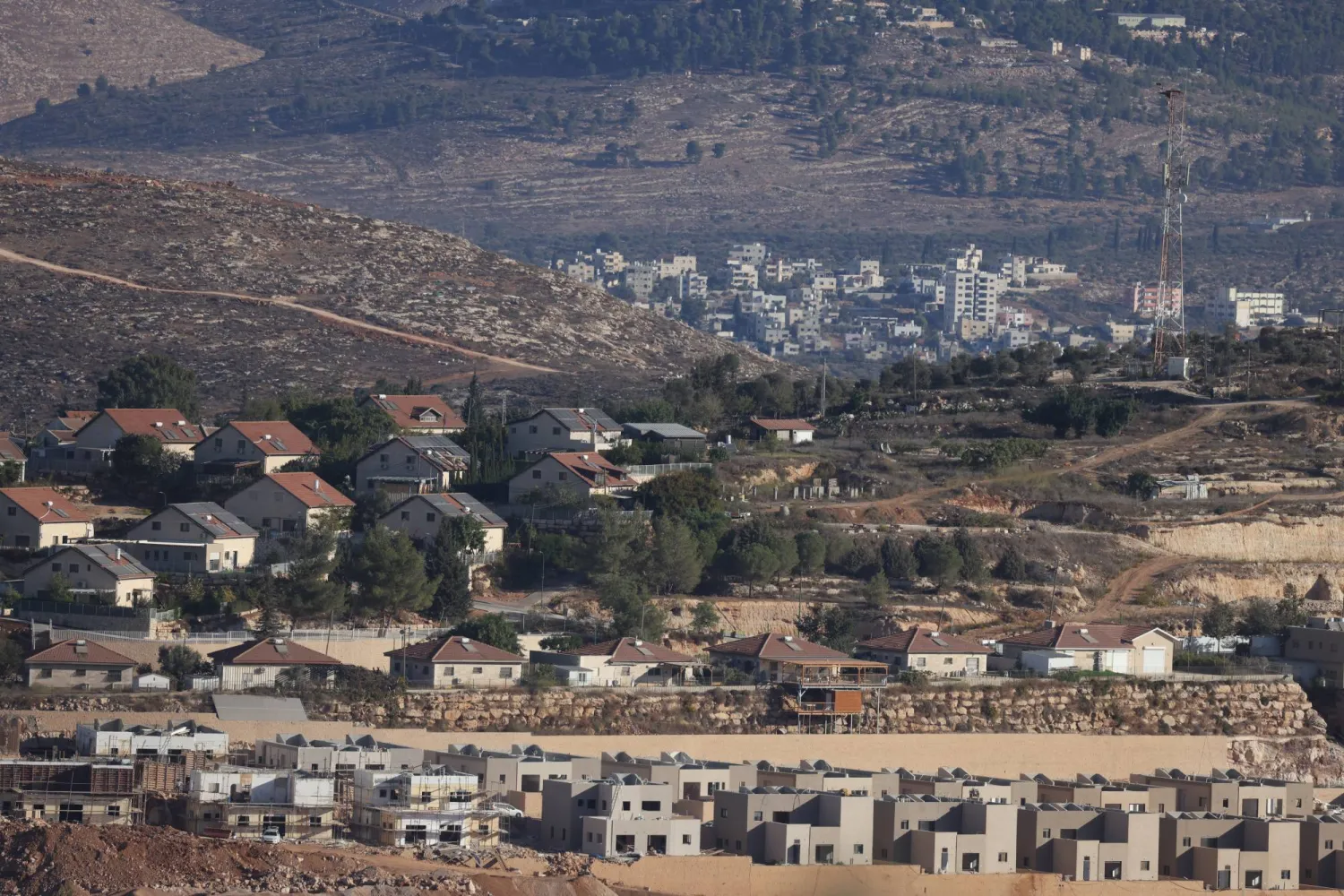
A view of the Israeli settlement of Itamar from the village of Awarta, south of Nablus in the West Bank, 20 October 2026. (EPA)
TT

Netanyahu Might Be Finished but His Policies Toward the Palestinians Will Largely Endure

A view of the Israeli settlement of Itamar from the village of Awarta, south of Nablus in the West Bank, 20 October 2026. (EPA)

Israel's elections Tuesday could mark the end of Prime Minister Benjamin Netanyahu's decades-long political career.

But his legacy in the Israeli-occupied West Bank — of massive settlement expansion, the displacement of tens of thousands of Palestinians and the empowerment of armed settler extremists — will likely endure, even if his opponents seek to rein it in.

Israelis are deeply divided over Netanyahu's leadership and moral character, but they largely support settlement expansion and are opposed to a Palestinian state. So, while Netanyahu's opponents have vowed to crack down on settler violence and remove the most contentious outposts, they are mostly against a two-state solution, seen internationally as the only realistic way to resolve the conflict.

“There shouldn’t be any illusions,” said Mairav Zonszein, senior Israel analyst at the International Crisis Group.

“At best, (a new government) would be able to slow down the extremely crazy acceleration that we’ve seen in the last four years of every aspect of Israel’s aggression in the occupied territories and inside Israel itself.”
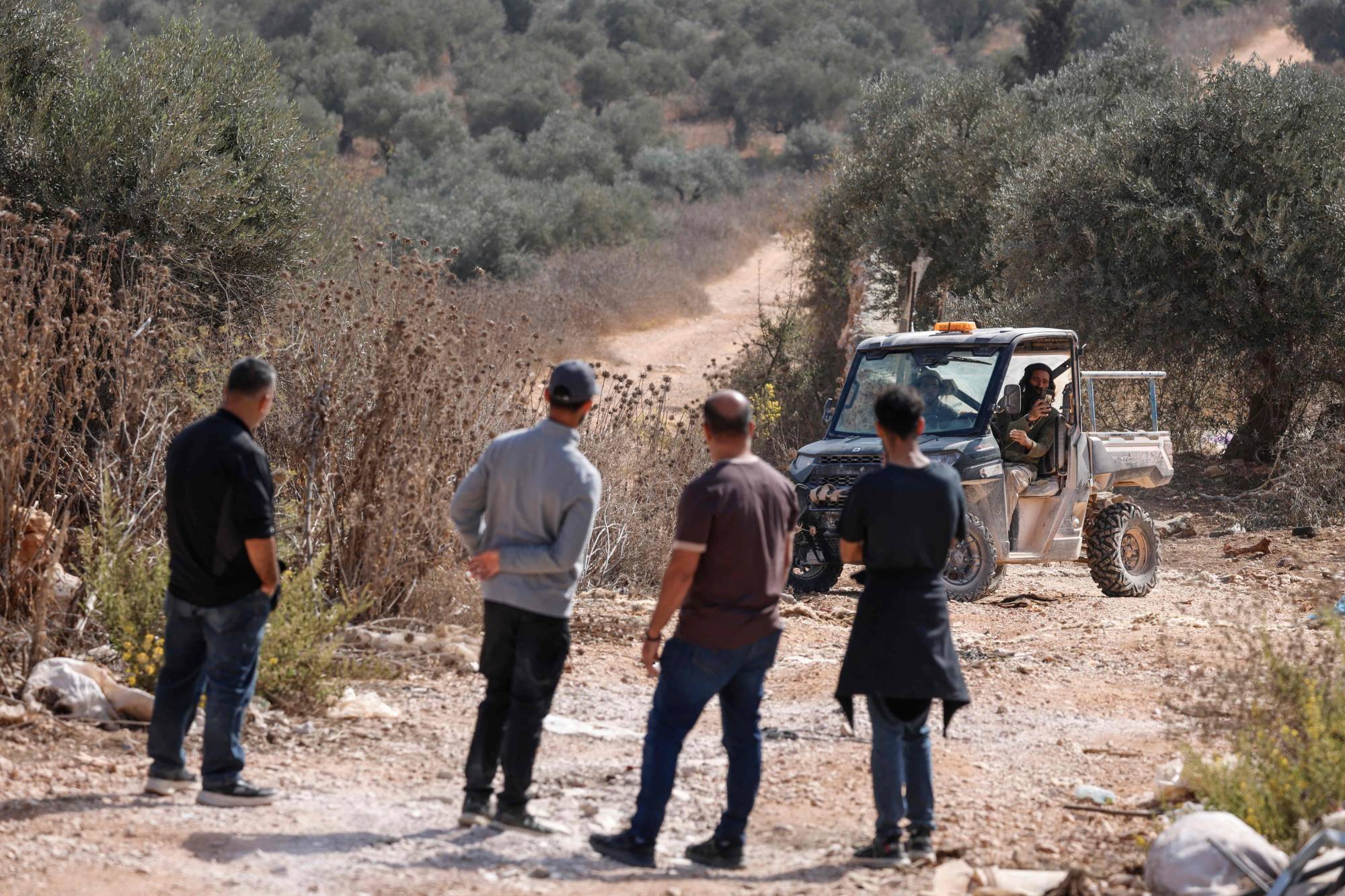
An Israeli settler takes photographs of Palestinian farmers and foreign activists gathered to pick olives in the village of Turmus Ayya, northeast of Ramallah in the Israeli-occupied West Bank, on October 21, 2026. (AFP)

The military stands down in the face of settler violence

One legacy of Netanyahu’s nearly unbroken 17-year rule — the longest of any Israeli leader — is that large groups of armed settlers now routinely defy the Israeli military as they rampage through Palestinian communities, drive people from their homes and seize ever larger swaths of their land.

Hamas' Oct. 7, 2023, attack out of Gaza turbocharged the process. Netanyahu's opponents could bring in more troops and authorize stricter measures, but the genie may already be out of the bottle.

Netanyahu's government has distributed thousands of firearms to the settlers, who have allies in the military and security forces. Some extremist settlers have become like sheriffs — making arrests, killing Palestinians they say posed a threat, summoning security forces and driving Palestinian families from their homes.

The Palestinian Tubasi family was forced out in July after settlers besieged their hilltop home in the West Bank village of Jalud for 19 days. The settlers cut off their water access and their electricity, and threatened to “barbecue” them if they didn’t leave, said Mahmoud Tubasi, 60, the patriarch.

An Israeli court ordered the military to bring the family back, but that hasn't happened. Troops aborted their latest mission soon after it began, when a mob of over 150 armed settlers quickly assembled, scaled the walls of the home and set a car on fire.

Troops threw Tubasi and his family into an armored jeep and drove them away as settlers torched the place. They now live in relatives' houses in the valley below their gutted and blackened home, around which settlers still roam.

Israel’s military did not respond to a request for comment.

“If they wanted to evacuate them, of course, 100%, they can do that,” Tubasi said. “This is an army that fights in Lebanon, Gaza and in Iran — they can’t control 150 or 200 settlers?”
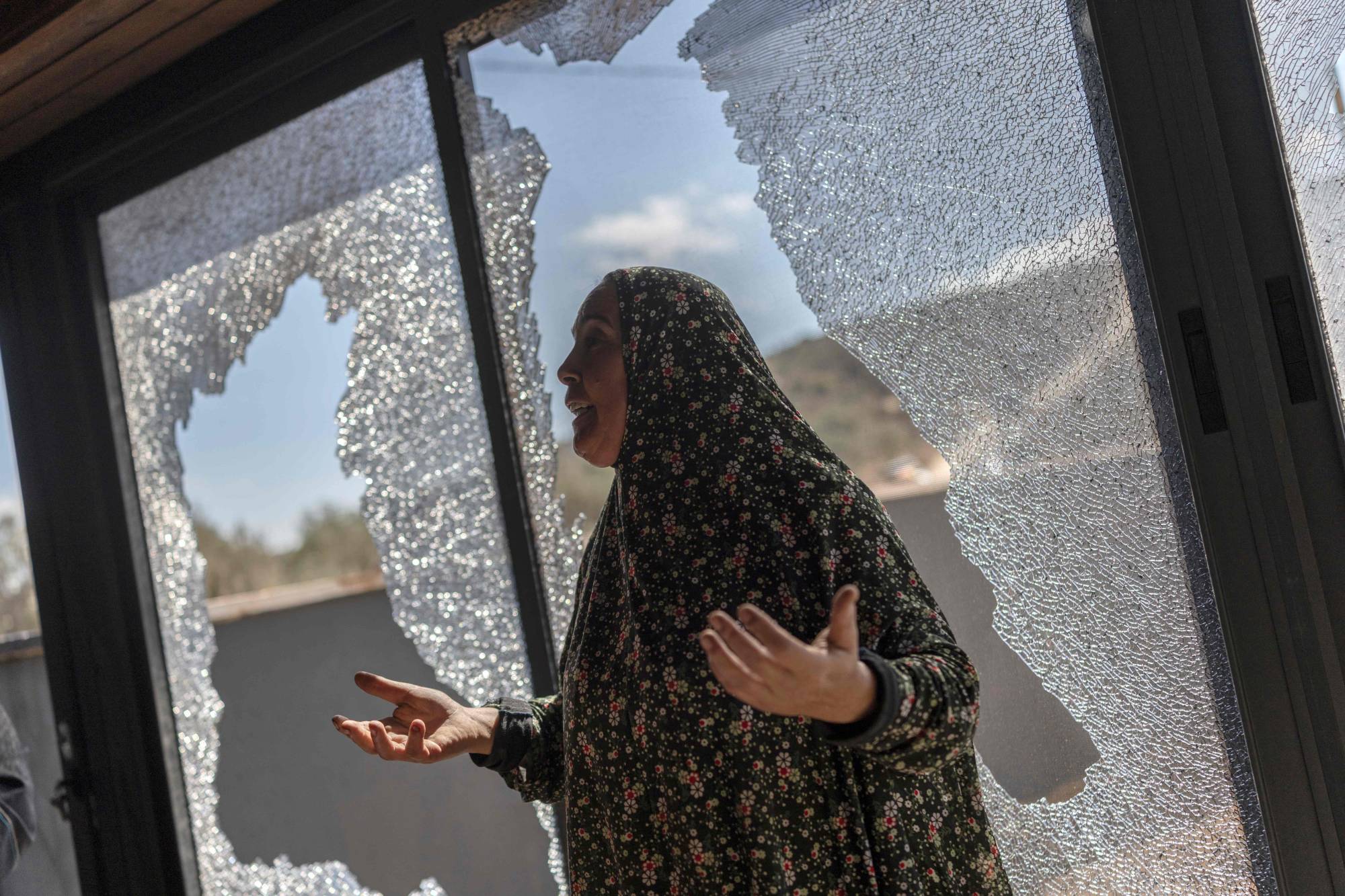
Palestinian Hanan Hamayei gestures as she stands near the shattered glass of her home following a reported attack by Israeli settlers, in the Israeli-occupied West Bank village of Turmus Ayya on October 19, 2026. (AFP)

The process is repeated across the West Bank

Under Netanyahu, settlers have established over 250 rustic camps across the territory, focusing particularly on areas where Palestinian herding communities have dwelled for decades.

The outposts allow the settlers to effectively run Palestinians off vast rural areas by attacking shepherds, taking over water resources and grazing their own herds, all under the eye of Israeli troops.

Dror Etkes, a researcher with an Israeli anti-settlement group, says the outposts have allowed the settlers to seize effective control of around a fifth of the West Bank. Israel captured the territory, along with Gaza and east Jerusalem, in the 1967 Middle East war. The Palestinians want all three territories for their future state.

Since 2023, the strategy has forced at least 127 Palestinian herding communities off their land, according to data gathered by Etkes' organization, known as Kerem Navot, and B'Tselem, another Israeli anti-settlement group.

The departures have cleared nearly the entire eastern flank of the West Bank, along the border with Jordan, of Palestinians. The settlers' explicit goal is to prevent the establishment of a viable Palestinian state.

Netanyahu’s opponents say they will go after the most violent settlers and dismantle outposts, which are illegal under Israeli law. But they will not evacuate the over 100 new settlements Netanyahu's government legalized, including 44 that were formerly outposts. Nor will they remove settlements dating back decades, many of which now resemble fully developed suburbs.

Most of the international community views all Israeli settlements as illegal and an obstacle to a two-state solution. Israel views the West Bank as the biblical and historical heartland of the Jewish people and says its future status should be decided by negotiations, which have not been held in over a decade.

Even if some outposts are removed, many Palestinians seeking to return would find their homes burned and looted, and would continue to face threats from nearby settlers.

“The story is over. There will be no massive dismantlement of settlement,” said Etkes. “It’s now a full and prouder-than-ever apartheid regime.”

Amnesty International and other major rights groups accused Israel of the international crime of apartheid even before the Oct. 7 attack and its aftermath. Israel denies the allegation.
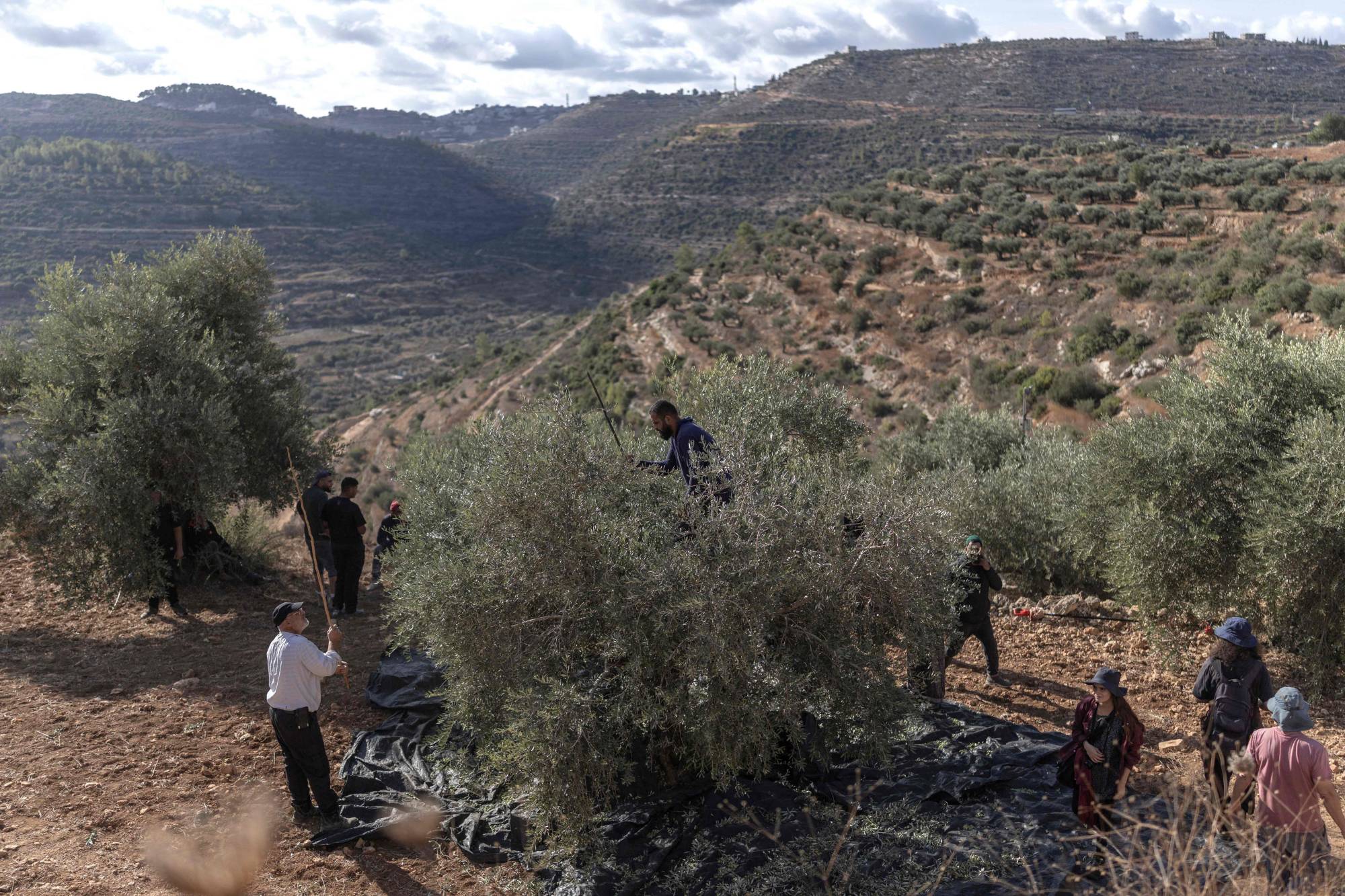
Palestinians harvest their olive trees in the Israeli-occupied West Bank village of Deir Abu Mashal on October 19, 2026. (AFP)

Netanyahu's opponents promise modest change

The politician most likely to replace Netanyahu as prime minister is retired general Gadi Eisenkot, a political centrist. He hopes to form a majority coalition with three other parties spanning Israel's political spectrum and without Arab-led parties advocating a two-state solution.

Beth Oppenheim, an Israel analyst for the European Council on Foreign Relations, said the opposition has “struggled to formulate a convincing alternative" to the right's new security strategy of “aggressively preempting threats, maintaining complete freedom of operation and imposing buffer zones.”

Palestinian attacks, like a shooting on Friday that killed two Israeli soldiers, and efforts on the right to cast the Israeli left as enemy sympathizers, have taken their toll. “The net effect is that talk of ‘peace’ and compromise has become politically toxic,” Oppenheim said.

Eisenkot does not support a Palestinian state, but is open to limited self-rule in the 40% of the West Bank currently administered by the Palestinian Authority under agreements reached in the 1990s. He would allow settlement growth in the other 60% of the territory, which is under direct Israeli military rule.

He has also vowed to empower Israeli troops and paramilitary Border Police to crack down on settler violence.

Eisenkot “is interested in lowering the friction in the West Bank and interested in definitely lowering the sanctions and the intention for sanctions by European countries,” Zonszein said. “He’ll do kind of the minimum necessary to get the maximum effect.”

Eisenkot's prospective allies include left-wing politicians who oppose settlements and have favored a two-state solution, but they have agreed to set those positions aside to form a coalition to oust Netanyahu.

Israeli leaders have long balanced their ambitions in the occupied territories with demands from Washington aimed at resolving the conflict. But they are unlikely to face any significant pressure from US President Donald Trump, who endorsed Netanyahu and has long backed his policies.

Xi-Putin-Trump Summit: What Comes Next?

19 November 2026, China, Shenzhen: (L-R) Russian President Vladimir Putin, Chinese President Xi Jinping and US President Donald Trump pose for a photo as they arrive for a trilateral meeting at Kylin Villa, on the sidelines of the APEC Summit. (Kremlin/dpa)
TT

Xi-Putin-Trump Summit: What Comes Next?

19 November 2026, China, Shenzhen: (L-R) Russian President Vladimir Putin, Chinese President Xi Jinping and US President Donald Trump pose for a photo as they arrive for a trilateral meeting at Kylin Villa, on the sidelines of the APEC Summit. (Kremlin/dpa)

An unprecedented summit between Chinese, US and Russian leaders this week in Shenzhen was light on substance but immensely symbolic, analysts say.

From nuclear weapons to reforming the United Nations and cancelling international arrest warrants, AFP looks at what was announced, its significance and what might come next:

- Substance or hot air? -

The three leaders jointly declared lofty goals to "reduce nuclear risks" and reform the United Nations, as well as commitments to immunity for state officials.

Their "Declaration toward Peace" also said the countries plan to boost oil supply and reaffirmed the importance of "stable energy flows".

The promise of dialogue on nuclear risks and non-proliferation "creates an opening for cooperation despite disagreements over arsenal reductions", said Sun Chenghao, senior fellow at the Center for International Security and Strategy at Tsinghua University.

"Implementation is now the main test," he told AFP.

Progress could be signaled by dates for nuclear talks or the appointment of designated officials.

Beijing previously rebuffed Trump's invitations to nuclear arms talks, arguing the US and Russia should first cut their giant arsenals before it agreed to discuss its smaller stockpiles.

The four-point declaration contains few details on future actions, with Germany's Chancellor Friedrich Merz calling the meeting a "photo op".

The "fairly sparse" points were "least common denominators" among the leaders, said Ryan Hass at the Brookings Institution.

Trump told reporters he would give a press conference on Friday, where he may provide more details.

- A new Yalta? -

The symbolism of three powerful leaders gathering to discuss global security issues -- including Putin's invasion of Ukraine and Trump's war with Iran -- had raised comparisons to the 1945 Yalta Conference.

Then-leaders of Britain, the United States and the Soviet Union met to hash out the post-World War II settlement and re-draw European borders.

Ukraine's Volodymyr Zelensky and European powers worried Thursday's summit would push for a peace settlement favorable to Moscow without them at the table.

The format "suggests the creation of conditions where Beijing, Moscow, and Washington call the shots for the rest of the world", said Chong Ja Ian, an associate professor at the National University of Singapore.

But "a functioning 'G3' would require much greater agreement among the three countries and cooperation from many other governments," Tsinghua University's Sun told AFP.

"The Yalta analogy also overlooks today's economic interdependence and the influence of regional actors," he said.

- Should Europe, others worry? -

Other US allies such as Japan, South Korea and Taiwan -- which unlike China and Russia are vibrant democracies -- will also have eyed the summit with unease.

"From South Korea's perspective, this inevitably raises questions about whether it can continue to rely on its alliance with the United States," said Lee Jae-mook, a political science professor at Hankuk University of Foreign Studies.

"The pillars of South Korea's foreign and security policy that it has long taken for granted are being shaken," Lee told AFP.

Japan, too, may reconsider its relationships with China and the US.

"If China and Russia really draw the United States together, I think Japan will have a huge pressure to... make a better relationship with China," said Tzeng Wei-feng, an associate research fellow at Taiwan's National Chengchi University.

However, Tokyo and Washington maintain a bilateral defense pact, so there will likely be "no substantial change" in their ties, he added.

The US has roughly 54,000 military personnel stationed in Japan -- whose relations with China are poor -- and 28,500 in South Korea.

Despite the bonhomie between Xi, Trump and Putin displayed in Shenzhen, major strategic differences remain between their countries.

Washington has curbed Beijing's access to US technologies, while Moscow is fighting a Ukraine that still relies in large part on American intelligence.

Diverging national interests between China, the US and Russia means the rest of Asia won't be "overly concerned" yet, according to Dylan Loh of Singapore's Nanyang Technological University.

The format may not stick, especially after Trump leaves office in two years, he said.

- What next? -

"Perhaps the most noteworthy aspect is the absence of any commitment to reconvene or continue meeting at the leader-level," said Brookings' Hass.

With no follow-up announced, eyes will turn to next month's G20 summit in Miami, where Xi and Trump are due to hold their fourth meeting of the year, and Putin could make his first appearance at the grouping since his war in Ukraine began.

He has been shunned by most Western leaders since Russia's full-scale invasion in 2022.

Still, "there is little chance that such a meeting will be held again", said Shen Dingli, a Shanghai-based scholar of international relations.

International Criminal Court (ICC) members -- which exclude the US -- are obliged to detain Putin if he travels to their territory after the court issued a warrant for him for war crimes associated with the Ukraine invasion.

"Putin has been ruled an international criminal by the ICC, and most APEC and G20 members are signatories to the Rome Statute. So, there are few opportunities for the three countries' leaders to convene," said Shen.


Turkish Investments in Egypt Strengthen Ties Despite Political Differences

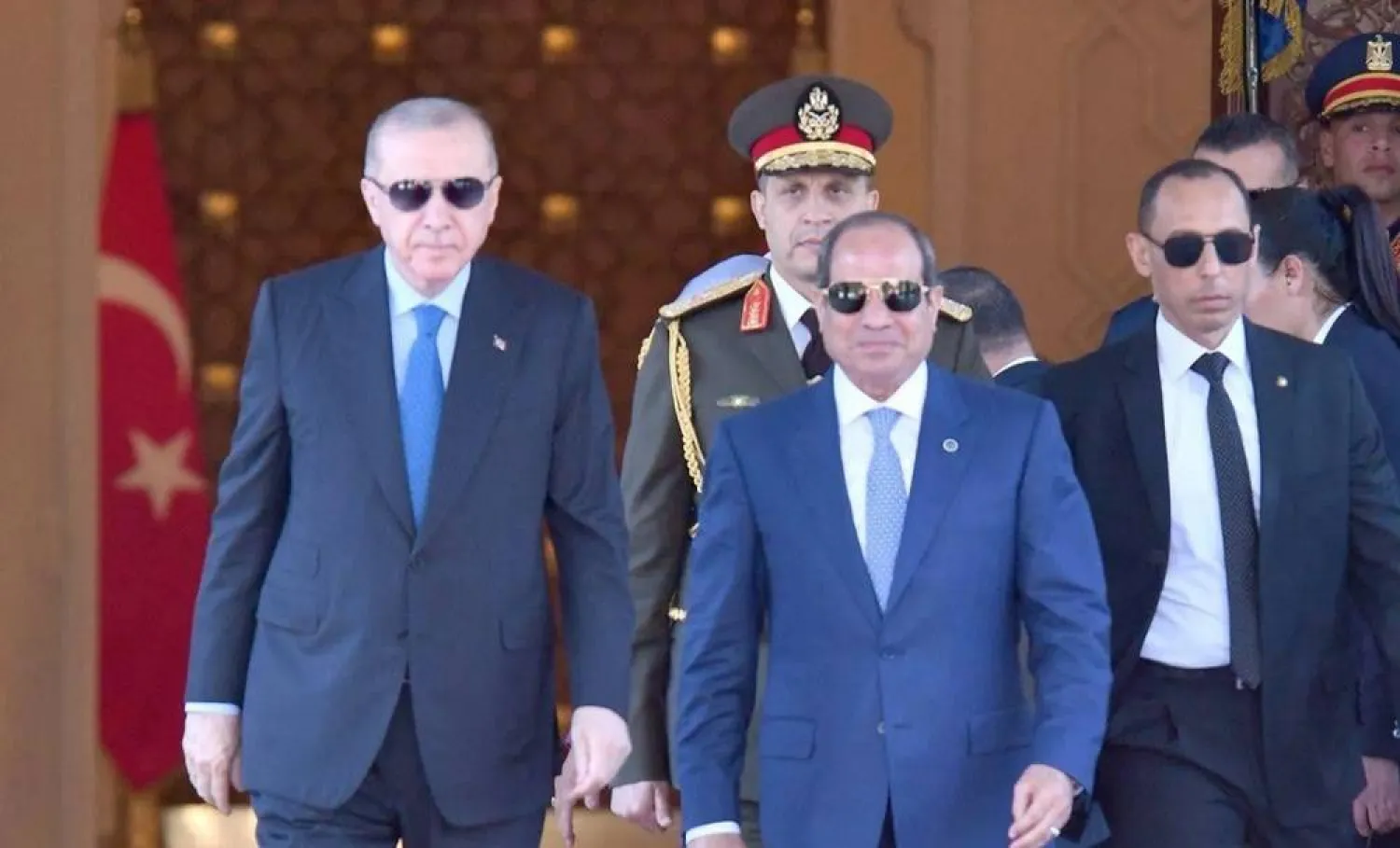
Egyptian President Abdel Fattah al-Sisi welcomes his Turkish counterpart Recep Tayyip Erdogan in Cairo last February. (Egyptian Presidency)
TT

Turkish Investments in Egypt Strengthen Ties Despite Political Differences

Egyptian President Abdel Fattah al-Sisi welcomes his Turkish counterpart Recep Tayyip Erdogan in Cairo last February. (Egyptian Presidency)

Growing Turkish investment in Egypt is strengthening economic ties between Cairo and Ankara despite ongoing disagreements over a maritime deal between Türkiye and Libya, according to analysts.

The Egyptian government highlighted the expanding Turkish business presence in the country on Wednesday, releasing figures that analysts interpreted as a sign of both sides’ determination to deepen economic cooperation while managing political disputes.

According to the Egyptian Cabinet’s Media Center, Turkish investment has expanded across manufacturing, trade, services and other economic activities in recent years. Turkish companies have contributed around $921.5 million in investment through 1,869 businesses established in Egypt, creating around 43,900 jobs.

Annual Turkish investment inflows surged 393.2% over eight years, reaching $175.1 million in the 2024-2025 fiscal year, compared with $35.5 million in 2016-2017.

The increase came despite a period of strained relations before Cairo and Ankara restored ambassador-level diplomatic ties in 2023.

Bilateral trade rose 44.7%, reaching $6.8 billion in 2025, up from $4.7 billion in 2016, according to the government figures, which highlighted major Turkish projects in the garment and food-processing industries.

Economic interests

Bashir Abdel Fattah, a Türkiye affairs specialist at the Al-Ahram Center for Political and Strategic Studies, said the growth in Turkish investment reflects Ankara’s determination to strengthen its strategic partnership with Cairo.

Speaking to Asharq Al-Awsat, Abdel Fattah described economic cooperation as a key component of the rapprochement, adding that Türkiye is seeking to capitalize on investment opportunities in Egypt while broadening the partnership across multiple sectors.

Egypt also provides Turkish companies with access to Arab and African markets through trade arrangements, including the free trade agreement with members of the Common Market for Eastern and Southern Africa (COMESA), enabling businesses to manufacture goods in Egypt for export across the continent.

Hani al-Gamal, deputy director of the Tafkir Center for Political Affairs, said that the government figures demonstrate how closely Turkish capital has become integrated into Egypt’s economy, particularly in manufacturing, employment and exports, generating benefits for both countries.

While acknowledging the importance of investment in strengthening bilateral cooperation, al-Gamal cautioned that economic ties alone could not resolve geopolitical disputes.

He attributed the broader improvement in relations to political and regional circumstances that have also facilitated closer military cooperation and notable progress in defense industries.

Military cooperation

Egyptian and Turkish naval forces participated in the Sea of Friendship exercises this month. The Egyptian military described the drills as part of growing cooperation between the two countries’ armed forces, aimed at sharing expertise and strengthening naval coordination.

The exercises took place despite Cairo’s repeated rejection of the Libyan parliament’s ratification in October of a maritime boundary agreement with Ankara.

Egypt and Türkiye have nevertheless continued consultations aimed at reducing regional tensions.

Abdel Fattah identified the separation of contentious political issues from areas of cooperation as a key factor behind the recent improvement in relations.

Disagreements over maritime boundaries and the Libyan crisis have not prevented Cairo and Ankara from developing ties in other sectors, he explained.

He viewed this approach as evidence of political maturity and a shared determination to avoid a return to tensions.

He said that rapprochement and cooperation could build confidence, narrow disagreements and create more favorable conditions for resolving outstanding issues.

Al-Gamal similarly emphasized that translating political rapprochement into tangible economic interests could deepen mutual trust and broaden the foundations of cooperation.


Al-Mirghani: A Statesman of Peace

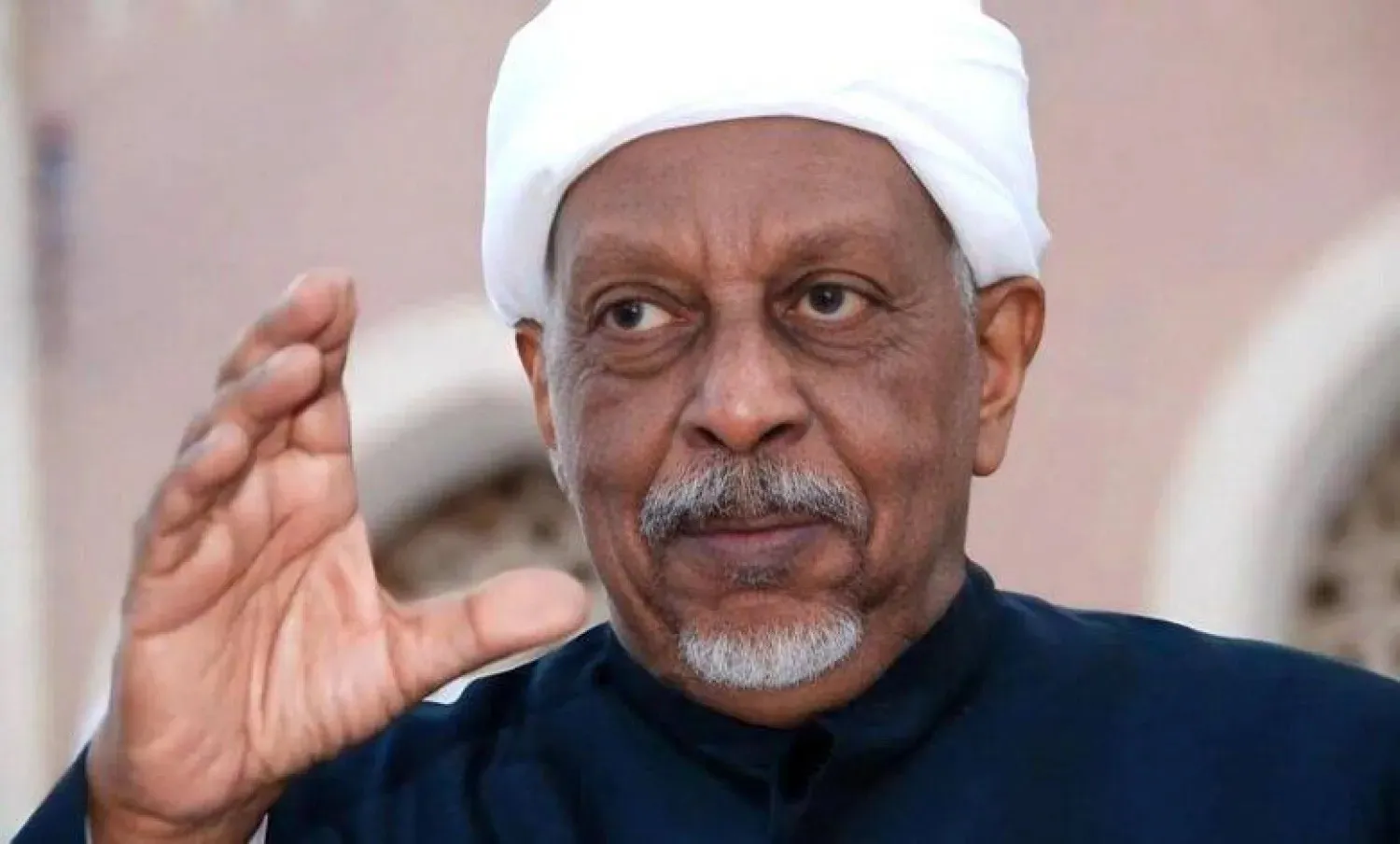
Mohammed Osman al-Mirghani, the late leader of Sudan’s Democratic Unionist Party.
TT

Al-Mirghani: A Statesman of Peace

Mohammed Osman al-Mirghani, the late leader of Sudan’s Democratic Unionist Party.

November 16 was no ordinary date in Sudan’s collective memory. It was the day Mohammed Osman al-Mirghani was laid to rest in Khartoum North. It was also the anniversary of the Sudanese Peace Initiative he signed 38 years earlier with Dr. John Garang in Addis Ababa, an accord known as the Mirghani-Garang Agreement.

It was as though history had chosen the day of his farewell to remind Sudan of the defining conviction he carried throughout his life: that the country could not be saved through war, but through dialogue.

This is not to place al-Mirghani, leader of the Democratic Unionist Party, beyond criticism or to dismiss the disputes and disagreements that marked his political career. But fairness demands recognition of his unwavering commitment, at decisive moments, to peace, consensus and national unity. That is why he deserves to be called a man of peace.

On November 16, 1988, al-Mirghani and Garang made political history with a remarkably brief document: barely a page long and fewer than 400 words. But its significance was immense.

The agreement called for a ceasefire, the suspension of the provisions on hudud punishments and related articles of the September 1983 laws pending a national constitutional conference, the lifting of the state of emergency, cancellation of military agreements affecting national sovereignty, and formation of a national committee to prepare for the constitutional conference.

Its central premise was fundamental: the war was not an isolated southern problem, but a manifestation of a broader Sudanese crisis that could be resolved only through dialogue on equal terms among all political and social forces.

The agreement faced open opposition from the National Islamic Front before the Constituent Assembly approved it on April 3, 1989. Then came the June 30 coup, cutting short the process before it could be completed.

It would be wrong to attribute the coup solely to the Mirghani-Garang Agreement, just as it would be impossible to assert that peace was guaranteed had democracy been allowed to run its course. But it is entirely reasonable to say that Sudan lost a genuine opportunity for peace, one that would not be forgotten.

Instead of the swift peace envisioned in a single-page document, the war continued for roughly another 16 years after the coup. It claimed hundreds of thousands of lives, forced millions from their homes and into exile, and saw the proliferation of armed groups and militias.

Ultimately, Sudan needed years of negotiations and volumes of protocols and agreements to reach the 2005 Comprehensive Peace Agreement. That accord, in turn, opened the way to self-determination, the 2011 referendum and the secession of South Sudan.

This contrast is what makes the Mirghani-Garang initiative a living document to this day. One page had outlined a broad political vision for a united country. Years later, Sudan required seemingly endless documents to reach an outcome in which it lost a cherished part of its territory and people.

Jaafar Hassan, a leading figure in the Unionist Alliance and spokesman for the Sumoud coalition, told Asharq Al-Awsat that the late al-Mirghani was “one of Sudan’s pillars and one of the few men of sound judgment.”

Hassan said al-Mirghani had pursued peace early on, drawing on his position as head of the Democratic Unionist Party and leader of the Khatmiyya Sufi order.

Al-Mirghani had put his considerable popularity among his followers at the service of peace, recognizing early the dangers of allowing the war in South Sudan to continue. He was behind the landmark agreement between the Democratic Unionist Party and the Sudan People’s Liberation Movement led by John Garang.

“Had it not been for the National Islamic Front’s coup in 1989, Sudan would still be united today,” Hassan said.

He stressed that al-Mirghani’s commitment to peace and national unity was not a fleeting political position, but of principles on which he refused to compromise.

Milestones in the pursuit of peace

The 1988 initiative was not the only landmark in al-Mirghani’s record. At least six major milestones can be identified in his pursuit of peace.

The first was his agreement with Garang. The second was his leadership of the National Democratic Alliance after the coup, bringing together political parties, trade unions and armed movements of differing orientations under one umbrella.

The third was the 1995 Asmara Conference on Fundamental Issues, which placed war, democracy, identity and the relationship between religion and the state at the heart of the national dialogue.

The fourth came at the alliance’s second conference in Massawa in 2000, when it affirmed that Sudan’s problems could be resolved only through “serious and sustained dialogue among all Sudanese political forces” in a democratic environment.

The fifth milestone came through negotiations in Jeddah and Cairo, culminating in the 2005 Cairo Agreement between the government and the National Democratic Alliance under al-Mirghani’s leadership. The agreement opened the door to ending a prolonged political confrontation and allowing opposition forces to return to political life.

In Darfur, al-Mirghani sought to narrow differences between the government and armed movements that had not signed peace agreements. He encouraged those movements to unify their positions so they could join negotiations from a stronger position.

In 2022, he again proposed an initiative for comprehensive national dialogue and returned to Khartoum after a long absence, making another attempt to bring Sudanese factions together before the country descended into its current war.

Not everyone agreed with all his political choices. But at the time of his passing, there was broad agreement that his name had been closely associated with national unity and dialogue.

Political analyst Mohamed Latif told Asharq Al-Awsat that al-Mirghani’s political record might be a subject of disagreement for some, “but it is difficult to dispute that he was one of the leaders of Sudan’s two largest religious communities.”

“He succeeded in preserving the cohesion of the Khatmiyya order inside and outside Sudan, as well as its peaceful religious mission, far removed from violence and extremism,” he added.

The Mirghani-Garang Agreement was among the most significant moments not only in al-Mirghani’s life but also in Sudan’s modern history, he went on to say.

The agreement came after more than five years of fierce war between the Sudan People’s Liberation Movement and the Sudanese army, despite repeated attempts to bring the fighting to an end.

Latif said Sudanese collective memory preserves two contrasting images from that period: the enormous crowds that welcomed al-Mirghani upon his return to Khartoum after signing the agreement in the Ethiopian capital, Addis Ababa, and the subsequent attempt to assassinate him at his home in the Khartoum 2 neighborhood.

The two episodes seemed to offer early signs of the struggle between the desire for peace and the path of violence that would later come to define Sudan.

The most meaningful tribute to al-Mirghani lies not in words of mourning alone, but in drawing lessons from his life and Sudan’s recent history.

Whenever the door to dialogue has been closed, the doors to war have opened wider. Whenever the illusion of a military solution has prevailed, the Sudanese people have paid the price in bloodshed, displacement and division.

Sudan once squandered the opportunity presented by a brief agreement that might have opened a different path. It must not squander today’s opportunity to end this devastating war.

Peace is not weakness. Negotiation is not betrayal. Ending the war is not merely one political option among many, but a national and moral duty to save what remains of Sudan.