For Palestinian Citizens of Israel, a Historic Vote Borne of Fear and Frustration

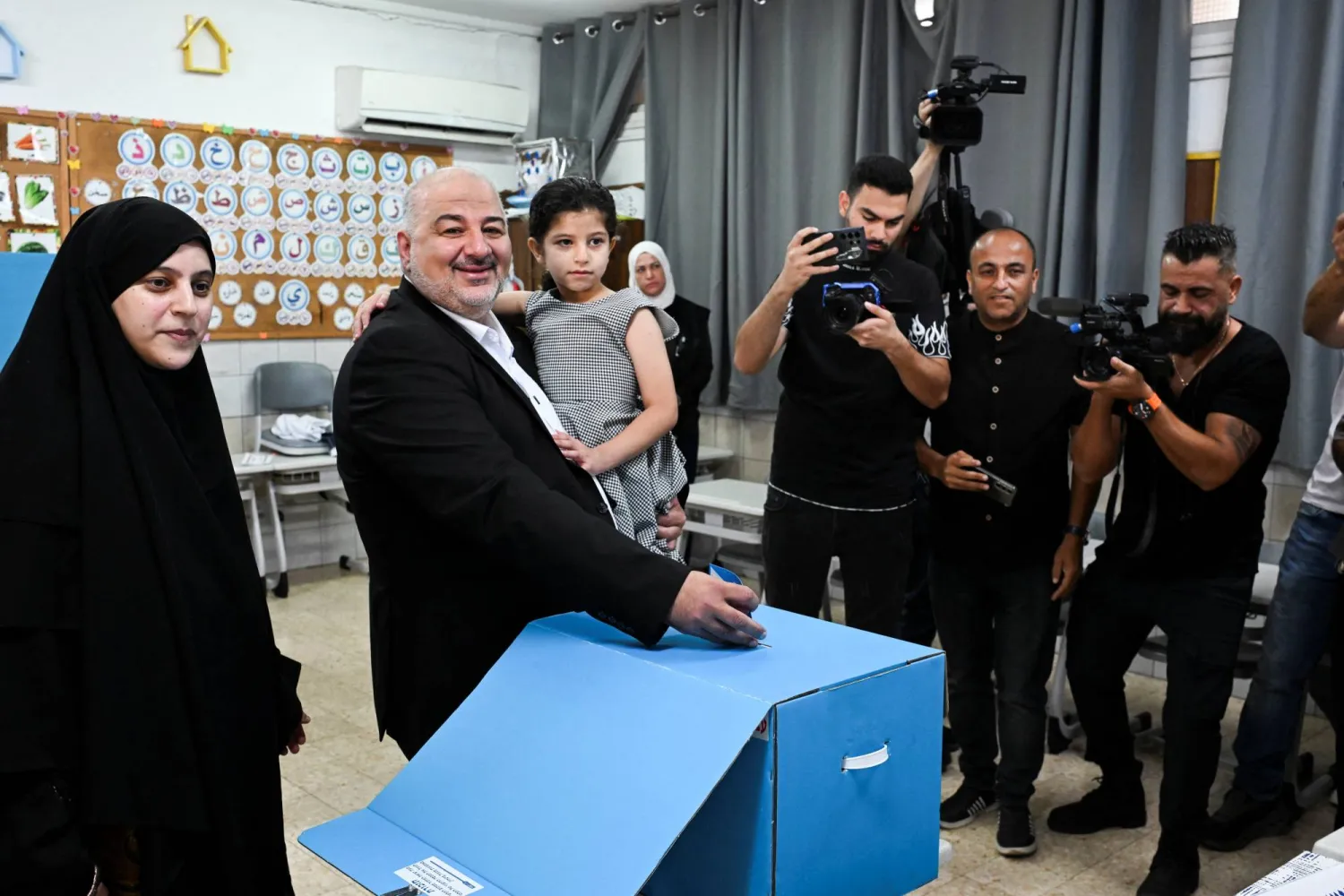
Palestinian candidate Mansour Abbas, leader of the Ra'am party, holds his daughter as he places his vote at a polling station, on the day of Israel’s national election, in Maghar, Israel, October 27, 2026. REUTERS/Rami Shlush
TT

For Palestinian Citizens of Israel, a Historic Vote Borne of Fear and Frustration

Palestinian candidate Mansour Abbas, leader of the Ra'am party, holds his daughter as he places his vote at a polling station, on the day of Israel’s national election, in Maghar, Israel, October 27, 2026. REUTERS/Rami Shlush

For Palestinian citizens of Israel, it was a rare moment of political triumph.

Hundreds of thousands voted in record numbers, giving two Arab-led parties their largest-ever number of seats in Israel’s parliament.

Many boycotted past elections, seeing little point. But after years of their communities being demonized or neglected, some of Israel’s most marginalized citizens turned to the ballot box to fight back against the most right-wing government in the country’s history.

“We are here and we’re not on the sidelines,” declared Mansour Abbas, leader of the Ra'am party, as supporters cheered in a wedding hall Tuesday night, watching the exit polls.

The surge makes them a major political force that could enable opposition parties to assemble a coalition to oust Prime Minister Benjamin Netanyahu.

But the question is whether Netanyahu’s main rival, Gadi Eisenkot, and other opponents will ally with them. Only once has an Arab-led party ever served in an Israeli government. During the campaign, Netanyahu had accused his main opponents of planning to form a coalition with them, which Eisenkot denied.

Netanyahu and his allies are now turning up the anti-Arab rhetoric even further, making unproven claims that foreign powers bribed voters to back Arab-led parties. In a Thursday post on X, Netanyahu warned against any party forming a government with them, saying it would lead to the "Islamization of Israel.”

Palestinian grievances fueled the surge

More than 800,000 people on Tuesday voted for Ra’am and the Joint List, a coalition of three Arab-led parties, a more than 60% increase from the last elections in 2022, according to figures from the Central Election Committee.

The parties won 19 seats in Israel's 120-member Knesset, surpassing the previous record of 15.

Crowds packed polling places in Arab communities from the Negev Desert to the northern Galilee.

In Tarabin, a Bedouin village in the Negev, Netanyahu’s party had won majorities the past two elections. Turnout nearly doubled on Tuesday and Ra’am won 93% of the vote.

The northern town of Sakhnin had Israel’s highest voter turnout, at 87%. Mayor Mazen Ghnaim said voters saw it as an emergency measure to fight rising violent crime in Arab communities and incitement by Netanyahu's far-right allies.

“I want to protect my constituents from being killed, my children from being attacked at their universities and Arab doctors getting attacked at hospitals,” said Ghnaim, a Ra'am supporter, referring to recent incidents of anti-Arab violence.

The parties worked hard to overcome past reluctance to vote among Palestinians, who have long felt ignored in the halls of power. They held community meetings in cities and towns that Jewish-led parties mostly ignored. A grassroots movement went door-to-door in Bedouin villages to encourage women to vote.

A reaction to Israel's most far-right government ever Voters and candidates said their heightened participation did not reflect faith in Israeli democracy — it was a sign of desperation to unseat Netanyahu.

Two of his far-right allies, Itamar Ben Gvir and Bezalel Smotrich, are responsible for some of Israel’s most extreme policies and anti-Arab incitement.

Ben Gvir, the national security minister, raised alarm on Election Day over Arab turnout, telling his supporters, “If you want this country to remain Jewish and Zionist ... then get out and vote!”

The rhetoric, also echoed by Netanyahu and Smotrich, may have only galvanized Arab voters.

“We see the government going from bad to worse,” 52-year-old Awni Zoabi said after voting in Nazareth. “We want to live, we want a future for our children, and we want a future for ourselves.”

The parties offer different visions Palestinians who managed to stay in Israel after the 1948 war surrounding its creation — when hundreds of thousands were expelled or fled — today, along with their descendants, make up more than 20% of the population. They have Israeli citizenship, including the right to vote, but also feel deep solidarity with Palestinians in Gaza and the West Bank.

Ra'am and the Joint List both campaigned on combating crime and securing investment for Arab communities. But they offered different visions for how to approach the wider conflict.

Ra’am made the advantages of joining a coalition government central to its pitch to voters and said little that could alienate potential Jewish allies. It placed a Jewish former police official second on its candidate list.

In contrast, members of the Joint List called Israel’s campaign in Gaza a genocide and compared the occupation of the West Bank to apartheid South Africa. Most Jewish Israelis ardently reject both accusations.

“People are clever enough to see what’s happening. Of the two options, one is proposing a genocide, and the other is proposing apartheid. These are the choices: bad or worse,” said Sami Abou Shehadeh, the leader of one of the slate’s parties.

Strong showing doesn't guarantee a role in government

Mainstream Israeli parties have long resisted partnering with Arab-led parties elected to the Knesset, portraying them as threats to Israel’s Jewish character or questioning their loyalty to the state.

Netanyahu’s opponents welcomed Ra’am into a short-lived coalition government in 2021, in return offering investment in Arab communities and legal status for unrecognized Bedouin villages facing the threat of demolition.

The Islamist party's inclusion broke a longstanding taboo and gave it newfound political influence.

But given Israel's rightward shift, it will be difficult for Eisenkot to maintain support if he partners with Arab-led parties this time, said Tamar Hermann, senior research fellow at the Israel Democracy Institute.

Israel, she said, has been “moving away from a liberal democracy and moving toward an ethnic democracy where one ethnicity has advantages over others.”

Ra’am and the Joint List could handily give Eisenkot the numbers needed to form a government. Both have expressed openness to anything that removes Netanyahu, including abstaining from a Knesset leadership vote to lower the threshold Eisenkot would need to win a majority.

But in public, rather than court them, Eisenkot has set conditions, including that they profess that Israel is a Jewish and democratic state and declare Hamas a terrorist organization “to be demolished.”

Leaders of both parties have condemned Hamas’ Oct. 7, 2023, attack on Israel but have balked at labeling the group a terrorist organization, in part because it would appear to justify Israel's devastating campaign in Gaza. Abbas acknowledged Israel as a Jewish state in 2021, while some Joint List leaders have questioned whether a country can be both democratic and privilege members of one religion.

The conditions of any such partnership are unclear

Abbas said Tuesday that he was confident Ra'am would join a government. But his party did not respond to questions this week about whether it would accept Eisenkot’s conditions or what its own terms were.

Yousef Jabareen, the Joint List’s leader, told The Associated Press on Wednesday he had not yet spoken to Eisenkot but was ready for talks. He said parties on his slate had not agreed on their conditions, but hoped for protections and equality for Palestinian citizens, and promises to revive the peace process.

Above all, he recognized the desire to see Netanyahu gone.

“We have promised our community to do our best to get rid of this fascist government,” Jabareen said.


Report: Iran’s Hidden Web of Military Agencies Is Slipping Hardware Past the US Blockade

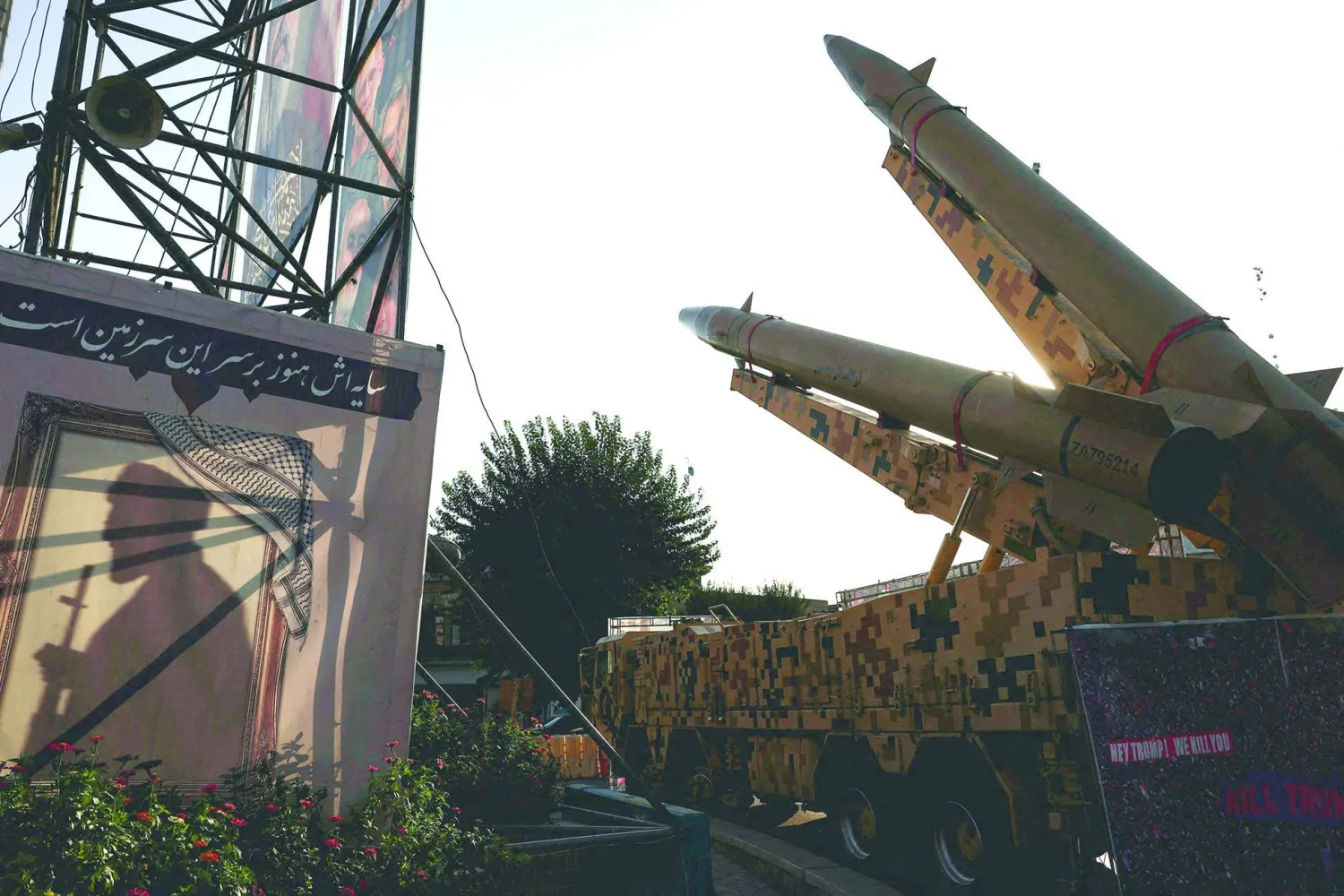
Iranian missiles are displayed on a street in Tehran, Iran, September 27, 2026. Majid Asgaripour/WANA (West Asia News Agency) via Reuters
TT

Report: Iran’s Hidden Web of Military Agencies Is Slipping Hardware Past the US Blockade

Iranian missiles are displayed on a street in Tehran, Iran, September 27, 2026. Majid Asgaripour/WANA (West Asia News Agency) via Reuters

Iran has created a secret network of military agencies with global reach to import at least $2 billion in hardware, explosives and heavy-duty trucks since January 2025, evading both the US naval blockade and Western sanctions, a Reuters investigation has found.

Hidden behind names ‌starting with the letters MOD, for the Ministry of Defense, are more than 5,000 agencies that form a formidable financial and military machine. Their financial footprints are on bills of lading and other shipping data dating back to 2016. Some are tied to the Iranian Revolutionary Guard Corps (IRGC) and to business conglomerates known as bonyads that are controlled by Iran's elite.

The findings offer a window into one of the war’s great mysteries: How is the IRGC replenishing its missile and drone arsenals while firing them in their thousands?

In the 18 months from January 2025 to June 2026 – including four months into this year’s war – a single one of these agencies, MOD 346428, imported huge quantities of rocket propellants, explosives and weapons components that are critical for making drones and missiles, as well as heavy-duty trucks that can serve as missile launchers. The hardware came in by land, sea and air – much of it recorded as originating in China, Russia and Germany.

This investigation of the MOD network is based on thousands of Iranian bank and government records, corporate filings and import data.

The secret agencies all share the same Tehran address as Iran’s Ministry of Defense and Armed Forces Logistics, or MODAFL. They list their incorporation date as February 11, 1979, the day Khomeini took power in Iran after overthrowing the monarchy. Most were actually established in 2013, the records show, as Iran struggled under sanctions that saw its crude exports and currency plunge.

The agencies, identified for the first time by Reuters in collaboration with the Israeli-American risk consultancy 240 Analytics, form the backbone of Iran’s military procurement and sanctions evasion apparatus. They operate a web of frontmen and foreign shell companies, collectively known as trustees, who use the proceeds from illicit oil sales to buy goods for Iran.

Senior military leaders involved in Iran’s ballistic missile and drone programs use the network. Phone numbers registered to 91 of the agencies also appear in records from state-run Bank Sepah of IRGC personnel with accounts there. Among them are at least two commanders the US has accused of abuses against civilian protestors.

While Iran’s military has been under multiple US sanctions for decades, Reuters could find no evidence that any of the numbered agencies referenced in the documents have been designated by Western governments.

“What you have here is the regime's military lifeline during this conflict and for many years before,” said Miad Maleki, a former senior official at the US Treasury Department who helped design the American sanctions program against Iran. “This is the complete ecosystem of the Iranian military’s trade business.”

The weapons import network has provided many of the raw materials Iran needs to make missiles and drones. Those munitions are responsible for Iran’s relentless precision attacks against Gulf energy infrastructure, allowing Tehran to blunt America’s military assault.

In other reports this year, Reuters has shown how Iran withstood US pressure by exploiting crypto exchanges and illegal gambling networks to tap illicit revenues and circumvent sanctions, how the IRGC consolidated control of the Strait of Hormuz, and how the war has ushered in a new era of repression.

Maleki was one of four experts on Iranian sanctions and weapons who reviewed the Reuters findings and confirmed that many of the materials could be used in Iran’s missile and drone programs.

None of the Iranian government entities or companies contacted by Reuters responded to detailed requests for comment, including Tehran’s UN delegation to Geneva and the presidency.

In a statement in response to the Reuters findings, a Treasury Department spokeswoman said the United States “has severed the regime’s economic lifelines.”

“While the regime may continue its desperate attempts to evade our powerful sanctions, fund its military and weapons programs, and access foreign currency, we are always 10 steps ahead,” the spokeswoman said.

In tracking the materials, Reuters cross-checked a portion of some 19,000 import records using the shipping documents, footage from social media, and state media reports. Nearly all of the items that Iran imported were exempt from duty and specifically marked as military equipment, the data shows. The experts noted that much of the material, even explosives, can be considered dual-use, and so could also have civilian purposes.

The Wall Street Journal reported some of the shipments from China on September 23.

PARALLEL TRADE SYSTEM

The secret military agencies form a foreign-trade system parallel to the formal global economy that allows Iran to spend the money it earns abroad selling illicit oil on military hardware, said Maleki, who was the associate director of the Treasury’s Office of Foreign Assets Control until last year.

Money rarely crosses borders, where it might trip a sanctions alarm. Instead, for 97% of the shipments Reuters reviewed, the transactions were settled “without currency transfer,” the import data shows. Trusted frontmen in the diaspora, using cash held in foreign banks, bought the goods and shipped them home.

One end user of the network is the military unit overseeing Iran’s ballistic missile program. Another is Sahara Thunder, which was sanctioned by the US in 2024 for manufacturing and supplying drones to Russia that have devastated Ukraine. Reuters and 240 Analytics identified the Iranian military units by cross-referencing the import data with corporate registry filings, and emails and documents compiled on the website WikiIran.

Reuters could not determine the identities of the people who run WikiIran, a website that solicits leaked documents from the Islamic Republic and says it is operated by Iranians opposed to the government and “forced into exile.”

During the first six months of this year, according to the import data, deliveries included $1.9 million worth of detonators, tons of explosives, aircraft engine parts, rocket fuel ingredients and heavy-duty launch vehicles. All could be used as key components to build and fire ballistic missiles and drones ‌including the Shahed series, according to weapons and sanctions experts.

“This ‌looks like an industrial-scale effort to rebuild or expand Iran's existing fleet” of drones and missiles, said Peter Salisbury, an adjunct assistant professor at Columbia University who has spent the past several years researching Iranian arms transfers and supply chains. “This data clearly shows the Iranian ecosystem’s adaptability and its ability to find new routes.”

Salisbury and one of the other experts said they have used WikiIran’s data in the past and have found it to ‌be accurate.

The United States ⁠and Israel have targeted Iran’s ballistic missile and ⁠drone operations from the start of this year’s war on February 28, including factories the Pentagon said were turning out munitions. Reuters could not determine the extent of the damage, but Iran has continued to fire on its neighbors and on ships trying to transit Hormuz.

The material entered Iran by cargo ship across the Caspian Sea from Russia, by truck from Central Asia, and by freight planes from China,, according to documents reviewed by Reuters and records provided by ImportGenius, a platform that aggregates import-export data.

In response to detailed questions about the Reuters findings, China’s Foreign Ministry said it was “unaware of the situation you describe.”

“We firmly oppose attempts to maliciously link regional hostilities to China or smear China’s reputation,” the Foreign Ministry said in a faxed statement.

Russia’s Defense Ministry, the White House and CENTCOM did not respond to requests for comment.

Beyond individual components, Iran is buying precision machinery that could be used to manufacture its own military equipment. The purchases include items coded as sophisticated computer-controlled lathes, electron-beam furnaces and particle accelerators, according to import data that runs to June. All have industrial purposes and can also be used to make military equipment, including drone and missile bodies.

On October 12, US President Donald Trump said he did not believe China and Russia were providing support to Iran. “If they are, it’s at a very low level, but I don’t believe they are at all,” he posted on social media. “They have too much to lose, and we would know about it, and know about it very fast!”


For Palestinian Citizens of Israel, a Historic Vote Borne of Fear and Frustration

Palestinian candidate Mansour Abbas, leader of the Ra'am party, holds his daughter as he places his vote at a polling station, on the day of Israel’s national election, in Maghar, Israel, October 27, 2026. REUTERS/Rami Shlush
TT

For Palestinian Citizens of Israel, a Historic Vote Borne of Fear and Frustration

Palestinian candidate Mansour Abbas, leader of the Ra'am party, holds his daughter as he places his vote at a polling station, on the day of Israel’s national election, in Maghar, Israel, October 27, 2026. REUTERS/Rami Shlush

For Palestinian citizens of Israel, it was a rare moment of political triumph.

Hundreds of thousands voted in record numbers, giving two Arab-led parties their largest-ever number of seats in Israel’s parliament.

Many boycotted past elections, seeing little point. But after years of their communities being demonized or neglected, some of Israel’s most marginalized citizens turned to the ballot box to fight back against the most right-wing government in the country’s history.

“We are here and we’re not on the sidelines,” declared Mansour Abbas, leader of the Ra'am party, as supporters cheered in a wedding hall Tuesday night, watching the exit polls.

The surge makes them a major political force that could enable opposition parties to assemble a coalition to oust Prime Minister Benjamin Netanyahu.

But the question is whether Netanyahu’s main rival, Gadi Eisenkot, and other opponents will ally with them. Only once has an Arab-led party ever served in an Israeli government. During the campaign, Netanyahu had accused his main opponents of planning to form a coalition with them, which Eisenkot denied.

Netanyahu and his allies are now turning up the anti-Arab rhetoric even further, making unproven claims that foreign powers bribed voters to back Arab-led parties. In a Thursday post on X, Netanyahu warned against any party forming a government with them, saying it would lead to the "Islamization of Israel.”

Palestinian grievances fueled the surge

More than 800,000 people on Tuesday voted for Ra’am and the Joint List, a coalition of three Arab-led parties, a more than 60% increase from the last elections in 2022, according to figures from the Central Election Committee.

The parties won 19 seats in Israel's 120-member Knesset, surpassing the previous record of 15.

Crowds packed polling places in Arab communities from the Negev Desert to the northern Galilee.

In Tarabin, a Bedouin village in the Negev, Netanyahu’s party had won majorities the past two elections. Turnout nearly doubled on Tuesday and Ra’am won 93% of the vote.

The northern town of Sakhnin had Israel’s highest voter turnout, at 87%. Mayor Mazen Ghnaim said voters saw it as an emergency measure to fight rising violent crime in Arab communities and incitement by Netanyahu's far-right allies.

“I want to protect my constituents from being killed, my children from being attacked at their universities and Arab doctors getting attacked at hospitals,” said Ghnaim, a Ra'am supporter, referring to recent incidents of anti-Arab violence.

The parties worked hard to overcome past reluctance to vote among Palestinians, who have long felt ignored in the halls of power. They held community meetings in cities and towns that Jewish-led parties mostly ignored. A grassroots movement went door-to-door in Bedouin villages to encourage women to vote.

A reaction to Israel's most far-right government ever Voters and candidates said their heightened participation did not reflect faith in Israeli democracy — it was a sign of desperation to unseat Netanyahu.

Two of his far-right allies, Itamar Ben Gvir and Bezalel Smotrich, are responsible for some of Israel’s most extreme policies and anti-Arab incitement.

Ben Gvir, the national security minister, raised alarm on Election Day over Arab turnout, telling his supporters, “If you want this country to remain Jewish and Zionist ... then get out and vote!”

The rhetoric, also echoed by Netanyahu and Smotrich, may have only galvanized Arab voters.

“We see the government going from bad to worse,” 52-year-old Awni Zoabi said after voting in Nazareth. “We want to live, we want a future for our children, and we want a future for ourselves.”

The parties offer different visions Palestinians who managed to stay in Israel after the 1948 war surrounding its creation — when hundreds of thousands were expelled or fled — today, along with their descendants, make up more than 20% of the population. They have Israeli citizenship, including the right to vote, but also feel deep solidarity with Palestinians in Gaza and the West Bank.

Ra'am and the Joint List both campaigned on combating crime and securing investment for Arab communities. But they offered different visions for how to approach the wider conflict.

Ra’am made the advantages of joining a coalition government central to its pitch to voters and said little that could alienate potential Jewish allies. It placed a Jewish former police official second on its candidate list.

In contrast, members of the Joint List called Israel’s campaign in Gaza a genocide and compared the occupation of the West Bank to apartheid South Africa. Most Jewish Israelis ardently reject both accusations.

“People are clever enough to see what’s happening. Of the two options, one is proposing a genocide, and the other is proposing apartheid. These are the choices: bad or worse,” said Sami Abou Shehadeh, the leader of one of the slate’s parties.

Strong showing doesn't guarantee a role in government

Mainstream Israeli parties have long resisted partnering with Arab-led parties elected to the Knesset, portraying them as threats to Israel’s Jewish character or questioning their loyalty to the state.

Netanyahu’s opponents welcomed Ra’am into a short-lived coalition government in 2021, in return offering investment in Arab communities and legal status for unrecognized Bedouin villages facing the threat of demolition.

The Islamist party's inclusion broke a longstanding taboo and gave it newfound political influence.

But given Israel's rightward shift, it will be difficult for Eisenkot to maintain support if he partners with Arab-led parties this time, said Tamar Hermann, senior research fellow at the Israel Democracy Institute.

Israel, she said, has been “moving away from a liberal democracy and moving toward an ethnic democracy where one ethnicity has advantages over others.”

Ra’am and the Joint List could handily give Eisenkot the numbers needed to form a government. Both have expressed openness to anything that removes Netanyahu, including abstaining from a Knesset leadership vote to lower the threshold Eisenkot would need to win a majority.

But in public, rather than court them, Eisenkot has set conditions, including that they profess that Israel is a Jewish and democratic state and declare Hamas a terrorist organization “to be demolished.”

Leaders of both parties have condemned Hamas’ Oct. 7, 2023, attack on Israel but have balked at labeling the group a terrorist organization, in part because it would appear to justify Israel's devastating campaign in Gaza. Abbas acknowledged Israel as a Jewish state in 2021, while some Joint List leaders have questioned whether a country can be both democratic and privilege members of one religion.

The conditions of any such partnership are unclear

Abbas said Tuesday that he was confident Ra'am would join a government. But his party did not respond to questions this week about whether it would accept Eisenkot’s conditions or what its own terms were.

Yousef Jabareen, the Joint List’s leader, told The Associated Press on Wednesday he had not yet spoken to Eisenkot but was ready for talks. He said parties on his slate had not agreed on their conditions, but hoped for protections and equality for Palestinian citizens, and promises to revive the peace process.

Above all, he recognized the desire to see Netanyahu gone.

“We have promised our community to do our best to get rid of this fascist government,” Jabareen said.


What to Know about the Impacts of Flávio Bolsonaro’s Move from Brazil to the US

(FILES) WASHINGTON, DC - MARCH 19: US President Donald Trump and Brazilian President Jair Bolsonaro participate shake hands after a joint news conference at the Rose Garden of the White House March 19, 2019 in Washington, DC. President Trump is hosting President Bolsonaro for a visit and bilateral talks at the White House today. (Photo by MARK WILSON / GETTY IMAGES NORTH AMERICA / AFP)
TT

What to Know about the Impacts of Flávio Bolsonaro’s Move from Brazil to the US

(FILES) WASHINGTON, DC - MARCH 19: US President Donald Trump and Brazilian President Jair Bolsonaro participate shake hands after a joint news conference at the Rose Garden of the White House March 19, 2019 in Washington, DC. President Trump is hosting President Bolsonaro for a visit and bilateral talks at the White House today. (Photo by MARK WILSON / GETTY IMAGES NORTH AMERICA / AFP)

Flávio Bolsonaro is now in Miami after fleeing to the US following his stunning defeat to Luiz Inácio Lula da Silva in Brazil’s presidential elections.

Bolsonaro has refused to concede and has positioned himself as the “leader of Brazil” while declaring that there was electoral fraud, without providing evidence. In a letter on Wednesday, the senator for Rio de Janeiro said he relocated to the US because he is the victim of political and judicial persecution.

The departure of the 45-year-old ally of US President Donald Trump from Brazil days after losing the runoff vote is sending shock waves across Brazil’s right and reverberating across the region, and it may spell more trouble for relations between Washington and Brasilia.

Here’s what to know about the possible impacts of Bolsonaro’s exodus from Brazil.

The shake-up of Brazil’s right

Bolsonaro has promised to lead the opposition to Lula from abroad. “I will say what you cannot say, and I will assume the risks you cannot take,” he said in a letter on Wednesday, addressing himself to political representatives of his party.

But Bolsonaro’s move to Miami complicates that vow, analysts say, leaving a power vacuum on the Brazilian right, which had united around Flávio’s presidential bid. His father, former President Jair Bolsonaro, appointed him as his political heir last December. The elder Bolsonaro is serving a 27-year sentence for attempting a coup.

“Flávio’s departure, along with the difficulty of directing the process from a distance and all the criticism he is likely to face for saying he wouldn’t flee and then fleeing, is likely to weaken him,” said Carlos Melo, a political-science professor at Insper university.

But as a political force, the right may lose neither influence nor impact following his departure due to its gains in Congress, said Luciana Santana, a political scientist at the Federal University of Alagoas.

“The group in Congress retains instruments to block proposals, negotiate with government and dispute the public agenda,” Santana said.

Impact on the global far right A Bolsonaro win would have aligned Brazil with many of its regional neighbors, where conservatives have swept to power in seven presidential elections in 18 months.

Across much of Latin America, voters fed up with rising crime have rewarded presidential candidates promising to restore order. From Peru’s Keiko Fujimori to Colombia’s Abelardo de la Espriella, newly elected conservatives have courted Trump while taking their cues from El Salvador’s President Nayib Bukele, whose sweeping gang crackdown has sharply reduced homicides at the cost of mass arrests and suspended civil liberties.

Bolsonaro’s defeat is a setback for the far-right in the region and beyond, as it stops its ascension to the presidency of an economic powerhouse in the region that has significant diplomatic weight, said Santana.

But Lula’s win will not necessarily translate into the overall weakening of the movement, she said. As well as the gains in Congress, Flávio received nearly 60 million votes, indicating the competitiveness of the movement in Brazil.

Beyond Brazil’s borders, the international repercussions of Flávio’s flight depend on how the episode will be interpreted.

“Bolsonaro’s escape can be used by international networks as a symbol of alleged persecution. This could mobilize those who most strongly identify with the movement,” said Santana.

Tense relations between Washington and Brasilia

As congratulations poured in from Brazil’s allies and rivals around the world, Trump suggested Monday, without providing evidence, that Lula’s reelection was “rigged.”

But when asked about Bolsonaro’s assertion on Wednesday that he was the “rightful president-elect of Brazil” — a term the defeated candidate later softened to “leader of Brazil” — the US president said he would not comment. Instead, Trump said he has given Bolsonaro a “pass” to come into the country.

“I won’t get involved,” Trump said, before repeating his claim that the election was “very strange.”

Lula’s win cements Latin America’s most populous country and largest economy as a counterweight to Washington and limits Trump’s drive to tighten his grip on the Western Hemisphere.

Lula has championed Brazil’s long tradition of nonalignment, cultivating ties with competing powers. His government deepened trade ties with China and sought greater global influence through BRICS, a group of emerging economies.

While Bolsonaro’s presence in the US adds “a new layer of problems to the already complicated bilateral relationship,” it is unlikely to be decisive, said Oliver Stuenkel, a political scientist and researcher at the Carnegie Endowment think-tank.

While there will now be two Bolsonaro brothers potentially lobbying the US government on behalf of specific policies vis-a-vis Brazil, whether Washington heeds any such calls remains to be seen, Stuenkel said.

“Either Trump will pursue a pragmatic stance and basically recognize that US pressure to elect Flávio failed (...) or there will continue to be continued friction,” he said.