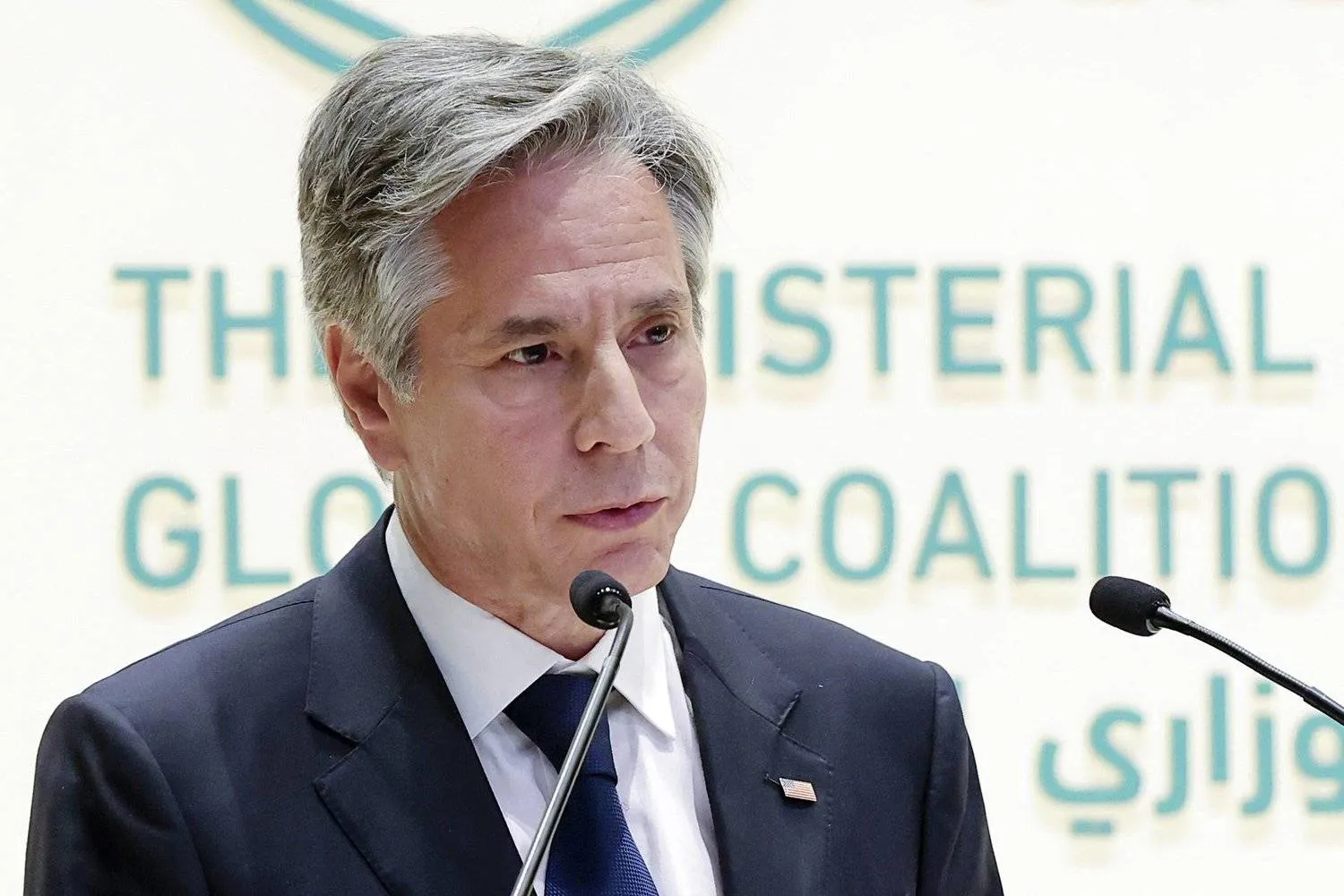

US Secretary of State Antony Blinken emphasized the strategic “partnership” with Saudi Arabia and noted that Washington would not leave the Middle East.
He added that the China-sponsored Saudi-Iranian agreement is a “good thing” if it leads to a decline in tensions.
Blinken was speaking during an interview with Asharq News on the sidelines of his visit to Saudi Arabia on June 6-8.
“[...] what we are seeing is an increasing convergence in our partnership to advance in issues of mutual interest to Saudi Arabia, to the United States,” he said.
The US Secretary of State underlined the importance of collaboration between his country and Saudi Arabia in addressing some challenges “that not only are of concern to our people, but to people around the world.”
He cited in this context health, climate, energy and food security, in addition to the transition to clean energy and working on emerging technologies.
“So there is a longstanding foundation, but there are also increasingly areas where we have convergence, and we are working together to advance the mutual interests of our people. So in that sense it is strategic...” he told the interview.
Welcoming the Saudi-Iranian agreement
Blinken pointed to cooperation between Washington and Riyadh on several issues, including the conflict in Yemen.
He said: “If you look at the work that we have been doing together – just to cite two examples, Yemen, ending a horrific war, Saudi Arabia is playing a critical and very positive role in trying to bring that war to an end, and then just in recent weeks, the partnership we have had in Sudan in trying to end the violence.”
Blinken continued: “So I see this as being a positive trajectory based on the interests that we share.”
The US senior official welcomed the recent agreement between Riyadh and Tehran, which was sponsored by Beijing, saying: “We applaud what happened. Anything that de-escalates tensions, takes at least one problem off of the agenda, and in this case also may have the additional benefit of helping to advance a peace in Yemen, we think is a good thing.”
Blinken added that his country continues to believe that diplomacy is the best way in general to ensure that Iran does not acquire a nuclear weapon.
“So we remain open to diplomacy, and that is clearly the best path. At the same time, we are also very determined to stand against the actions that Iran takes that are dangerous, destabilizing, and that was very much the – part of the conversation that we had yesterday with our colleagues at the Gulf Cooperation Council,” he remarked.
The US Secretary of State went on to say: “So what we have seen in the region is greater integration, and we have seen that in part through the process of normalization between Israel and its neighbors, between Arab countries, Muslim-majority countries beyond the region. And that is a very positive trend. It is something that we have been determined to help work on, both to deepen some of the existing agreements and also to broaden the effort.”
Joint efforts in Sudan
Blinken praised the joint efforts with Saudi Arabia to end the violence and achieve a truce between the two warring parties in Sudan.
He noted: “[Through] very close partnership with Saudi Arabia, we had some success in getting very limited ceasefires that were highly imperfect, but did allow more humanitarian assistance to get in and reach about 2 million people that otherwise would not have had this assistance provided to them.”
But he warned that if the two warring parties were not serious about the ceasefire, “we will have to look at other options for dealing with the situation.”
Regarding Washington’s policy towards Syria, Blinken said that what Syrian President Bashar al-Assad “has inflicted on his own country and on his own people, is a tragedy.”
“Our policy remains to see the actual application of the relevant UN Security Council Resolution 2254 so that there is a genuine political transition in Syria that reflects the rights and aspirations of the Syrian people,” he stated.