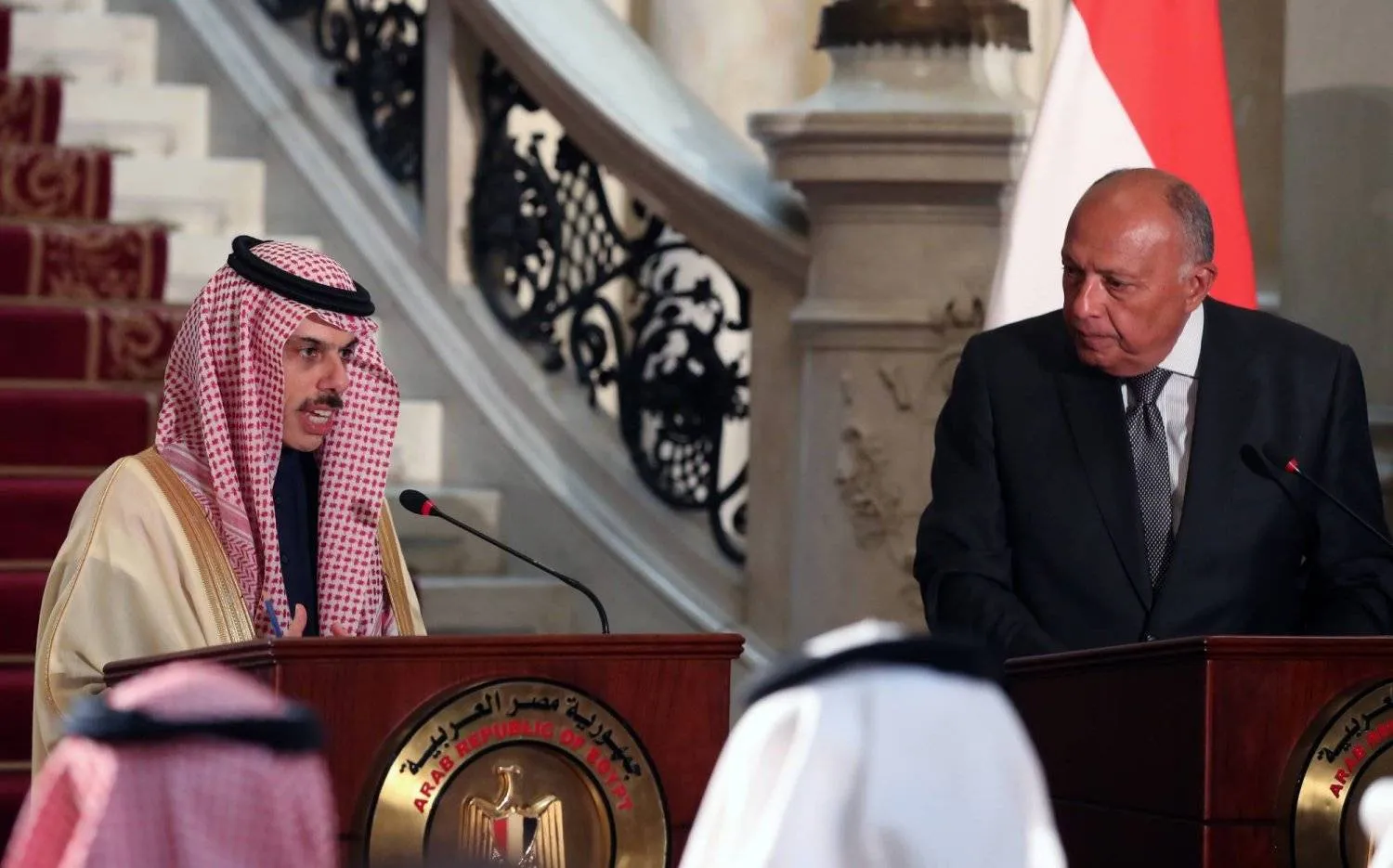

Saudi Arabia and Egypt agreed on Sunday to “continue ongoing coordination and consultation in a way that contributes to strengthening regional and international security and stability and meets the ambitions of the two countries’ leaderships.”
Saudi Foreign Minister Prince Faisal bin Farhan and his Egyptian counterpart Minister Sameh Shoukry co-chaired the regular meeting of the Political Follow-up and Consultation Committee, which was hosted by Cairo on Sunday.
In a joint press conference bin Farhan noted that recent developments have proven the importance of the stabilizing factor that the two countries represent for the region, in addition to the importance of their relationship and the need to maintain cooperation and coordination, within the framework of Arab action.
The Saudi-Egyptian meeting discussed “mechanisms of joint cooperation and the situation in Palestine,” and affirmed “our common priority towards an immediate ceasefire, and the entry of sufficient and necessary humanitarian aid into Gaza, paving the way for a just and sustainable political solution based on the two-state solution,” the Saudi minister said.
In response to a question about Israel’s refusal to implement the decision of the International Court of Justice (ICJ), he replied: “The most important thing we need is for everyone to respect international law... This applies to Israel as it applies to others. This is the great challenge, and the court’s ruling must be adhered to.”
Bin Farhan praised the Saudi-Egyptian relations, stressing the Kingdom’s aspiration to strengthen ties in various fields.
For his part, the Egyptian Foreign Minister reaffirmed “the demand for an immediate and comprehensive ceasefire in the Gaza Strip.”
“Cairo and Riyadh are keen to hold the political consultation mechanism at the ministerial level on an annual basis, in addition to discussions at the level of senior officials on a quarterly basis. This reflects the priority and importance that Cairo and Riyadh attach to coordination regarding various topics in an in-depth and continuous manner,” Shoukry underlined.
Regarding the decision by a number of countries to suspend UNRWA’s funding, he said: “UNRWA bears a huge responsibility, and limiting its ability to do so... is irrational.”