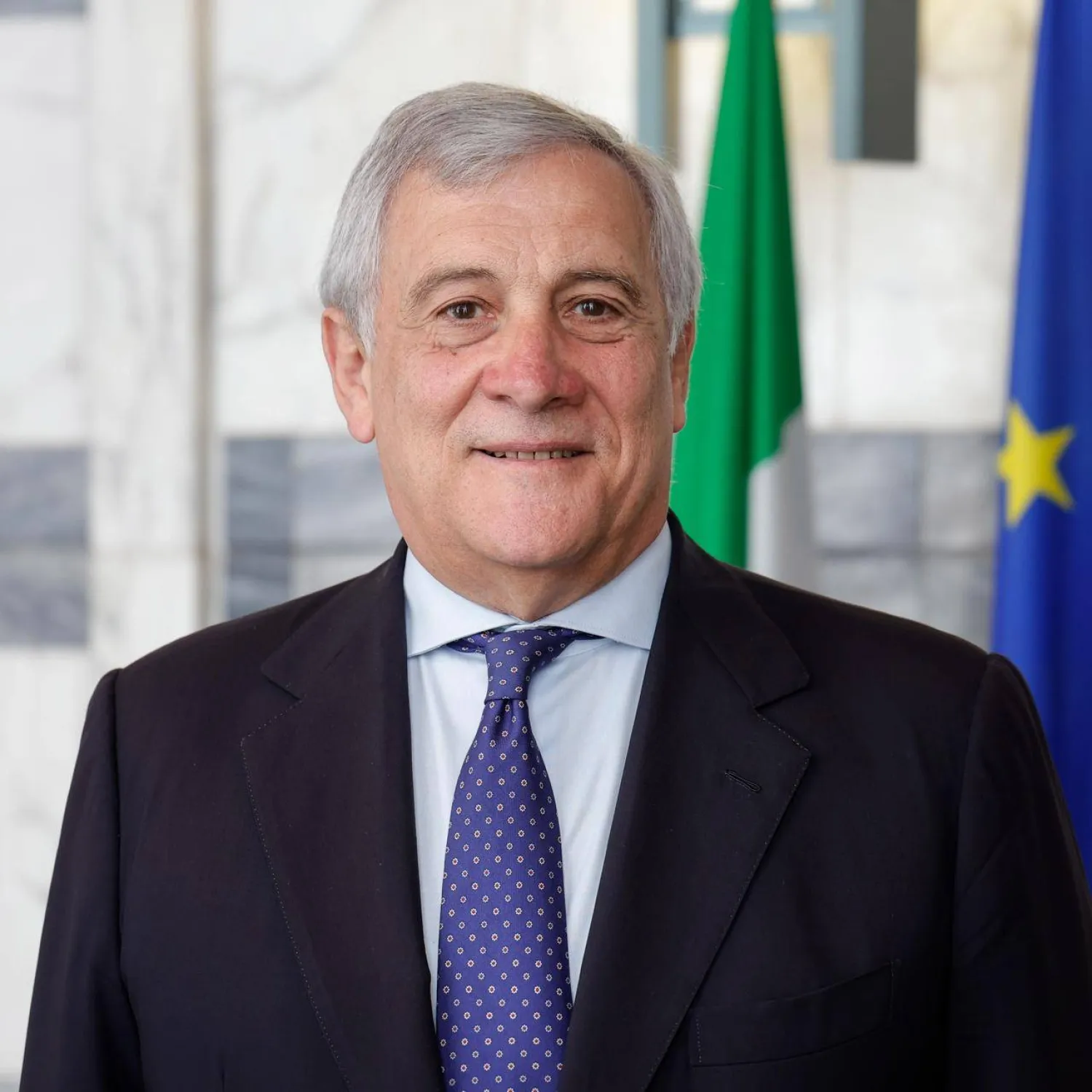
Italian Vice President of the Council of Ministers and Minister of Foreign Affairs and International Cooperation Antonio Tajani stressed the strategic nature of relations between Riyadh and Rome, describing Italy's relationship with Saudi Arabia as one of the pillars of Italy's engagement in the region.
In an interview with Asharq Al-Awsat, he said Saudi Arabia has become an indispensable partner in promoting dialogue, regional stability and sustainable growth, noting that Saudi-Italian coordination is underway to contain what he described as profound regional uncertainty.
"We have reaffirmed from Rome our shared commitment with Saudi Arabia to safeguarding freedom of navigation in the Strait of Hormuz, the Red Sea, Bab el-Mandeb, the Gulf of Aden and all international maritime routes," he said, describing the Gulf as a crucial political, economic and security partner.
The Saudi-Italian Partnership
On the Saudi-Italian partnership, Tajani said: "In Rome, together with my counterpart, Saudi Foreign Minister Prince Faisal bin Farhan, we adopted an important political declaration reaffirming not only the growing strategic partnership between Italy and Saudi Arabia."
He added: "We went further and declared our shared commitment to making the Wider Mediterranean an area of peace, prosperity and sustainable growth. The declaration also reiterates our firm condemnation of extremist settler violence and our rejection of any form of annexation."
Saudi-Italian Coordination to Contain Profound Regional Uncertainty
Asked about the latest Saudi-Italian coordination aimed at enhancing security and stability in the region and addressing the challenges arising from the US-Iran conflict, Tajani said: "The partnership between Italy and Saudi Arabia has never been more important than it is today. At a time of profound regional uncertainty, our two countries share a common strategic vision based on dialogue, stability and responsible leadership."
He added: "Italy views the regional situation within the broader context of growing international instability. Our strategic partnership is not confined to traditional geographical boundaries, as our vision of the Wider Mediterranean naturally extends to the Gulf and beyond."
He continued: "We therefore regard the Gulf as a crucial political, economic and security partner, and we consider our relationship with the Kingdom to be one of the pillars of Italy's engagement in the region. Saudi Arabia has become an indispensable partner in promoting dialogue, regional stability and sustainable growth, a vision that Italy has consistently advanced within the G7, the European Union and NATO."
He added: "One of Italy's greatest strengths is its ability to engage simultaneously with all the principal actors involved in regional crises. This enables us to keep all diplomatic channels open and to contribute to de-escalation even in the most difficult moments."
Maritime Security... A Shared Strategic Vision
Against the backdrop of tensions in the Strait of Hormuz and Bab el-Mandeb and threats to navigation in the Red Sea, Tajani said: "Maritime security remains a top national priority for Italy. A significant share of our trade passes through the Strait of Hormuz and Bab el-Mandeb, making freedom of navigation in these waters essential not only for Italy but also for global energy and economic security."
He added: "Together with Saudi Arabia, we have reaffirmed our shared commitment to safeguarding freedom of navigation in the Strait of Hormuz, the Red Sea, Bab el-Mandeb, the Gulf of Aden and all international maritime routes."
According to Tajani, Italy is already making a tangible contribution through its leading role in the EU naval operations EUNAVFOR ASPIDES, protecting commercial shipping in the Red Sea, and ATALANTA in the northwestern Indian Ocean.
He stressed that Rome and Riyadh increasingly share not only common interests but a genuine strategic vision for the region.
Tajani said: "We greatly value the Kingdom's growing diplomatic role in promoting dialogue and regional stability, and we intend to deepen an already excellent partnership built on trust, mutual respect and a shared ambition for a more stable, secure and prosperous Middle East."
Tajani added: "Saudi Arabia's proposal for a Global Maritime Defence Alliance reflects the growing international focus on maritime security and freedom of navigation, objectives that Italy fully shares. We will continue to work closely with the Kingdom and with our international partners to advance these common goals, with confidence, determination and a shared sense of responsibility for the stability and prosperity of the region."
Two-State Solution
On the situation in Gaza and the key outcomes of the meetings of the Global Alliance for the Implementation of the Two-State Solution held in Rome over the last few days, Tajani said: "The tragedy unfolding in Gaza demands more than expressions of concern."
He added: "It requires political leadership, sustained diplomacy and the determination to keep working for peace even when the obstacles appear overwhelming. Italy is playing a central diplomatic role in advancing a political solution to the crisis."
He said: "The Meeting of the 'Global Alliance for the Implementation of the Two-State Solution', held in Rome recently, clearly demonstrated our commitment to advancing political solutions and creating space for dialogue in the context of one of the most difficult crises facing the Mediterranean and the Middle East."
Tajani added: "This is an endeavor that we have proudly pursued together with our Saudi friends. Saudi Arabia has shown remarkable leadership in keeping the political horizon of the two-state solution alive, and I would like to acknowledge the outstanding level of cooperation we have developed together."
He continued: "The message from Rome was clear: the two-state solution remains the only credible option for guaranteeing Israel's security while enabling the emergence of a free, democratic and peaceful Palestinian state living side by side with Israel. For this reason, the disarmament of Hamas is essential, and a strong Palestinian National Authority is needed, capable of exercising effective authority throughout the Palestinian territories."
Tajani said: "We remain firmly committed to the objective of 'two peoples, two states', a position made possible by our longstanding relations with all the key actors in the region. Israelis, Palestinians, Lebanese and our Gulf partners all know that Rome is a place where dialogue is encouraged, trust is built and diplomacy is given every opportunity to succeed."
He stressed that Italy places particular emphasis on interfaith dialogue as an essential bridge for changing narratives and preparing the political ground for peace. He said a powerful demonstration of this commitment was the participation of Cardinal Pierbattista Pizzaballa, President of the Conference of European Rabbis Rabbi Pinchas Goldschmidt, and Sheikh Mohammed Al-Issa at the Global Alliance meeting held at the Ministry of Foreign Affairs.
Our Commitment in Gaza Is Firm
The Italian official added: "Alongside our continued engagement through the Food for Gaza initiative, we recently allocated an additional €10 million to support the Palestinian National Authority through the United Nations. We have also trained a group of Palestinian diplomats in Turin in cooperation with the International Labour Organization (ILO) and established university corridors enabling young Palestinians to study at leading Italian universities. We firmly believe that people-to-people diplomacy is one of the strongest investments we can make in building a just and lasting peace."
He added: "Italy also continues to play a leading role on the security front through its bilateral assistance mission to the Palestinian Security Forces and through the participation of our Carabinieri in the EU Border Assistance Mission at Rafah (EUBAM Rafah)."
The Crisis in Lebanon
On Italy's assessment of the current situation in Lebanon and its efforts in this regard, Tajani said: "Lebanon's stability is not only vital for the Lebanese people; it is essential for the security and stability of the entire region. This is why Italy has invested so much diplomatic effort in supporting dialogue and strengthening Lebanon's legitimate institutions."
He stressed that Italy is playing an important role as a facilitator and host of dialogue between the parties involved. He said it was no coincidence that Rome had once again been chosen as the venue for the latest round of US-mediated talks between Israel and Lebanon, adding that this reflects the trust both sides place in Italy's ability to facilitate dialogue and help create the conditions for lasting stability.
Tajani explained that Italy's approach to resolving the crisis in Lebanon is focused on restoring the country's full sovereignty and strengthening its legitimate institutions. He stressed that his government strongly supports President Joseph Aoun and is working with its international partners to ensure that the Lebanese state can progressively regain effective authority throughout the national territory. Another essential pillar of this strategy, he said, is the permanent disarmament of Hezbollah.
He added: "We strongly support President Joseph Aoun and are working with our international partners to ensure that the Lebanese state can progressively regain effective authority throughout the country. To ensure long-term stability, we are also focused on managing any future security transition after UNIFIL."
"Our priority is to avoid dangerous security vacuums while preserving stability in southern Lebanon in close coordination with our allies. We had rounds of talks in Rome as part of our continued efforts to facilitate dialogue. We remain convinced that dialogue is the only sustainable path towards lasting peace."