



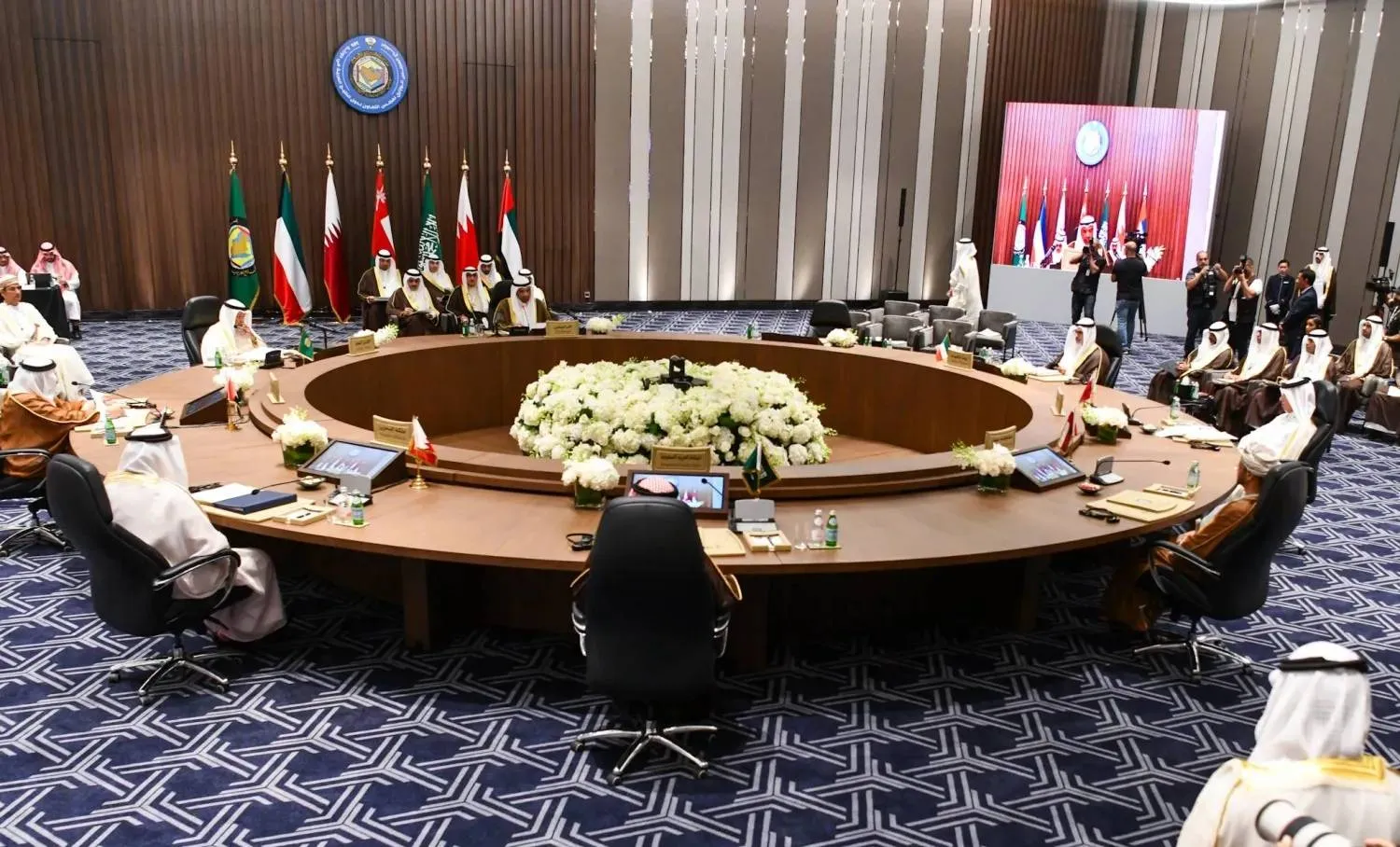

The Ministerial Council of the Gulf Cooperation Council (GCC) called on Monday for an immediate and permanent ceasefire in Gaza, stressing the need to protect civilians and ensure the unimpeded delivery of humanitarian aid.
Holding its 165th meeting in Kuwait, the council condemned Israel’s crimes against the Palestinians and its siege on Gaza, while hailing the mediation efforts led by Qatar, Egypt and the United States.
The council strongly condemned “the crime of genocide committed by the Israeli forces against the people of the Gaza Strip, as well as the deliberate siege policy that has led to famine in Gaza.”
It also condemned “the policies of ethnic cleansing, collective punishment, the killing of civilians and journalists, torture, field executions, forced disappearance and displacement, and looting.”
It denounced “the continued destruction of residential areas, hospitals, schools, universities, mosques, churches, and infrastructure, which aims to displace the Gaza’s inhabitants and resettle it.”
It demanded that the international community take immediate action to stop these crimes committed by the Israeli government and take serious steps to prevent them and hold perpetrators accountable.
The council reiterated “its consistent positions and previous decisions on the centrality of the Palestinian cause, emphasizing the need to end the Israeli occupation and establish an independent Palestinian state on the 1967 borders with East Jerusalem as its capital, in accordance with the Arab Peace Initiative and international resolutions.”
The council praised the success of the high-level international conference on settling the Palestinian issue through peaceful solutions and implementing the two-state solution.
The conference, co-chaired by Saudi Arabia and France, was held from July 28-30 at the United Nations headquarters. It stressed support for all efforts aimed at ending the war in the Gaza Strip and achieving a just and sustainable settlement of the Palestinian issue through the two-state solution, unifying the Gaza Strip and the West Bank under the Palestinian Authority's umbrella, and ensuring stability and security for all countries in the region.
The council confirmed its support for the Global Coalition for the Implementation of the Two-State Solution and the efforts of Saudi Arabia and the participating countries in the conference to set a timeline for the establishment of an independent Palestinian state and the end of the Israeli occupation. It called on all countries that desire peace to join this initiative.
The council also commended the measures initiated by France, the United Kingdom, Portugal, Malta, Canada, Australia, New Zealand, and others to recognize the State of Palestine, which confirms the international community's consensus on the right of the Palestinian people to establish their independent state. The council called on all countries to promptly recognize the State of Palestine to help end the Israeli occupation and fulfill the legitimate rights of the brotherly Palestinian people.
Iraq
On Iraq, the ministerial council reaffirmed its consistent positions and previous decisions on the importance of regulating navigation in Khor Abdullah and Iraq's respect for the sovereignty of Kuwait and the integrity of its territories, islands, highlands, and all its maritime areas.
It also stressed the need to adhere to bilateral and international commitments, agreements, and all relevant UN resolutions, especially Security Council Resolution 833 concerning the demarcation of the land and maritime borders between Kuwait and Iraq.
The Council called for the completion of the maritime boundary demarcation between the two countries beyond maritime marker 162, in accordance with the rules and principles of international law and the 1982 United Nations Convention on the Law of the Sea.
Syria and Lebanon
Turning to Syria, the council welcomed the agreement reached to end the crisis in the Sweida governorate, stressing the need to protect the country’s unity and citizens. The council praised the commitment of Syrian President Ahmed al-Sharaa to hold all those responsible for abuses against Syrian citizens in Sweida accountable.
It also supported all efforts to establish security, state sovereignty, and the rule of law across all Syrian territories, while rejecting violence, sectarianism, and attempts to sow discord, incitement, and hatred.
The council also condemned the repeated Israeli violations against Syria and its blatant attacks against its sovereignty and stability. The council said these actions destabilize its security, unity, and territorial integrity, undermine the Syrian government's efforts to build a new Syria.
The council underlined its full support for the measures taken by the Syrian government to maintain security and stability and rejected any separatist calls aimed at dividing Syria.
On Lebanon, the council welcomed the announcement by Prime Minister Nawaf Salam of a cabinet decision to ensure that the possession of weapons is restricted to the state throughout the country, based on the Taif Accords and relevant international resolutions.
The council condemned the continued Israeli attacks on Lebanon, stressing the need to implement UN Security Council resolutions concerning Lebanon, especially Resolution 1701. It praised the mediation efforts of the United States in this regard and expressed its rejection of external statements and interference in the internal affairs of Lebanon.


