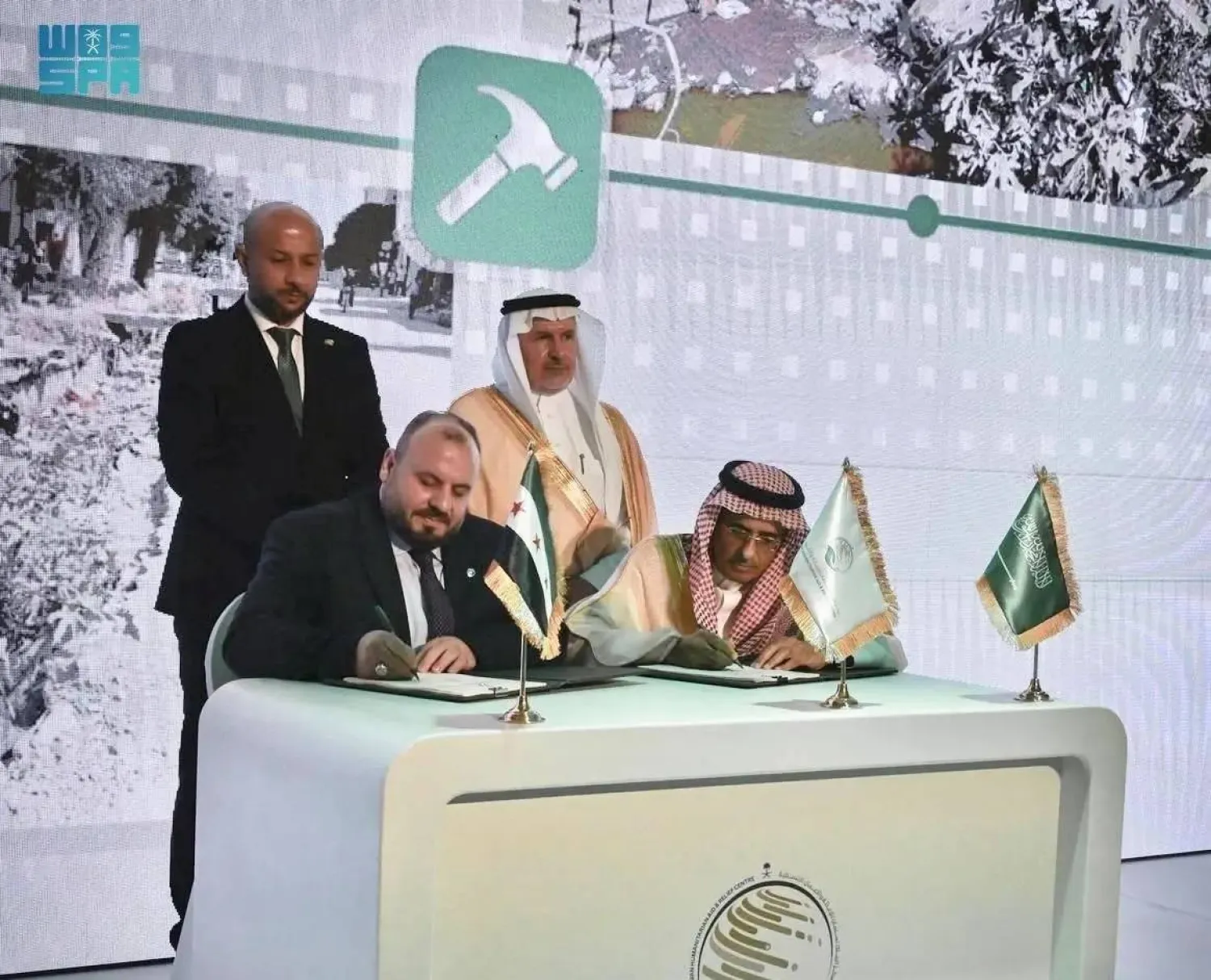

Saudi Arabia’s King Salman Humanitarian Aid and Relief Center (KSrelief) signed in Damascus on Sunday a number of agreements with the Syrian Ministry of Emergency and Disaster Management and other agencies as part of its humanitarian and relief efforts across Syria.
The first agreement signed with the ministry aims to remove and manage debris in the Damascus countryside, specifically in Darayya and Douma.
The partnership includes removing more than 75,000 cubic meters of debris from roads and public facilities to support recovery efforts.
Under the agreement, a debris management unit will also be established and equipped, and no less than 30,000 cubic meters of debris will be recycled.
The initiative strengthens local capacities by providing equipment to sustain debris removal and recycling operations. It will reduce environmental impact and is expected to benefit more than four million people.
The second agreement with the ministry aims to rehabilitate sewage networks in Qaboun, in the Damascus governorate.
The project includes rehabilitating sewage networks and cleaning and sealing exposed canals. It aims to improve access to residential areas, curb the spread of disease, enhance environmental and health sustainability and promote public safety. About 21,000 people are expected to benefit.
The third agreement with the ministry aims to rehabilitate wells in the Douma area.
The signing ceremony was attended by Advisor at the Royal Court and Supervisor General of KSrelief Dr. Abdullah Al Rabeeah and Syrian Minister of Emergency and Disaster Management Raed Al-Saleh. The agreement was signed by KSrelief Assistant Supervisor General for Operations and Programs Eng. Ahmed bin Ali Al-Baiz.
The agreement provides for the full rehabilitation of 15 wells, improving groundwater extraction efficiency and supporting the sustainability of water resources. It also includes awareness campaigns to promote rational water use among local residents, benefiting an estimated 250,000 people.
This initiative comes as part of the Kingdom’s ongoing humanitarian efforts, through KSrelief, to enhance water services in affected areas, ensure access to safe water, reduce the spread of disease, promote public health, and support sustainable development in Syria.
KSrelief also signed a joint cooperation agreement with a civil society organization to support the wheat production chain in the eastern countryside of Aleppo.
Efforts will focus on rehabilitating agricultural infrastructure, including irrigation and drainage systems. The project seeks to improve the availability of high-quality Syrian wheat seeds and provide crucial technical support for agricultural extension and mechanization.
The intervention will cover a total area of 2,750 hectares, benefiting approximately 16,500 individuals from 2,750 families. By empowering small farmers, the program aims to increase local reliance on agricultural resources and promote self-sufficiency.
The agreements are part of Saudi Arabia's ongoing humanitarian and relief efforts to improve services and support recovery in affected areas across Syria.