


Egypt Sends Message of Solidarity with Qatar

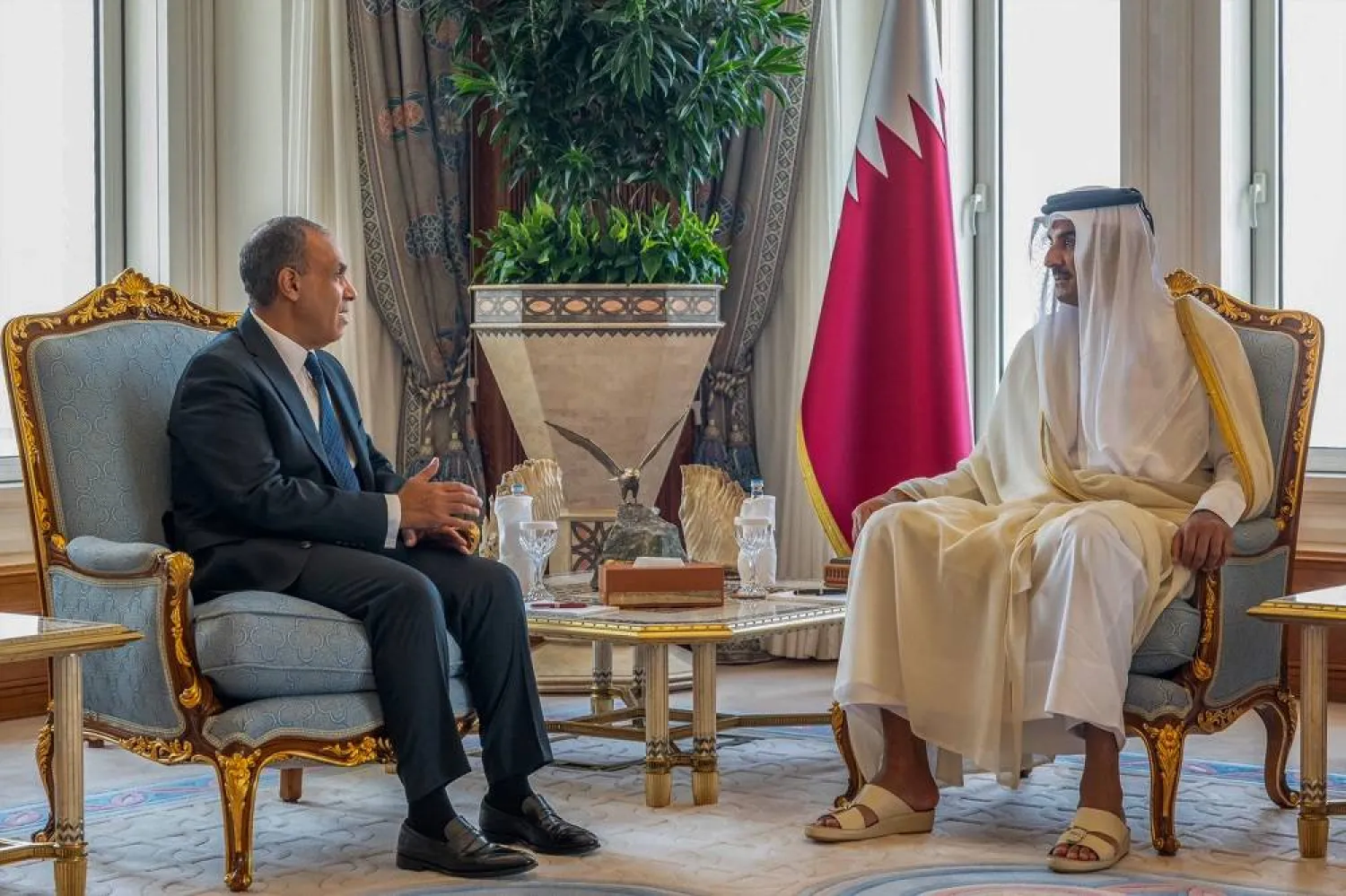
This handout picture made available by the Qatar Amiri Diwan shows Qatar's Amir Sheikh Tamim bin Hamad Al Thani receiving Egypt's Foreign Minister Badr Abdelatty in Doha on September 11, 2025. (Qatar Amiri Diwan / AFP)
TT

Egypt Sends Message of Solidarity with Qatar

This handout picture made available by the Qatar Amiri Diwan shows Qatar's Amir Sheikh Tamim bin Hamad Al Thani receiving Egypt's Foreign Minister Badr Abdelatty in Doha on September 11, 2025. (Qatar Amiri Diwan / AFP)

Egyptian Foreign Minister Badr Abdelatty on Thursday conveyed a verbal message of solidarity from Egyptian President Abdel Fattah al-Sisi to Qatari Emir Sheikh Tamim bin Hamad Al Thani in wake of the Israeli attack on Doha on Tuesday.

Abdelatty described the attack as a dangerous precedent, not only against Qatar but also against collective Arab security, adding that “any harm to Qatar’s security is a direct infringement on Arab national security.”

On Wednesday, Sisi spoke over the phone with Sheikh Tamim and stressed Egypt’s absolute rejection of any violation that undermines the sovereignty of Qatar.

He underscored Egypt’s unwavering and unshakable solidarity, at both the leadership and popular levels, with Qatar in the face of this outrageous violation of international law and the Charter of the United Nations.

The president described the Israeli attack as a provocative assault on the sovereignty of a fellow Arab nation and a blatant, unacceptable threat to its security, stability, and territorial integrity.

Sisi reiterated Egypt’s full and resolute support for all measures undertaken by Qatar to safeguard its security and stability.

A presidential statement said both sides agreed on the urgent need for the international community to assume its responsibilities in confronting this “egregious Israeli violation and to ensure that those responsible are held fully accountable.”

The leaders stressed the imperative to stop any transgression against the sovereignty of states so as to safeguard regional and international peace and security.

During his meeting with Sheikh Tamim on Thursday, Abdelatty renewed Egypt's firm stance against any action that threatens Qatar's security, stability, and sovereignty.

He condemned the strike as a “blatant violation” of Qatar’s sovereignty and a “serious breach” of international law and the UN Charter.

He offered condolences to the emir of Qatar for those killed in the assault, calling the strike “disgraceful.”

For his part, Sheikh Tamim thanked Sisi for his call and praised Egypt’s supportive stance, saying the visit by Abdelatty highlighted the close ties between the two countries.

Both sides reiterated their commitment to continued coordination in the face of regional challenges.

The attack killed at least six people, including a Qatari security officer and Humam Al-Hayya, the son of senior Hamas figure Khalil Al-Hayya.



Saudi Arabia, Djibouti Sign Mutual Visa Exemption Agreement for Diplomatic, Special Passport Holders

Saudi Deputy Minister for Protocol Affairs Ambassador Abdulmajeed Al-Smari and Djibouti’s Ambassador to the Kingdom Dya-Eddine Bamakhrama at Monday's signing ceremony. (SPA)
TT

Saudi Arabia, Djibouti Sign Mutual Visa Exemption Agreement for Diplomatic, Special Passport Holders

Saudi Deputy Minister for Protocol Affairs Ambassador Abdulmajeed Al-Smari and Djibouti’s Ambassador to the Kingdom Dya-Eddine Bamakhrama at Monday's signing ceremony. (SPA)

Saudi Arabia and Djibouti signed on Monday a mutual visa exemption agreement for holders of diplomatic and special passports between the governments of the two countries.

The agreement was signed by Saudi Deputy Minister for Protocol Affairs Ambassador Abdulmajeed Al-Smari, on behalf of Minister of Foreign Affairs Prince Faisal bin Farhan bin Abdullah, and by Djibouti’s Ambassador to the Kingdom Dya-Eddine Bamakhrama.

The agreement comes within the framework of the distinguished bilateral relations between the two countries and will boost coordination and the development of joint cooperation across various fields.


Sixth Hajj Conference and Exhibition to Be Held in Jeddah in November

The sixth edition of the Hajj Conference and Exhibition will be held in Jeddah from November 8 to 11. (SPA)
TT

Sixth Hajj Conference and Exhibition to Be Held in Jeddah in November

The sixth edition of the Hajj Conference and Exhibition will be held in Jeddah from November 8 to 11. (SPA)

Under the patronage of Custodian of the Two Holy Mosques King Salman bin Abdulaziz Al Saud, the Ministry of Hajj and Umrah, in cooperation with the Pilgrim Experience Program (PEP), one of the programs of Saudi Vision 2030, will organize the sixth edition of the Hajj Conference and Exhibition in Jeddah from November 8 to 11.

The event will bring together more than 520 entities from the government, private, and nonprofit sectors at the local and international levels. It will also bring together decision-makers from the government, private, and third sectors.

The conference reflects the leadership's continued commitment to serving pilgrims and Saudi Arabia's efforts to develop the Hajj services ecosystem and improve its quality. It supports the objectives of Saudi Vision 2030 and the Pilgrim Experience Program.

This year's event will serve as a key platform for early preparations for the next Hajj season. It will bring together relevant stakeholders to finalize contracts, discuss operational and regulatory matters, showcase solutions and initiatives, build partnerships, and enhance readiness for the upcoming season.

As a global platform for leaders, decision-makers, and specialists from around the world, the event will showcase solutions and practices and facilitate the exchange of expertise across three tracks.

The first track, Infrastructure and Operational Services, covers transportation and logistics, infrastructure and facilities management, housing and hospitality, and catering and nutrition. The second, Empowerment and Integration, focuses on safety and security, healthcare, media and communication, and technology and innovation. The third, Sustainable Development, covers the third sector, entrepreneurship, training and development, and enhancing the pilgrim experience.

Alongside the conference, an exhibition covering the Hajj services ecosystem will be held, bringing together entities and providers of services and solutions from more than 150 countries.

The exhibition will feature specialized communities comprising leaders, Hajj affairs offices, and service providers. It will include communities representing aviation, transportation, hospitality, healthcare, infrastructure, technology, innovation, the workforce, investment, and business development.

The previous edition of the Hajj Conference and Exhibition attracted more than 204,000 visitors and 270 exhibitors from more than 150 countries. It featured 134 specialized sessions and workshops, while more than 2,600 trainees from around the world participated in its training programs.


Islamic Military Counter Terrorism Coalition, Oman Discuss Strategic Partnership, Maritime Security

Oman’s Chief of Staff of the Sultan's Armed Forces Vice Admiral Abdullah bin Khamis Al Raisi and Islamic Military Counter Terrorism Coalition (IMCTC) Secretary-General Maj. Gen. Mohammed bin Saeed Al-Moghedi meet on Monday. (SPA)
TT

Islamic Military Counter Terrorism Coalition, Oman Discuss Strategic Partnership, Maritime Security

Oman’s Chief of Staff of the Sultan's Armed Forces Vice Admiral Abdullah bin Khamis Al Raisi and Islamic Military Counter Terrorism Coalition (IMCTC) Secretary-General Maj. Gen. Mohammed bin Saeed Al-Moghedi meet on Monday. (SPA)

Oman’s Chief of Staff of the Sultan's Armed Forces Vice Admiral Abdullah bin Khamis Al Raisi received on Monday Islamic Military Counter Terrorism Coalition (IMCTC) Secretary-General Maj. Gen. Mohammed bin Saeed Al-Moghedi for talks on strengthening cooperation and coordination with member states.

They reviewed areas of cooperation and ways to strengthen the partnership between the IMCTC and Oman, particularly in countering terrorism, building capacities, and exchanging expertise, in support of regional and international efforts to address extremist threats and promote security, stability, and peace.

Al-Moghedi outlined the coalition's key activities, initiatives, and programs across its four domains: intellectual, media, counter-terrorist financing, and military, as well as its efforts to support member states and develop their institutional and human capabilities.

He outlined the role of the IMCTC's Initiatives Fund, its objectives, and its main areas of operation. The fund supports strategic initiatives that member states identify as priorities, enabling them to implement specialized programs and sustainable projects across various fields of counter-terrorism.

The secretary-general and his delegation visited the Maritime Security Center in Oman, where they were briefed on the center's mandate and operational responsibilities, its mechanisms for monitoring and coordinating activities at sea, and its role in strengthening maritime security and safety and addressing potential risks and threats.