


Saudi Arabia Expands Support in Yemen with New Health, Women’s Empowerment Initiatives

Saudi humanitarian aid to Yemen has covered all aspects of life, including the health sector. (Saba)
TT

Saudi Arabia Expands Support in Yemen with New Health, Women’s Empowerment Initiatives

Saudi humanitarian aid to Yemen has covered all aspects of life, including the health sector. (Saba)

Saudi Arabia, through its King Salman Humanitarian Aid and Relief Center (KSrelief), continues to expand its humanitarian and development programs across Yemen, focusing on improving living conditions for vulnerable groups and promoting economic recovery in areas ravaged by war.

In the city of Seiyun, in the Hadramout Governorate, KSrelief launched a new package of specialized health services for women and their families under the “Bidaya” (Beginning) project, implemented by the Al-Amal Women’s Cultural and Social Foundation. The initiative benefits around 21 families in Wadi Hadramout and aims to close critical healthcare gaps for those most in need.

The project provides free medical consultations, diagnostic tests, and essential medicines, as well as awareness sessions on disease prevention, vaccination campaigns for unvaccinated children, and reproductive and mental health services. It covers about 180 cases across primary, physical, and psychological care.

Amer Al-Amri, Deputy Governor of Hadramout for the Valley and Desert Affairs, described the initiative as “a key contribution to strengthening healthcare services in remote areas.”

He highlighted the importance of partnership with KSrelief in delivering projects that directly address citizens’ needs, adding that the programs “also help empower women and prepare them to play a greater role in supporting their families and local communities.”

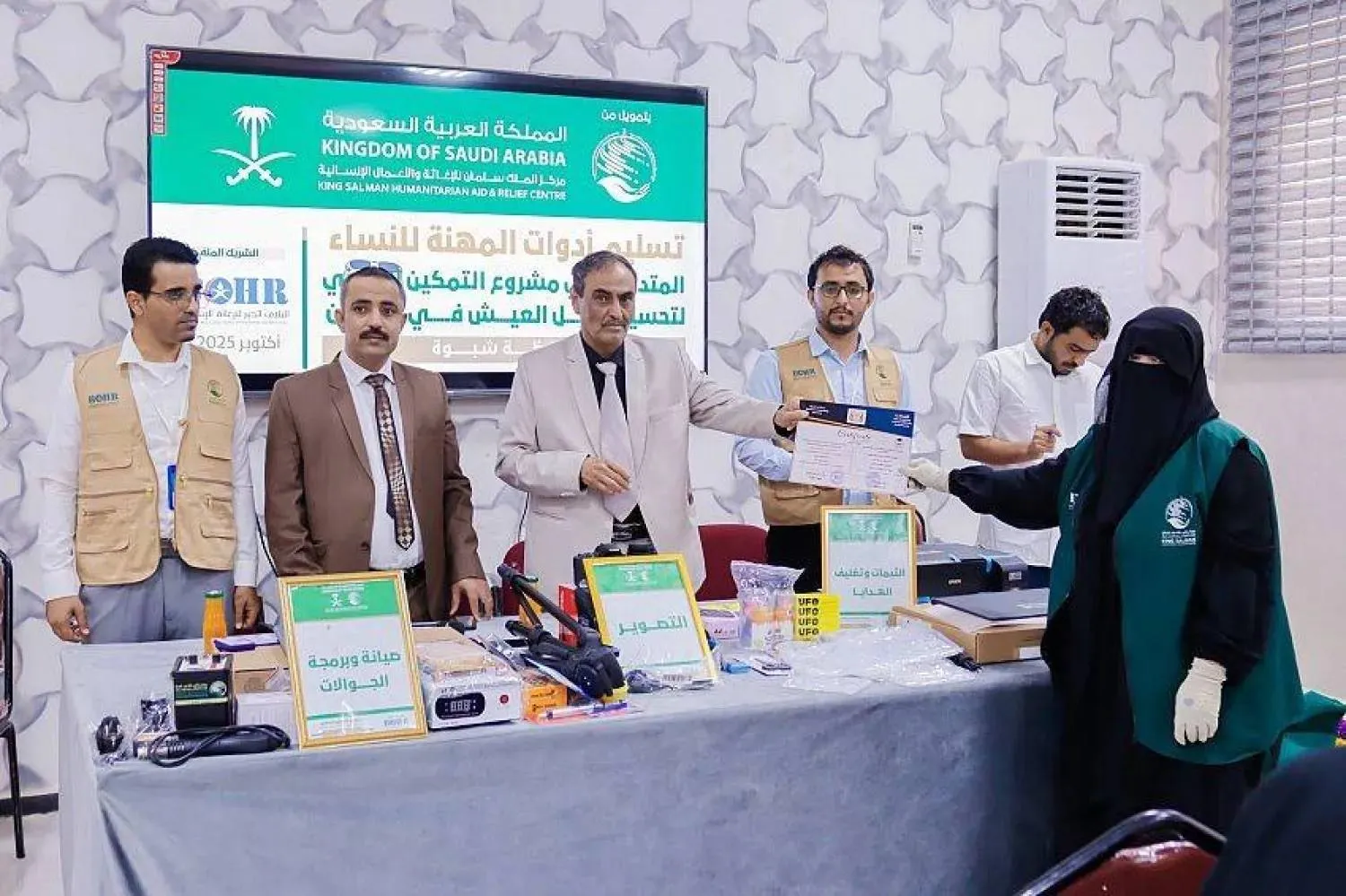
Alongside its humanitarian efforts, Saudi Arabia is advancing economic empowerment programs aimed at improving livelihoods and promoting stability. KSrelief recently distributed vocational toolkits to 650 women as part of its Professional Empowerment Project in the governorates of Marib, Hadramout, Lahj, Al-Mahrah, Shabwa, Taiz and Socotra.

The toolkits span various trades, including food production, livestock breeding, perfume and incense making, photography, sewing and embroidery, phone repair, and fishing net weaving, enabling participants to launch small income-generating projects and support their families.

Targeting 1,500 beneficiaries, the project is part of a broader Saudi strategy to help Yemen transition from dependence on relief aid to sustainable development.

Organizers said the program offers job opportunities for vulnerable groups, particularly widows and female breadwinners, by providing them with professional tools and training to start small businesses without significant capital.

These initiatives reflect Saudi Arabia’s comprehensive approach that combines immediate humanitarian aid with long-term development planning to alleviate suffering and improve living standards in conflict zones.

According to KSrelief, Saudi Arabia has implemented hundreds of projects in Yemen in recent years, covering sectors such as health, education, food security, water, women’s empowerment, and psychosocial support.



GCC Secretary-General Commends UN Resolution Extending UNRWA Operations

Secretary General of the Gulf Cooperation Council Jasem Mohamed Albudaiwi. GCC
TT

GCC Secretary-General Commends UN Resolution Extending UNRWA Operations

Secretary General of the Gulf Cooperation Council Jasem Mohamed Albudaiwi. GCC

Secretary-General of the Gulf Cooperation Council (GCC) Jasem Albudaiwi welcomed the resolution adopted by the United Nations General Assembly renewing the mandate of the United Nations Relief and Works Agency for Palestine Refugees in the Near East (UNRWA) for an additional three years, extending through 2029.

He stressed that UNRWA’s role is more vital today than ever, in light of the escalating challenges facing the Palestinian people, the Saudi Press Agency reported on Sunday.

Albudaiwi reaffirmed the GCC’s firm support for the agency’s programs and initiatives, underscoring the Council’s unwavering commitment to the Palestinian cause, the protection of the legitimate rights of the Palestinian people, and the continuity and sustainability of UNRWA’s operations.


KSrelief Delivers Shelter Aid to Palestinian People in Gaza

KSrelief delivers shelter aid to Palestinian people in Gaza. (SPA)
TT

KSrelief Delivers Shelter Aid to Palestinian People in Gaza

KSrelief delivers shelter aid to Palestinian people in Gaza. (SPA)

The King Salman Humanitarian Aid and Relief Center (KSrelief) delivered a new shipment of shelter aid to the Gaza Strip on Saturday, targeting urgent winter needs for displaced residents and offering protection from increasingly harsh weather conditions.

The delivery forms part of the broader Saudi campaign to support the Palestinian people, the Saudi Press Agency reported.

The latest consignment included fully equipped tents prepared by the Saudi Center for Culture and Heritage, KSrelief’s executive partner in Gaza, ahead of distribution to affected families.

The Kingdom has so far established air and sea bridges that have transported more than 7,677 tons of food, medical supplies, and shelter materials aboard 74 aircraft and eight ships.

Saudi Arabia has also supplied 20 ambulances to the Palestine Red Crescent Society. In addition, the center has signed relief agreements for projects in the strip totaling $90.35 million and is conducting joint airdrop operations with Jordan to widen access to aid.

The latest delivery underscores the Kingdom’s continued efforts to ease the humanitarian crisis facing Palestinians in Gaza.


Qatar’s PM Says Gaza Ceasefire at Critical Moment

Qatar's Prime Minister and Minister for Foreign Affairs Sheikh Mohammed bin Abdulrahman bin Jassim Al-Thani, attends a session on the opening day of the Doha Forum, an annual diplomatic conference, in Doha on December 6, 2025. (Photo by MAHMUD HAMS / AFP)
TT

Qatar’s PM Says Gaza Ceasefire at Critical Moment

Qatar's Prime Minister and Minister for Foreign Affairs Sheikh Mohammed bin Abdulrahman bin Jassim Al-Thani, attends a session on the opening day of the Doha Forum, an annual diplomatic conference, in Doha on December 6, 2025. (Photo by MAHMUD HAMS / AFP)

Qatar’s Prime Minister on Saturday said the Gaza ceasefire has reached a “critical moment” as its first phase winds down, with the remains of just one Israeli hostage still held in Gaza.

Sheikh Mohammed bin Abdulrahman Al Thani told an international conference in the Qatari capital that international mediators, led by the US, are working “to force the way forward” to the second phase to cement the deal.

“What we have just done is a pause,” he told the Doha Forum. “We cannot consider it yet a ceasefire.”

“A ceasefire cannot be completed unless there is a full withdrawal of Israeli forces, there is stability back in Gaza, people can go in and out, which is not the case today,” he said.

While the ceasefire halted the heavy fighting of the two-year war, Gaza health officials say that over 360 Palestinians have been killed by Israeli fire since the truce took effect in October.

The first phase of US President Donald Trump’s 20-point peace plan took effect Oct. 10. The fighting stopped and dozens of hostages held in Gaza were exchanged for hundreds of Palestinians held in Israeli prison. Israel sent a delegation last week to Egypt for talks on returning the remains of the last hostage.

The next phase, which includes the deployment of an international security force in Gaza, formation of a new technocratic government for the territory, disarmament of Hamas and an eventual withdrawal of Israeli forces from Gaza, has not yet begun.

Sheikh Mohammed said that even the upcoming phase should be “temporary” and that peace in the region could only take place with the eventual establishment of a Palestinian state.

“If we are just resolving what happened in Gaza, the catastrophe that happened in the last two years, it’s not enough,” he said. “There is a root for this conflict. And this conflict is not only about Gaza."

He added: “It’s about Gaza. It’s about the West Bank. It’s about the rights of the Palestinians for their state. We are hoping that we can work together with the US administration to achieve this vision at the end of the day.”