

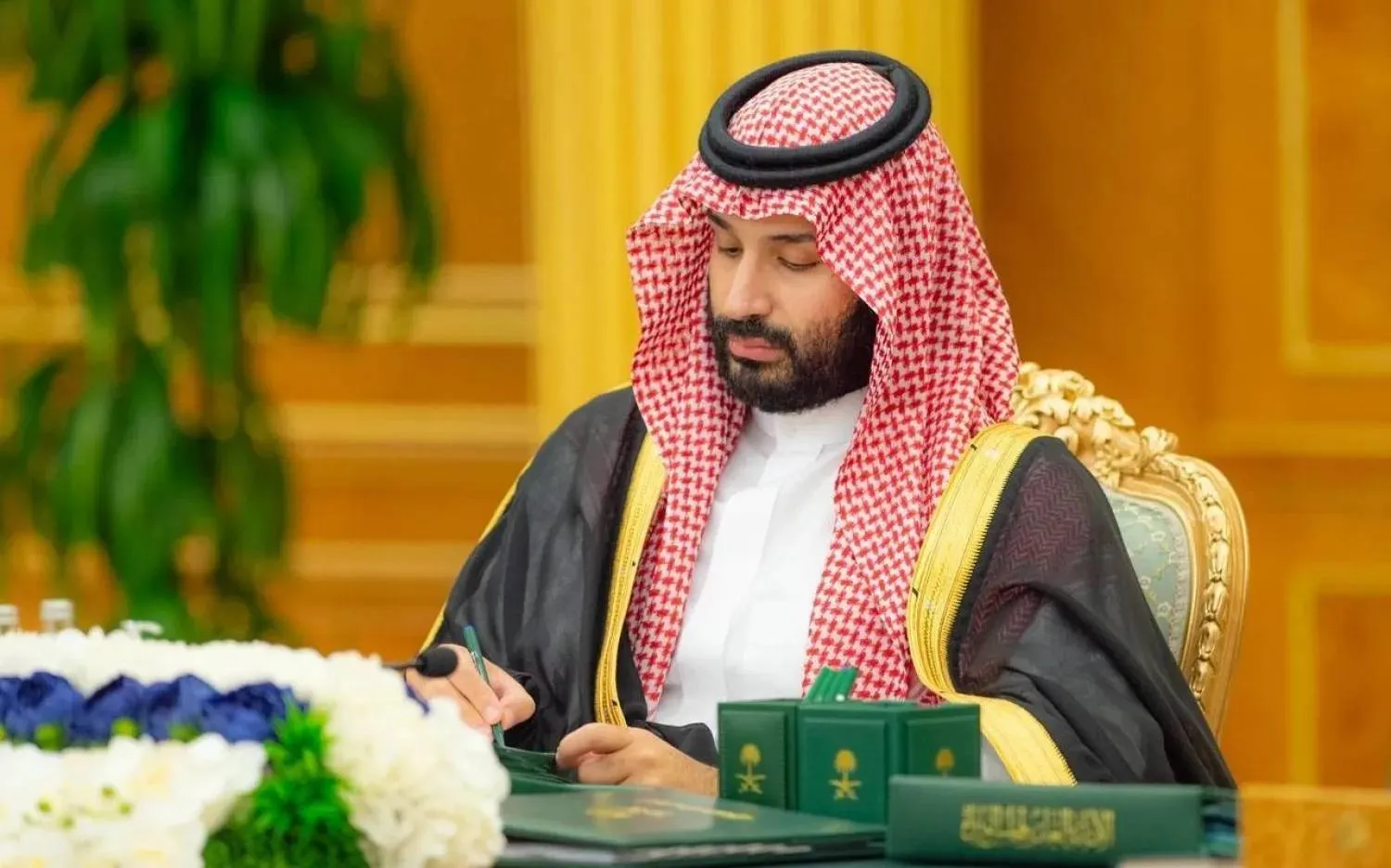

Saudi Arabia Stresses its Support for Regional, Int’l Efforts to Achieve Global Security, Peace

Prince Mohammed bin Salman bin Abdulaziz Al Saud, Crown Prince and Prime Minister, chairs the cabinet meeting in Riyadh. (SPA)
TT

Saudi Arabia Stresses its Support for Regional, Int’l Efforts to Achieve Global Security, Peace

Prince Mohammed bin Salman bin Abdulaziz Al Saud, Crown Prince and Prime Minister, chairs the cabinet meeting in Riyadh. (SPA)

The Saudi government stressed on Tuesday the Kingdom’s support for regional and international efforts aimed at achieving global security and peace.

Prince Mohammed bin Salman bin Abdulaziz Al Saud, Crown Prince and Prime Minister, chaired the cabinet meeting that was held in Riyadh.

The Crown Prince briefed the ministers on the telephone call he received from French President Emmanuel Macron. They discussed developments in Gaza and stressed the urgent need to ease the humanitarian suffering of the Palestinian people, secure a full Israeli withdrawal, and agree on the importance of initiating practical steps to achieve a just peace based on the two-state solution.

The cabinet reiterated Saudi Arabia’s support for regional and international efforts to achieve security and peace worldwide, while renewing its welcome of the agreement between Pakistan and Afghanistan on an immediate ceasefire and the establishment of mechanisms to consolidate lasting peace and stability between them.

On local affairs, the cabinet discussed development program plans across several government agencies, particularly those related to the ecosystem of development projects and initiatives focused on boosting service quality and productivity and harnessing various capabilities and resources to achieve a prosperous future and sustainable development.

The cabinet commended the launch of the King Salman Gate project, saying it represents a significant shift in the development of infrastructure in Makkah’s central area. The project aims to establish Makkah as a global model of urban planning and will be a major contributor to providing high-quality services to Grand Mosque visitors, aligning with the objectives of the Pilgrim Experience Program.

The cabinet hailed the ongoing implementation steps to bolster housing supply and achieve real estate balance across the Kingdom. These efforts will support the process of construction and development, provide suitable and diverse housing options for citizens, and attract more investors and development companies to the Saudi market.

Moreover, the cabinet said the Kingdom’s receipt of global awards in open education, rural development, and rail transport is confirmation of the state’s commitment and unwavering support in enabling these sectors to achieve continued excellence, competitiveness, and global leadership.

The cabinet praised the success of the Saudi International Rail Exhibition and Conference, noting that its second edition featured participation from 22 countries and the signing of over 50 contracts and agreements set to support the objectives of the National Transport and Logistics Strategy.




Saudi Arabia Welcomes US Designation of 3 Muslim Brotherhood Branches as Terrorist 

This 2011 photo shows a Muslim Brotherhood office in Amman, Jordan. (AFP)
TT

Saudi Arabia Welcomes US Designation of 3 Muslim Brotherhood Branches as Terrorist 

This 2011 photo shows a Muslim Brotherhood office in Amman, Jordan. (AFP)

The Saudi Ministry of Foreign Affairs welcomed on Wednesday the United States' designation of the Muslim Brotherhood branches in Egypt, Jordan, and Lebanon as terrorist organizations.

The ministry stressed the Kingdom’s condemnation of extremism and terrorism, its support for all that achieves security, stability, and prosperity of Arab countries, and the security of the region and the world.


Islamic Military Coalition Launches ‘Competence’ Military Strategic Initiative in Sierra Leone

Officials are seen at Tuesday's launch. (SPA)
TT

Islamic Military Coalition Launches ‘Competence’ Military Strategic Initiative in Sierra Leone

Officials are seen at Tuesday's launch. (SPA)

The Islamic Military Counter-Terrorism Coalition (IMCTC) launched on Tuesday the “Competence” military strategic training for counter-terrorism in Sierra Leone.

The launch was attended by Sierra Leonean Minister of Internal Affairs Morie Lengor, IMCTC Secretary General of the Islamic Military Counter-Terrorism Coalition (IMCTC) Major General Pilot Mohammed bin Saeed Al-Moghedi, senior military and security officials, civil representatives, and members of the diplomatic corps accredited to Republic of Sierra Leone.

The initiative runs from January 13 to February 3, targeting the training and capacity building of 30 military and security personnel through an intensive 15-day program focused on counter-terrorism, including handling explosives, improvised devices, and unexploded ordnance, while enhancing the operational readiness of specialized forces.

The training aims to develop the skills and capabilities of personnel in counter-terrorism units and facilitate the transfer of advanced professional knowledge and expertise among member states, enabling them to address complex terrorist threats with high-level scientific and professional methods.


Saudi Govt Rejects Any Attempts to Undermine Somalia’s Sovereignty

Custodian of the Two Holy Mosques King Salman bin Abdulaziz Al Saud chairs the Cabinet meeting in Riyadh. (SPA)
TT

Saudi Govt Rejects Any Attempts to Undermine Somalia’s Sovereignty

Custodian of the Two Holy Mosques King Salman bin Abdulaziz Al Saud chairs the Cabinet meeting in Riyadh. (SPA)

The Saudi government stressed on Tuesday the Kingdom’s rejection of any attempts “to create parallel entities that undermine Somalia's unity, territorial integrity, or national sovereignty.”

Custodian of the Two Holy Mosques King Salman bin Abdulaziz Al Saud chaired the Cabinet meeting that was held in Riyadh.

The Cabinet welcomed the outcomes of the Organization of Islamic Cooperation's extraordinary meeting on Somalia in Jeddah that stressed the Kingdom’s stance on Somalia.

The Cabinet reviewed recent high-level discussions between the Kingdom and various countries, focusing on regional developments, ongoing efforts to anchor security and peace, and the Kingdom's commitment to multilateral initiatives that drive global stability and foster collective responses to shared challenges.

The Cabinet reiterated the centrality of the Palestinian cause, stressing the Kingdom's unwavering support for a ceasefire in the Gaza Strip. These efforts aim to enable the Palestinian people to exercise their right to self-determination and to establish an independent state within the 1967 borders, with East Jerusalem as its capital.

The Cabinet commended the successful conclusion of the Gulf Shield 2026 joint military exercise, hosted by Saudi Arabia. Featuring the air and air defense forces of the Gulf Cooperation Council (GCC) and the GCC Unified Military Command, the exercise underscored the commitment to boosting regional defense cooperation and strengthening collective military readiness.

The Cabinet reviewed several high-profile economic events hosted by the Kingdom, specifically highlighting the Saudi-Japan Ministerial Investment Forum and the Saudi-Canadian Business and Investment Forum. The summits resulted in numerous memoranda of understanding across strategic sectors, including space, cybersecurity, ICT, manufacturing, education, finance, water, and agriculture.