


Muscat Calls on Washington and Tehran to Restart Talks

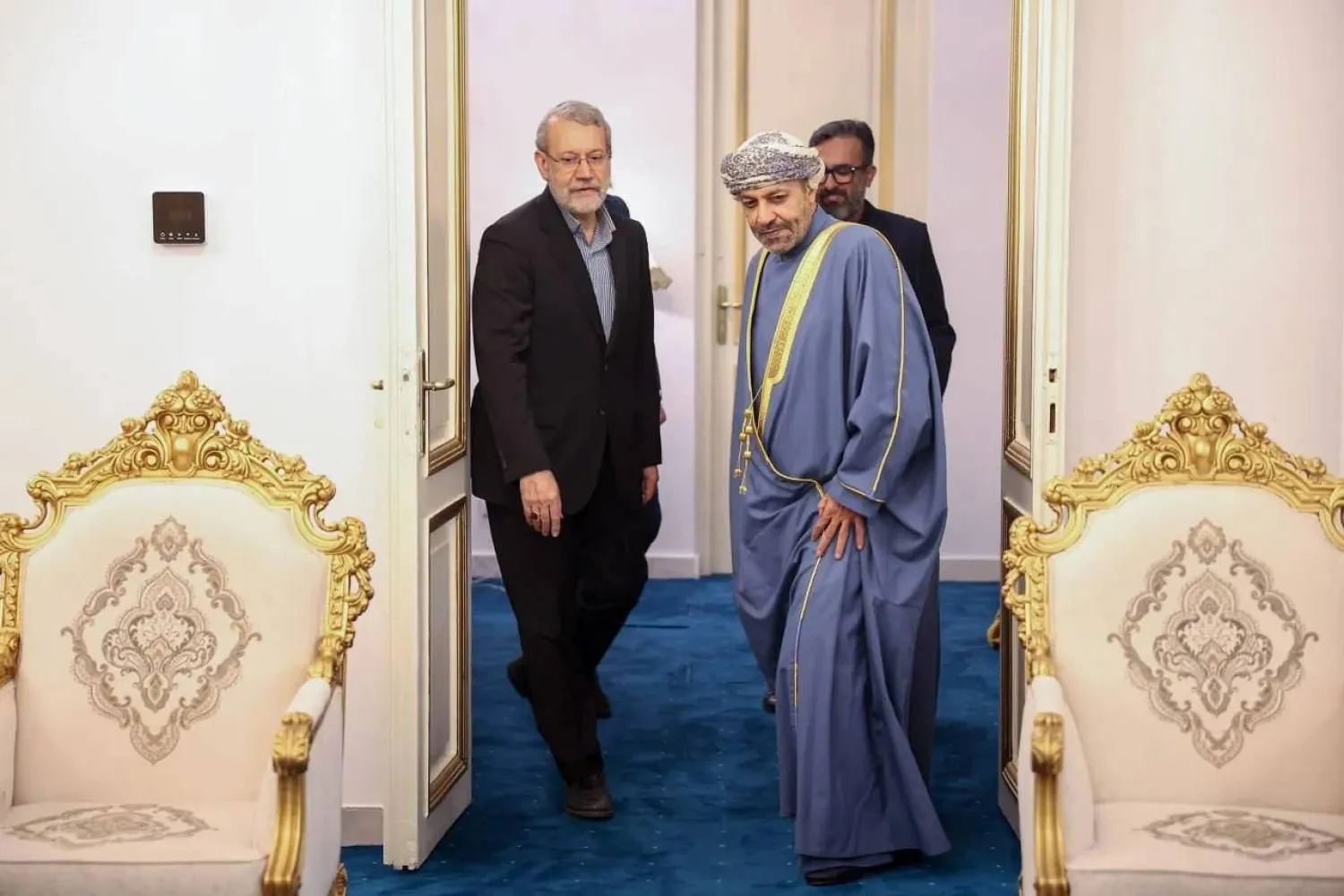
A photo released by Ali Larijani’s website shows him receiving Oman’s interior minister at the Iranian National Security Council headquarters in Tehran on Monday
TT

Muscat Calls on Washington and Tehran to Restart Talks

A photo released by Ali Larijani’s website shows him receiving Oman’s interior minister at the Iranian National Security Council headquarters in Tehran on Monday

The Sultanate of Oman, which has served as mediator in recent dialogues between the United States and Iran, has publicly urged both sides to return to the negotiating table after their discussions were suspended in June.

Speaking at the annual IISS Manama Dialogue in Bahrain, Oman’s Foreign Minister Badr Al-Busaidi said his country “would like to see a return to negotiations between Iran and the United States.”

Al-Busaidi revealed that Oman hosted five rounds of indirect talks between Washington and Tehran this year. He said: “Just three days before the sixth and possibly decisive round of talks, Israel unleashed its bombs and missiles in an illegal and deadly act of sabotage.”

He also pressed Gulf states to move away from isolating Iran, arguing that “over the years the Gulf Cooperation Council has at best sat back and permitted the isolation of Iran... I believe this needs to change,” according to AFP.

The diplomacy, mediated by Oman, focused on Tehran’s nuclear program and broader regional security concerns, but ground to a halt after the surprise Israeli-Iran confrontation in June, followed by US strikes on Iranian enrichment facilities. Iran’s Supreme Leader Ali Khamenei rejected President Donald Trump’s offer to restart negotiations, declaring: “Deals built on coercion are nothing but bullying.”

Tehran insists its uranium enrichment is for peaceful purposes, while the United States, Israel and European allies view it as a path to a nuclear weapon. The International Atomic Energy Agency says Iran is the only non-nuclear-weapon state currently enriching uranium to 60 percent - near weapons grade of 90 percent - raising fresh pressure for talks.

Al-Busaidi stressed Oman’s longstanding role as interlocutor, stating that Muscat had welcomed all parties to engage in an “inclusive mechanism” involving Iran, Iraq, Yemen and others. He called for a regional dialogue framework rather than confrontation.

“I think we are very close to a basis for negotiations ... we will continue to work together,” he added in earlier remarks.

In recent days, Omani and Iranian officials met in Muscat and Tehran to explore next steps. Iran’s Deputy Foreign Minister for Political Affairs, Majid Takht Ravanchi, reportedly told his hosts that Washington had shown little willingness for “talks based on equality and dignity,” suggesting that Tehran sees little reason to proceed under the current conditions.



Qatar’s PM Says Gaza Ceasefire at Critical Moment

Qatar's Prime Minister and Minister for Foreign Affairs Sheikh Mohammed bin Abdulrahman bin Jassim Al-Thani, attends a session on the opening day of the Doha Forum, an annual diplomatic conference, in Doha on December 6, 2025. (Photo by MAHMUD HAMS / AFP)
TT

Qatar’s PM Says Gaza Ceasefire at Critical Moment

Qatar's Prime Minister and Minister for Foreign Affairs Sheikh Mohammed bin Abdulrahman bin Jassim Al-Thani, attends a session on the opening day of the Doha Forum, an annual diplomatic conference, in Doha on December 6, 2025. (Photo by MAHMUD HAMS / AFP)

Qatar’s Prime Minister on Saturday said the Gaza ceasefire has reached a “critical moment” as its first phase winds down, with the remains of just one Israeli hostage still held in Gaza.

Sheikh Mohammed bin Abdulrahman Al Thani told an international conference in the Qatari capital that international mediators, led by the US, are working “to force the way forward” to the second phase to cement the deal.

“What we have just done is a pause,” he told the Doha Forum. “We cannot consider it yet a ceasefire.”

“A ceasefire cannot be completed unless there is a full withdrawal of Israeli forces, there is stability back in Gaza, people can go in and out, which is not the case today,” he said.

While the ceasefire halted the heavy fighting of the two-year war, Gaza health officials say that over 360 Palestinians have been killed by Israeli fire since the truce took effect in October.

The first phase of US President Donald Trump’s 20-point peace plan took effect Oct. 10. The fighting stopped and dozens of hostages held in Gaza were exchanged for hundreds of Palestinians held in Israeli prison. Israel sent a delegation last week to Egypt for talks on returning the remains of the last hostage.

The next phase, which includes the deployment of an international security force in Gaza, formation of a new technocratic government for the territory, disarmament of Hamas and an eventual withdrawal of Israeli forces from Gaza, has not yet begun.

Sheikh Mohammed said that even the upcoming phase should be “temporary” and that peace in the region could only take place with the eventual establishment of a Palestinian state.

“If we are just resolving what happened in Gaza, the catastrophe that happened in the last two years, it’s not enough,” he said. “There is a root for this conflict. And this conflict is not only about Gaza."

He added: “It’s about Gaza. It’s about the West Bank. It’s about the rights of the Palestinians for their state. We are hoping that we can work together with the US administration to achieve this vision at the end of the day.”


Arab, Muslim States Alarmed by Israeli Plan to Move Gazans to Egypt

Rafah border crossing (Reuters file photo)
TT

Arab, Muslim States Alarmed by Israeli Plan to Move Gazans to Egypt

Rafah border crossing (Reuters file photo)

Saudi Arabia, Egypt, Jordan, the United Arab Emirates, Indonesia, Pakistan, Türkiye and Qatar said on Friday they were deeply concerned over Israeli statements about opening the Rafah crossing in one direction to push Gaza residents into Egypt.

In a joint statement, the foreign ministers of the eight countries underlined their total rejection of any attempt to displace the Palestinian people from their land.

They said full adherence was needed to US President Donald Trump’s plan, which called for opening the Rafah crossing in both directions, safeguarding freedom of movement and preventing any resident of the enclave from being forced to leave.

The ministers said conditions must be created for Palestinians to remain on their land and to take part in rebuilding their homeland within an integrated vision to restore stability and improve humanitarian conditions.

The ministers reiterated their appreciation for Trump’s commitment to establishing peace in the region, saying it was important to move forward with the plan and carry out all its requirements without delay or obstruction in order to achieve security and peace and to strengthen the foundations of regional stability.

They called for a full and lasting ceasefire, an end to civilian suffering, and unrestricted humanitarian access into Gaza. They also urged the start of early recovery and reconstruction efforts and the creation of conditions that would allow the Palestinian Authority to resume its responsibilities in the territory, paving the way for a new phase of security and stability in the region.

The ministers affirmed their countries’ readiness to continue working and coordinating with the United States and all relevant regional and international parties to ensure full implementation of Security Council Resolution 2803 and all related resolutions.

They said the objective was to provide an environment conducive to achieving a just, comprehensive and sustainable peace in line with international legitimacy and the two state solution, leading to the establishment of an independent Palestinian state on the June 4, 1967 borders, including the occupied territories in Gaza and the West Bank, with East Jerusalem as its capital.


Saudi FM, Qatari PM Co-Chair Coordination Council Executive Committee Meeting

Prince Faisal bin Farhan and Sheikh Mohammed Al Thani co-chair the Executive Committee meeting of the Saudi-Qatari Coordination Council. SPA
TT

Saudi FM, Qatari PM Co-Chair Coordination Council Executive Committee Meeting

Prince Faisal bin Farhan and Sheikh Mohammed Al Thani co-chair the Executive Committee meeting of the Saudi-Qatari Coordination Council. SPA

Saudi Minister of Foreign Affairs Prince Faisal bin Farhan bin Abdullah met on Thursday with Qatari Prime Minister and Minister of Foreign Affairs Sheikh Mohammed bin Abdulrahman bin Jassim Al Thani in Riyadh.

The meeting reviewed bilateral relations, aspects of cooperation, and ways to develop them in a manner that meets the aspirations of the leaderships and peoples of the two countries.

Following the meeting, Prince Faisal and Sheikh Mohammed co-chaired the Executive Committee meeting of the Saudi-Qatari Coordination Council.

They reviewed the strong fraternal relations and ways to enhance them at bilateral and multilateral levels. They also discussed strengthening cooperation through several initiatives that would elevate relations to broader prospects.

Both sides praised the cooperation and coordination among the committees and working groups formed under the coordination council, stressing the importance of maintaining this level of progress to serve the mutual interests of both nations and their peoples.

The Executive Committee Secretariat presented an overview of the council’s activities and its committees over the past period, along with the latest updates and preparatory work for the eighth meeting of the Saudi-Qatari Coordination Council.

At the end of the meeting, the two ministers signed the minutes of the Executive Committee of the Saudi-Qatari Coordination Council.