


Royal Saudi Naval Forces Floats First Combat Ship in US under Tuwaiq Projecthttps://english.aawsat.com/gulf/5220155-royal-saudi-naval-forces-floats-first-combat-ship-us-under-tuwaiq-project
Royal Saudi Naval Forces Floats First Combat Ship in US under Tuwaiq Project
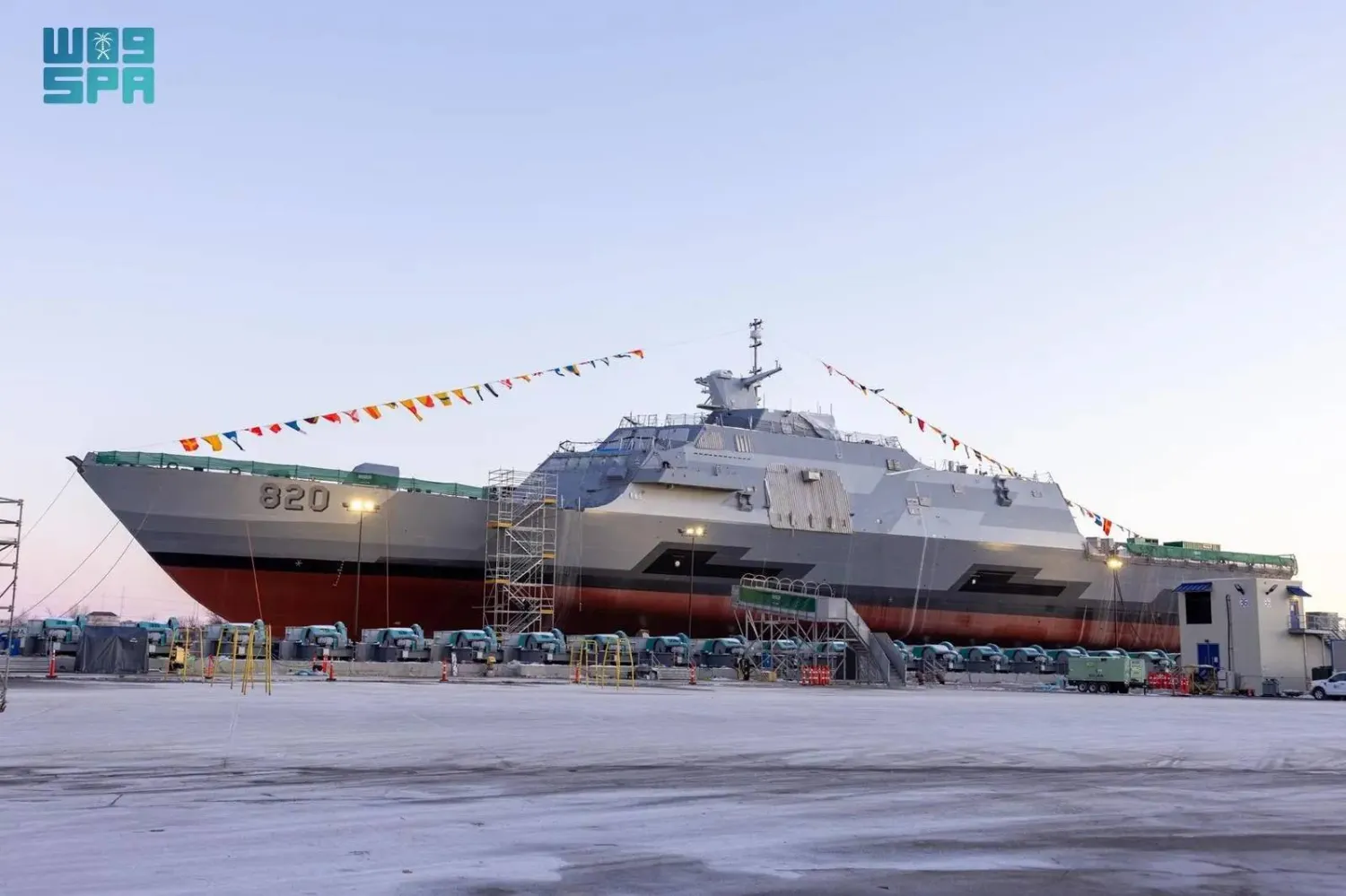
The Royal Saudi Naval Forces (RSNF) floated the His Majesty King Saud ship in the US state of Wisconsin. (SPA)
TT
TT
Royal Saudi Naval Forces Floats First Combat Ship in US under Tuwaiq Project
The Royal Saudi Naval Forces (RSNF) floated the His Majesty King Saud ship in the US state of Wisconsin. (SPA)
The Royal Saudi Naval Forces (RSNF) floated the His Majesty King Saud ship, the first vessel under the Tuwaiq Project, in the US state of Wisconsin, reported the Saudi Press Agency on Tuesday.
The project includes the construction of four multi-mission combat ships.
The ceremony was attended by Chief of Naval Staff Lieutenant General Mohammed Al-Ghuraibi, in the presence of a number of senior officers and officials from Saudi Arabia and the US, as well as representatives of Lockheed Martin, a leading defense and military industries company, and Fincantieri, which specializes in the construction of advanced military and naval vessels.
Al-Ghuraibi underscored the unlimited support enjoyed by the Armed Forces in general and the RSNF from the Saudi leadership, which has contributed to achieving accomplishments in modernization and development.
The Tuwaiq Project is one of the key and strategic projects in the development journey of the RSNF, embodying the Kingdom’s direction toward building a modern and professional naval force based on the latest military technologies, alongside advanced training and qualification programs for its personnel, he added.
The project boosts the readiness of the RSNF to protect the Kingdom’s strategic interests and secure vital maritime routes, he remarked, revealing that the project’s ships are equipped with the latest advanced combat systems that enable them to carry out various naval warfare missions and engage aerial, surface, and subsurface targets.
Saudi Arabia Declares This Year’s Hajj an Exceptional Successhttps://english.aawsat.com/gulf/5278470-saudi-arabia-declares-year%E2%80%99s-hajj-exceptional-success
Saudi Arabia Declares This Year’s Hajj an Exceptional Success
The holy sites were marked by organization and harmony, in a scene that embodied the combined efforts of the various participating bodies. (SPA)
Prince Saud bin Mishaal bin Abdulaziz, Deputy Governor of the Makkah region, announced on Friday the “exceptional” success of this year’s Hajj, saying it was supported by an integrated system of security, organization and services that enabled pilgrims to perform their rituals with ease and reassurance.
He said the success was achieved first by God’s grace, then through the unlimited support and directives of the Saudi leadership, which provided the necessary capabilities and resources, as well as close follow-up of all stages of preparation, work and implementation.
Prince Saud bin Mishaal said the Hajj reflected the image of a country working with sincerity and dedication to serve the guests of God.
The holy sites were marked by organization and harmony, in a scene that embodied the combined efforts of the various participating bodies, he added.
This year’s Hajj affirmed Saudi Arabia’s ability to manage crowds efficiently and capably, he declared, saying pilgrims performed their rituals in an atmosphere of security, reassurance and care befitting the honor of the place and its sanctity.
Prince Saud bin Mishaal said the achievements made during Hajj were the result of the leadership’s approach, which has made serving pilgrims both an honor and a priority.
Support was present and work continued with a spirit of responsibility and dedication, he stressed, adding that the success of the season was not the end of the work, but the start of new responsibilities and a pledge renewed each year to preserve Saudi Arabia’s status as a beacon of security and generosity and a destination for serving Islam and Muslims.
Pilgrims are seen at the Prophet’s Mosque after they completed the Hajj. (SPA)
At the end of his announcement, the deputy governor prayed to God to preserve Saudi Arabia’s security and stability, protect its leadership and bless the efforts of all those who contributed to the success.
Meanwhile, pilgrims in a hurry to leave Mina departed the holy sites after completing the stoning of the devil on the second day of Tashreeq, the 12th day of Dhu al-Hijjah. They then performed the farewell tawaf of the holy Kaaba in Makkah with humble hearts and prayers, concluding their Hajj.
Hundreds of thousands of pilgrims headed to Madinah to visit the Prophet’s Mosque. Others departed the Kingdom, while those who wished to stay overnight continued to complete the stoning on the third day of Tashreeq.
The Grand Mosque witnessed heavy movement around the Kaaba, amid a high level of readiness by the General Authority for the Care of the Affairs of the Two Holy Mosques, in cooperation with relevant bodies, as part of an integrated operational plan for this year’s Hajj.
The concerned authorities mobilized all their capabilities to facilitate the movement of pilgrims leaving early and ensure smooth movement inside the Grand Mosque, enabling them to perform their rites with ease.
In a related development, the Authority completed preparations to receive pilgrims arriving to visit the Prophet’s Mosque after performing Hajj. The operational plan focused on preparing the Prophet’s Mosque and all its facilities to receive visitors and worshippers in a safe and well-equipped environment.
Saudi Arabia, Syria Sign MoU on Combating Cross-Border Corruption Crimeshttps://english.aawsat.com/gulf/5278327-saudi-arabia-syria-sign-mou-combating-cross-border-corruption-crimes
The MoU was signed by Nazaha President Mazin Al-Kahmous and Chairman of Syria’s Central Commission for Control and Inspection Eng. Amer Al-Ali. (SPA)
TT
TT
Saudi Arabia, Syria Sign MoU on Combating Cross-Border Corruption Crimes
The MoU was signed by Nazaha President Mazin Al-Kahmous and Chairman of Syria’s Central Commission for Control and Inspection Eng. Amer Al-Ali. (SPA)
Saudi Arabia, represented by the Oversight and Anti-Corruption Authority (Nazaha), and Syria, represented by the Central Commission for Control and Inspection, signed on Thursday a memorandum of understanding (MoU) on preventing and combating corruption and boosting cooperation between the two sides.
The MoU was signed by Nazaha President Mazin Al-Kahmous and Chairman of Syria’s Central Commission for Control and Inspection Eng. Amer Al-Ali.
The MoU aims to boost cooperation in combating cross-border corruption crimes and exchanging relevant information and expertise. It seeks to develop and strengthen the institutional capacities of both sides.
During the signing ceremony, Al-Kahmous and Al-Ali discussed ways to strengthen cooperation between their countries in protecting integrity and combating corruption.
They reviewed key measures and practices implemented by Nazaha to promote transparency, protect integrity, and combat corruption, in addition to reviewing Syria’s efforts and experience in the same field.
Saudi Interior Minister Meets Jordanian, Malaysian Counterpartshttps://english.aawsat.com/gulf/5278326-saudi-interior-minister-meets-jordanian-malaysian-counterparts
Saudi Minister of Interior and Chairman of the Supreme Hajj Committee Prince Abdulaziz bin Saud bin Naif bin Abdulaziz receives his Jordanian counterpart Mazen Al-Faraya in Makkah on Thursday. (SPA)
TT
TT
Saudi Interior Minister Meets Jordanian, Malaysian Counterparts
Saudi Minister of Interior and Chairman of the Supreme Hajj Committee Prince Abdulaziz bin Saud bin Naif bin Abdulaziz receives his Jordanian counterpart Mazen Al-Faraya in Makkah on Thursday. (SPA)
Saudi Minister of Interior and Chairman of the Supreme Hajj Committee Prince Abdulaziz bin Saud bin Naif bin Abdulaziz received in Makkah on Thursday his Jordanian counterpart Mazen Al-Faraya and Minister of Home Affairs of Malaysia Datuk Seri Saifuddin Nasution bin Ismail.
The separate meetings discussed security cooperation and coordination between their countries. The ministers also reviewed several issues of mutual interest.
The Jordanian and Malaysian ministers praised the capabilities and integrated services provided by the Kingdom of Saudi Arabia to serve Hajj pilgrims. They commended the high level of organization and coordination within the Hajj system, which allowed pilgrims to perform their rituals with ease and tranquility.
Also on Thursday, Prince Abdulaziz bin Saud reviewed the workflow at several health facilities operated by the Ministry of Interior’s medical services at the holy sites.
He inspected the Ministry of Interior Medical Services Clinics Complex and reviewed its specialized medical, pharmaceutical, and laboratory clinics, in addition to critical-care units and support services operating within the healthcare system provided to pilgrims under the supervision of specialized medical, technical, and administrative personnel.
The minister viewed a visual presentation highlighting the efforts of the ministry’s medical services during the Hajj season, the healthcare-provider network, field and seasonal teams and clinics, as well as hospitals and medical centers operating in Makkah, Madinah, and the holy sites.
Prince Abdulaziz bin Saud further reviewed the Medical Services Command and Control Center during the Hajj and its real-time monitoring capabilities for health-facility readiness, case movement, deployment of field teams, and operational-performance indicators. The capabilities support rapid decision-making and boost the efficiency of field medical response.
The tour included the Ministry of Interior Medical Services Field Hospital in Arafat, where the minister reviewed the medical and treatment services provided, including emergency, intensive-care, and resuscitation departments, heat-exhaustion and heatstroke treatment units, as well as preventive, laboratory, and pharmaceutical services.
The minister reviewed efforts by the medical services in operating mobile clinics, medical vehicles, and field teams to provide first aid, health awareness, and preventive guidance and reduce health risks associated with heat exhaustion and infectious diseases.
The efforts included employing modern technologies to enhance field healthcare through the smart health bracelet, visual communication technologies supporting field teams medically, and the use of drones to deliver medical supplies when needed.
لم تشترك بعد
انشئ حساباً خاصاً بك لتحصل على أخبار مخصصة لك ولتتمتع بخاصية حفظ المقالات وتتلقى نشراتنا البريدية المتنوعة
