


Saudi Arabia, Egypt Stress Need to Contain Regional Tensions

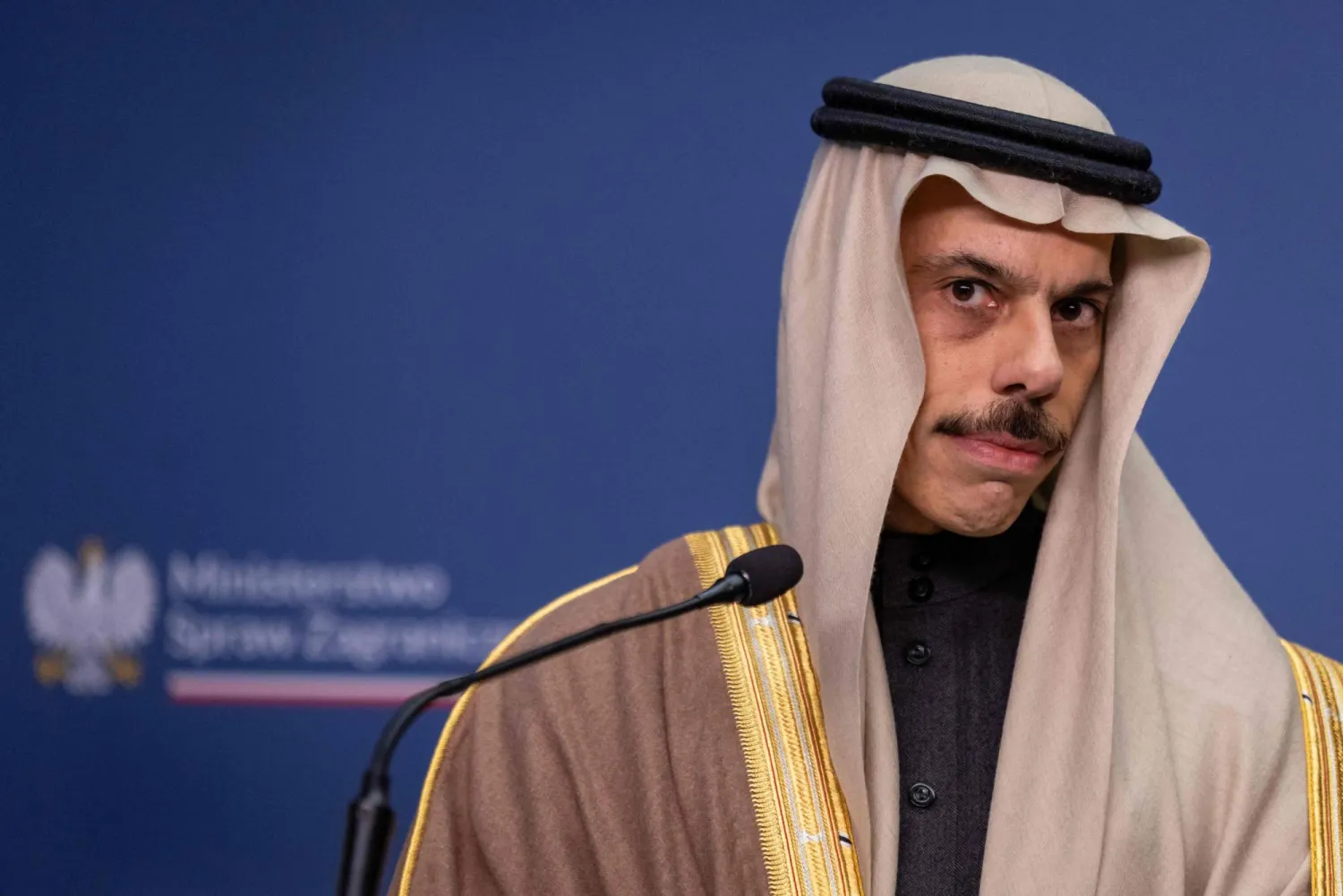
Saudi Arabia's Foreign Affairs Minister Prince Faisal bin Farhan bin Abdullah and Poland's Foreign Affairs Minister (not in picture) give a joint press conference after their meeting at the Foreign Office in Warsaw, January 26, 2026. (AFP)
TT

Saudi Arabia, Egypt Stress Need to Contain Regional Tensions

Saudi Arabia's Foreign Affairs Minister Prince Faisal bin Farhan bin Abdullah and Poland's Foreign Affairs Minister (not in picture) give a joint press conference after their meeting at the Foreign Office in Warsaw, January 26, 2026. (AFP)

Saudi Arabia and Egypt stressed on Tuesday the importance of containing tensions and preventing a wider escalation in the region, calling for intensified efforts to achieve calm and to prioritize political and diplomatic approaches in addressing ongoing crises.

Saudi Foreign Minister Prince Faisal bin Farhan bin Abdullah and his Egyptian counterpart Badr Abdelatty underscored this position during talks in Riyadh.

The meeting covered regional de-escalation efforts and developments in the Gaza Strip, Sudan, and the Iranian nuclear file, said the Egyptian Foreign Ministry in a statement.

On the Iranian nuclear issue, Abdelatty stressed the importance of diplomacy and creating conditions conducive to resuming dialogue between Washington and Tehran to reach a comprehensive and balanced agreement that addresses the concerns of all parties and boosts regional and international stability.

On Gaza, the FMs emphasized the need to advance the next phase of US President Donald Trump's peace plan, ensure unimpeded humanitarian access, support mechanisms for running the territory, and pave the way for early recovery and reconstruction.

On Sudan, the ministers underscored the importance of continued coordination to reach an urgent humanitarian truce as a step toward a comprehensive ceasefire and a Sudanese-owned political process.

Saudi Arabia and Egypt have intensified their contacts in wake of the regional tensions. A phone call between their foreign ministers on Sunday urged the need to reduce tensions, rejected escalation and the use of force, and underlined the importance of supporting regional security and stability while preventing further deterioration.

Prince Faisal visited Cairo last month where he held talks with President Abdel Fattah al-Sisi. They stressed the need to pursue peaceful solutions to regional crises, while preserving the unity and territorial integrity of states, particularly Sudan, Yemen, Somalia, and Gaza.


Gulf Ministerial Council: GCC States Retain Right to Respond to Iranian Aggression

The Council held a virtual meeting on Sunday to discuss the Iranian aggression. Photo: GCC
TT

Gulf Ministerial Council: GCC States Retain Right to Respond to Iranian Aggression

The Council held a virtual meeting on Sunday to discuss the Iranian aggression. Photo: GCC

The Ministerial Council of the Gulf Cooperation Council has expressed its firm rejection and strongest condemnation of “heinous” Iranian attacks targeting GCC states and Jordan, saying they retain their legal right to respond.

The Council held a virtual meeting on Sunday to review “the extensive damage resulting from the treacherous Iranian attacks on these countries, including strikes on civilian facilities, service sites, and residential areas, causing significant material damage, posing threats to the security, safety, and lives of citizens and residents, and terrorizing innocent civilians.”

A statement said that the Council “also discussed the necessary measures and steps to coordinate efforts to restore security and stability and achieve peace in the region.”

It “expressed its firm rejection and strongest condemnation of these heinous attacks targeting GCC states” as well as Jordan, saying they constitute “a serious violation of the sovereignty of these states, the principles of good neighborliness, and a clear breach of international law and the Charter of the United Nations.”

The statement added that the targeting of civilians and civilian objects constitutes a grave violation of the rules of international humanitarian law.

The Council underscored full solidarity among its member states, affirming their united stance in confronting the Iranian attacks, and stressed that the security of each member state is indivisible and that any attack against one member constitutes a direct attack on all.

“The GCC states retain their legal right to respond under Article 51 of the United Nations Charter, which guarantees the right of self-defense, individually or collectively, in the event of aggression, and to take all necessary measures to safeguard their sovereignty, security and stability,” said the statement.

The Council commended the armed forces of the member states, which “successfully intercepted missile and drone attacks with high professionalism, thereby neutralizing the threats, mitigating their effects, and protecting lives, facilities, and critical infrastructure.”

The conferees stressed that “in light of this unjustified Iranian aggression against GCC states, the member countries will take all necessary measures to defend their security and stability and to protect their territories, citizens, and residents, including the option to respond to the aggression.”

The Council also called on the international community to condemn and strongly denounce the Iranian attacks, and urged the UN Security Council to assume its responsibilities by taking an immediate and firm stance to prevent such violations.


Germany, France Call on Iran to Cease Attacks on Gulf

 German Chancellor Friedrich Merz makes a statement on the situation in the Middle East, after Israel and the US launched strikes on Iran, at the chancellery in Berlin, Germany, March 1, 2026. (Reuters)
German Chancellor Friedrich Merz makes a statement on the situation in the Middle East, after Israel and the US launched strikes on Iran, at the chancellery in Berlin, Germany, March 1, 2026. (Reuters)
TT

Germany, France Call on Iran to Cease Attacks on Gulf

 German Chancellor Friedrich Merz makes a statement on the situation in the Middle East, after Israel and the US launched strikes on Iran, at the chancellery in Berlin, Germany, March 1, 2026. (Reuters)
German Chancellor Friedrich Merz makes a statement on the situation in the Middle East, after Israel and the US launched strikes on Iran, at the chancellery in Berlin, Germany, March 1, 2026. (Reuters)

German Chancellor Friedrich Merz on Sunday called on Iran to "immediately stop" its "indiscriminate attacks", while predicting that the country's rule by clerics was coming to an end with the death of supreme leader Ali Khamenei.

Germany shares Iranians' "relief" to see the "mullah regime come to an end", Merz said, though he cautioned that the killing of Khamenei in US and Israeli strikes on Tehran had set Iran on a path to an "uncertain future".

France slammed Iran's "massive and unjustifiable" attacks on the Gulf states and Jordan Sunday, with Foreign Minister Jean-Noel Barrot saying they were being "drawn into a war they did not choose".

"I have expressed to each of them France's unequivocal condemnation, full solidarity and complete support," he added in a post on X.

- 'Day after' in Iran - 

Merz also called on US and European partners to start planning for the future of Iran and the region, saying the people of Iran deserved a better future after US and Israeli strikes killed its supreme leader. 

Merz said his government agreed with ‌US goals ‌to end Tehran's nuclear armament ‌and ⁠finish a "destructive game" ⁠being played by Iran, but he warned of possible dangers ahead. 

"This is not without risk. We do not know how far the region will be drawn into escalation by ⁠Iran's harsh counterstrikes," Merz told ‌reporters. 

Pointing to some ‌reservations over the US and Israeli actions, ‌Merz said now was not the ‌time to lecture partners and allies, despite doubts. 

"We want to work with our partners in the US, Israel, the region, ‌and Europe to develop an agenda for the day after," ⁠said Merz. 

His ⁠four aims were to ensure peace and stability in the region, to get Iran to end its nuclear and ballistic missile program, to contribute to a stable future for Iran and to help Iranians decide their own fate. 

Merz also said Germany would not tolerate attacks on US or Israeli institutions in the country. 


Saudi Arabia, GCC Slam Iranian Attack on Oman

A general view of Muscat, Oman. (AP file)
TT

Saudi Arabia, GCC Slam Iranian Attack on Oman

A general view of Muscat, Oman. (AP file)

Saudi Arabia strongly condemned on Sunday the “flagrant” Iranian attack against Oman, saying it was a blatant violation of its sovereignty.

It stressed its full solidarity with Oman and readiness to place all its capabilities at the Sultanate's disposal in support of any measures it may take.

It warned of the serious consequences of Iran’s continued violations of the sovereignty of nations, which undermine the security and stability of the region.

Saudi Arabia called on the international community to take firm positions and decisive measures against Iranian violations.

Secretary-General of the Gulf Cooperation Council (GCC) Jasem Albudaiwi also condemned the attack on Oman.

"These assaults constitute a flagrant violation of the Sultanate of Oman’s sovereignty and a dangerous escalation that undermines regional security and stability, while threatening the safety of maritime navigation and global energy supplies," he stressed.

Albudaiwi said that “the treacherous military operations launched by Iran against the council states reflect its intentions toward the GCC and the region at large.”

The GCC states had previously conveyed assurances to the Iranian regime, through various meetings and occasions, that they would not permit the use of their territories or airspace for any military operations against Iran, he added.

He stressed that Iran’s targeting of civilian facilities is a major breach of international law, the United Nations Charter, and the principles of good neighborliness.

Albudaiwi underscored the GCC’s full solidarity with Oman in all measures it takes to protect its sovereignty and safeguard its security and stability, reiterating the council’s rejection of all forms of aggression targeting the security of its member states.