


First Saudi State Seal: Official Recognition, Administrative Record

Dr. Faris Almushrafi, head of the History Department at King Saud University (Asharq Al-Awsat)
TT

First Saudi State Seal: Official Recognition, Administrative Record

Dr. Faris Almushrafi, head of the History Department at King Saud University (Asharq Al-Awsat)

Dr. Faris Almushrafi, head of the History Department at King Saud University, said Founding Day is not only a moment to recall events or celebrate beginnings, but an opportunity to scrutinize the very tools through which the state defined and asserted itself.

Chief among them is the seal, a compact material document that distills the idea of the state into a single imprint.

Almushrafi told Asharq Al-Awsat that because a seal cannot be read in isolation from its political and administrative context, examining its structure and formulation opens the door to a deeper understanding of the nature of the state that produced it.
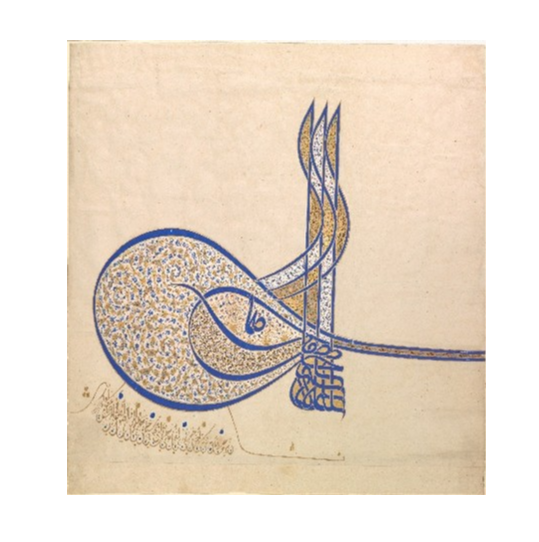
 

The tughra of Sultan Suleiman the Magnificent (r. 1520–1566)


The seal attributed to Imam Saud bin Abdulaziz (1229 AH/1814), the third imam of the First Saudi State, was used to authenticate official correspondence, including a letter addressed to the Governor of Damascus in the first decade of the 13th century AH.

The seal bears the central inscription “His servant Saud bin Abdulaziz,” and includes the date 1223 AH, set within a circular frame suggesting completeness and order.

A seal, he said, is not created for ornamentation but for formal recognition. Its presence signals a central authority that needs to document its decisions and correspondence, and an administration conscious of representation. Every sealed letter implicitly declares: this is a state speaking in its own name. Legitimacy is not derived from content alone, but from the imprint affixed to it.

Almushrafi said the phrase “His servant Saud” transcends a personal dimension and enters the language of political legitimacy. The choice of the word “servant” reflects a conception of authority inseparable from religious reference, presenting leadership as a moral duty before it is a political privilege.

This language, he said, is not spontaneous but expresses a model of governance that views political power as incomplete without value-based legitimacy, and sees the state as operating within a system of belief rather than above it.

The seal and state functions: inside and out

The head of the History Department at King Saud University stressed that the seal’s importance increases when one considers that it was used in correspondence beyond the local sphere, addressed to the governor of Damascus.

In this context, the seal became an instrument of external political relations, reflecting the First Saudi State’s awareness of itself as a political actor communicating and defining itself in a formal language recognized in the world of political correspondence at the time. The seal was thus not directed inward only, but also performed a sovereign function externally.

At the same time, the inclusion of the Hijri date on the seal is not a mere formal detail but an indicator of the temporal ordering of administrative work.

A state that dates its documents, he said, understands the importance of sequence, precedence and proof, and recognizes that political action is incomplete without being fixed in time. Here, early features of what could be called the administrative mind of the First Saudi State begin to emerge.

Almushrafi placed the seal in its contemporary regional context, saying its significance becomes clearer when compared with the seals of other Islamic states in the late 18th and early 19th centuries.

In the Ottoman Empire, the imperial tughra functioned as a composite sovereign signature, bearing the sultan’s name and titles in a dense visual form.

It carried a highly symbolic function that emphasized imperial rank and hierarchical authority before any procedural dimension, turning the seal into a visual declaration of sovereignty as much as a tool of authentication.

In Qajar Iran, official seals were likewise tied to the shah’s name and titles, with a clear emphasis on personal mark and royal legitimacy, making the seal an extension of the ruler’s prestige and symbolic representation of the state more than a neutral administrative device.

In Egypt under Muhammad Ali Pasha, despite early features of administrative modernization, the official seal continued to operate within a language of authority and rank derived not solely from its wording but from the sovereign structure to which the ruler belonged as an Ottoman governor.

Even when Muhammad Ali used the phrase “His servant Muhammad Ali,” Almushrafi said, it did not serve as a foundational definition of legitimacy but functioned as a procedural courtesy within Ottoman writing conventions, softening the tone of rank within the seal while full titles were restored outside it through the system of official ranks and designations - including “Pasha,” a high rank in the Ottoman administrative and military hierarchy, and “Governor of Egypt,” the legally and sovereignly recognized title, along with protocol formulations such as “Governor of Protected Egypt.”

In the Egyptian case, the seal remained as much a declaration of political standing as an instrument of documentation, inseparable from a higher structure of authority defining the ruler’s position.

By contrast, Almushrafi said, the Saudi seal presents a different formulation. The phrase “His servant Saud bin Abdulaziz,” coupled with the Hijri date, suffices to perform the function of official recognition and administrative authentication without symbolic display, inflation of titles, or reference to a higher sovereignty outside the framework of the state itself.

Here, the function of the seal as a state instrument takes precedence over its role as a statement of rank, reflecting a sovereign model based on economy of symbols, clarity of representation and administrative discipline. This distinction, he said, is significant in understanding the nature of the First Saudi State and the logic of its early formation as a state that defines itself through its function and practice rather than through the grandeur of symbols alone.
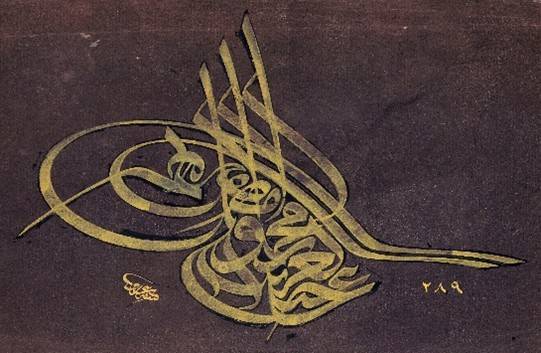
 

The tughra of Sultan Abdulaziz


The seal and the function of the emerging Saudi state

In light of this regional comparison, Almushrafi said the seal of Imam Saud bin Abdulaziz should not be read as an isolated administrative tool but understood in the context of the emerging Saudi state at the time.

It was not formed as a ceremonial or symbolic entity, but as an authority concerned with regulation, implementing rulings, securing its domain and organizing relations between inside and outside.

In this context, the seal becomes a direct reflection of the state’s function: a tool for endorsing decisions, fixing correspondence and regulating political action within a clear legal framework.

The simplicity of the seal’s wording, its economy in titles and its association with the Hijri date all point to a state that sees authority as responsible practice before sovereign display. A state that reduces its symbols to a minimum, he said, prioritizes action over rhetoric, organization over ornamentation and function over representation.

Thus, the seal is read not as a mark of the imam’s person, but as an instrument of a state that operates, communicates, binds and records.

In this sense, the seal of Imam Saud bin Abdulaziz stands as testimony to the nature of the First Saudi State as a state of practice, defining itself by what it executes rather than what it displays, and affirming its presence through administrative and legal discipline rather than symbolic grandeur alone.

Almushrafi concluded that the seal teaches that a state is not read only in battles or major treaties, but in its silent details: a seal, a signature and a linguistic formulation.

On Founding Day, recalling this seal is not merely a celebration of an old artifact, but a conscious reading of a moment that shaped the Saudi state as an organized entity with legitimacy and awareness of political representation.

In this way, the seal becomes a historical testimony declaring: here is a state, and here is an authority that knows itself and knows how to assert its presence.



King Salman: Our Kingdom Was Founded on Justice, Unification under One Banner 

Custodian of the Two Holy Mosques King Salman bin Abdulaziz. (SPA)
TT

King Salman: Our Kingdom Was Founded on Justice, Unification under One Banner 

Custodian of the Two Holy Mosques King Salman bin Abdulaziz. (SPA)

Custodian of the Two Holy Mosques King Salman bin Abdulaziz stressed on Sunday that the Saudi state was built on justice and unification.

In a tweet on the X platform on the occasion of the Kingdom’s Founding Day, he said: “On this glorious day, we remember the founding of our blessed state, established by our forefathers on the word of monotheism, the pursuit of justice and the unification of people under one banner; which, by the grace of God, achieved security and prosperity.”

King Salman and Prince Mohammed bin Salman, Crown Prince and Prime Minister, received several cables of congratulations from Gulf, Arab and Muslim leaders on the occasion.

The leaders hailed Saudi Arabia’s high global standing and its constant achievements in various fields, as well as its role in supporting security and stability and bolstering peace in the region.

They underlined their keenness on boosting relations with Saudi Arabia on all levels to serve common interests, hoping that the Kingdom and its people continue to enjoy progress and prosperity under the wise leadership.

Founding Day was celebrated across the Kingdom on Sunday with various cultural, national and entertainment activities that attracted locals, residents and tourists.


Arab Leaders Congratulate Saudi Leadership on Founding Day

Saudi Arabia marking Founding Day - SPA
TT

Arab Leaders Congratulate Saudi Leadership on Founding Day

Saudi Arabia marking Founding Day - SPA

Palestinian President Mahmoud Abbas extended his congratulations to Custodian of the Two Holy Mosques King Salman bin Abdulaziz Al Saud and Prince Mohammed bin Salman bin Abdulaziz Al Saud, Crown Prince and Prime Minister, on the occasion of Founding Day.

In two cables, President Abbas expressed his heartfelt congratulations and best wishes to the Saudi leadership, government, and people for continued prosperity and progress.

According to SPA, he also expressed hope that the deep-rooted relations between the two countries would continue to develop and advance.

Furthermore, the Palestinian president commended the Kingdom’s honorable and supportive stance toward the Palestinian people and praised its historic success in securing recognition of the independent State of Palestine by major countries.

For his part, Sultan Haitham bin Tarik of Oman has sent a cable of congratulations to the Saudi King and Crown Prince expressing his warmest congratulations and sincere best wishes.

He prayed to Allah Almighty to bless the Kingdom of Saudi Arabia and its people with lasting stability, progress, and prosperity.

Also, Kuwait's Emir Sheikh Meshal Al-Ahmad Al-Jaber Al-Sabah congratulated the Saudi leadership on this occasion. In two cables, the Kuwaiti Emir praised the Kingdom of Saudi Arabia’s international standing, its continuous contributions to civilization and development, and its significant role in supporting security, stability, and promoting peace in the region.

Sheikh Meshal expressed deep pride in the enduring and close fraternal relations that have united the two families throughout history. He acknowledged the strong bonds between Kuwait and Saudi Arabia and prayed for further progress and prosperity for the Kingdom under the wise leadership of the Custodian of the Two Holy Mosques.

Additionally, Crown Prince of the State of Kuwait Sheikh Sabah Khaled Al-Hamad Al-Sabah sent two similar cables congratulating the Custodian of the Two Holy Mosques and the Crown Prince. He praised the Kingdom’s civilizational and developmental achievements, praying for further progress and prosperity for the Kingdom and its people.

Prime Minister of the State of Kuwait Sheikh Ahmad Abdullah Al-Ahmad Al-Sabah also sent two cables of congratulations to the Saudi King and Crown Prince on this occasion. 


Saudi Researcher: Women Played Pivotal Role in Historic Battles

A view of Diriyah, which witnessed numerous historic events during the First and Second Saudi States (Diriyah Gate Development Authority)
TT

Saudi Researcher: Women Played Pivotal Role in Historic Battles

A view of Diriyah, which witnessed numerous historic events during the First and Second Saudi States (Diriyah Gate Development Authority)

Women’s resistance during the Ottoman campaigns against Diriyah and other regions of the First Saudi State, and later the Second Saudi State, was a hard test of society’s capacity to endure.

The confrontation was not confined to the battlefield. It spread across the social fabric, where women played a decisive role in preserving cohesion and sustaining the community under siege and in the face of destruction.

Dr. Fatmah bint Hussein Al Fardan Alqhtani, professor of history at King Saud University, told Asharq Al-Awsat that recognizing women’s presence in the resistance does not mean casting them in stereotypical combat roles. It means acknowledging the practical responsibilities imposed by society and by the historical moment itself.

Daily resilience under siege

During the Ottoman siege, Diriyah was not merely a battlefield. It was a community under total pressure, and women stood at its center.

They ran households in the absence of men, shielded children and property, tended the wounded, secured what food they could and held the social fabric together at a decisive existential moment.

Ottoman reports, Alqhtani noted, treated Diriyah not as an isolated military force but as a full society. That helps explain the sweeping captivity and deportation measures imposed on women and children after the city’s fall, an implicit recognition that resistance was not only about weapons but about a community that believed in its cause and defended it to the end.

Foreign accounts add another layer. Harford Jones, tasked by the British Empire in the region, cited French historian Felix Mengin, who was then at the court of Muhammad Ali Pasha and had access to correspondence related to Ibrahim Pasha's campaign.

According to that account, when Imam Abdullah bin Saud learned Ibrahim Pasha was absent from his camp, he ordered attacks on all Turkish lines. The battle raged for hours in searing heat, with sustained gunfire and fierce exchanges.

Amid the clash, women of the Saudi state were seen carrying water jars, moving through live fire to supply defending fighters. The image is stark: women not as distant symbols of morale, but as active participants in danger, embodying sacrifice and solidarity in defense of their state and identity.

From trenches to vigilance

Alqhtani pointed to events in Shaqra in 1233 AH (1818) as a clear example of women’s direct engagement during Ibrahim Pasha’s march toward Diriyah.

The town was encircled by a trench whose construction had begun in the days of Tusun Pasha before stalling. As the threat intensified, the emir ordered the trench completed in anticipation of a prolonged siege.

Men and women mobilized together. Women took part in digging and in support tasks, enduring harsh conditions. Their role, Alqhtani said, went beyond moral backing. They were physically involved in fortifying the town and safeguarding the community.

Women were also part of the broader security awareness of war. During the siege of Al-Rass, Ottoman forces attempted to tunnel under the city wall to infiltrate it at night. A woman grinding grain late into the night heard unfamiliar sounds near her home and sensed the danger.

She reported it to Sheikh Qurnas bin Abdulrahman bin Qurnas, Emir of Al-Rass. The alert enabled defenders to act swiftly. The sheikh ordered a counter-trench to block the attempt.

The episode, Alqhtani said, underscores that women’s role in resistance was neither emotional nor symbolic. It was vigilant, responsible and operational, part of a collective defense effort spanning all segments of society.

When survival meant bearing arms

Women’s involvement was not limited to endurance and support. A contextual reading of Najdi and Ottoman sources suggests that in moments of extreme peril, particularly during sieges, some women took part in armed defense.

“In besieged societies, where survival itself becomes a battle, carrying weapons was not absolutely confined to men,” Alqhtani said. “It could become a direct act of defending self and place.”

Although sources do not record specific female names in these instances, references to fighting inside the city and to the participation of the “people of Diriyah” in its defense allow for a broader understanding of women as part of an armed home front when necessary.

Alqhtani cited Ghalia Al-Baqamiyya as one of the most prominent examples of direct female military leadership during the Ottoman campaigns against the First Saudi State.

Felix Mengin, then the French consul in Cairo, described the circumstances surrounding the Ottoman advance, including the arrival of forces in Turbah and the three-day siege it faced in a bid to subdue it.

The town held firm. Ghalia Al-Baqamiyya played a central role, raising the morale of fighters from her tribe, Al-Buqum. Some sources indicate she went out at the head of a group of her men to confront the attackers.

The standoff coincided with the arrival of Saudi reinforcements, leading to the Battle of Wadi Al-Sulaym. The fighting was fierce and ended with Ottoman forces defeated and withdrawing toward Taif, leaving behind casualties and substantial spoils in one of the most severe setbacks of those campaigns.

The episode, Alqhtani said, makes one point clear: women were not on the margins of resistance. At pivotal moments, they assumed leadership roles that directly shaped the course of battle, embedding their presence in the history of defending the state and society.