EU, Gulf States Urge Iran to End Attacks Threatening 'Global Security'

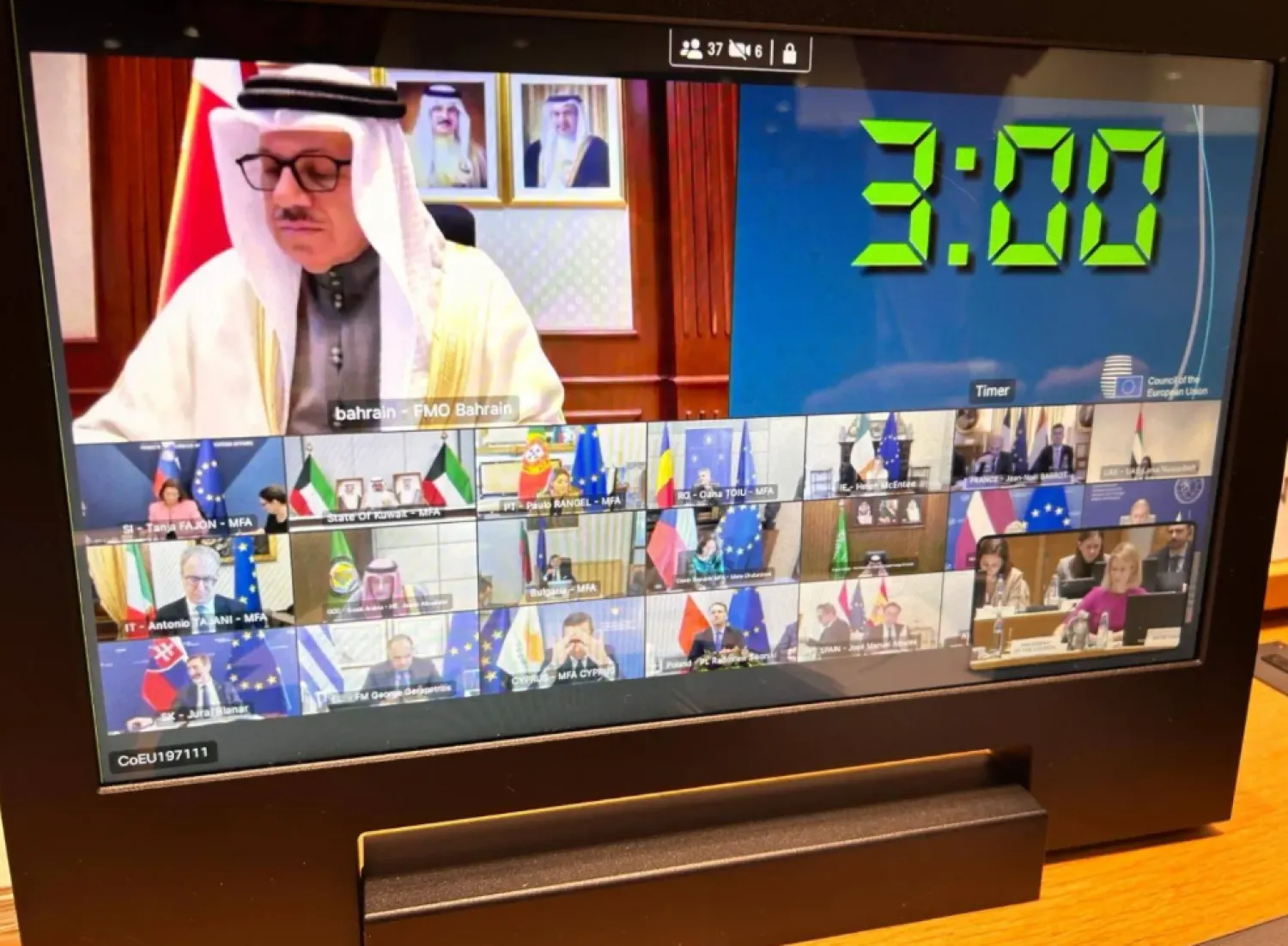
EU and Gulf ministers called following crisis talks Thursday for Iran to immediately end "indiscriminate" attacks across the region (EU)
TT

EU, Gulf States Urge Iran to End Attacks Threatening 'Global Security'

EU and Gulf ministers called following crisis talks Thursday for Iran to immediately end "indiscriminate" attacks across the region (EU)

EU and Gulf ministers called following crisis talks Thursday for Iran to immediately end "indiscriminate" attacks across the region in retaliation for US-Israeli attacks, warning global security was at stake.

The foreign ministers met by video link as Iran stepped up attacks on countries of the Gulf Cooperation Council.

"The ministers strongly condemned the unjustifiable Iranian attacks against the GCC countries which threaten regional and global security and called on Iran to cease immediately its attacks," said a joint statement issued afterwards, AFP reported.

Addressing the fallout of "indiscriminate" Iranian attacks, they also "affirmed that the GCC states have the right to take all necessary measures" to defend themselves.

EU and Gulf ministers jointly reaffirmed their "unwavering commitment to dialogue and diplomacy" as a means to resolve the crisis.

They pledged "joint diplomatic efforts" for a lasting solution to prevent Iran from acquiring a nuclear weapon and for it to "cease production and proliferation" of ballistic missiles and drones.

EU foreign policy chief Kaja Kallas, who chaired the talks, earlier said the bloc was looking to help Gulf nations fend off Iranian drone strikes, but warned supplies of relevant kit might be limited.

Speaking ahead of the talks, Kallas warned production of drone interceptors would struggle to keep up with high demand both in Ukraine and now the Middle East.

"Everybody has the need for air defense... So there is really a problem with production," she told journalists in Brussels, adding Europe needed to "speed up" production.

"I'm worried that the capabilities are limited," she said.


Empty Quarter: Reservoir of Energy and Graveyard for Drones

The Empty Quarter lies atop two of the world’s largest oil and gas fields (SPA)
TT

Empty Quarter: Reservoir of Energy and Graveyard for Drones

The Empty Quarter lies atop two of the world’s largest oil and gas fields (SPA)

Stretching across the southern Arabian Peninsula, the Empty Quarter desert spreads like an endless sea of sand. It covers three Saudi administrative regions and extends across four countries, accounting for more than 67% of Saudi Arabia’s sand accumulations and about 22% of the Kingdom’s total land area.

Occupying nearly a fifth of the Arabian Peninsula, the vast desert is viewed by observers as both a reservoir of energy and a graveyard for drones targeting Saudi Arabia. Saudi defense authorities frequently announce interceptions of attacks headed for oil installations in the desert.

The Empty Quarter, one of the world’s largest sand seas, is also among its harshest environments, with temperatures reaching unbearable levels.

National Geographic describes it as a land “tamed only by the most resilient and wise of men despite its harshness,” a testament to the endurance of nomadic Bedouin tribes who forged unique bonds of kinship and marriage across generations.

Beneath the harsh landscape lie immense riches. The Empty Quarter sits atop some of the world’s largest oil and gas reserves. Nearby lie giant fields such as Shaybah, among the world’s largest crude oil fields on the desert’s edge, and Jafurah, Saudi Arabia’s largest unconventional gas field discovered to date. Jafurah alone holds an estimated 200 trillion standard cubic feet of gas and more than 60 billion barrels of condensate.

The Jafurah oil field. Aramco

The result is a striking contrast: a silent desert resting above resources that help drive the global economy.

Since March 5, the Empty Quarter has taken on another, unexpected role — a graveyard for drones targeting Saudi Arabia.

In just one week, its sands swallowed more than 63 drones as Saudi defenses carried out 27 interception and destruction operations, preventing them from striking the Shaybah field and reinforcing confidence in the Kingdom’s ability to protect energy supplies and ensure their delivery to global markets.

Ironically, three countries across which the Empty Quarter stretches — Saudi Arabia, which holds about 80% of the desert, along with Oman and the United Arab Emirates to the east, have faced Iranian drone, ballistic missile and cruise missile attacks.

The Shaybah oil field. Reuters

While many civilian and military sites have been affected, the attempt to target Shaybah marked what analysts described as an escalation threatening global energy sources.

A recent study by King Abdullah University of Science and Technology (KAUST) found that the Empty Quarter was once far different from the barren landscape it is known for today.

In the distant past, it was home to lakes, rivers and green plains that supported rich ecosystems and helped early human populations spread across the Arabian Peninsula.

Today it is among Saudi Arabia’s hottest and driest regions, with average rainfall of less than 50 millimeters a year and summer temperatures exceeding 50°C.

But researchers say these harsh conditions followed a wetter climate period known as “Green Arabia,” which lasted between 11,000 and 5,500 years ago in the late Quaternary era.

During that time, strong monsoon rains from Africa and India — driven by orbital climate shifts — fueled vegetation and wildlife across the region.

The desert’s name reflects both its scale and isolation. Saudi sources say it was called the “Empty Quarter” because it occupies roughly a quarter of the Arabian Peninsula and lacks permanent human settlement, aside from a small number of nomadic Bedouins, with limited wildlife and vegetation.

Some sources also refer to parts of the desert as “Al-Ahqaf,” believed to apply mainly to its southern reaches between Saudi Arabia, Oman, and Yemen.

Tradition links the area to the ancient people of ‘Ad and the legendary city of Iram, said to lie buried beneath the sands.

The Empty Quarter is more than a vast expanse of desert. It is a landscape where extremes meet — immense natural wealth beneath a silent sea of dunes, and a remote terrain that has quietly become a shield protecting vital energy supplies.


Saudi Foreign Minister Discusses Regional Escalation with Spanish Counterpart

Prince Faisal bin Farhan, Saudi Foreign Minister (Asharq Al-Awsat)
TT

Saudi Foreign Minister Discusses Regional Escalation with Spanish Counterpart

Prince Faisal bin Farhan, Saudi Foreign Minister (Asharq Al-Awsat)

Saudi Minister of Foreign Affairs Prince Faisal bin Farhan bin Abdullah received a phone call on Thursday from his Spanish counterpart José Manuel Albares.

During the call, they discussed the regional escalation and the efforts being exerted in this regard.


Pakistani Prime Minister Arrives in Jeddah

Pakistan's Prime Minister arriving in Jeddah - SPA
TT

Pakistani Prime Minister Arrives in Jeddah

Pakistan's Prime Minister arriving in Jeddah - SPA

Pakistan's Prime Minister Muhammad Shehbaz Sharif and his accompanying delegation arrived in Jeddah on Thursday, SPA reported.

At King Abdulaziz International Airport, the Pakistani prime minister was welcomed by Deputy Governor of Makkah Region Prince Saud bin Mishaal bin Abdulaziz, and several other officials.