


Kuwaiti Emir Condemns 'Brutal Iran Attack’, Affirms Right to Self-Defense

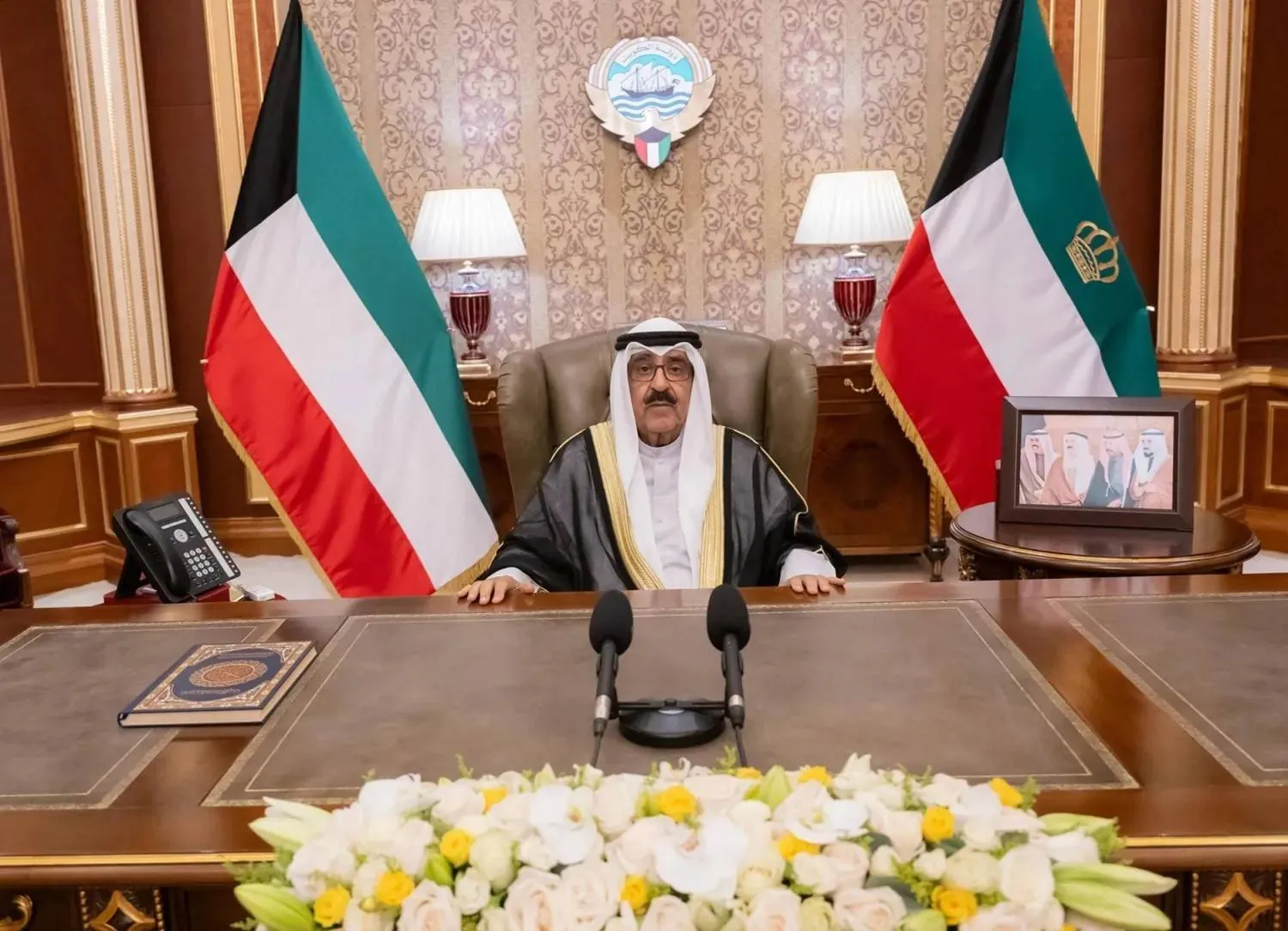
Kuwait’s Emir Sheikh Mishal Al-Ahmad Al-Jaber Al-Sabah speaks in a televised address on the occasion of the last 10 nights of Ramadan (KUNA) 
TT

Kuwaiti Emir Condemns 'Brutal Iran Attack’, Affirms Right to Self-Defense

Kuwait’s Emir Sheikh Mishal Al-Ahmad Al-Jaber Al-Sabah speaks in a televised address on the occasion of the last 10 nights of Ramadan (KUNA) 

Kuwait’s Emir Sheikh Mishal Al-Ahmad Al-Jaber Al-Sabah said on Monday his country, where 12 people were killed, has been subjected to a brutal attack by Iran, despite not allowing the use of its land, airspace, or coasts for any military action against the Iranian Republic.

On Feb. 28, the United States and Israel launched a surprise strike against Iran, which responded by firing ballistic missiles on lands and facilities in Gulf countries and Jordan.

In a televised address on the occasion of the last 10 nights of Ramadan, Sheikh Mishal Al-Ahmad stressed Kuwait's full and inherent right to self-defense in response to Iran’s blatant aggression.

“Our country has been subjected to a brutal attack by a neighboring Muslim country, which we consider a friend, even though we have not permitted the use of our land, airspace, or coasts for any military action against it, and we have repeatedly informed them of this through our diplomatic channels,” he said.

The Emir insisted on Kuwait's full and inherent right to self-defense under Article 51 of the United Nations Charter, in response to this blatant aggression, in a manner proportionate to the scale and nature of the attack and in accordance with international law, including taking all necessary measures to protect its territory, its people, and residents while preserving its sovereignty, security, and stability.

Addressing Kuwaiti nationals, he said, “I address you tonight... during a period in which the region is witnessing rapid developments, increasing tensions, and an unprecedented escalation.”

He said that awareness of current developments is no longer a choice but a national necessity that allows for the accurate interpretation of developments, understanding potential political and security challenges, and dealing with them rationally and responsibly, without neither exaggeration nor underestimation.

The Emir praised the Kuwaiti Armed Forces who managed to intercept hundreds of drones and missiles and said he ordered authorities to enhance precautionary measures and safeguard critical sites to ensure a rapid response to any emergency and maintain public stability.

“The military, security and civilian institutions are operating with high readiness and coordination to ensure the safety of citizens under all circumstances,” he said.

Sheikh Mishal Al-Ahmad said attacks targeting Kuwait’s airspace, territory, civilian facilities and infrastructure constitute a blatant violation of international norms and conventions and a direct assault on the country’s sovereignty, security and stability.

He said Kuwait’s sovereignty is a red line protected by the will of its people and the courage of its men and women, adding that the country will not allow any state to threaten its security or stability.

He also called on the international community to take responsibility in condemning the aggression and ensuring respect for international law.

The Emir said the attacks targeting neighboring states are attacks on the security of the entire region and a direct threat to its stability and peace.

He stressed that the security of the Gulf Cooperation Council states is indivisible and that any violation of one member state’s sovereignty is a threat to the collective security of all.

Sheikh Mishal Al-Ahmad reaffirmed Kuwait’s solidarity with its neighbors and support for all measures taken to protect the sovereignty, security and stability of the region.

The Crown Prince also expressed gratitude to the leaders of sisterly and friendly countries for their messages condemning the Iranian aggression against Kuwait.

“These communications showed strong solidarity and support for Kuwait in defending its sovereignty and security and reflected the close ties of friendship and unity in facing threats to regional stability and the safety of its people,” Sheikh Mishal Al-Ahmad said.



Saudi Arabia Condemns Terrorist Attack in Dera Ismail Khan, Reaffirms Support for Pakistan

Victims of a blast are shifted to a hospital following a blast, in Dera Ismail Khan, Pakistan, 26 September 2026. EPA/SAOOD REHMAN
TT

Saudi Arabia Condemns Terrorist Attack in Dera Ismail Khan, Reaffirms Support for Pakistan

Victims of a blast are shifted to a hospital following a blast, in Dera Ismail Khan, Pakistan, 26 September 2026. EPA/SAOOD REHMAN

Saudi Arabia on Monday condemned a terrorist attack that targeted a security checkpoint in the Dera Ismail Khan district of northwestern Pakistan, killing and injuring several people.

In a statement, the Saudi Foreign Ministry said, "the Kingdom categorically rejects all forms of terrorist and extremist acts", reaffirming its support for Pakistan and its efforts to maintain its security and stability.

Saudi Arabia also extended its sincere condolences to the families of the victims, as well as to the Pakistani government and people.

On Saturday, a suicide bomber detonated an explosives-laden vehicle at a roadside police checkpoint in Dera Ismail Khan, a district in Khyber Pakhtunkhwa province, northwestern Pakistan, killing at least 11 people and wounding about 30 others, officials said.

Local police chief Safdar Baloch said most of those killed and wounded were security personnel and passersby.

Following the bombing, gunmen opened fire on an ambulance attending the scene of the attack as it was transporting casualties from the blast site, killing two rescue workers, according to Pakistan's state broadcaster.

Pakistani President Asif Ali Zardari and Prime Minister Shehbaz Sharif condemned the attack, offered condolences to the victims’ families.

Zardari described the targeting of civilians and law enforcement personnel as “highly condemnable” and called for intensified action against the Pakistani Taliban, which he accused of carrying out “heinous and brutal acts” with foreign support.


King Mohammed VI: Saudi Security is an Integral Part of Morocco’s Security

Moroccan King Mohammed VI (MAP)
TT

King Mohammed VI: Saudi Security is an Integral Part of Morocco’s Security

Moroccan King Mohammed VI (MAP)

Morocco’s King Mohammed VI, on his own behalf and on behalf of the Moroccan people, has condemned the repeated attacks carried out by the terrorist Houthi militias against Saudi Arabia.

The attacks targeted civilian and economic facilities, vital installations, cities, and residential areas.

The King affirmed on Sunday that what further deepens the condemnation is that the attacks have not been confined to targeting facilities and civilians. Rather, they have extended to desperate and criminal attempts to target the two holiest sites in Islam, revered by Muslims around the world: Makkah and Madinah.

In two cables addressed to Custodian of the Two Holy Mosques King Salman bin Abdulaziz Al Saud and Prince Mohammed bin Salman bin Abdulaziz Al Saud, Saudi Crown Prince and Prime Minister, the Moroccan King said: “Out of loyalty to the bonds of faith, history and shared destiny, and the strong ties of brotherhood that personally unite us, as well as our two families and our two brotherly peoples, I address you at this critical juncture facing your dear country, when our historical responsibility, religious values and strategic considerations require us all to stand united in defense of truth, sovereignty, security and the sacred sites of the Muslim Ummah.”

“These despicable attacks and desperate attempts to undermine the security, stability and well-being of the proud Saudi people are not merely an assault on the brotherly Kingdom of Saudi Arabia, its people and the Umrah performers there; they are also a blatant assault on the sentiments of more than 1.8 billion Muslims across the world. They also constitute a flagrant violation of the values and principles upon which the noble Islamic faith is founded, including peace, tolerance, and the sanctity of blood, honor and sacred sites,” he said.

“We express our condemnation of these criminal acts, for which the terrorist Houthi militias, as well as those who stand behind them, finance and arm them, bear full responsibility. We consider them all accountable before Allah Almighty, history and international law, with the international sanctions that should follow accordingly,” the Moroccan king said.

“The security and stability of the Kingdom of Saudi Arabia, like those of the other Gulf Cooperation Council (GCC) states, are an integral part of the security of the Kingdom of Morocco. Any attack on Saudi Arabia is an attack on Morocco, because we consider standing with our brothers in Saudi Arabia and in the brotherly Arab Gulf states to be standing for truth and legitimacy, while defending their vital interests is defending our shared strategic interests,” King Mohammed VI added.

He also affirmed his country's steadfast support for Saudi Arabia in confronting the risks it faces as a result of the actions of terrorist and separatist militias and the regional powers backing them, which target the security of their neighbors and the wider region with a short-sighted and destructive approach.

He indicated that these actions seek to undermine the security of the entire region, disrupt the stability enjoyed by its countries, and threaten vital maritime routes of paramount importance to the global economy and the security of international maritime navigation.

The King stressed that such attacks “constitute a flagrant violation of international law and relevant UN provisions, foremost among them Resolution 2216 (2015), which calls on the militias to withdraw, surrender their weapons and cease violence, and Resolution 2722 (2024), which calls on them to immediately cease attacks on maritime navigation.”

“The targeting of civilian areas, economic facilities and holy sites also constitutes a blatant violation of international humanitarian law and international conventions and norms, and cannot go without accountability or punishment,” he added.


Saudi Foreign Minister Arrives in Washington on Official Visit

Saudi Foreign Minister Faisal bin Farhan Al-Saud attends a multilateral meeting with leaders from the Gulf Cooperation Council, which includes the United Arab Emirates (UAE), Qatar, Bahrain, Kuwait, and Oman, during the 81st United Nations General Assembly (UNGA) in New York City, US, September 22, 2026. REUTERS/Kylie Cooper
TT

Saudi Foreign Minister Arrives in Washington on Official Visit

Saudi Foreign Minister Faisal bin Farhan Al-Saud attends a multilateral meeting with leaders from the Gulf Cooperation Council, which includes the United Arab Emirates (UAE), Qatar, Bahrain, Kuwait, and Oman, during the 81st United Nations General Assembly (UNGA) in New York City, US, September 22, 2026. REUTERS/Kylie Cooper

Saudi Foreign Minister Prince Faisal bin Farhan arrived in Washington on an official visit, where he is due to meet his US counterpart Marco Rubio.

The two officials are set to discuss bilateral relations and the latest developments on the regional and international fronts.