


Riyadh Consultative Meeting: Regional Countries Will Not Stand Idly by against Threats

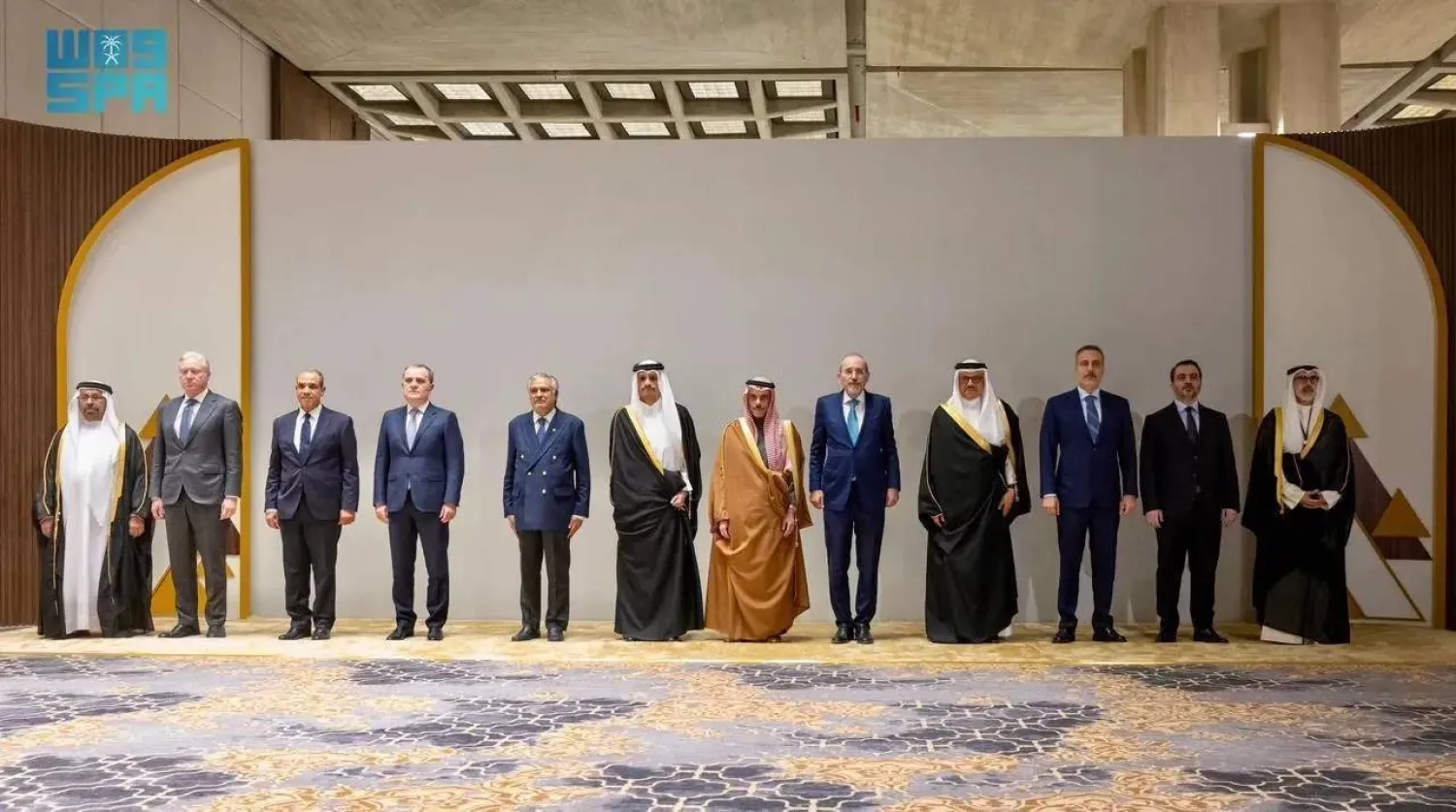
The foreign ministers pose for a family photo during their consultative meeting in Riyadh. (SPA)
TT

Riyadh Consultative Meeting: Regional Countries Will Not Stand Idly by against Threats

The foreign ministers pose for a family photo during their consultative meeting in Riyadh. (SPA)

Foreign ministers of Gulf, Arab and regional countries condemned on Thursday Iran’s flagrant violation of principles of good neighborliness and of the sovereignty of nations, saying it will have grave repercussions against it and the security of the Middle East.

“Iran's attacks will cost it highly and impact relations with the countries and peoples of the region that will not stand idly by as they are threatened,” they warned in a statement after holding a consultative meeting in Riyadh.

The meeting brought together the foreign ministers of Saudi Arabia, Bahrain, Kuwait, Qatar, Egypt, Jordan, the United Arab Emirates, Lebanon, Syria, Türkiye, Pakistan and Azerbaijan to discuss the Iranian escalation and efforts to bolster coordination to protect regional stability.

In a statement, the gatherers strongly condemned Iran’s rocket and drone attacks on the Gulf, Jordan, Azerbaijan and Türkiye, and its targeting of residential areas and civilian infrastructure, including oil facilities, water desalination plants, airports and diplomatic districts.

“The attacks cannot be justified under any excuse,” they stressed, saying they were a violation of sovereignty of nations and international law.

They held Iran “fully responsible for the losses”, saying the countries reserve the right to defend themselves.

Moreover, they warned Iran of the danger of supporting militias, urging it to “seriously reconsider is miscalculations and immediately and unconditionally cease its attacks and commit to United Nations Security Council resolutions.”

They urged Iran “to respect international and humanitarian laws and the principles of good neighborliness as a first step towards ending the escalation and achieving security and stability in the region”. They called for diplomacy to resolve crises.

“The future of relations with Iran depends on the respect of the sovereignty of countries and non-interference in their internal affairs and refraining from attacking their sovereignty and territories in any way, shape or form,” they demanded.

It must also refrain from using its military capabilities to threaten regional countries, they added. It must stop supporting, financing and arming its militias in Arab countries.

Iran must also refrain from threatening or impeding marine navigation in the Hormuz and Bab el-Mandeb Straits.

The FMs also expressed their support for Lebanon’s security, stability and territorial integrity. Lebanon must have sovereignty across its territories.

They stressed their backing of the Lebanese government’s decision to impose state monopoly over weapons, while condemning the Israeli attacks on Lebanon and its expansionist ambitions in the region.

The FMs said they will continue to hold intense consultations to follow up on the developments to come up with joint positions and take the necessary measures to protect their security, stability and sovereignty and stop the heinous Iranian attacks against their countries.



UN Security Council Condemns Attack on UAE Nuclear Plant

The Barakah nuclear power plant in Abu Dhabi. (WAM)
TT

UN Security Council Condemns Attack on UAE Nuclear Plant

The Barakah nuclear power plant in Abu Dhabi. (WAM)

Russia joined other UN Security Council members on Tuesday to condemn the drone strike on the UAE's Barakah nuclear power plant, which Abu Dhabi said originated from Iraq where pro-Iranian proxies are active.

The unclaimed drone struck an electrical generator on Sunday near the Arab world's first nuclear power plant in Barakah in the emirate of Abu Dhabi, triggering a fire but causing no injuries nor radiation leak.

"Attacks targeting peaceful nuclear facilities in any country of the world...are categorically unacceptable," said Russia's ambassador to the UN Vassily Nebenzya.

"Against this backdrop, our country categorically condemns the actions of those who carried out the strike targeting the plant on the territory of the UAE, thereby generating risks of escalation," he continued without naming any party.

"We trust that all stakeholders will do everything necessary to avoid a recurrence of such a dangerous incident," he added, noting that the strike likely would not have happened without the US-Israeli operation against Iran, Moscow's long-standing ally.

Abu Dhabi said Tuesday that the drones came from Iraq, where Iran-backed groups have been carrying out attacks against Gulf nations since the Middle East war erupted.

From China to the United States, the other members of the Security Council also condemned the strikes, which have not been claimed by any group.

"What sane nation, either directly or indirectly through proxies, sends drone attacks into an active and ongoing nuclear power plant?" asked US ambassador Mike Waltz, denouncing "outrageous and unacceptable attacks."

"What is the world left to believe? That if Iran...can't achieve a nuclear weapon -- and it can't use it as it has threatened over and over again on its neighbors -- that it's now going to find a clever and dangerous way to weaponize a nuclear power plant?

"I struggle to come to any other conclusion," he said.


Saudi Arabia Expands Use of AI to Serve Hajj Pilgrims

The Smart Makkah Operations Center is one of the operational and technical pillars supporting SDAIA’s work during Hajj (SPA)
TT

Saudi Arabia Expands Use of AI to Serve Hajj Pilgrims

The Smart Makkah Operations Center is one of the operational and technical pillars supporting SDAIA’s work during Hajj (SPA)

The Saudi Data and Artificial Intelligence Authority, known as SDAIA, has expanded the technological transformation Saudi Arabia is driving during the Hajj season, rolling out programs designed to boost operational efficiency and strengthen coordination among government agencies in one of the world’s largest annual logistical operations.

The aim is to deliver faster and better services to pilgrims.

SDAIA’s work included operating and supporting 75 sites in the holy sites and 14 sorting sites and security control centers by providing technical systems and services. It also supported Hajj operations at air, land and sea ports across the Kingdom in cooperation with the Ministry of Interior, while running technical systems and platforms in the holy sites.

Makkah Route

Dr. Majid AlShehry, official spokesman for SDAIA, told Asharq Al-Awsat that the authority had continued to support the Ministry of Interior’s Makkah Route initiative, now in its eighth year and implemented with several government agencies.

He said SDAIA provided advanced technical services in 10 countries through 17 international ports, equipping the initiative’s halls with the latest digital solutions powered by data and artificial intelligence. The services helped pilgrims complete procedures at airports in their home countries before arriving in Saudi Arabia.

Mobile device

AlShehry said SDAIA, in partnership with the Ministry of Interior, had developed a mobile device this year supported by data and AI technologies to help authorities complete pilgrims’ procedures automatically and flexibly, particularly for the elderly and people with disabilities.

The device verifies travel documents and visas with high accuracy, ensuring a smoother and safer experience from departure. It can capture biometrics, take a facial image and read a pilgrim’s passport data in no more than 40 seconds, helping improve performance and ease the Hajj journey this year, 1447 AH.

SDAIA also supported Hajj operations at air, land and sea ports across the Kingdom in cooperation with the Ministry of Interior, while running technical systems and platforms in the holy sites and supporting sorting sites and security control centers, AlShehry said.

He said the work strengthens technical integration with relevant government agencies, speeds up procedures, supports business continuity and improves operational efficiency during the season.

SDAIA has reinforced its technical capabilities at the Kingdom’s air, land and sea ports with specialized teams working around the clock to ensure the continuity of technical services and primary and backup communication networks, maintaining uninterrupted operational readiness.

It provided technical services at several key ports, including King Abdulaziz International Airport in Jeddah, Prince Mohammad bin Abdulaziz International Airport in Madinah, Taif Airport, Jeddah Islamic Port, the Empty Quarter crossing, Al Batha, Salwa, Al Ruqi, King Fahd Causeway, Halat Ammar, Neom Port, Jadidat Arar, Al Haditha and Al Wadiah.

Operating 75 sites in the holy sites

AlShehry said SDAIA’s work extended to operating and supporting 75 sites in the holy sites and about 14 sorting sites and security control centers. This included providing technical systems and services, supervising infrastructure and communication rooms, preparing workstations and connecting them to SDAIA’s network under approved cybersecurity standards.

The work also covered preventive maintenance, receiving and immediately handling technical reports, and training participating staff to use modern systems and platforms.

AlShehry described the Smart Makkah Operations Center, SMART MOC, in Makkah as one of the main operational and technical pillars supporting SDAIA’s Hajj work this year. The center monitors the performance of systems and digital platforms supervised by the authority and tracks response indicators and business continuity around the clock.

He said specialized Saudi staff monitor data flow, detect technical challenges and address them proactively, helping maintain stable and reliable digital services in line with operational requirements and cybersecurity standards.

Surveillance cameras

SDAIA, in partnership with the Ministry of Interior, developed a smart digital system for security surveillance cameras through the Sawaher platform, AlShehry said.

The platform included infrastructure for smart surveillance cameras, security monitoring rooms and operational platforms to support field monitoring and crowd management in the holy sites and on roads leading to them during Hajj.

The system analyzes data, grouping indicators and crowd behavior using advanced algorithms to measure density and crowd numbers.

AlShehry also cited the Baseer platform, which SDAIA developed with the Ministry of Interior through advanced technical work based on AI technologies and algorithms, including computer vision and large language models.

He said Baseer monitors crowds, supports their safety and helps smooth their movement as they enter the Two Holy Mosques during the Hajj 1447 season. The platform is integrated with security and service agencies, providing field commanders with accurate, immediate analysis, supporting decision-making and improving pilgrim safety.

19 languages

AlShehry said the comprehensive national application Tawakkalna accompanied pilgrims during this year’s Hajj through an integrated package of services available in 19 languages.

Pilgrims can log in easily to view services relevant to their journey, including Hajj permits available through Tawakkalna in integration with the unified digital Hajj permit platform, Tasreeh. The application also allows users to view all types of Hajj permits issued by government agencies.

On charitable work, AlShehry said the national platform Ehsan continued to support projects serving pilgrims by offering trusted opportunities to support Hajj-related initiatives.

He said Ehsan also enabled the electronic performance of the udhiyah sacrifice ritual in line with Islamic guidelines and organized digital mechanisms that ensure efficiency and reliability, while strengthening the sustainability of charitable impact through the Ehsan Endowment Fund.


Iraq Vows No Leniency with Parties Harming Ties with Saudi Arabia

Iraqi government spokesman Bassem al-Awadi. (INA)
TT

Iraq Vows No Leniency with Parties Harming Ties with Saudi Arabia

Iraqi government spokesman Bassem al-Awadi. (INA)

Iraq said it was ready to cooperate fully in verifying any information about an attack on Saudi Arabia that was launched from its territory, renewing its condemnation of the incident and vowing measures to prevent any breach of Iraqi sovereignty.

The Iraqi government’s latest condemnation came a day after the Foreign Ministry denounced the attacks on the Kingdom, in what observers said signaled Prime Minister Ali al-Zaidi’s new government was keen to protect ties with Saudi Arabia and other Gulf states.

Saudi Arabia’s Defense Ministry said on Sunday it had intercepted and destroyed three drones after they entered the Kingdom’s airspace from Iraq.

Iraqi government spokesman Bassem al-Awadi renewed Baghdad’s condemnation on Tuesday, saying Iraq “reaffirms its firm and historic position in support of distinguished and lasting relations with brotherly and friendly countries of the region, its commitment to the security of Arab states, the importance of supporting stability, all efforts to ease tensions, and preventing attacks, whatever their source.”

“The Iraqi government condemns the recent drone attacks that targeted Saudi Arabia and affirms its continued joint efforts to strengthen regional security and safeguard the security and sovereignty of countries in the region,” he said.

Awadi repeated that the military authorities did not detect or record any activity from the country’s airspace, stressing, however, that Iraqi institutions were fully ready “to cooperate in verifying any information related to the circumstances of the attack that targeted the Kingdom.”

He stressed Iraq’s “categorical rejection of the use of its territory, airspace or territorial waters to launch any attack on neighboring countries.”

Awadi said Iraqi security forces had taken “all necessary steps and measures to thwart and uncover any attempt in this context,” adding that there would be “no leniency toward anyone who tries to violate the sovereignty of the Iraqi state or damage relations with the Kingdom, neighboring countries or brotherly states.”

Observers are now raising questions over how Zaidi will deal with pro-Iran armed factions and confront their activities at home and abroad, particularly under continued US pressure.

In recent months, after the outbreak of the US-Israeli war against Iran, factions launched hundreds of attacks on targets inside Iraq, most of them in the northern Kurdistan region.

They also carried out attacks on more than one country in Iraq’s regional neighborhood. Those attacks stopped during the ceasefire, before resuming with three drones over Saudi territory.

Many believe the factions’ latest attacks pose a serious challenge to Zaidi’s authority. The prime minister, whose government was approved by parliament last week, has received clear US, domestic and Arab backing, a development that was not welcomed by the factions, which are seeking to embarrass him at the start of his tenure in Iraq’s top executive post.