

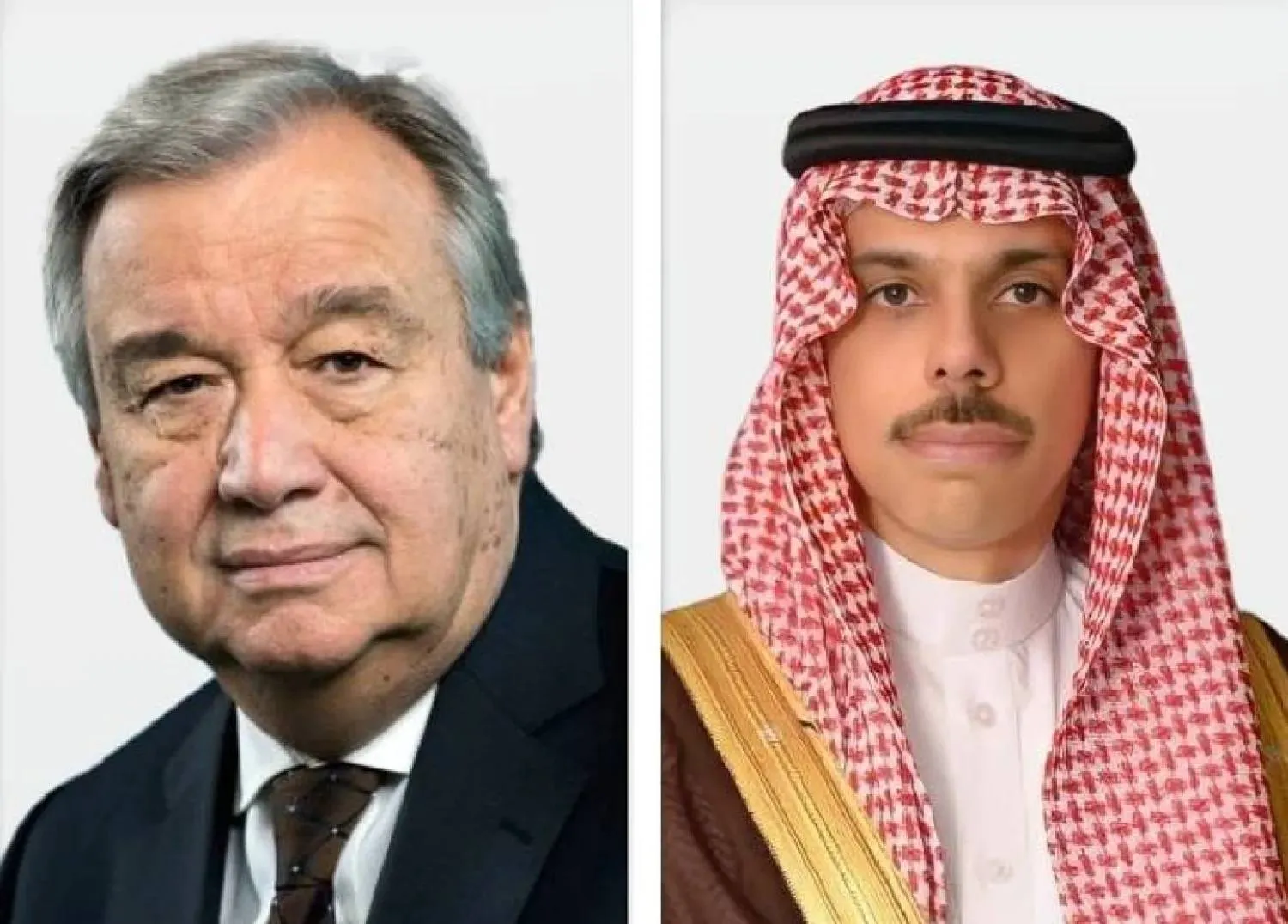

Saudi Foreign Minister, UN Secretary-General Discuss Regional Developments

Saudi FM Prince Faisal bin Farhan and UN Secretary-General Antonio Guterres (Saudi Ministry of Foreign Affairs)
TT

Saudi Foreign Minister, UN Secretary-General Discuss Regional Developments

Saudi FM Prince Faisal bin Farhan and UN Secretary-General Antonio Guterres (Saudi Ministry of Foreign Affairs)

Saudi Minister of Foreign Affairs, Prince Faisal bin Farhan bin Abdullah, received a phone call on Wednesday from Secretary-General of the United Nations, Antonio Guterres, where discussions focused on the latest developments in the region and the ongoing international efforts to address the situation.

Iran continues to carry out hostile attacks against Gulf countries and the wider region since February 28, in response to US and Israeli strikes. These actions have drawn widespread international condemnation along with expressions of solidarity with the affected countries.

On March 11, the United Nations Security Council adopted a resolution strongly condemning Iran’s continued attacks on Gulf countries and Jordan, describing them as violations of international law and a serious threat to international peace and security.

Security Council Resolution No. 2817, which was approved by 136 countries, affirmed the right of affected states to individual or collective self-defense, in accordance with Article 51 of the UN Charter, and called on Tehran to immediately cease all attacks.



Iran Threatens Energy Security with Attacks on Gulf Oil Tankers

Saudi Arabia possesses one of the most advanced missile defense systems in the world (Saudi Ministry of Defense). 
TT

Iran Threatens Energy Security with Attacks on Gulf Oil Tankers

Saudi Arabia possesses one of the most advanced missile defense systems in the world (Saudi Ministry of Defense). 

Iran escalated its military operations in the region on Wednesday, targeting Gulf states and oil tankers in regional waters in attacks widely seen as a direct threat to energy security and international navigation.

Gulf air defenses intercepted dozens of missiles and drones, with officials stressing a high level of readiness to protect airspace and critical infrastructure while minimizing damage.

Saudi Arabia

Saudi Arabia’s defense ministry spokesman, Brigadier General Turki al-Maliki, said four drones had been intercepted and destroyed in recent hours.

In two separate statements, al-Maliki confirmed the success of the operations, underscoring the armed forces’ readiness to defend the Kingdom’s airspace and counter various threats, with no damage reported.

Riyadh also reiterated its strong condemnation of what it described as “blatant Iranian aggression” against the Kingdom, Arab states and the wider region during the 43rd session of the Council of Arab Interior Ministers, held via videoconference.

Interior Minister Prince Abdulaziz bin Saud stressed the importance of strengthening Arab security cooperation and coordinating efforts to confront evolving threats and combat crime in all its forms to safeguard regional stability.

Kuwait

A drone attack by Iran and allied groups targeting fuel tanks at the Kuwait International Airport triggered a large fire on Wednesday but caused no casualties.

Kuwait News Agency quoted civil aviation spokesman Abdullah al-Rajhi as saying rescue teams responded immediately, with initial reports indicating material damage to facilities operated by Kuwait Aviation Fueling Company (KAFCO).

Britain affirmed its support for Kuwait’s security amid the current situation, pledging to stand by the country against any threats to its sovereignty, stability and safety.

The message was conveyed from King Charles III to Kuwait’s emir, Sheikh Mishal al-Ahmad al-Jaber al-Sabah, and delivered by British ambassador Qudsi Rasheed to Minister of Amiri Diwan Affairs Sheikh Hamad Jaber al-Ali al-Sabah.

Bahrain

Bahrain’s Defense Force said it intercepted and destroyed four ballistic missiles and 19 drones in recent hours.

The General Command added that since the start of the Iranian attacks, 186 missiles and 419 drones had been intercepted. It said the use of such weapons against civilian sites and private property constitute a “flagrant violation” of international humanitarian law and the UN Charter and pose a direct threat to regional peace and security.

The interior ministry said firefighters had extinguished a blaze at a company facility caused by what it described as Iranian aggression.

Bahrain’s National Communication Center urged the public to follow official guidance, verify information accuracy and avoid spreading rumors amid the ongoing attacks.

United Arab Emirates

The United Arab Emirates said its air defenses intercepted five ballistic missiles and 35 drones launched from Iran.

Falling debris from an intercepted drone killed an Asian national on a farm in Fujairah, authorities said. The victim was identified as a Bangladeshi citizen.

The Fujairah government media office said emergency teams responded to the incident in the Al-Rifaa area following the successful interception.

Official figures showed that since the start of the attacks, UAE defenses had dealt with 438 ballistic missiles, 19 cruise missiles and 2,012 drones. The assaults have killed two members of the armed forces while on duty, a Moroccan civilian contractor working with the military, and nine other civilians.

Qatar and maritime incidents

Qatar’s defense ministry said the country had been targeted by three Iranian cruise missiles. Air defenses intercepted two, while the third struck an oil tanker chartered by QatarEnergy in the country’s exclusive economic zone.

Authorities coordinated the evacuation of the vessel, which carried a crew of 21, with no casualties reported.

In a related development, the United Kingdom Maritime Trade Operations reported a new security incident in Gulf waters.

According to the organization, the incident occurred 17 nautical miles north of Ras Laffan. A company security officer said the tanker was hit on its port side, causing damage above the waterline without injuries among the crew.

In a later update, the organization said the vessel had in fact been struck twice. One impact caused a fire that was later extinguished, while a second projectile remained unexploded in the engine room, with authorities working to secure it and investigate the incident.

On Tuesday, Iran targeted the Kuwaiti crude oil tanker “Al-Salmi” while it was anchored off the United Arab Emirates outside Dubai port. Several vessels in the Strait of Hormuz were also attacked using armed boats, missiles and drones.


Presidents of the UAE, US Discuss Regional Escalation and Global Security Risks

File photo: Emirati President Sheikh Mohamed bin Zayed and US President Donald Trump meet in Abu Dhabi on Thursday (AP)
TT

Presidents of the UAE, US Discuss Regional Escalation and Global Security Risks

File photo: Emirati President Sheikh Mohamed bin Zayed and US President Donald Trump meet in Abu Dhabi on Thursday (AP)

UAE President Sheikh Mohamed bin Zayed Al Nahyan discussed on Wednesday the regional escalations and their impact on regional and global security during a phone call with US President Donald Trump.

The two leaders addressed the implications of rising tensions, including their impact on global markets, international maritime security, the world economy, and supply chains. They exchanged views on the broader consequences of the current escalation.

The two sides also addressed the ongoing Iranian attacks targeting the United Arab Emirates and several countries in the region, including strikes on civilians, critical facilities, and infrastructure. They stressed that such actions represent a breach of national sovereignty and international law and pose a direct threat to regional security and stability.

On Wednesday, the UAE Ministry of Defense said its air defenses intercepted five ballistic missiles and 35 drones launched from Iran on its territories.

It added that a total of 438 ballistic missiles, 19 cruise missiles, and 2,012 drones have been intercepted since the start of these attacks on February 28.

The attacks killed two armed forces personnel and 10 civilians of various nationalities, and injured 190 others. The ministry said it remains on high alert and ready to respond decisively to any threats to national security, sovereignty, and stability.


Saudi Arabia: High-Level Readiness for Hajj Season

Prince Saud bin Mishaal chairs Hajj and Umrah committee meeting in Makkah
TT

Saudi Arabia: High-Level Readiness for Hajj Season

Prince Saud bin Mishaal chairs Hajj and Umrah committee meeting in Makkah

Saudi authorities on Wednesday reviewed preparedness for this year’s Hajj season, assessing operational plans and readiness indicators as officials called for intensified coordination ahead of the annual pilgrimage.

The permanent Hajj and Umrah committee, chaired by Prince Saud bin Mishaal bin Abdulaziz, examined scenarios already implemented and others planned to ensure full readiness, in a meeting held under directives from Prince Khalid bin Faisal bin Abdulaziz.

Prince Saud bin Mishaal thanked agencies involved in the Ramadan Umrah season, citing extensive logistical and human support from the Saudi leadership that helped deliver smooth operations for visitors to the Grand Mosque.

Officials reviewed Ramadan performance across transport, ambulance and healthcare services, reporting no epidemics or incidents.

The meeting also covered the departure phase of Umrah performers via King Abdulaziz International Airport, and progress on upgrading the Hajj and Umrah terminal complex, with its first and second phases completed.

In Madinah, Prince Salman bin Sultan bin Abdulaziz chaired a parallel meeting of the regional Hajj and Umrah committee, attended by his deputy, Prince Saud bin Nahar bin Saud bin Abdulaziz, to review government preparations for the upcoming season.

Prince Salman congratulated agencies on the success of Ramadan operations, saying coordinated plans enabled visitors to perform rituals in a calm and secure environment.

He said the results reflect sustained leadership support for the Two Holy Mosques and their visitors, highlighting oversight by Prince Abdulaziz bin Saud bin Naif bin Abdulaziz to enhance services and ensure safety.

He stressed the need for full readiness across government, service and volunteer sectors, calling for proactive planning and stronger coordination to reinforce facilities and services in line with the care provided to pilgrims.

The Madinah meeting issued recommendations to support relevant entities and ensure high-quality services for visitors to the Prophet’s Mosque during Hajj.

Prince Salman was also briefed by the Minister of Hajj and Umrah Tawfiq al-Rabiah, accompanied by Pilgrim Experience Program CEO Mohammed Ismail, on a digital dashboard designed to track the readiness of Hajj projects and improve coordination.

Al-Rabiah said the platform enables continuous monitoring through daily updates, including readiness plans and performance indicators, project progress in the holy sites, alignment of operational plans, and integration with a central database.

Prince Salman also reviewed the Hajj and Umrah sector’s indicators platform, which presents real-time data and analysis on services provided to pilgrims. The platform supports decision-making by delivering timely, precise data, enhancing monitoring efficiency and strengthening system-wide readiness within an integrated institutional framework.