


Shehbaz Sharif, Tamim bin Hamad Support Path of De-escalation

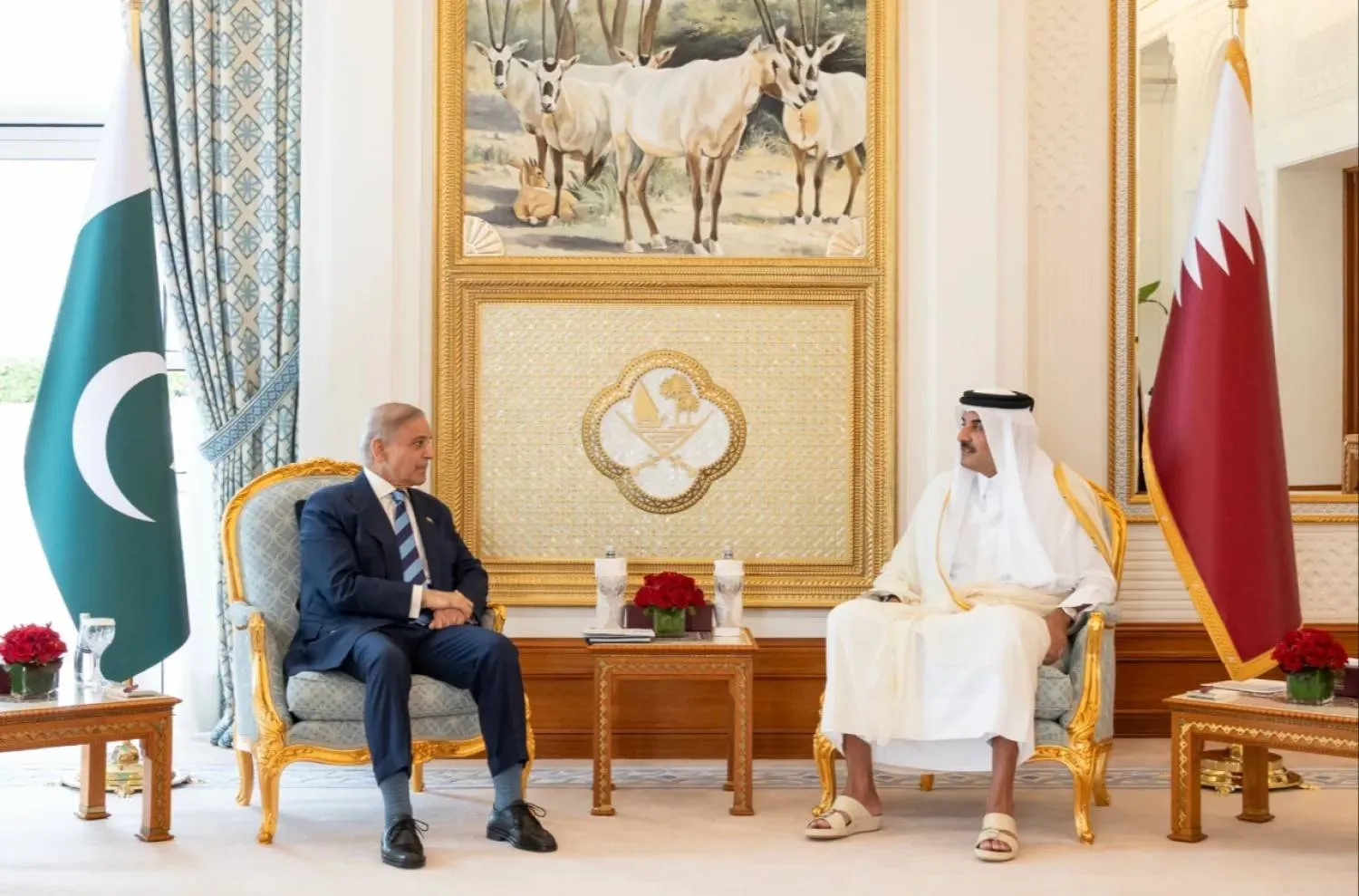
The Emir of Qatar, Sheikh Tamim bin Hamad Al Thani meets Pakistan’s Prime Minister Shehbaz Sharif in Doha, Qatar, April 16, 2026. (QNA)
TT

Shehbaz Sharif, Tamim bin Hamad Support Path of De-escalation

The Emir of Qatar, Sheikh Tamim bin Hamad Al Thani meets Pakistan’s Prime Minister Shehbaz Sharif in Doha, Qatar, April 16, 2026. (QNA)

Following his shuttle tour that kicked off in Saudi Arabia, Pakistan’s Prime Minister Shehbaz Sharif discussed with Qatar’s Emir Sheikh Tamim bin Hamad Al Thani the latest regional and international developments, particularly those in the Middle East, during a meeting held Thursday at the Amiri Diwan.

The Pakistani Prime Minister reiterated his country's condemnation of the attacks targeting Qatar and other countries in the region, affirming Pakistan's full solidarity with Doha and support for the measures it takes to protect its sovereignty and safeguard its security and stability, the Amiri Diwan said in a statement.

During the meeting, Qatar’s Emir expressed his appreciation for Pakistan's role in supporting efforts to deescalate tensions and promote diplomatic dialogue in the service of regional peace and security.

According to official sources, both sides stressed the necessity of supporting the path of deescalation and strengthening international coordination to ensure the security and stability of the region, especially maintaining the smooth flow of energy supply chains through vital maritime routes.

They further discussed the cooperation and friendship relations between the two countries and ways to develop them, aiming to strengthen the partnership and open new horizons for bilateral cooperation.

The Qatari Emir and the Prime Minister also held a bilateral meeting, where they exchanged views on current developments of mutual interest and emphasized the importance of continued coordination and consultation between the two countries, particularly amidst current events and their repercussions on the region's security and stability.

Sharif arrived in Doha on Thursday morning for a working visit to the country. The PM and the accompanying delegation were welcomed upon arrival at Doha International Airport by Minister of State for Foreign Affairs Sultan bin Saad Al Muraikhi.


Saudi FM: We Welcome Trump's Decision to Allow More Time for Diplomacy to End the War

Saudi Foreign Minister Prince Faisal bin Farhan bin Abdullah. (SPA)
TT

Saudi FM: We Welcome Trump's Decision to Allow More Time for Diplomacy to End the War

Saudi Foreign Minister Prince Faisal bin Farhan bin Abdullah. (SPA)

Saudi Foreign Minister Prince Faisal bin Farhan bin Abdullah expressed on Wednesday the Kingdom's appreciation for US President Donald Trump’s granting negotiations more opportunity to reach an agreement that ends the war on Iran and restores security and freedom of navigation in the Strait of Hormuz

In a statement, the Saudi Foreign Minister underlined the Kingdom's appreciation for diplomatic efforts aimed at containing the escalation.

He added that Saudi Arabia remained supportive of ongoing mediation efforts carried out by Pakistan and urged Iran to seize "the opportunity to avoid the dangerous implications of escalation". 

Prince Faisal stressed the importance of leveraging this opportunity to avoid further tensions, saying Saudi Arabia is awaiting Iran’s response to the efforts that aim to reach an agreement that achieves lasting peace and boosts regional and international security and stability.

Trump announced on Monday that he had postponed an attack on Iran set for Tuesday in response to a request from Gulf leaders.


UAE Demands that Iraq Halt Attacks Launched from its Territories

A handout picture obtained from the media office of the Barakah Nuclear Power Plant on February 13, 2020 shows a general view of the power plant in the western Al Dhafra Region of Abu Dhabi on the Gulf coastline about 50 kilometers west of Ruwais. (Barakah Nuclear Power Plant / AFP)
TT

UAE Demands that Iraq Halt Attacks Launched from its Territories

A handout picture obtained from the media office of the Barakah Nuclear Power Plant on February 13, 2020 shows a general view of the power plant in the western Al Dhafra Region of Abu Dhabi on the Gulf coastline about 50 kilometers west of Ruwais. (Barakah Nuclear Power Plant / AFP)

The United Arab Emirates strongly condemned on Wednesday “the unprovoked terrorist drone attacks launched from Iraqi territory, including an attack targeting the Barakah Nuclear Power Plant on Sunday, which struck an electricity generator located outside the inner perimeter of the plant.”

In a statement, the Ministry of Foreign Affairs stressed the UAE’s “strong condemnation and categorical rejection of the heinous terrorist attacks launched from Iraqi territory against critical civilian institutions across the Gulf Cooperation Council (GCC) countries, in flagrant violation of their sovereignty, airspace, and in clear breach of the principles of international law, international humanitarian law, and the Charter of the United Nations.”

The Ministry underscored the importance of the Iraqi government’s commitment “to immediately and unconditionally halt and prevent all acts of aggression launched from its territory,” stressing the need to address these threats in an immediate and responsible manner, in accordance with relevant international and regional laws and charters.

Furthermore, the Ministry underscored “the importance of Iraq fulfilling its role in strengthening security and stability in the region, thereby preserving its sovereignty and boosting its position as an active and responsible partner within the region.”


UN Security Council Condemns Attack on UAE Nuclear Plant

The Barakah nuclear power plant in Abu Dhabi. (WAM)
TT

UN Security Council Condemns Attack on UAE Nuclear Plant

The Barakah nuclear power plant in Abu Dhabi. (WAM)

Russia joined other UN Security Council members on Tuesday to condemn the drone strike on the UAE's Barakah nuclear power plant, which Abu Dhabi said originated from Iraq where pro-Iranian proxies are active.

The unclaimed drone struck an electrical generator on Sunday near the Arab world's first nuclear power plant in Barakah in the emirate of Abu Dhabi, triggering a fire but causing no injuries nor radiation leak.

"Attacks targeting peaceful nuclear facilities in any country of the world...are categorically unacceptable," said Russia's ambassador to the UN Vassily Nebenzya.

"Against this backdrop, our country categorically condemns the actions of those who carried out the strike targeting the plant on the territory of the UAE, thereby generating risks of escalation," he continued without naming any party.

"We trust that all stakeholders will do everything necessary to avoid a recurrence of such a dangerous incident," he added, noting that the strike likely would not have happened without the US-Israeli operation against Iran, Moscow's long-standing ally.

Abu Dhabi said Tuesday that the drones came from Iraq, where Iran-backed groups have been carrying out attacks against Gulf nations since the Middle East war erupted.

From China to the United States, the other members of the Security Council also condemned the strikes, which have not been claimed by any group.

"What sane nation, either directly or indirectly through proxies, sends drone attacks into an active and ongoing nuclear power plant?" asked US ambassador Mike Waltz, denouncing "outrageous and unacceptable attacks."

"What is the world left to believe? That if Iran...can't achieve a nuclear weapon -- and it can't use it as it has threatened over and over again on its neighbors -- that it's now going to find a clever and dangerous way to weaponize a nuclear power plant?

"I struggle to come to any other conclusion," he said.
