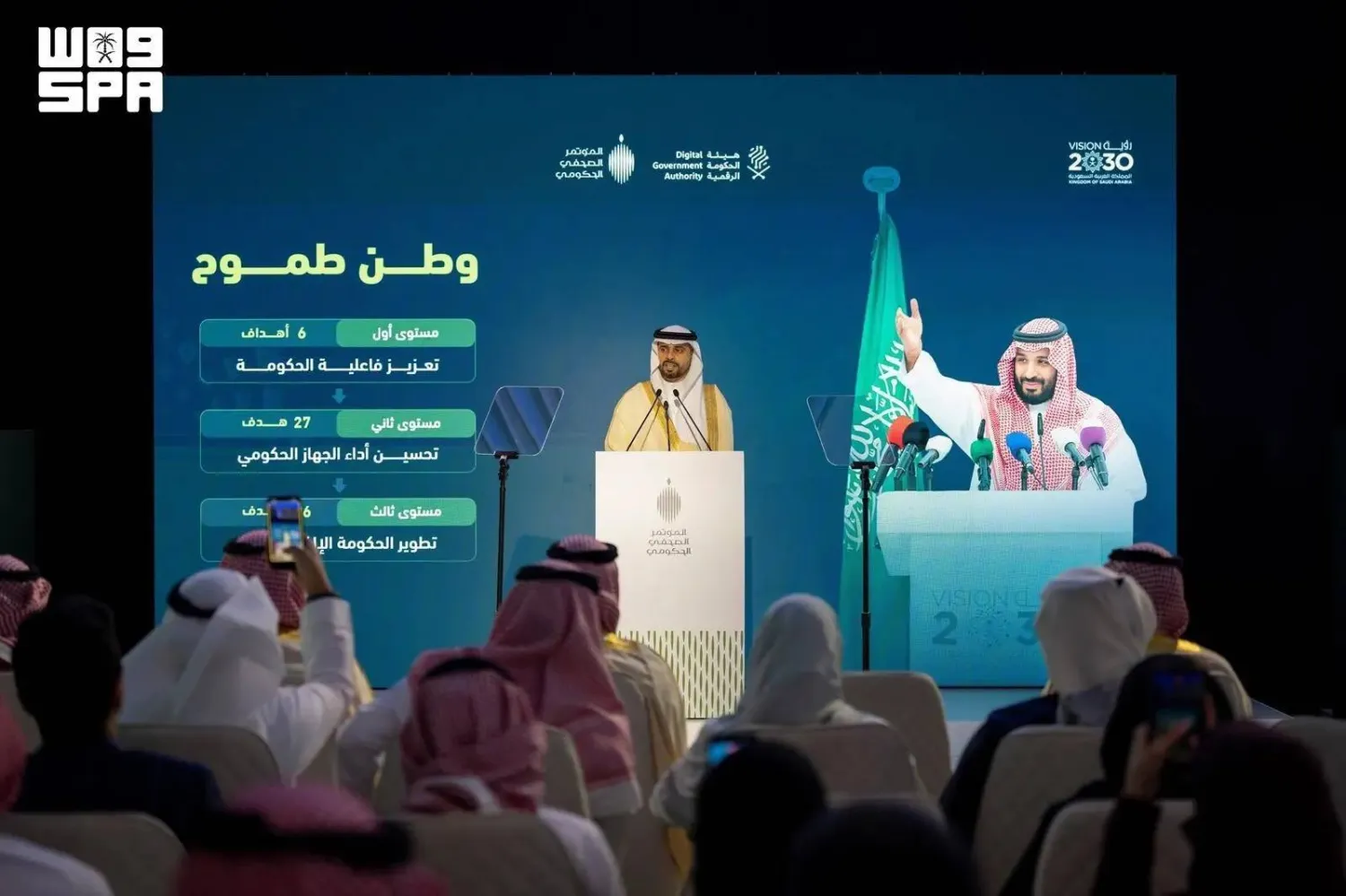
Governor of Saudi Arabia’s Digital Government Authority (DGA) Eng. Ahmed bin Mohammed Alsuwaiyan underlined on Sunday the importance of raising the readiness of government services and strengthening their digital resilience against risks amid growing reliance on digital services.
He noted that maintaining business continuity requires "providing operational alternatives and conducting continuous exercises to ensure government entities' capacity to handle risks and continue delivering their services".
During a government press conference in Riyadh, Alsuwaiyan explained that the National Cybersecurity Authority is responsible for setting technical standards and monitoring service providers' compliance with them, while the DGA oversees business continuity and strengthens readiness and resilience by providing alternatives and running periodic exercises to address cyber and operational risks.
He called for boosting interconnectivity among digital governments to facilitate the seamless cross-border transfer of data and services in collaboration with the United Nations, the Gulf Cooperation Council (GCC), and international bodies.
He pointed to the ability to complete transactions inside Saudi Arabia using only a mobile phone, contrasted with the continued need to carry a physical passport when traveling between countries.
Alsuwaiyan revealed an ambition to enable users in the future to authorize a "smart agent" (agentic AI) to execute transactions on their behalf without needing to log into government platforms, such as renewing driver's licenses and domestic worker residencies, noting that work is underway to develop new models over the coming months.
Reviewing Saudi Arabia’s progress on the E-Government Development Index (EGDI), he explained that the Kingdom’s baseline ranking in the Saudi Vision 2030 document, based on the 2014 report, stood at 36th globally before declining to 44th in 2016 and 52nd in 2018.
Early stages faced challenges that required restructuring, organizing governance, and establishing appropriate frameworks, ultimately propelling the Kingdom to 4th place globally in 2026 out of 194 countries, achieving the Vision 2030 target of ranking among the world's top five digital governments, Alsuwaiyan added.
Saudi Arabia climbed from 49th place globally in 2018 to first in the world in digital government services, while its capital, Riyadh, rose from 30th to first place globally in local digital government services he revealed.
Citing examples of direct impact, Alsuwaiyan stated that completing services via the "Absher" platform was reduced from four hours to 30 seconds, generating estimated annual savings of SAR 26 billion. Virtual courts have enabled 95 percent of court hearings to be conducted remotely, while the average time required to issue judicial rulings in personal status cases dropped from 219 to 20 days.
Digital healthcare services have eliminated the need for more than 60 million in-person visits annually, with 51 percent of medical appointments now conducted remotely, he went on to say.
Furthermore, the time required to dispense medications fell from 72 hours to less than eight minutes, yielding savings exceeding SAR 1.5 billion in medication costs, and eliminating more than 1.3 million in-person visits daily and reducing customs clearance time from 12 days to two hours.
Alsuwaiyan also revealed that government spending on information and communications technology (ICT) services exceeded SAR 145 billion between 2022 and the end of 2025, while contracts awarded to small and medium-sized enterprises (SMEs) and entrepreneurs surpassed SAR 9 billion in 2025.
He explained that the DGA’s Innovation Center provides specialized innovation spaces, workshops, and laboratories to support government entities in developing high-quality services and products, having benefited more than 4,000 government employees and delivered over 2,100 specialized consultations.
The center serves as a tool to harness modern technologies for economic impact and better job quality, rather than being an end in itself, he noted.
Alsuwaiyan also highlighted a reduction in the cost of monitoring visual blight using modern technologies from SAR 197 million to SAR 47 million, alongside expanding geographical coverage from 11 percent to 95 percent.
Meanwhile, the number of government platforms was consolidated from more than 840 down to around 400, while the unified national application "Tawakkalna" offers more than 1,800 services and processes over 88 million transactions daily.
In the Hajj and Umrah sector, users of the "Nusuk" platform surpassed 60 million, while visa issuance times dropped from five days to five minutes, with more than 22 million visas issued during 2025.
Alsuwaiyan stressed that leveraging artificial intelligence is closely tied to boosting productivity and improving job quality and developing national capabilities and strengthening partnerships with the private sector.